Have you ever typed a business email, stopped at a word, and wondered whether it should be vendor vs vender? You are not alone. These two spellings look almost identical, and both can appear in English writing. That makes the choice feel harder than it really is. ✍️
The good news is that the rule is simple for most US English writing. Vendor is the standard spelling you should normally use when you mean a person or company that sells goods or services. Vender is a much less common spelling variant. It may appear in some dictionaries or older texts, but it is not the normal choice in modern American business writing.
I have edited plenty of workplace documents where a writer used the less common spelling simply because it looked logical. Once you know the standard form, however, this is an easy word pair to handle.
In this guide, I will explain the difference, show you correct and incorrect examples, cover common mistakes, and give you a few quick ways to remember the answer. By the end, you should be able to choose the right form without stopping to think twice. 😊 | Disastrous vs Disasterous | Concede vs Conceed | Humorous vs Humerous
🎯 Quick Answer: Vendor vs Vender
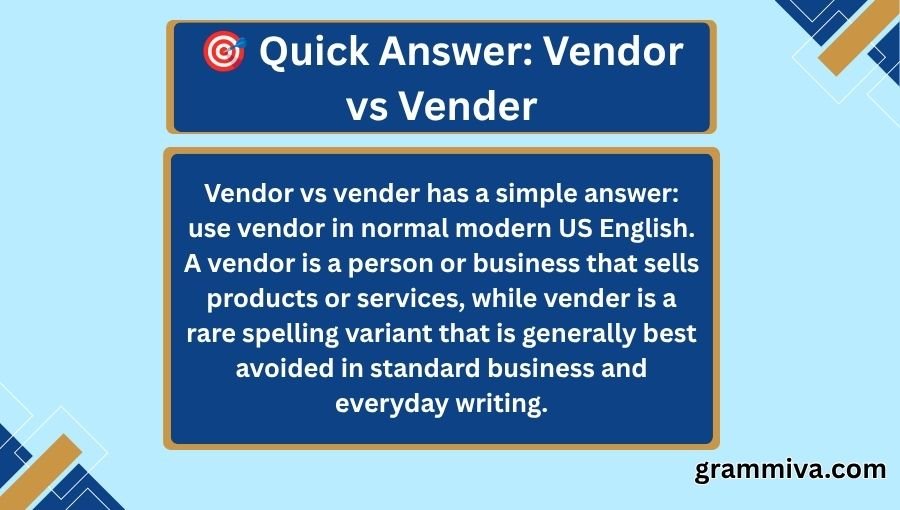
Vendor vs vender has a simple answer: use vendor in normal modern US English. A vendor is a person or business that sells products or services, while vender is a rare spelling variant that is generally best avoided in standard business and everyday writing.
For example:
- The company selected a new vendor for office supplies. ✅
- The company selected a new vender for office supplies. ❌
If you are writing an email, report, contract, resume, website, or school paper, vendor is the safe and standard choice.
Related Forms of Vendor
The word vendor has several useful grammatical forms. These forms change according to number or possession, but the main spelling stays the same.
| Form | Type | Example |
|---|---|---|
| vendor | Singular noun | The vendor sent an invoice. |
| vendors | Plural noun | Several vendors submitted bids. |
| vendor’s | Singular possessive | The vendor’s contract expires soon. |
| vendors’ | Plural possessive | The vendors’ prices were compared. |
| vender | Rare spelling variant | The older text used the spelling vender. |
The key point is that vendors is the normal plural of vendor. You do not need to switch to venders in standard US writing just because you see the alternate spelling elsewhere.
The possessive forms also follow normal apostrophe rules:
- The vendor’s office is downtown.
- The vendors’ contracts were reviewed.
🎯 Understanding Vendor vs Vender
The main difference is not meaning. It is standard usage.
Vendor is the common modern spelling for a person or company that sells something. Vender can function as a spelling variant of the same noun, but it is far less common and may look unusual to modern readers.
| Form | Type | Meaning | Example | Correct/Incorrect |
|---|---|---|---|---|
| vendor | Noun | A seller of goods or services | We hired a software vendor. | ✅ Correct |
| vender | Noun variant | A seller of goods or services | The book uses the word vender. | ⚠️ Rare |
| vendors | Plural noun | More than one seller | Three vendors submitted offers. | ✅ Correct |
| vendor’s | Possessive noun | Belonging to one vendor | The vendor’s quote arrived. | ✅ Correct |
| vendors’ | Plural possessive | Belonging to multiple vendors | The vendors’ quotes differed. | ✅ Correct |
In practical writing, the distinction is easy:
Use vendor unless you have a specific reason to preserve the alternate spelling.
Vendor as a Person or Business
A vendor can be an individual seller, but it can also be a company.
For example:
- The street vendor sold fresh fruit. ✅
- Our software vendor released an update. ✅
- The hospital changed its medical supply vendor. ✅
The word works in both informal and professional settings.
A vendor may sell:
- physical products
- food
- software
- consulting services
- equipment
- supplies
- subscriptions
- digital services
This wide use is one reason vendor appears so often in business English.
Vendor in Business Writing
In professional writing, vendor is especially common.
You might see phrases such as:
- vendor agreement
- vendor management
- vendor selection
- vendor contract
- vendor payment
- vendor relationship
- approved vendor
- third-party vendor
For example:
Our purchasing team is reviewing the current vendor agreement.
That sentence sounds natural in US business English. Replacing vendor with vender would make the sentence look unusual.
Vender as a Rare Variant
Vender is not simply a meaningless typo. It can be found as a spelling variant of vendor. However, that does not make it the best choice for normal modern writing.
This is an important distinction.
A word can exist in English without being the spelling that most readers expect. When your goal is clear, professional communication, the familiar spelling usually wins.
I once reviewed a short purchasing memo that used vender several times. The writer had not misunderstood the meaning at all. They had simply assumed that because someone who sells is a “vender,” the spelling should follow the verb vend. Changing the spelling to vendor made the memo look much more polished.
💡 What Does Vendor Mean?
Vendor means a person or business that sells goods or services.
Here are several common uses:
- A seller at a market
- A vendor sold handmade jewelry at the market. ✅
- A company that supplies another company
- We signed a contract with a new vendor. ✅
- A service provider
- The company uses an outside vendor for payroll services. ✅
- A technology company
- The software vendor released a security update. ✅
The word is flexible. The basic idea remains the same: a vendor provides something for sale or purchase.
Meanings at a Glance
| Meaning | Word Type | Example Sentence |
|---|---|---|
| Seller of goods | Noun | The vendor sold fresh vegetables. |
| Supplier | Noun | The vendor delivered the equipment. |
| Service provider | Noun | We hired a vendor to clean the office. |
| Technology supplier | Noun | The software vendor issued an update. |
💡 Test Tip: Use the “Seller Test”
When you are unsure about the spelling, ask yourself:
Am I talking about a person or company that sells something?
If the answer is yes, write vendor.
For example:
We need to contact the equipment vendor.
The word clearly means the company that supplied the equipment.
This simple test works especially well when you are writing quickly.
Is Vendor the Same as Vender?
Yes, the two spellings can refer to the same basic idea: a seller. However, they are not equally common in modern US English.
Vendor is the normal spelling used in business, education, journalism, websites, and everyday professional communication. Vender is a rare spelling variant and may be encountered in older or less common usage.
That means you should not normally treat the two forms as equal choices.
| Sentence | Correct/Incorrect | Why |
|---|---|---|
| We need a new vendor. | ✅ Correct | Standard modern spelling |
| We need a new vender. | ⚠️ Avoid | Rare variant in modern writing |
| The vendor sent the invoice. | ✅ Correct | Natural business usage |
| The vender sent the invoice. | ⚠️ Avoid | Unusual spelling |
| Several vendors attended the meeting. | ✅ Correct | Standard plural |
The safest rule is:
If you are choosing the spelling yourself, choose vendor.
📝 Case Study: Choosing the Right Word at Work
Imagine that Maya works for a small marketing company. Her team needs a new printing company for business cards and brochures.
She writes this email:
Hi James,
We are comparing three vendors for our new print project. Each vendor has provided a quote, and I have attached the pricing details.
Please let me know which vendor you prefer.
Thanks,
Maya
Every use of vendor is correct. The word clearly refers to companies that provide a product or service.
Now imagine that Maya writes vender instead. Her readers would probably understand her meaning, but the spelling could distract them. In a professional email, there is no advantage to choosing the unusual form.
Here is the practical lesson:
| Workplace Situation | Best Choice | Example |
|---|---|---|
| Email to a client | vendor | We contacted the vendor. |
| Purchasing report | vendor | The vendor met our requirements. |
| Contract | vendor | The vendor must provide insurance. |
| Internal message | vendor | Can you call the vendor? |
| Formal proposal | vendor | We selected an approved vendor. |
Why Do People Confuse Vendor and Vender?
People often confuse these spellings because vender looks like a logical spelling.
The English verb vend means to sell. From that base, some writers naturally expect the person who sells to be spelled vender. That reasoning is understandable, but standard modern usage favors vendor.
Fast typing also creates problems. When I am editing quickly, I have caught myself reading a word based on its sound instead of its spelling. That is especially easy with pairs that differ by only one letter.
Autocorrect can add another layer of confusion. A writing program may not flag a rare word as completely wrong. That does not mean it is the best choice for your audience.
Here are three common reasons people make this mistake:
- Fast typing: You write the first spelling that comes to mind.
- Autocorrect: Your software may not strongly reject the unusual form.
- Lack of knowledge: You may simply never have learned which spelling is standard.
Common Grammar and Spelling Confusions
| Confusion | Correct Form | Common Problem |
|---|---|---|
| it’s / its | Both can be correct | Apostrophe changes the meaning |
| your / you’re | Both can be correct | Possession vs. “you are” |
| they’re / their / there | All can be correct | Different meanings |
| affect / effect | Both can be correct | Different grammatical roles |
| then / than | Both can be correct | Time vs. comparison |
| vendor / vender | vendor is standard | Rare spelling causes confusion |
The important thing is not to memorize every English spelling rule at once. Learn the common form you are most likely to need.
⚠️ Common Mistakes With Vendor
The most common mistake is writing vender when you mean the standard noun vendor.
Other errors involve plurals and possessives.
For example:
- The vendor called us. ✅
- The vendors called us. ✅
- The vendor’s office is closed. ✅
- The vendors’ offices are closed. ✅
Writers sometimes add or remove apostrophes without checking whether the noun is singular or plural.
I once caught a small but noticeable error in a draft report where the writer had used vendors when they meant something belonging to one company. The sentence needed vendor’s, not vendors. The spelling was right, but the apostrophe changed the meaning.
Specific Wrong Spellings and Uses
| Wrong Form | What’s Wrong | Correct Form |
|---|---|---|
| vender | Rare spelling used where standard spelling is expected | vendor |
| venders | Uncommon plural variant | vendors |
| vender’s | Rare spelling plus possessive | vendor’s |
| venders’ | Uncommon plural possessive | vendors’ |
| vendor’s | Wrong if you mean more than one vendor | vendors |
| vendors’ | Wrong if you mean something belonging to one vendor | vendor’s |
These errors are easy to fix once you identify whether you are talking about one seller, multiple sellers, or possession.
Vendor vs Vender in Different Contexts
The preferred spelling stays the same across most types of writing. Vendor is the safest choice in everyday, professional, creative, and digital communication.
| Context | Which Term to Use | Example |
|---|---|---|
| Everyday conversation | vendor | The food vendor was busy. |
| Professional writing | vendor | We selected a new vendor. |
| Creative writing | vendor | A street vendor called out to customers. |
| Social media/texting | vendor | Does anyone know a good food vendor? |
Creative writing gives you more freedom than a business report. If you are deliberately reproducing the spelling of an old document or character, you may encounter vender. But if you are simply writing a modern sentence, vendor remains the better choice.
Key Differences Between Vendor and Vender
The differences can be summarized in a few points.
Vendor is:
- standard in modern US English
- common in business writing
- common in everyday writing
- widely recognized
- the preferred spelling for most situations
Vender is:
- a rare spelling variant
- much less common
- likely to look unusual to many readers
- generally not the best choice in modern professional writing
| Feature | Vendor | Vender |
|---|---|---|
| Modern US usage | Very common | Rare |
| Business writing | Preferred | Usually avoided |
| Meaning | Seller or supplier | Seller or supplier |
| Plural | vendors | venders, rare |
| Best default choice | Yes | No |
So, although the meanings can overlap, the practical writing choice is clear.
Grammar Rules Explanation
The word vendor is a noun. It names a person or organization that sells goods or services.
The spelling vender can occur as a variant noun, but standard modern US usage strongly favors vendor. In most ordinary writing, choosing the familiar spelling makes the sentence clearer and more natural.
The reason this can feel confusing is that English does not always spell nouns in the way a writer might expect from a related verb. The existence of vend does not mean that vender must be the preferred noun spelling.
Most standard English reference sources recognize vendor as the normal spelling. For practical writing, especially in the United States, there is little reason to choose the less common variant.
Correct vs Incorrect at a Glance
| Sentence | Correct/Incorrect | Why |
|---|---|---|
| We hired a software vendor. | ✅ Correct | Uses the standard noun |
| We hired a software vender. | ❌ Incorrect for standard usage | Uses the rare variant unnecessarily |
| The vendor’s price was reasonable. | ✅ Correct | Singular possessive is correct |
| The vendors submitted their bids. | ✅ Correct | Standard plural form |
| The vender submitted a bid. | ❌ Avoid | Nonstandard-looking spelling in ordinary modern use |
A useful writing rule is to favor the spelling your readers are most likely to recognize immediately.
How To Remember the Difference
The easiest memory trick is to connect vendor with the word vendor that appears in business terms you already know.
Think of:
- vendor contract
- vendor invoice
- vendor list
- vendor management
- vendor payment
You are much more likely to see these phrases with vendor than vender.
Another trick is to remember:
Business seller = vendor.
If you see a company selling software, equipment, food, or services, call it a vendor.
You can also save the word in your spelling checker or personal word list if you often write purchasing or business documents.
Common Phrases With Vendor
Unlike an idiom, vendor appears most often in standard business phrases. These combinations are useful because they reinforce the correct spelling.
| Phrase | Meaning |
|---|---|
| vendor agreement | A contract between a buyer and seller |
| vendor management | Managing relationships with suppliers |
| vendor selection | Choosing a supplier |
| vendor contract | A formal agreement with a supplier |
| vendor invoice | A bill sent by a supplier |
| approved vendor | A supplier accepted by an organization |
These phrases are especially common in offices, schools, hospitals, government agencies, and large companies.
If you learn the word through these phrases, you will naturally become more comfortable spelling it correctly.
Synonyms and Alternatives for Vendor
Sometimes you can replace vendor with another word. The best alternative depends on the situation.
| Alternative | Works When | Does Not Work When |
|---|---|---|
| seller | You mean someone who sells something | You need a formal business term |
| supplier | A business provides goods or materials | The person is simply selling something casually |
| provider | A company supplies a service | The focus is specifically on selling products |
| merchant | Someone sells goods, often in a retail setting | You are discussing a technical service provider |
| retailer | A business sells products directly to consumers | The company sells services rather than products |
For example, supplier may be a better choice when discussing raw materials:
The supplier delivers steel every Friday.
Provider may fit better for services:
We changed our internet provider.
Vendor is useful when you want a broad business term covering many types of outside sellers or service companies.
Why Does Getting Vendor Right Matter?
Correct spelling helps readers understand your writing without distractions. A single unusual word may not destroy a message, but repeated spelling choices can make a professional document look less polished.
This matters especially when you are communicating with clients, managers, customers, or hiring teams.
Clear writing lets your reader focus on your message instead of your spelling.
| Situation | Why Getting It Right Matters |
|---|---|
| Resume | Shows care and attention to detail |
| Client email | Creates a professional impression |
| Published content | Builds reader trust |
| Social post | Makes the message easier to read |
Digital communication makes this even more important. Emails, reports, websites, and messages are often read quickly. Familiar spelling reduces friction.
A reader who sees vendor instantly understands the word. A reader who sees vender may pause and wonder whether it is a typo.
That small pause is exactly what good editing tries to prevent.
Is Vendor the Better Choice in Professional Writing?
Yes. Vendor is clearly the better choice for professional writing.
Use it in:
- business emails
- purchase orders
- reports
- proposals
- resumes
- contracts
- websites
- presentations
- company policies
- customer communications
For example:
Please contact the vendor before placing the order.
That sentence is direct and natural.
If you are preparing material for a professional audience, there is almost never a practical benefit to replacing vendor with vender.
How Should You Use Vendor in a Sentence?
Use vendor as a noun when you need to identify the person or company selling something.
Here are several sentence patterns:
Pattern 1: Subject
The vendor delivered the equipment.
Here, vendor performs the action.
Pattern 2: Object
We contacted the vendor.
Here, vendor receives the action.
Pattern 3: Possessive
The vendor’s invoice was missing.
Here, vendor’s shows that the invoice belongs to the vendor.
Pattern 4: Plural
Five vendors attended the trade show.
Here, vendors means more than one seller.
These four patterns cover most situations you will encounter.
Can Vender Ever Be Correct?
Yes, but it is best treated as a rare spelling variant rather than your normal choice.
If you are quoting an old text, reproducing a historical document, or discussing spelling variants, vender may appear. You might also encounter it in older publications or specialized material.
That does not mean you should use it freely in modern writing.
For ordinary US English, the practical rule remains:
Choose vendor unless you have a specific reason to preserve the variant vender.
This is similar to other cases where English contains more than one accepted form, but one form is far more familiar to modern readers.
How Do Vendor and Vender Work in Plural and Possessive Forms?
The standard forms are easy once you start with vendor.
For one seller:
The vendor called this morning.
For more than one:
The vendors called this morning.
For something belonging to one vendor:
The vendor’s office is downtown.
For something belonging to several vendors:
The vendors’ offices are downtown.
| Meaning | Correct Form | Example |
|---|---|---|
| One seller | vendor | The vendor arrived. |
| More than one | vendors | The vendors arrived. |
| Belonging to one | vendor’s | The vendor’s car arrived. |
| Belonging to several | vendors’ | The vendors’ cars arrived. |
Notice that the apostrophe does not change the basic spelling of vendor.
⚠️ How Can You Avoid This Spelling Mistake?
I recommend three simple habits.
1. Learn the standard form
Write vendor in your personal vocabulary list.
2. Watch for the business phrases
When you see vendor contract or vendor invoice, let those familiar phrases reinforce the spelling.
3. Proofread unusual words
If a spelling looks strange while you are reviewing a document, stop and check it.
You do not need to spend five minutes on every word. A quick pause can prevent an embarrassing typo.
Quick Recap Checklist
Use this checklist whenever you are unsure.
| Question | If Yes → Use |
|---|---|
| Do you mean a person who sells something? | vendor |
| Do you mean a company that supplies goods? | vendor |
| Are you writing a business email? | vendor |
| Are you writing a report or contract? | vendor |
| Are you deliberately preserving an unusual or historical spelling? | Possibly vender |
| Are you talking about several sellers? | vendors |
| Does something belong to one seller? | vendor’s |
| Does something belong to several sellers? | vendors’ |
Practice Examples
- We need to contact the new vendor before Friday. ✅
- Three vendors submitted proposals. ✅
- The vendor’s contract ends next month. ✅
The more you see these forms in real sentences, the easier they become.
FAQs About Vendor vs Vender
Is vendor or vender correct?
Vendor is the standard spelling for modern US English. Vender exists as a rare spelling variant, but vendor is the better choice for normal writing.
Is vendor the correct spelling for a seller?
Yes. Vendor is the standard spelling for a person or business that sells goods or services.
Example:
The vendor sells office equipment.
Is vender a misspelling of vendor?
Not always. Vender can be found as a spelling variant, but it is uncommon. In modern US writing, vendor is the preferred form.
Why is vendor spelled with an “o”?
English spelling does not always follow the most obvious pattern suggested by a related word. Although vend means to sell, the standard noun form in modern usage is vendor.
Should I use vendor in a business email?
Yes. Vendor is the best choice in a business email because it is familiar, standard, and professional.
For example:
Please send the invoice to the vendor management team.
What is the plural of vendor?
The standard plural is vendors.
Example:
Several vendors attended the conference.
You do not normally need to use venders in modern US English.
What is the possessive form of vendor?
For one vendor, use vendor’s.
Example:
The vendor’s contract expires in June.
For multiple vendors, use vendors’.
Example:
The vendors’ contracts were reviewed.
Is vendor used for services?
Yes. A vendor can provide services as well as physical products.
For example:
We hired an outside vendor to manage payroll.
Which is better for SEO content, vendor or vender?
Use vendor when you mean a seller or supplier in modern US English. If people search for the spelling comparison, you can discuss vender as the less common variant, but the standard term should remain vendor.
How can I remember vendor vs vender?
Use the simple rule “seller or supplier = vendor.” If you are writing a normal modern sentence and need the noun for a person or company that sells something, choose vendor.
Conclusion
Vendor vs vender becomes much easier once you remember that vendor is the standard spelling for modern US English. Use it for a person, business, supplier, or service company that sells or provides something. The alternate spelling vender can appear, but it is rare and usually unnecessary in everyday and professional writing.
The standard forms are also easy to remember: vendor, vendors, vendor’s, and vendors’. If you are writing an email, report, website, resume, or business document, choosing vendor will give your readers the spelling they expect.
I always recommend choosing the familiar form when two spellings could cause hesitation. Clear writing should make the reader’s job easier, not give them another small question to solve. ✨
So keep this rule in mind: When you mean a seller or supplier, vendor is the spelling to reach for. Once that habit is set, this common spelling question becomes one less thing to worry about.

I am Alex Morgan, an English grammar and vocabulary writer passionate about making language learning simple and useful. I work at Grammiva, where I create clear educational content and practical English examples for learners.

[…] real examples. By the end, you should be able to choose the right form with confidence. ✍️ Vendor vs Vender | Disastrous vs Disasterous | Concede vs […]
[…] be able to choose the right form without stopping to second-guess yourself. ✨ Too Bad vs To Bad | Vendor vs Vender | Disastrous vs […]
[…] This guide will show you the difference in plain US English. You will learn the meanings, grammar rules, common mistakes, memory tricks, examples, and answers to the questions people ask most often. | Afterward vs Afterwards | Too Bad vs To Bad | Vendor vs Vender […]