Have you ever written a sentence like, “We went home afterwards,” and then wondered if it should be “afterward” instead? You are not alone. afterward vs afterwards is a small grammar question that can make even confident writers stop and think. 😊
The good news is that the difference is much smaller than it first appears. Both words can mean “at a later time” or “later.” In most cases, they can be used in the same place in a sentence. The main difference is regional preference, not meaning.
As a US English writer and editor, I usually recommend afterward for American writing. It is the more common choice in American English. Afterwards is also correct, but it is more strongly associated with British English and other varieties of English.
In this guide, I’ll explain the difference in plain English. You’ll see clear examples, common mistakes, workplace examples, memory tricks, and answers to the questions writers ask most often. By the end, you should be able to choose the right form without stopping to second-guess yourself. ✨ Too Bad vs To Bad | Vendor vs Vender | Disastrous vs Disasterous
🎯 Quick Answer: Afterward vs Afterwards
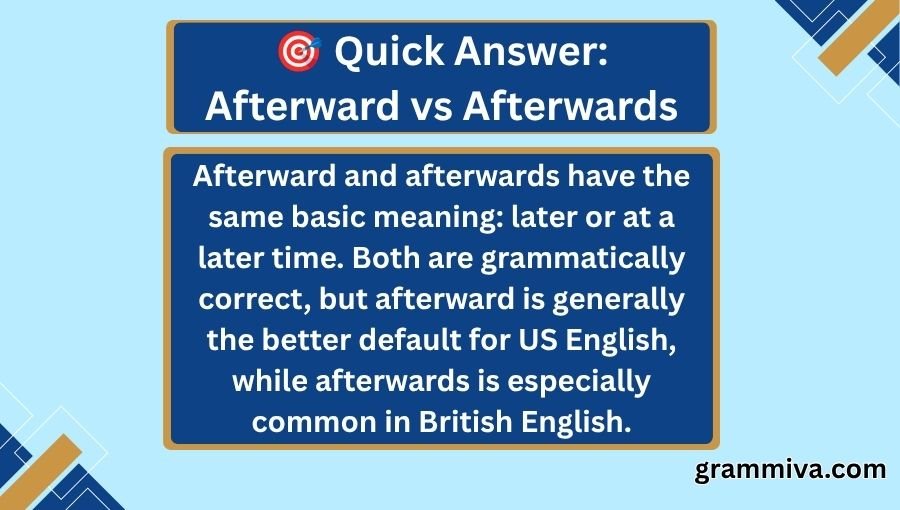
Afterward and afterwards have the same basic meaning: later or at a later time. Both are grammatically correct, but afterward is generally the better default for US English, while afterwards is especially common in British English.
For example:
- “We had dinner afterward.” ✅
- “We had dinner afterwards.” ✅
Neither sentence is grammatically wrong. The choice mainly depends on the variety of English you are writing.
| Word | Basic meaning | US English | British English |
|---|---|---|---|
| afterward | later | Very common | Correct |
| afterwards | later | Correct | Very common |
If you are writing for an American audience, I would normally choose afterward.
Afterward vs Afterwards: The Core Difference
The core difference between these two words is usage preference, not meaning. Both are adverbs that tell readers that something happens later.
Consider this example:
“Maria finished her presentation and spoke with her manager afterward.”
The word afterward tells us when Maria spoke with her manager. The conversation happened after the presentation.
Now change the word:
“Maria finished her presentation and spoke with her manager afterwards.”
The meaning stays the same.
That is the key point. You do not need to learn two different meanings. You need to understand that English has two accepted forms.
A simple comparison
| Form | Type | Meaning | Example | Correct/Incorrect |
|---|---|---|---|---|
| afterward | Adverb | later | We talked afterward. | ✅ Correct |
| afterwards | Adverb | later | We talked afterwards. | ✅ Correct |
| after word | Two words | Not the intended adverb | We talked after word. | ❌ Incorrect |
| afterwords | Misspelling | Not the standard adverb | We talked afterwords. | ❌ Incorrect |
The last two forms cause problems because they look or sound similar. They are not interchangeable with the adverb.
💡 Is Afterward the Preferred Form in American English?
Yes. Afterward is generally the preferred form in American English, although afterwards is also grammatically correct.
If I were editing a US business report, school paper, website, or news article, I would normally keep afterward unless there were a style reason to do otherwise.
Here are a few natural examples:
- “The team met afterward to discuss the results.”
- “I called her afterward.”
- “We can grab coffee afterward.”
- “He felt tired afterward.”
- “She apologized afterward.”
All of these use afterward to mean “later.”
This preference does not mean that afterwards is wrong in American English. It simply means that the shorter form often sounds more natural to US readers.
Test Tip
Here is the test I teach students:
If you mean “later,” try replacing the word with “later.”
“We went for lunch afterward.”
Becomes:
“We went for lunch later.”
The meaning still works. That tells you afterward is being used as an adverb of time.
The same test works with afterwards:
“We went for lunch afterwards.”
→ “We went for lunch later.”
Again, the meaning remains clear.
Afterward vs Afterwards in American English
For American readers, afterward is usually the safest choice. For British readers, afterwards may sound more natural.
This is a regional spelling and usage preference. It is similar to other cases where different English-speaking regions favor slightly different forms.
| Audience | Recommended default | Is the other form acceptable? |
|---|---|---|
| US readers | afterward | Yes |
| UK readers | afterwards | Yes |
| Canadian readers | Either, depending on style | Yes |
| International audience | afterward is a simple choice | Yes |
| Academic US writing | afterward | Yes, if used consistently |
The most important rule is consistency.
If you are writing a long document for an American audience, using afterward throughout can make the style feel more uniform. You do not need to worry if you occasionally encounter afterwards in American writing, though.
A quick memory trick
Think of it this way:
US English → afterward
British English → afterwards
This is not an absolute rule. It is a useful default.
I once reviewed a short student essay in which the writer used afterward in one paragraph and afterwards in the next. The student thought one word meant “immediately later” and the other meant “much later.” It does not work that way. The two forms generally mean the same thing.
📝 Correct Meanings and Uses of Afterward
Afterward means that something happens later than another event. It normally connects one action or event with something that happens after it.
1. After a specific event
Use afterward when one action follows another.
“We watched a movie afterward.”
The first event is understood from context. Perhaps the people had dinner first. The movie came later.
2. After a conversation or meeting
This use is common in professional writing.
“I spoke with the client afterward.”
Here, “afterward” means after the conversation or meeting.
3. After an activity
You can also use the word after sports, trips, meals, classes, or other activities.
“We went for ice cream afterward.”
The ice cream happened after the earlier activity.
4. Referring to a later period
The word can refer to a later point without giving an exact time.
“She regretted the decision afterward.”
This tells us that the regret happened later. It does not tell us exactly when.
Meaning summary
| Meaning | Word Type | Example Sentence |
|---|---|---|
| Later after an event | Adverb | We talked afterward. |
| Later after a meeting | Adverb | I emailed him afterward. |
| Later after an activity | Adverb | They went home afterward. |
| At a later time | Adverb | She understood it afterward. |
The word does not usually tell you how long later. The gap could be a few minutes, several hours, or even longer. Context provides that information.
Is Afterwards Also Correct?
Yes. Afterwards is fully acceptable English. It carries the same basic meaning as afterward.
For example:
“She called me afterward.”
and
“She called me afterwards.”
Both mean that she called later.
The difference is mainly regional and stylistic. In American English, afterward is generally more common. In British English, afterwards is very common.
So if someone tells you that afterwards is always grammatically wrong, that advice is incorrect.
Likewise, if someone says that Americans must never use afterwards, that is too strict.
Correct examples
- “We cleaned the room afterward.” ✅
- “We cleaned the room afterwards.” ✅
- “He felt better afterward.” ✅
- “He felt better afterwards.” ✅
Incorrect forms
- “We cleaned the room afterwords.” ❌
- “We cleaned the room after word.” ❌
The problem with these forms is not regional preference. They are spelling or spacing errors.
🏢 Case Study: How the Choice Works in a Workplace Email
Imagine that you are writing to a coworker after a team meeting.
You could write:
“Thanks for meeting with me. I reviewed the notes afterward and added two comments.”
This sounds natural in US English.
You could also write:
“Thanks for meeting with me. I reviewed the notes afterwards and added two comments.”
This is also grammatically correct.
For a US workplace, I would choose afterward because it fits common American usage.
The same rule applies to reports:
“The company reviewed the proposal afterward.”
Or:
“The company reviewed the proposal afterwards.”
Again, there is no major difference in meaning.
A useful editing habit is to decide which regional style you are following before you start polishing a long document. That prevents small choices from becoming distracting.
Grammar Rules Explanation
Afterward and afterwards function as adverbs of time. They modify an action by showing that it takes place later than an event already mentioned or understood from context.
Both forms can appear at the end of a sentence:
“We discussed the issue afterward.”
They can also appear in other positions when the sentence structure allows it:
“Afterward, we discussed the issue.”
The word does not need a noun directly after it. This is different from after, which can work as a preposition:
“We talked after the meeting.”
Here, after is followed by the noun phrase the meeting.
Compare:
“We talked afterward.”
Here, afterward stands alone as an adverb.
Most standard English references recognize both afterward and afterwards as valid forms. The main distinction is usage preference by region.
For US English, afterward is generally the stronger default. For British English, afterwards is especially common.
The important lesson is simple: do not treat the final -s as a marker of correctness. The spelling with -s does not make the word wrong.
Correct vs Incorrect at a Glance
| Sentence | Correct/Incorrect | Why |
|---|---|---|
| We talked afterward. | ✅ Correct | Standard American usage |
| We talked afterwards. | ✅ Correct | Valid form, common in British English |
| We talked afterwords. | ❌ Incorrect | Wrong spelling |
| We talked after word. | ❌ Incorrect | Wrong spacing and construction |
| Afterward, we went home. | ✅ Correct | Adverb used at the beginning |
⚠️ Why Do People Confuse Afterward and Afterwards?
People often confuse these forms because the extra -s looks like it should change the grammar. In this case, it does not.
Several everyday writing habits also make the problem worse.
Fast typing
When people type quickly, they may add or remove the final s without thinking.
Autocorrect
Spell-check tools may accept both forms. That can make writers assume that one must be wrong because they remember seeing only the other.
Lack of knowledge
Some writers simply have never learned that both forms are correct.
Exposure to different varieties of English
A US reader may mostly see afterward, while a British reader may frequently see afterwards. Each can make the other version seem unusual.
I once caught myself changing afterwards to afterward in an international report. Then I realized the original writer was using British English throughout the document. I restored the original form because consistency mattered more than my personal preference.
Similar grammar confusions
| Confusion | Correct Forms | Main Difference |
|---|---|---|
| it’s / its | it’s, its | contraction vs. possessive |
| your / you’re | your, you’re | possessive vs. contraction |
| their / there / they’re | all three | different meanings |
| affect / effect | both | usually verb vs. noun |
| then / than | both | time/order vs. comparison |
| afterward / afterwards | both | mainly regional preference |
The key difference is that afterward and afterwards are both correct, while some of the other pairs contain forms that are wrong when used in the wrong place.
Common wrong spellings and uses
| Wrong Form | What’s Wrong | Correct Form |
|---|---|---|
| afterwords | Incorrect spelling | afterward / afterwards |
| after word | Incorrect spacing for this meaning | afterward / afterwards |
| after wards | Incorrect separation | afterward / afterwards |
| afterwardss | Extra final letter | afterwards |
| afterward’s | Incorrect apostrophe | afterward |
| afterwards’ | Incorrect apostrophe | afterwards |
Notice the apostrophe issue. Neither afterward nor afterwards needs an apostrophe when used as an adverb.
Does Afterward Mean the Same as Later?
Usually, yes. Afterward can often be replaced with later without changing the basic idea.
For example:
“We went home afterward.”
means roughly:
“We went home later.”
However, afterward often has a clearer connection to a previous event.
Compare:
“I will call you later.”
This simply says the call will happen at a later time.
Now:
“I finished the meeting and called you afterward.”
Here, afterward clearly connects the call to the meeting.
| Word | Main idea | Example |
|---|---|---|
| afterward | later, after a stated or understood event | We left afterward. |
| afterwards | later, after a stated or understood event | We left afterwards. |
| later | at a later time | I will call later. |
| subsequently | later in a sequence; more formal | The issue was subsequently reviewed. |
| then | at that time or next | We ate, then left. |
“Later” is often a good substitute, but it is not always identical in tone or sentence structure.
How Should You Use Afterward in Different Contexts?
The best choice depends partly on your audience and the style of the writing. In US English, afterward works comfortably in casual, professional, academic, and creative writing.
| Context | Which Term to Use | Example |
|---|---|---|
| Everyday conversation | afterward | Let’s get coffee afterward. |
| Professional writing | afterward | The team met afterward. |
| Creative writing | afterward or afterwards | She thought about it afterward. |
| Social media/texting | either | I’ll tell you afterward. |
For American social media, either form is understandable. If you want your writing to follow common US usage, afterward is a simple choice.
In creative writing, the author’s regional voice may matter more. A British character, narrator, or publication may naturally use afterwards.
What Are Common Phrases With Afterward?
There are no major idioms built around afterward, but several natural sentence patterns appear often in everyday English.
| Phrase or Pattern | Meaning |
|---|---|
| shortly afterward | a short time later |
| immediately afterward | directly after an event |
| soon afterward | not long after |
| sometime afterward | at an unspecified later time |
| afterward that day | later on the same day |
| afterward in the story | later in the sequence of events |
These patterns are useful because they make the timing more specific.
For example:
“Shortly afterward, the manager returned.”
This tells the reader that the manager returned fairly soon.
Compare:
“Afterward, the manager returned.”
This tells us that the manager returned later but gives less detail about the time gap.
✍️ Afterward in Professional and Academic Writing
In professional and academic writing, afterward is often a clean and simple choice for US readers.
Consider:
“The researchers reviewed the results afterward.”
The sentence is short and clear.
You could write:
“The researchers subsequently reviewed the results.”
That is also grammatical, but subsequently sounds more formal.
This illustrates an important writing lesson: a word can be correct without being the best choice for every situation.
I prefer afterward when the goal is plain, direct English. I might use subsequently when the writing calls for a more formal tone or when repeated use of “afterward” becomes awkward.
Professional examples
- “Please send the file afterward.”
- “The client called afterward.”
- “We discussed the results afterward.”
- “The team completed the review and met afterward.”
- “The issue was resolved shortly afterward.”
These examples all work naturally in American professional writing.
Can You Start a Sentence With Afterward?
Yes. Afterward can appear at the beginning of a sentence.
For example:
“Afterward, we went back to the office.”
This is completely correct.
The same is true of afterwards:
“Afterwards, we went back to the office.”
The comma is commonly used when the introductory adverb sets the timing for the sentence.
You can also put the word at the end:
“We went back to the office afterward.”
Both structures are natural.
| Position | Example | Correct? |
|---|---|---|
| Beginning | Afterward, we went home. | ✅ |
| Middle | We afterward learned the truth. | ✅ Grammatically possible, but less natural |
| End | We went home afterward. | ✅ |
| Beginning with afterwards | Afterwards, we went home. | ✅ |
In everyday US English, the beginning and end positions are usually the easiest and most natural.
Is Afterward More Formal Than Afterwards?
No. Afterward is not inherently more formal than afterwards, and afterwards is not inherently more casual.
The main distinction is regional preference.
Both can appear in casual speech:
“See you afterward.”
“See you afterwards.”
Both can appear in professional writing:
“The team met afterward.”
“The team met afterwards.”
The choice should not be based on a supposed formality difference.
Instead, think about audience, region, and consistency.
🎯 Afterward vs Afterwards: How To Remember the Difference
The easiest memory rule is:
For US English, think “afterward.”
If you are writing for a British audience, afterwards may feel more natural.
Here is another useful trick:
After + ward = afterward
You do not need to memorize a complicated grammar rule. Just remember that the extra s does not create a new meaning.
Three-second check
When you see one of these words, ask:
- Does it mean “later”?
- Am I using it as an adverb?
- Am I writing for a US audience?
If the answers are yes, yes, and yes, afterward is a strong choice.
Why Does Getting Afterward vs Afterwards Right Matter?
The difference may seem tiny, but careful word choice helps your writing look polished.
Clarity
A correctly spelled word is easier to read. Errors such as afterwords can distract readers even when the intended meaning is obvious.
Professionalism
Small spelling errors can make a business email or report look rushed.
Digital communication
Online writing is often read quickly. Clear wording helps readers understand your meaning without stopping.
A useful writing principle is:
“Good grammar should make the message easier to read, not harder to notice.”
The goal is not to make every sentence sound fancy. The goal is to make every sentence easy to understand.
| Situation | Why Getting It Right Matters |
|---|---|
| Resume or cover letter | Shows careful editing |
| Client email | Builds a polished impression |
| Published content | Protects consistency and readability |
| Social post | Makes short messages easier to read |
Afterward and Afterwards: Synonyms and Alternatives
Sometimes you can replace these words with another phrase. The best choice depends on the sentence.
| Alternative | Works When | Does Not Work When |
|---|---|---|
| later | You mean a later time | You need a clear link to a previous event |
| later on | The tone is casual | The writing needs a very concise style |
| subsequently | The tone is formal | Simple everyday language is preferred |
| after that | You want a clear sequence | The sentence becomes repetitive |
| then | You mean the next event or time | “Then” could create another meaning |
For example:
“We had dinner afterward.”
Could become:
“We had dinner after that.”
Both can work if the earlier event is clear.
But afterward is often shorter and smoother.
Does the Final S Change the Meaning?
No. The final s in afterwards does not normally create a different meaning.
This is one of the most important facts to remember.
| Word | Meaning |
|---|---|
| afterward | later |
| afterwards | later |
| afterwords | incorrect spelling |
| after word | usually means something different or is an incorrect attempt at the adverb |
So do not waste time trying to invent a meaning difference between afterward and afterwards. There generally isn’t one.
Common Sentence Patterns to Learn
Instead of memorizing isolated rules, learn a few sentence patterns.
Pattern 1: Event + afterward
“We talked afterward.”
Pattern 2: Afterward + comma + sentence
“Afterward, we went home.”
Pattern 3: shortly afterward
“Shortly afterward, the phone rang.”
Pattern 4: immediately afterward
“Immediately afterward, she called her mother.”
Pattern 5: soon afterward
“Soon afterward, the problem was fixed.”
These patterns work with afterwards as well.
For example:
“Shortly afterwards, the phone rang.”
That is also correct.
⚠️ Quick Recap Checklist
Use this checklist whenever you are unsure.
| Question | If Yes → Use |
|---|---|
| Do I mean “later”? | afterward / afterwards |
| Am I writing for a US audience? | afterward is the usual default |
| Am I writing for a British audience? | afterwards is a natural choice |
| Am I spelling it “afterwords”? | Change it |
| Am I adding an apostrophe? | Remove it |
| Am I using the word as an adverb? | afterward / afterwards |
Practice examples
1. We went to dinner ______ the show.
Answer: afterward or afterwards.
2. ______, I realized that I had forgotten my keys.
Answer: Afterward or Afterwards.
3. We discussed the issue ______ and agreed on a solution.
Answer: afterward or afterwards.
The key is not to search for a hidden difference in meaning. Focus on correct spelling and regional style.
FAQs About Afterward vs Afterwards
Is afterward or afterwards correct?
Both are correct. They have the same basic meaning and function as adverbs meaning “later.” Afterward is generally the more common default in American English, while afterwards is especially common in British English.
Is afterward preferred in American English?
Yes. Afterward is generally preferred in American English. However, afterwards is still grammatically correct and can be used by American writers.
Is afterwards wrong in American English?
No. Afterwards is not wrong in American English. It is simply less typical as the default choice for many US writers.
What is the difference between afterward and afterwards?
There is usually no difference in meaning. Both mean “later” or “at a later time.” The main difference is regional usage and style preference.
Can I use afterward at the beginning of a sentence?
Yes. For example: “Afterward, we went home.” This is a standard and natural sentence structure.
Can I use afterwards in formal writing?
Yes. Afterwards is grammatically acceptable in formal writing. The best choice depends on the regional variety and style guide being followed.
Is “afterwords” a correct spelling?
No. Afterwords is not the standard spelling of the adverb meaning “later.” Use afterward or afterwards instead.
Does afterward mean later?
Yes. Afterward usually means “later” or “at a later time,” especially in relation to an event that has already been mentioned or understood.
Should I use afterward or later?
Both can be correct. Later is more general, while afterward often makes a clearer connection to something that happened before it.
Which is better for a US English article?
For a US English article, I recommend afterward as the default. It is simple, clear, and natural for an American audience.
Conclusion
Afterward vs afterwards is easier than it looks: both words mean “later,” and both are grammatically correct. The main difference is regional preference. For US English, afterward is generally the best default. For British English, afterwards is especially common.
The most important thing is not to treat the final s as a grammar test. It does not make the word more or less correct. Instead, choose the form that fits your audience and keep your style consistent.
Remember three points: afterward and afterwards have the same basic meaning, afterward is the usual US English choice, and afterwords is an incorrect spelling for this meaning.
Once you know that, this small grammar question becomes simple. When you mean “later” in American English, afterward is usually the easy choice. Keep the rule in mind, write with confidence, and let your reader focus on your message rather than your spelling. ✨

I am Ryan Mitchell, a writer focused on English grammar, vocabulary, and everyday language. I work at Grammiva, creating easy-to-understand articles that help readers improve their English with confidence.
[…] This guide explains summary vs summery with clear definitions, examples, tables, memory tricks, common mistakes, and practical examples. By the end, you should know exactly which word to choose. Partier vs Partyer | Lose vs Loose | Afterward vs Afterwards […]