Have you ever typed a word, looked at it twice, and suddenly wondered if it even looks right? 😅 disastrous vs disasterous is one of those spelling questions that can make even careful writers stop for a moment.
The confusion is easy to understand. The word disastrous comes from disaster, so it may seem natural to add -ous directly and get the correct form. But the extra o in disasterous makes the spelling wrong in standard US English.
I teach and edit English writing, and I see this kind of mistake often. The good news is that the rule is simple once you see the pattern.
In this guide, I will explain which spelling is correct, why the other form is wrong, how to remember the difference, and how to use the word in everyday and professional writing.
I will also cover common mistakes, useful alternatives, examples, and frequently asked questions. By the end, you should be able to choose the right spelling without stopping to think. ✍️ Concede vs Conceed | Humorous vs Humerous | Affect vs Effect
🎯 Quick Answer: Disastrous vs Disasterous
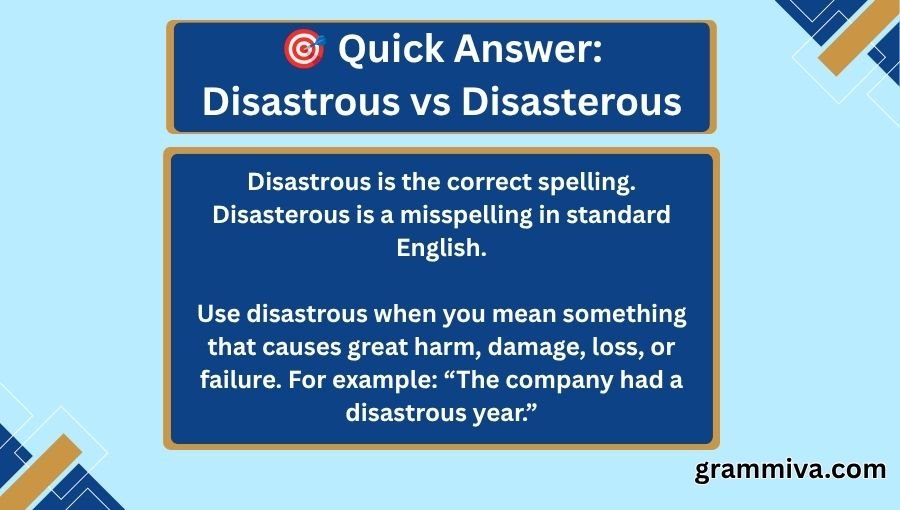
Disastrous is the correct spelling. Disasterous is a misspelling in standard English.
Use disastrous when you mean something that causes great harm, damage, loss, or failure. For example: “The company had a disastrous year.”
Is Disastrous the Correct Spelling?
Yes. Disastrous is the standard spelling in US English. The spelling disasterous is incorrect.
The key point is that the correct adjective is formed as disastrous, not by keeping every letter of disaster and then adding -ous. The middle e in disaster does not remain in the adjective.
Compare these forms:
| Form | Status | Example |
|---|---|---|
| disastrous | ✅ Correct | The storm had disastrous effects. |
| disasterous | ❌ Incorrect | The storm had disasterous effects. |
| disaster | ✅ Correct | The flood was a disaster. |
| disastrously | ✅ Correct | The plan ended disastrously. |
A simple rule helps: disaster → disastrous.
Do not write disasterous.
Disastrous vs Disasterous at a Glance
The difference between the two spellings is only one letter, but that letter matters. Disastrous is correct, while disasterous is not standard English.
| Form | Type | Meaning | Example | Correct/Incorrect |
|---|---|---|---|---|
| disastrous | adjective | Causing or involving great harm or failure | It was a disastrous decision. | ✅ Correct |
| disasterous | adjective-like misspelling | Intended to mean “disastrous” | It was a disasterous decision. | ❌ Incorrect |
| disaster | noun | A very bad event or situation | The launch was a disaster. | ✅ Correct |
| disastrously | adverb | In a disastrous way | The project failed disastrously. | ✅ Correct |
The mistake usually happens because writers look at disaster and try to build the adjective letter by letter.
That method does not work here.
Think of the word as a fixed spelling:
disastrous
not:
disaster + ous
🎯 Understanding Disastrous vs Disasterous
The core difference is spelling and standard usage. Disastrous is the accepted adjective, while disasterous is a spelling error.
What Does Disastrous Mean?
Disastrous is an adjective. It describes something that causes or involves serious harm, damage, failure, or bad results.
Examples include:
- a disastrous mistake
- a disastrous accident
- a disastrous decision
- a disastrous business deal
- a disastrous result
- a disastrous storm
Consider this sentence:
The company made a disastrous choice.
Here, company is the subject. Made is the verb. Choice is the noun. Disastrous describes the choice.
That is the basic job of the word: it gives information about a noun.
What Does Disasterous Mean?
Disasterous is not the standard spelling of the adjective. It is normally a misspelling of disastrous.
You may occasionally see it in informal online writing, old text, user-generated content, or other places where spelling has not been checked. Seeing the spelling does not make it correct.
If you are writing an essay, report, email, article, resume, or business document, use disastrous.
💡 How Can You Remember the Correct Spelling?
The easiest memory trick is to remove the extra e before adding the adjective ending.
Start with:
disaster
Then remember:
disastrous
Notice what disappears:
disast[e]r → disastrous
You do not need to memorize a complicated grammar rule. Just remember that the correct adjective is disastrous.
Test Tip
If you are unsure, write the two choices side by side:
- disastrous
- disasterous
The first one is the standard form.
Another useful test is to remember the related adverb:
disastrous → disastrously
You will never write disasterously in standard English.
| Meaning | Word Type | Example Sentence |
|---|---|---|
| Causing serious harm or failure | Adjective | The mistake was disastrous. |
| Describing a very bad outcome | Adjective | They suffered a disastrous loss. |
| In a disastrous way | Adverb | The meeting ended disastrously. |
Why Do People Confuse Disastrous and Disasterous?
People confuse these spellings because disasterous looks like a logical combination of disaster and -ous. The eye naturally wants to keep the whole base word.
There is also a visual reason. Both versions look almost identical:
disastrous
disasterous
Only one letter separates them.
I once caught myself typing disasterous while editing a draft late in the afternoon. I knew the correct spelling, but the base word disaster pulled my fingers toward the extra e. That small mistake reminded me why spelling checks matter even when you know the rule.
Other factors can make the problem worse:
- Fast typing can cause skipped or added letters.
- Autocorrect may not catch every spelling error.
- Spell-check tools can behave differently depending on the dictionary being used.
- Writers may never have learned the correct form.
- Reading the incorrect spelling online can make it look familiar.
- The word disaster strongly influences how people expect the adjective to look.
Familiarity is not the same as correctness. A misspelled word can look normal if you have seen it often enough.
📝 A Real-Life Case Study
Imagine a manager sending this email after a failed product launch:
“The first launch was disasterous, but we have learned several useful lessons.”
The meaning is clear. The reader knows what the manager intends to say. However, the spelling creates an unnecessary problem.
A corrected version would read:
“The first launch was disastrous, but we have learned several useful lessons.”
I once edited a workplace report where one spelling error appeared several times. The writer had used the incorrect form because the word disaster was already in the document. Once we corrected the first example, we found four more.
That is a common pattern. One spelling mistake can spread through an entire document when writers copy and paste text.
The lesson is simple: when you find one questionable spelling, search the entire document for the same word.
What Grammar Rule Explains the Correct Form?
The standard adjective is disastrous. The form disasterous is not the standard spelling.
The word disastrous functions as an adjective. It modifies nouns and tells the reader that something has very bad, harmful, or damaging results.
For example:
The team made a disastrous error.
Here, disastrous modifies error.
The spelling should be learned as the established form rather than produced by simply attaching -ous to every letter of disaster. English has many words whose related forms do not preserve every letter of the base form in a simple, predictable way.
Most standard English reference sources list disastrous as the accepted spelling.
No special punctuation is needed. There is also no apostrophe in the word.
The standard forms are:
- disaster
- disastrous
- disastrously
The nonstandard spelling is:
- disasterous
Correct vs Incorrect at a Glance
The examples below show how the correct spelling works in complete sentences.
| Sentence | Correct/Incorrect | Why |
|---|---|---|
| The storm had disastrous effects on the town. | ✅ Correct | Disastrous is the standard adjective. |
| The storm had disasterous effects on the town. | ❌ Incorrect | The adjective is spelled disastrous. |
| It was a disastrous business decision. | ✅ Correct | The word correctly describes decision. |
| It was a disasterous business decision. | ❌ Incorrect | The extra e makes the spelling wrong. |
| The project ended disastrously. | ✅ Correct | Disastrously is the correct adverbial form. |
A useful editing habit is to look for the sequence -strous.
Correct:
disastrous
Incorrect:
disasterous
⚠️ Common Mistakes With Disastrous
The main mistake is adding an extra e after the t.
Wrong: disasterous
This form follows the visual pattern of disaster too closely.
Right: disastrous
The correct adjective drops the e found in the noun.
Another mistake is changing the word into an unnecessary noun phrase. Writers sometimes say:
The results were a disasterous situation.
This has two problems. First, disasterous is misspelled. Second, the sentence is wordier than necessary.
A cleaner version is:
The results were disastrous.
Good writing is not just about spelling. It is also about choosing the clearest structure.
Similar Spelling Confusions Writers Make
This spelling problem belongs to a larger group of common English mistakes.
| Confusion | Correct Form | Common Wrong Form | Main Reason |
|---|---|---|---|
| its / it’s | its / it’s | mixed up | Apostrophe confusion |
| your / you’re | your / you’re | mixed up | Similar sound |
| their / they’re | their / they’re | mixed up | Similar sound |
| definitely | definitely | definately | Sound-based spelling |
| separate | separate | seperate | Pronunciation influence |
| disastrous | disastrous | disasterous | Base-word influence |
The causes are often simple.
Fast typing: Fingers may follow a familiar pattern instead of the correct spelling.
Autocorrect: Writers may assume their device has checked every word.
Lack of knowledge: A person cannot apply a rule they have never learned.
Visual familiarity: Repeated exposure to a misspelling can make it look correct.
Specific Wrong Spellings to Avoid
Here are several forms you may encounter.
| Wrong Form | What’s Wrong | Correct Form |
|---|---|---|
| disasterous | Extra e | disastrous |
| disasterus | Incorrect ending | disastrous |
| disastrus | Missing letters | disastrous |
| disasterouse | Incorrect ending | disastrous |
| disastrious | Incorrect vowel pattern | disastrous |
| disasterously | Incorrect adjective spelling carried into the adverb | disastrously |
The most important one to remember is disasterous. That is the spelling most closely confused with the correct word.
If you see the word in your draft, replace it with disastrous.
📚 The Word’s History and Spelling Pattern
The spelling of disastrous is connected to the word disaster, but the adjective does not simply preserve the noun’s spelling and attach -ous.
English contains many related words where a letter or letter group changes when the word takes another form. That is why it is safer to learn common forms as they are actually spelled rather than assuming every word can be built mechanically.
For practical writing, the important progression is:
| Stage | Form | Note |
|---|---|---|
| Base noun | disaster | Names a very bad event or situation. |
| Adjective | disastrous | Describes something very harmful or unsuccessful. |
| Adverb | disastrously | Describes an action or result in a disastrous way. |
You do not need detailed word history to use the spelling correctly. The most useful fact is simply this:
disaster → disastrous → disastrously
Is Disastrous Used the Same Way in Every Context?
Yes. The spelling remains disastrous across everyday, professional, creative, and digital writing. What changes is the situation in which you use it.
| Context | Which Term to Use | Example |
|---|---|---|
| Everyday conversation | disastrous | That was a disastrous trip. |
| Professional writing | disastrous | The company faced disastrous losses. |
| Creative writing | disastrous | His disastrous choice changed everything. |
| Social media/texting | disastrous | That game was disastrous! |
The word can sound strong, so consider the situation before using it.
Calling a small mistake “disastrous” may sound dramatic. Calling a major failure “disastrous” may be accurate.
When Should You Use Disastrous in Professional Writing?
Use disastrous when you need to describe a serious failure, harmful outcome, or damaging event.
It works well in:
- business reports
- news-style writing
- academic essays
- workplace emails
- project reviews
- formal explanations
- opinion writing
For example:
The company experienced disastrous financial results.
Or:
The policy had disastrous effects on the local community.
In professional writing, the word should describe something genuinely serious. If the problem is minor, a softer word may communicate your point better.
For example, unfortunate, poor, or unsuccessful may be better choices when the consequences are limited.
Can Disastrous Describe People?
Usually, disastrous is most naturally used to describe actions, decisions, events, plans, results, situations, or effects.
Examples:
- a disastrous decision
- a disastrous plan
- a disastrous event
- a disastrous outcome
- a disastrous mistake
You can sometimes use the word in a broader way, but direct descriptions of people may sound unusual or harsh.
Instead of:
She was disastrous.
You might say:
Her decision was disastrous.
That sentence is clearer because the word identifies exactly what caused the problem.
Common Phrases With Disastrous
Disastrous appears in several common combinations. These are not special idioms, but they are natural word pairings.
| Phrase | Meaning |
|---|---|
| disastrous consequences | Very harmful results |
| disastrous effects | Very damaging effects |
| disastrous results | Extremely poor outcomes |
| disastrous decision | A decision with very bad results |
| disastrous mistake | A mistake that causes serious problems |
| disastrous failure | A very serious failure |
These phrases can help you build natural sentences.
For example:
The decision had disastrous consequences.
This is more natural than trying to create an unusual phrase around the word.
What Are Good Synonyms for Disastrous?
Several words can replace disastrous, but the best choice depends on the strength and type of problem.
| Alternative | Works When | Does Not Work When |
|---|---|---|
| terrible | You want a broad, strong description | You need a precise formal tone |
| catastrophic | The damage is extremely severe | The problem is only moderate |
| devastating | Something causes deep or serious harm | The outcome is merely disappointing |
| disastrous | The outcome is seriously harmful or unsuccessful | You are describing a minor inconvenience |
| unsuccessful | Something fails to achieve its goal | You want to stress severe harm or damage |
For example:
The project was unsuccessful.
This does not necessarily mean the project caused major damage.
But:
The project was disastrous.
suggests a much more serious outcome.
Choosing the right synonym is therefore a question of meaning, not just spelling.
Why Does the Correct Spelling Matter? 🎯
Correct spelling helps readers understand your writing without distractions. One small error may not change the meaning, but repeated errors can affect how professional the writing appears.
Clarity in Communication
Correct spelling makes your message easier to read. Readers should not have to stop and wonder whether a word is intentional.
Professionalism
A spelling error in a resume, report, or client email can make an otherwise strong document look rushed.
Digital Writing
Online writing spreads quickly. A misspelled word can be copied into posts, websites, newsletters, or documents.
A simple rule captures the idea:
Clear words build clear messages.
| Situation | Why Getting It Right Matters |
|---|---|
| Resume | Shows care and attention to detail |
| Client email | Supports a professional image |
| Published content | Protects readability and credibility |
| Social post | Makes the message easier to understand |
How To Remember the Difference
The fastest memory trick is to focus on the middle of the word.
Do not think:
disaster + ous
Instead, memorize:
disastrous
You can also connect it to the adverb:
disastrous → disastrously
Both forms keep the same disastr- pattern.
Here is another simple visual trick:
Disaster loses its “e” before it becomes disastrous.
That is not a rule you should apply to every English word. It is simply a useful memory aid for this particular spelling.
Can Spell-Check Catch Disasterous?
A spell-checker may flag disasterous, but you should not rely on software alone.
Spell-check tools can miss errors for several reasons. A word may appear in a custom dictionary. A tool may use a different language setting. A typo may also create a different valid word.
The safest approach is to know the spelling yourself.
If you are proofreading a document, search specifically for:
disasterous
If the search finds anything, replace it with:
disastrous
This is especially useful in long articles and reports.
What Should You Use in Everyday Conversation?
Use disastrous in everyday speech and writing when something has very bad results.
Examples include:
My first attempt at cooking the meal was disastrous.
The road trip became disastrous after the car broke down.
That was a disastrous choice.
The word can also be used humorously when the situation is not truly serious:
My attempt to assemble the furniture was disastrous.
The spelling does not change when the tone changes.
How Does Disastrous Work in Creative Writing?
Creative writers often use disastrous to increase tension or show the seriousness of an event.
For example:
The plan seemed perfect until one disastrous mistake changed everything.
The adjective creates a strong sense of danger or failure.
Still, strong words should have a purpose. If every small problem is called disastrous, the word loses some of its force.
Writers can vary their language with words such as:
- difficult
- troubling
- damaging
- severe
- terrible
- devastating
Choose the word that best matches the scene.
Is Disasterous Ever Correct?
No, not as the standard spelling of the adjective in ordinary US English. Disastrous is the form you should use.
You may encounter disasterous in an online comment, an old document, an unedited text, or a learner’s writing. Those examples do not establish it as the standard spelling.
If you are writing for school, work, publication, or a general audience, choose disastrous.
What Is the Difference Between Disaster and Disastrous?
Disaster is a noun. Disastrous is an adjective.
A noun names something. An adjective describes something.
Compare:
The flood was a disaster.
Here, disaster names the event.
The flood caused disastrous damage.
Here, disastrous describes the damage.
| Word | Part of Speech | Example |
|---|---|---|
| disaster | noun | The accident was a disaster. |
| disastrous | adjective | The accident had disastrous effects. |
| disastrously | adverb | The plan failed disastrously. |
This distinction is useful because it shows why you cannot simply swap the words in every sentence.
How Can You Proofread Disastrous Correctly?
When proofreading, use a three-step check.
Step 1: Search for the Wrong Form
Search your document for:
disasterous
Step 2: Replace It
Change it to:
disastrous
Step 3: Check Related Forms
Also look for:
- disastrously
- disaster
- disasters
Make sure each form fits its sentence.
For example:
The disaster damaged several buildings.
The storm had disastrous effects.
The response was handled disastrously.
Each word has a different grammatical job.
💡 A Simple Memory Rule
If you remember only one thing from this article, remember this:
Disastrous has no “e” after the “t.”
Correct:
disastrous
Incorrect:
disasterous
You can say the correct form aloud while spelling it:
dis-as-trous
Then write it.
The goal is not to memorize a long explanation. The goal is to make the correct spelling automatic.
Quick Recap Checklist ✅
Use this checklist whenever you are unsure.
| Question | If Yes → Use |
|---|---|
| Am I describing something very harmful or unsuccessful? | disastrous |
| Am I describing a bad decision or outcome? | disastrous |
| Am I naming the bad event itself? | disaster |
| Am I describing how something happened in a disastrous way? | disastrously |
| Am I considering “disasterous”? | Replace it with disastrous |
Practice Examples
- The project was disastrous.
- The flood was a disaster.
- The company responded disastrously.
If you can tell why each word fits, you understand the difference.
FAQs About Disastrous vs Disasterous
Is disastrous the correct spelling?
Yes. Disastrous is the correct standard spelling. Disasterous is a misspelling.
Why is disasterous wrong?
Disasterous keeps the e from disaster in a place where it does not belong. The standard adjective is disastrous.
How do you spell disastrous?
Spell it:
D-I-S-A-S-T-R-O-U-S
The key point is that there is no e between the t and r.
Is disastrous an adjective?
Yes. Disastrous is an adjective. It describes something that causes or involves very serious harm, damage, failure, or bad results.
What is the noun form of disastrous?
The related noun is disaster.
For example:
The event was a disaster.
What is the adverb form of disastrous?
The adverb is disastrously.
For example:
The plan failed disastrously.
Can I use disasterous in informal writing?
You may see it in informal or unedited writing, but it is still not the standard spelling. Use disastrous in all normal writing.
Is disastrous the same as terrible?
They can be similar, but they are not always identical. Disastrous usually suggests serious failure, harm, or damaging results. Terrible has a wider range of meanings.
Is disastrous too strong for a small mistake?
Often, yes. The word suggests a serious problem. For a minor mistake, words such as unfortunate, poor, or problematic may be more accurate.
How can I remember disastrous vs disasterous?
Remember this short rule:
Disaster → disastrous.
The correct adjective does not keep the e from disaster.
Why Disastrous vs Disasterous Is Easy to Fix
This spelling issue may look difficult because the two versions are so close. In reality, there is only one form you need to remember for standard English: disastrous.
The biggest trap is trying to build the adjective mechanically from the noun. Seeing disaster can make disasterous feel natural. But English spelling does not always work by attaching an ending to every letter of a base word.
The best strategy is repetition.
Write:
disastrous
Read:
disastrous
Use it in a sentence:
The decision had disastrous consequences.
Then connect it to its related forms:
disaster → disastrous → disastrously
Once that pattern becomes familiar, the incorrect spelling should start to look unusual.
Final Takeaway
Disastrous vs disasterous has a simple answer: disastrous is correct, and disasterous is a misspelling. The correct adjective describes something that causes or involves serious harm, damage, failure, or bad results.
When you need the noun, use disaster. When you need the adjective, use disastrous. When you need the adverb, use disastrously.
The easiest memory trick is to remember that disastrous does not contain the extra e from disaster. Keep the spelling pattern disastr- in mind, and you will avoid the most common error.
Good spelling does not require knowing every rule in English. Sometimes, one clear memory pattern is enough. ✨
Remember: disaster is the event, disastrous describes it, and “disasterous” stays out of your writing.

I am Adam Wilson, an English language content writer with an interest in grammar and vocabulary. I work at Grammiva and focus on creating clear explanations and practical examples for English learners.


[…] By the end, you should be able to choose the right form without stopping to think twice. 😊 | Disastrous vs Disasterous | Concede vs Conceed […]
[…] By the end, you should be able to choose the right form with confidence. ✍️ Vendor vs Vender | Disastrous vs Disasterous | Concede vs […]