Have you ever typed a word, looked at it twice, and suddenly wondered if you spelled it correctly? 🤔 That happens often with words that sound natural but have tricky letter patterns. Concede vs conceed is a good example. This guide explains the difference between concede vs conceed and shows why only one form is standard English.
If you have ever written, “I conceed that you are right,” you are not alone. The mistake is easy to make because the word concede sounds as if it might need an extra e before the final d. It does not.
I teach writing and editing, and this is one of those spelling questions that becomes simple once you see the pattern. The correct word is concede. The spelling conceed is incorrect in standard US English.
In this guide, I’ll explain what concede means, how to spell it, how to use it in a sentence, why people add the extra e, and how to remember the correct form. By the end, you should be able to spot the error quickly and write the word with confidence. ✍️ Humorous vs Humerous | Affect vs Effect | Advice vs Advise
🎯 Quick Answer: Concede vs Conceed
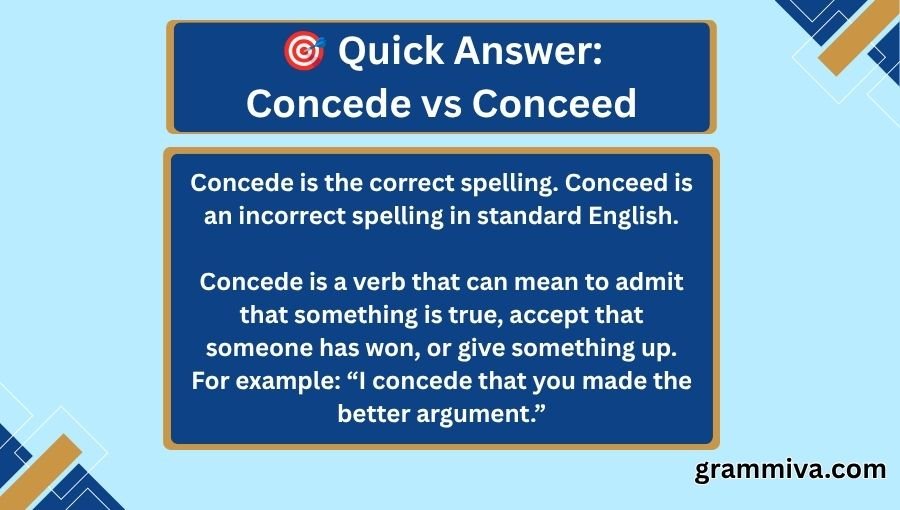
Concede is the correct spelling. Conceed is an incorrect spelling in standard English.
Concede is a verb that can mean to admit that something is true, accept that someone has won, or give something up. For example: “I concede that you made the better argument.”
🔤 Related Word Forms of Concede
The base verb concede has several standard forms. These forms change depending on tense or grammatical use, but they keep the correct spelling pattern.
| Form | Type | Example |
|---|---|---|
| concede | Base verb | I concede that you are right. |
| concedes | Third-person singular | She concedes the point. |
| conceded | Past tense/past participle | He conceded the match. |
| conceding | Present participle/gerund | They are conceding too much ground. |
| concession | Noun | His concession ended the dispute. |
The incorrect form conceded is not a standard form of the verb.
Notice something useful: concede has one e before the final d. When the verb becomes conceded, the final e remains before d. When it becomes conceding, the final e is dropped before -ing.
🎯 Concede vs Conceed: Understanding the Basics
The basic difference is simple: concede is a real English word, while conceded is a misspelling.
| Form | Type | Meaning | Example | Correct/Incorrect |
|---|---|---|---|---|
| concede | Verb | Admit something or accept defeat | I concede that you were right. | ✅ Correct |
| conceed | — | Not a standard English spelling | I conceed that you were right. | ❌ Incorrect |
| conceded | Verb, past tense | Admitted or accepted defeat | She conceded the point. | ✅ Correct |
| conceding | Verb form | Admitting or giving up | He is conceding the argument. | ✅ Correct |
What Does Concede Mean?
Concede is a verb. It is commonly used when someone admits that another person is right, accepts that they have lost, or agrees to give something up.
For example:
“After checking the numbers, I concede that your answer is correct.”
Here, the speaker has changed their position. They admit that the other person is right.
Another example is:
“The candidate conceded the election.”
Here, conceded means the candidate accepted that they had lost.
The word can also describe giving something up:
“The company refused to concede any more ground during the talks.”
In that sentence, concede means to give up or allow something.
Why Is Conceed Incorrect?
Conceed looks like a possible spelling because English has many words where an ending sound is represented by several letters. However, standard English spells the verb concede, not conceded.
The final part is -cede, as in concede. There is no standard English spelling conceded for this word.
Is Concede the Same as Conceed?
No. Concede is the correct English word, while conceded is a misspelling.
The confusion comes from how the word sounds. When people say concede, the ending can sound like it contains a long “e” sound. A writer may then guess that the spelling needs two e letters before the final d.
It does not.
Compare these examples:
- I concede your point. ✅
- I conceded your point. ❌
- She conceded defeat. ✅
- She conceeded defeat. ❌
The safest approach is to remember the spelling as one unit: con-cede.
Why Do People Confuse Concede and Conceed?
People often confuse these spellings because English spelling cannot always be predicted from sound alone.
There are several common reasons:
- The pronunciation can suggest extra letters.
- People type quickly and do not proofread.
- Autocorrect may fail to catch a misspelling.
- The writer may never have learned the correct spelling.
- Similar words can create false spelling patterns.
I once reviewed a short workplace memo where the writer had used conceded several times. The writer clearly understood the meaning. The only problem was the extra e. Once I pointed out the correct form, the error disappeared from the revised version.
That is a useful lesson: knowing what a word means does not always mean knowing exactly how to spell it.
💡 Test Tip
When you are unsure, say the word in your head and then remember this spelling pattern:
con + cede = concede
Do not add another e before the d.
If you write conceded, stop and check it. In standard English, the correct form is concede.
📝 Correct Meanings and Uses of Concede
Concede has several closely related uses. The central idea is accepting, admitting, or giving something up.
1. Concede That Something Is True
You can use concede when you admit that another person’s statement or argument is correct.
Example:
“I concede that your plan would cost less.”
The speaker may still prefer another plan. However, they admit that the other person’s plan costs less.
This use is common in debates, essays, discussions, and professional conversations.
2. Concede a Point
A person can concede a point without agreeing with everything else.
“I concede your point about the schedule, but I still think we need more staff.”
This is useful because concede does not always mean complete agreement. It can mean recognizing that one specific point is valid.
3. Concede Defeat
In sports, elections, competitions, and conflicts, concede can mean accepting that you have lost.
“The team conceded defeat after the final round.”
“The candidate conceded after the results became clear.”
In these cases, the word describes acceptance of an unfavorable result.
4. Concede Something to Someone
The word can also mean giving something to another person.
“The seller conceded a discount to the buyer.”
This use is less common in casual speech but is useful in business, negotiation, and formal writing.
Meaning Summary
| Meaning | Word Type | Example Sentence |
|---|---|---|
| Admit something is true | Verb | I concede that the data supports your view. |
| Admit that someone has a valid point | Verb | She conceded his point. |
| Accept defeat | Verb | The player conceded after the final round. |
| Give something up | Verb | The company conceded some demands. |
Is Concede a Verb?
Yes. Concede is a verb because it describes an action or state of accepting, admitting, or giving something up.
Here are a few common structures:
- concede + noun: “She conceded the point.”
- concede + that clause: “She conceded that he was right.”
- concede + defeat: “The team conceded defeat.”
- concede + something + to someone: “They conceded the advantage to their rivals.”
Understanding its grammar can make the word easier to use correctly.
🔎 Concede vs Conceed at a Glance
The simplest rule is that concede belongs in standard English sentences, while conceded does not.
| Feature | Concede | Conceed |
|---|---|---|
| Standard English word | Yes | No |
| Correct spelling | Yes | No |
| Part of speech | Verb | — |
| Can mean “admit” | Yes | — |
| Can mean “accept defeat” | Yes | — |
| Example | I concede the point. | I conceed the point. ❌ |
📝 Case Study: A Workplace Email
Imagine a manager and employee are discussing a project deadline.
The employee writes:
“I conceded that we should have started earlier.”
The meaning is clear, but the spelling is wrong.
A corrected version would be:
“I concede that we should have started earlier.”
The second sentence looks professional and polished.
Now consider a longer example:
“After reviewing the timeline, I concede that the original deadline was too ambitious. I recommend moving the launch date by one week.”
This is a strong professional use of concede. The writer admits that the original plan had a problem and then offers a solution.
The word can be especially useful when you want to sound fair. Instead of simply saying “You were right,” you can say “I concede that point.” That phrasing recognizes the other person’s argument while leaving room for further discussion.
📚 Grammar Rules Explanation
The standard spelling is concede. The spelling conceded is not a standard form of the verb.
The key spelling pattern is -cede. The word is written:
c-o-n-c-e-d-e
It is not written:
c-o-n-c-e-e-d
When the word is used in the present tense, use concede:
“I concede that the evidence is strong.”
When used with a third-person singular subject, use concedes:
“She concedes that the evidence is strong.”
For the simple past tense, use conceded:
“She conceded that the evidence was strong.”
For the -ing form, use conceding:
“She is conceding that the evidence is strong.”
A helpful spelling pattern is:
concede → concedes → conceded → conceding
Do not create the nonexistent form conceded.
Standard reference dictionaries and major English style resources consistently recognize concede as the standard spelling. The important point for everyday writing is simple: when you mean “admit,” “accept defeat,” or “give up,” write concede.
Correct vs Incorrect at a Glance
| Sentence | Correct/Incorrect | Why |
|---|---|---|
| I concede that you are right. | ✅ Correct | Concede is the standard spelling. |
| I conceed that you are right. | ❌ Incorrect | Conceed is a misspelling. |
| She conceded the point. | ✅ Correct | Conceded is the correct past form. |
| She conceeded the point. | ❌ Incorrect | The extra e is incorrect. |
| They are conceding the argument. | ✅ Correct | Conceding is the correct -ing form. |
⚠️ Common Mistakes With Concede
The biggest mistake is adding an extra e.
Writers may think:
concede → conceeded
But the correct form is:
concede → conceded
The same problem can happen when someone tries to write the base form from memory.
Common Grammar and Spelling Confusions
| Confusion | Correct Form | Common Wrong Form | Reason |
|---|---|---|---|
| Its/it’s | its / it’s | mixing the two | Apostrophe changes the meaning. |
| Your/you’re | your / you’re | mixing the two | One shows possession; one means “you are.” |
| Their/they’re | their / they’re | mixing the two | They have different grammatical roles. |
| Affect/effect | affect / effect | swapping them | Their usual grammatical roles differ. |
| Concede/conceed | concede | conceed | The second spelling adds an unnecessary e. |
There are three especially common reasons these mistakes appear.
Fast typing: When people type quickly, they often spell words by sound or muscle memory.
Autocorrect: Spell-check tools are useful, but they are not perfect. A tool may miss an error depending on the sentence.
Lack of knowledge: If you have rarely seen a word in writing, you may naturally guess its spelling.
I once caught myself typing conceded while editing a draft. I knew the word was concede, but my fingers followed the sound for a moment. That small error reminded me why even experienced writers need to proofread.
Specific Wrong Spellings of Concede
| Wrong Form | What’s Wrong | Correct Form |
|---|---|---|
| conceed | Extra e before d | concede |
| conceeded | Extra e in the past form | conceded |
| conceeding | Incorrect base spelling before -ing | conceding |
| concide | Letters are rearranged incorrectly | concede |
| conciede | Letters are in the wrong order | concede |
💡 How To Remember the Difference
A simple memory trick can make this spelling almost automatic.
Think:
CON + CEDE = CONCEDE
The word ends in cede, not ceed.
You can also connect it to the idea of a person saying:
“I concede.”
The spelling has only one e before the final d.
Try writing these forms as a group:
concede → conceded → conceding
Seeing them together helps your brain learn the pattern rather than guessing each form separately.
Another useful trick is to remember that the incorrect spelling looks longer than necessary. When your eyes see conceded, pause. Ask yourself, “Do I really need that second e?” The answer is no.
🌎 Usage in Different Contexts
The correct form works in everyday, professional, creative, and digital writing. The level of formality changes, but the spelling does not.
| Context | Which Term to Use | Example |
|---|---|---|
| Everyday conversation | concede | “I concede. You were right.” |
| Professional writing | concede | “We concede that the first estimate was too low.” |
| Creative writing | concede | “At last, he conceded that she had been right.” |
| Social media/texting | concede | “Okay, I concede 😂 You win.” |
In casual conversation, people may use simpler words such as admit or give in. In formal writing, concede can sound more precise.
Is Concede Appropriate in Professional Writing?
Yes. Concede is common and useful in professional writing when you need to acknowledge a fact, accept a point, or describe a negotiated compromise.
For example:
“We concede that the first proposal did not meet the client’s needs.”
That sentence sounds clear and professional.
Another example:
“The report concedes that additional testing is needed.”
Here, concedes means the report acknowledges or admits something.
You can also use the word during negotiations:
“The company conceded several minor terms but kept its main position.”
The word can show that someone has given something up without suggesting that they surrendered every part of their position.
💬 Common Phrases With Concede
Several natural phrases regularly appear with concede.
| Phrase | Meaning |
|---|---|
| concede a point | Admit that someone has a valid point |
| concede defeat | Accept that you have lost |
| concede that | Admit that something is true |
| concede an argument | Accept the strength or validity of an argument |
| concede ground | Give up an advantage or position |
| concede a demand | Agree to give someone what they requested |
These phrases can help you recognize the word when you see it in books, articles, news reports, or conversations.
🧩 Synonyms and Alternatives
Sometimes concede can be replaced with a simpler word. The best choice depends on the situation.
| Alternative | Works When | Does Not Work When |
|---|---|---|
| admit | You accept that something is true | You specifically mean giving up a position or advantage |
| acknowledge | You recognize a fact or point | You need to emphasize accepting defeat |
| accept | You agree to receive or recognize something | The specific meaning is admitting another person’s argument |
| give in | You stop resisting | Formal writing requires a more neutral tone |
| surrender | You give up completely | You only want to admit one small point |
For example, “I admit that you are right” is close to “I concede that you are right.” However, concede can sound more deliberate and formal.
“Give in” is more casual:
“Fine, I give in.”
That does not always carry the same careful tone as:
“I concede your point.”
Why Does Getting the Spelling Right Matter?
Correct spelling helps readers understand your message without distractions. A small spelling error can make otherwise strong writing look rushed.
This matters especially when you are writing for work, school, clients, or a public audience.
Clarity in Communication
Correct spelling removes unnecessary distractions. When readers see an unfamiliar spelling, they may stop to wonder whether the word is intentional.
Professionalism
A correctly spelled word can make an email, report, resume, or article look more polished.
Digital Communication
Online writing moves quickly. That makes small spelling mistakes easy to publish and hard to notice later.
A useful rule is:
“When the spelling is uncertain, check the word before the reader has to.”
That simple habit can prevent many avoidable errors.
| Situation | Why Getting It Right Matters |
|---|---|
| Resume | Shows care and attention to detail |
| Client email | Builds a professional impression |
| Published content | Protects readability and credibility |
| Social post | Makes the message easier to read and share |
Does Concede Have a Special Exception?
There is no standard English exception that makes conceded correct.
You may occasionally encounter unusual spellings in usernames, company names, product names, fictional writing, or other proper names. Those are individual naming choices, not evidence that conceded is a standard spelling of the English verb.
For normal English writing, use concede.
🎯 Concede vs Conceed in Sentences
Seeing the word in complete sentences is one of the best ways to remember it.
| Correct Sentence | Incorrect Sentence | Rule |
|---|---|---|
| I concede your point. | I conceed your point. | Use concede. |
| She conceded defeat. | She conceeded defeat. | Use conceded. |
| He concedes that the plan has problems. | He conceedes that the plan has problems. | Use concedes. |
| They are conceding some ground. | They are conceeding some ground. | Use conceding. |
| We concede that the result was fair. | We conceed that the result was fair. | Use concede. |
❓ Can You Use Concede in Casual Speech?
Yes. Concede can be used in casual speech, although words such as admit or give in may sound more natural in very informal situations.
For example:
“Okay, I concede. You win.”
That is perfectly understandable in a friendly conversation.
You could also say:
“Fine, I admit it. You were right.”
Both work. Concede simply has a slightly more formal or deliberate feel in many situations.
🧠 How Does Concede Change in Different Tenses?
The word follows regular patterns in its common forms.
| Tense/Form | Correct Form | Example |
|---|---|---|
| Base | concede | I concede the point. |
| Present, third person | concedes | She concedes the point. |
| Past | conceded | She conceded the point. |
| Present participle | conceding | She is conceding the point. |
| Perfect | conceded | They have conceded the point. |
The most common spelling mistake is adding an extra e to forms that do not need it.
Is Conceed Ever Correct?
No, not as the standard spelling of the English verb meaning “admit,” “accept defeat,” or “give up.”
If you intend that verb, use concede.
This is one of those cases where there is no meaningful choice between two standard words. It is not like gray and grey, where both spellings are accepted in different varieties of English. Here, concede is the standard form.
📋 Quick Recap Checklist
Use this checklist whenever you are unsure.
| Question | If Yes → Use |
|---|---|
| Do I mean “admit something is true”? | concede |
| Do I mean “accept defeat”? | concede |
| Do I mean “give something up”? | concede |
| Am I writing the past tense? | conceded |
| Am I describing an ongoing action? | conceding |
| Am I tempted to add another e before d? | Stop and write concede instead |
Practice Examples
- I concede that your argument is stronger. ✅
- The team conceded defeat after the final score. ✅
- She conceeded that she had made a mistake. ❌ → She conceded that she had made a mistake. ✅
FAQs About Concede vs Conceed
Is concede the correct spelling?
Yes. Concede is the correct standard spelling. Conceed is a misspelling when used as the English verb meaning “admit,” “accept defeat,” or “give up.”
What does concede mean?
Concede means to admit that something is true, accept that someone has won, or give something up. The exact meaning depends on the sentence.
Is conceded a word?
No. Conceed is not the standard spelling of the English verb concede. If you mean the standard verb, write concede.
How do you spell concede in the past tense?
The past tense is conceded, not conceeded. For example: “The player conceded defeat.”
Is it concede or conceded defeat?
The correct phrase is concede defeat. For example: “The candidate decided to concede defeat.”
Is it conceded or conceeded?
The correct spelling is conceded. There is only one e immediately before the final d in the base word, and the past form is spelled conceded.
How do you remember how to spell concede?
Remember the ending -cede. Think of the word as con + cede = concede. Do not add an extra e to make conceded.
What is the difference between concede and admit?
Both can mean accepting that something is true. Concede often suggests that someone is accepting another person’s point, position, or victory, while admit is broader and often more common in everyday speech.
Can concede mean “give up”?
Yes. Concede can mean giving something up, especially a position, advantage, demand, or point during a disagreement or negotiation.
Is concede formal or informal?
Concede works in both casual and formal English. It can sound more formal than admit or give in, so it is especially useful in professional, academic, and argumentative writing.
✨ Concede vs Conceed: The Final Rule
Concede vs conceded has a very simple answer: concede is the correct spelling, and conceded is incorrect in standard English.
Use concede when you mean to admit something is true, accept that someone has won, or give something up. Use its normal forms, such as concedes, conceded, and conceding, when the grammar of your sentence requires them.
The easiest spelling trick is to remember con + cede = concede. There is no extra e before the final d.
If you are writing an email, article, school assignment, report, or social post, taking one second to check this spelling can make your writing cleaner. And when you see conceded, you can now recognize the problem immediately. ✍️
Remember the rule, trust the pattern, and keep one simple spelling in mind: concede, never conceded.

I am Ryan Mitchell, a writer focused on English grammar, vocabulary, and everyday language. I work at Grammiva, creating easy-to-understand articles that help readers improve their English with confidence.
[…] By the end, you should be able to choose the right spelling without stopping to think. ✍️ Concede vs Conceed | Humorous vs Humerous | Affect vs […]
[…] able to choose the right form without stopping to think twice. 😊 | Disastrous vs Disasterous | Concede vs Conceed | Humorous vs […]