Have you ever typed a sentence, stopped, and thought, “Wait… who vs whom?” 😅 You are not alone. Even strong writers pause over these two small words because they can sound almost the same in everyday speech.
The good news is that the rule is much easier than it first appears. The main difference is simple: who usually acts as the subject of a sentence, while whom usually acts as the object. Once you learn how to spot the subject and object, the choice becomes much clearer.
I teach grammar by looking at what a word does in a sentence rather than asking writers to memorize long rules. That approach works especially well here. In this guide, I will show you how who vs whom works, when each word is correct, how to use a quick test, and what to do when formal grammar and everyday speech do not match.
By the end, you should be able to choose the right word with confidence. 👍 Aluminum vs Aluminium | Aerofoil vs Airfoil | Airplane vs Aeroplane
🎯 Quick Answer: Who vs Whom
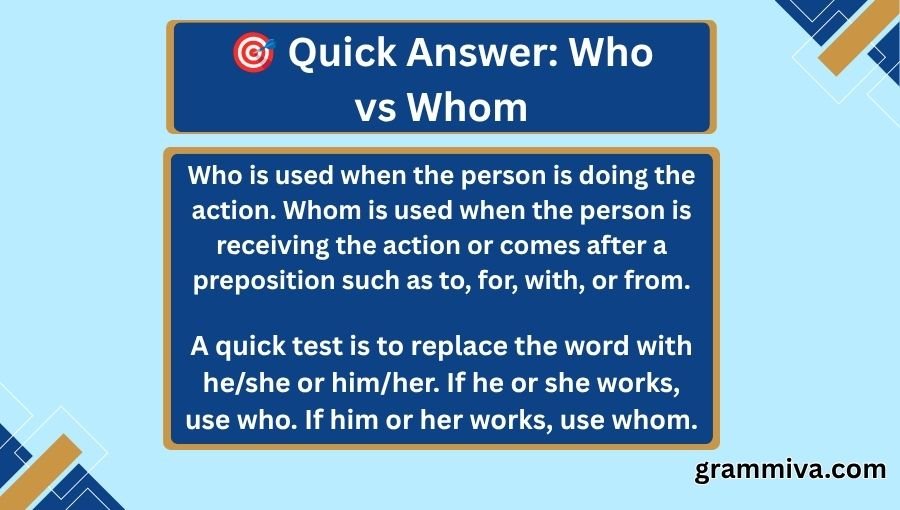
Who is used when the person is doing the action. Whom is used when the person is receiving the action or comes after a preposition such as to, for, with, or from.
A quick test is to replace the word with he/she or him/her. If he or she works, use who. If him or her works, use whom.
- Who called you? → She called you.
- Whom did you call? → You called her.
That simple test solves most who vs whom questions.
Who and Whom: Meaning and Correct Use
The easiest way to understand who and whom is to think about their jobs in a sentence.
Who is a subject pronoun. It refers to the person doing an action or performing the main role in a clause.
Whom is an object pronoun. It refers to the person receiving an action or following a preposition.
Here is the basic comparison:
| Form | Type | Meaning | Example | Correct/Incorrect |
|---|---|---|---|---|
| Who | Subject pronoun | The person doing the action | Who opened the door? | ✅ Correct |
| Whom | Object pronoun | The person receiving the action | Whom did you invite? | ✅ Correct |
| Who | Object in formal grammar | The person receiving the action | Whom did you invite? | ❌ Who is less formal here |
| Whom | Subject pronoun | The person doing the action | Whom called you? | ❌ Incorrect |
| Who | Subject | The person performing an action | Who wrote this note? | ✅ Correct |
The key question is not “Does the sentence sound formal?” The key question is “What job is the word doing?”
Who as the Subject
Use who when the person is doing the action.
Consider this sentence:
Who broke the window?
Someone broke the window. The unknown person is the one doing the action. Therefore, who is the subject.
Another example:
Who sent this package?
The unknown person sent the package. That person is the subject.
Whom as the Object
Use whom when the person receives the action.
Consider:
Whom did Sarah call?
Sarah is doing the calling. The person receiving the call is the object. Therefore, whom is correct in formal writing.
The same pattern appears here:
Whom did the manager choose?
The manager did the choosing. The person chosen receives the action.
The He/She vs Him/Her Test
This is my favorite practical test because it works quickly.
If you can replace the word with he or she, use who.
If you can replace it with him or her, use whom.
| Sentence | Replacement Test | Answer |
|---|---|---|
| Who is waiting outside? | She is waiting outside. | Who |
| Whom did you meet? | I met him. | Whom |
| Who made the cake? | She made the cake. | Who |
| Whom should I contact? | I should contact her. | Whom |
| Who wants pizza? | He wants pizza. | Who |
This test is especially useful when a sentence feels confusing.
🎯 Is Who the Same as Whom?
No. Who and whom have different grammatical roles. Who is normally the subject, while whom is normally the object.
Think of the difference this way:
Who = he/she
Whom = him/her
For example:
Who helped you?
You could answer:
She helped me.
So who is correct.
Now compare it with:
Whom did you help?
You could answer:
I helped her.
So whom is correct.
This is the heart of who vs whom. You do not need to memorize dozens of complicated rules. First find the action. Then ask who is doing it and who is receiving it.
Who vs Whom at a Glance
The fastest way to see the difference is to compare the two forms side by side.
| Question | Who | Whom |
|---|---|---|
| Is the person doing the action? | Yes | No |
| Is the person receiving the action? | No | Yes |
| Can you replace it with he/she? | Usually | No |
| Can you replace it with him/her? | No | Usually |
| Does it commonly follow a preposition? | Less formal | Yes |
| Is it common in casual speech? | Very common | Less common |
One useful point deserves special attention: whom is much more common in formal writing than in everyday conversation.
For example, you might naturally say:
Who did you invite?
Many speakers use who this way in normal conversation.
In formal writing, however, you may choose:
Whom did you invite?
The second sentence follows the traditional subject-object rule.
💡 How Can You Tell Whether to Use Who or Whom?
Start by finding the verb and identifying who performs the action.
If the unknown person performs the action, choose who. If the unknown person receives the action, choose whom.
Try this method:
- Find the main verb.
- Ask who is doing the action.
- Ask who is receiving the action.
- Replace the unknown word with he/she or him/her.
- Choose the form that matches.
For example:
Who gave Mark the keys?
The unknown person gave the keys. That person performs the action, so who is correct.
Now try:
Whom did Mark give the keys to?
Mark gives the keys to another person. That person receives them, so whom is correct in formal grammar.
Test Tip 💡
If you are stuck, remove the rest of the sentence and make a short answer.
For:
Who/whom did Lisa invite?
Say:
Lisa invited her.
You would not say:
Lisa invited she.
Because her is correct, the formal answer is whom.
For:
Who/whom called Lisa?
Say:
He called Lisa.
You would not say:
Him called Lisa.
Because he is correct, the answer is who.
📝 Correct Meanings and Uses
The difference becomes easier when you see the main patterns repeatedly.
| Meaning | Word Type | Example Sentence |
|---|---|---|
| Person doing an action | Subject | Who wrote the report? |
| Person receiving an action | Object | Whom did you call? |
| Person after a preposition | Object | With whom did you speak? |
| Person being identified as the subject | Subject | Who is your teacher? |
Use Who for the Person Doing the Action
Use who when the unknown person performs the verb.
Examples:
- Who designed this building?
- Who sent the email?
- Who won the game?
- Who left the lights on?
In each case, the person is doing something.
Use Whom for the Person Receiving the Action
Use whom when another person performs the action toward the unknown person.
Examples:
- Whom did you call?
- Whom did they select?
- Whom are you helping?
- Whom did the teacher praise?
The person represented by whom is not doing the main action. Someone else is.
Use Whom After a Preposition
Formal grammar traditionally uses whom after a preposition.
Examples include:
- To whom did you send the letter?
- With whom are you traveling?
- For whom is this gift?
- From whom did you receive the message?
- About whom were they talking?
In casual speech, people often move the preposition to the end and use who:
Who did you send the letter to?
That form is common and natural in conversation.
The more formal version is:
To whom did you send the letter?
Both are understandable. The second simply follows the traditional formal rule more closely.
Why Do People Confuse Who and Whom?
People confuse who and whom because English speakers often do not pronounce or distinguish them strongly in ordinary conversation.
There is also a second problem: many people learn the rule as a list of grammar terms rather than as a practical test.
I once helped a student revise a short essay that contained several sentences with whom. The student had added it because it “sounded smarter.” In one sentence, however, whom was actually the subject. We changed it to who, and the sentence immediately became clear.
That is a common trap. Whom should not be used simply because a sentence sounds formal.
Instead, check the word’s role.
| Confusion | Example | Better Approach |
|---|---|---|
| Formality | Using whom to sound professional | Check whether it is an object |
| Pronunciation | Who and whom sound similar | Use the he/she test |
| Habit | Always using who | Check the grammatical role |
| Overcorrection | Always using whom | Use whom only when appropriate |
| Conversation | Hearing who in object questions | Recognize informal usage |
Who vs Whom in Questions
Questions are where this grammar issue appears most often.
Compare these examples:
Who called the office?
The unknown person called. Who is the subject.
Whom did you call?
You called someone. That person is the object. Whom is the formal choice.
Now look at another pair:
Who invited Maria?
The unknown person did the inviting.
Whom did Maria invite?
Maria did the inviting.
The same names can appear in both sentences, but their grammatical roles change.
| Question | Person Doing the Action | Person Receiving the Action | Correct Form |
|---|---|---|---|
| Who called Tom? | Unknown person | Tom | Who |
| Whom did Tom call? | Tom | Unknown person | Whom |
| Who helped Anna? | Unknown person | Anna | Who |
| Whom did Anna help? | Anna | Unknown person | Whom |
This is one of the best ways to understand who vs whom. The correct word depends on the role, not on the person.
📝 Case Study: A Workplace Email
Imagine that you are writing to a group of coworkers.
You want to ask which person approved a project.
You could write:
Who approved the final budget?
That is correct because the unknown person performed the action of approving.
Now suppose you want to ask which person received approval.
You might write:
Whom did the director notify?
The director performed the action. The person notified received it.
I once edited a workplace memo where the writer had changed every who to whom because the memo was going to senior managers. That made several sentences grammatically wrong. We restored who in the subject positions and kept whom where it was the object. The final memo sounded professional without sounding forced.
The lesson is simple: professional writing does not mean using the more formal-looking word everywhere.
Grammar Rules Explanation
The traditional grammar rule is based on case.
Who functions as a subject pronoun. Whom functions as an object pronoun.
A subject performs an action:
Who wrote the article?
An object receives an action:
Whom did the editor contact?
The same pattern appears with other pronouns:
- he → him
- she → her
- they → them
- who → whom
This is why the replacement test works.
Most standard grammar references make the same basic subject-object distinction. A well-known dictionary such as Merriam-Webster also provides general guidance on the words, but you do not need to memorize a dictionary entry to use them correctly.
Correct vs Incorrect at a Glance
| Sentence | Correct/Incorrect | Why |
|---|---|---|
| Who sent you this message? | ✅ Correct | Who is the subject of “sent.” |
| Whom did you send the message to? | ✅ Correct | Whom is the object of “to” in formal usage. |
| Whom sent you this message? | ❌ Incorrect | Whom cannot normally be the subject here. |
| Who did you invite to dinner? | ⚠️ Informal/Common | Who is widely used in everyday speech as an object. |
| To whom did you address the letter? | ✅ Correct | Whom follows the preposition “to.” |
The fourth example deserves a special note. In formal grammar, whom is traditionally preferred because it is the object. But who is extremely common in ordinary speech and informal writing.
How Formal and Informal English Treat Whom
Formal and informal English do not always make the same choice.
In formal writing, whom remains useful. It is especially common after prepositions and in carefully edited prose.
In everyday speech, who often replaces whom.
Compare:
With whom did you go?
and:
Who did you go with?
The first is formal. The second is natural conversation.
Neither choice means the writer is intelligent or unintelligent. The choice depends on context and level of formality.
| Setting | Common Choice | Example |
|---|---|---|
| Academic paper | Whom when grammatically required | To whom does the rule apply? |
| Business letter | Whom in formal structures | Whom should I contact? |
| Casual conversation | Who is very common | Who did you talk to? |
| Text message | Who is very common | Who are you meeting? |
| Legal or formal notice | Whom may be preferred | To whom it may concern |
⚠️ Common Mistakes With Who and Whom
Most mistakes come from three sources: fast typing, autocorrect, and incomplete knowledge of the rule.
Fast typing makes people choose the first word that comes to mind. Autocorrect can also reinforce familiar forms. And if someone learned only that whom is more formal, they may use it in places where who belongs.
I once caught myself typing “whom” in a sentence where the word was clearly the subject. I had been editing a formal document for so long that I had started treating whom as the “professional” version of who. The quick he/she test caught the mistake.
That experience is a good reminder: even experienced writers should check the word’s job.
Similar Grammar Confusions
| Confusion | Incorrect Example | Correct Example |
|---|---|---|
| It’s / its | The dog hurt it’s paw. | The dog hurt its paw. |
| Your / you’re | Your going home. | You’re going home. |
| They’re / their / there | Their going over they’re. | They’re going over there. |
| Then / than | She is taller then me. | She is taller than me. |
| Who / whom | Whom called you? | Who called you? |
Common Wrong Forms and Uses
| Wrong Form | What’s Wrong | Correct Form |
|---|---|---|
| Whom called me? | Whom is acting as the subject. | Who called me? |
| Who did you invite? | Common in conversation, but formal grammar prefers the object form. | Whom did you invite? |
| Whom is at the door? | Whom is being used as a subject. | Who is at the door? |
| Who did you give it to? | Common informal construction. | To whom did you give it? |
| Whom wants coffee? | Whom is incorrectly replacing a subject. | Who wants coffee? |
| Who should I contact? | Common and natural in speech, but formal writing may prefer whom. | Whom should I contact? |
The important thing is not to label every use of who in an object position as a serious error. Modern English often uses who in informal settings.
How to Remember the Difference
You do not need a complicated memory trick.
Remember this:
Who does. Whom receives.
Then connect it to:
Who = he/she. Whom = him/her.
For example:
Who ate the cake?
→ She ate the cake.
Whom did you see?
→ I saw her.
Another useful trick is to look for a preposition.
If you see words such as to, for, with, from, by, about, or of, check whether whom is the formal choice.
| Memory Rule | Example |
|---|---|
| Who = he | Who called? He called. |
| Who = she | Who arrived? She arrived. |
| Whom = him | Whom did you call? I called him. |
| Whom = her | Whom did you invite? I invited her. |
| Whom after a preposition | With whom are you speaking? |
Usage in Different Contexts
The right choice can depend partly on the setting.
Everyday Conversation
In everyday conversation, who is often the natural choice even when traditional grammar would call for whom.
Who did you see at the store?
This sounds normal to most speakers.
Professional Writing
In formal business writing, whom can make sense when it clearly functions as an object.
Whom should I contact about the invoice?
You can also avoid the issue entirely:
Who should I contact about the invoice?
The second version is common and clear. If your workplace values a formal style, the first may fit better.
Creative Writing
Writers should choose based on the character and voice.
A character who speaks casually may naturally say:
Who did you give it to?
A narrator in formal prose may write:
To whom did he give the letter?
Social Media and Texting
Informal digital writing usually favors who.
Who are you going with?
There is rarely a need to force whom into a casual text unless the formal tone is part of the joke or style.
| Context | Which Term to Use | Example |
|---|---|---|
| Everyday conversation | Usually who | Who did you meet? |
| Professional writing | Who or whom, based on role and tone | Whom should I contact? |
| Creative writing | Depends on voice | Who did she call? |
| Social media/texting | Usually who | Who wants to join? |
Common Phrases With Whom
Some formal expressions naturally use whom.
| Phrase | Meaning |
|---|---|
| To whom it may concern | Used when the recipient is unknown |
| With whom | With which person |
| For whom | For which person |
| From whom | From which person |
| By whom | By which person |
| About whom | About which person |
The phrase “To whom it may concern” is especially common in formal letters and documents.
For example:
To whom it may concern:
This means the message is addressed to whoever is responsible for reading or handling it.
Alternatives to Who and Whom
Sometimes you can rewrite a sentence and avoid the choice entirely. If who vs whom feels awkward in a sentence, you can sometimes rewrite the sentence for greater clarity.
This can be useful when whom sounds too formal for your audience.
For example:
Whom should I contact?
can become:
Who should I contact?
Or:
To whom should I send the form?
can become:
Who should receive the form?
Rewriting is not cheating. Good writers often change a sentence when the original structure feels stiff.
| Alternative | Works When | Does Not Work When |
|---|---|---|
| Which person | You want maximum clarity | The sentence needs a pronoun |
| The person who | You need a subject clause | The person is an object |
| The person that | The person is treated as a relative clause subject/object in suitable contexts | A very formal style calls for a more precise form |
| Who | Informal or general communication | Formal grammar requires a clear object form |
| Rewrite the sentence | Either form sounds awkward | The original wording is already simple and natural |
Why Does Getting Who vs Whom Right Matter?
Getting who vs whom right matters because grammar can affect clarity, tone, and confidence.
A grammar mistake usually does not make your meaning impossible to understand. But in a resume, formal email, academic paper, or published article, small errors can distract readers.
Good grammar also shows that you took care with your writing.
A useful writing principle is:
Clear writing makes the reader’s job easier.
You do not need fancy words to sound professional. You need accurate words that fit the sentence.
| Situation | Why Getting It Right Matters |
|---|---|
| Resume | Shows care and writing skill |
| Client email | Supports a professional tone |
| Published content | Builds reader trust |
| Social post | Improves clarity and polish |
When Should You Use Whom in Formal Writing?
Knowing the rules of who vs whom helps you decide when the formal object form is appropriate. Use whom when it is clearly an object, especially after a preposition or in formal edited writing.
Examples include:
Whom did the committee select?
To whom should I send the application?
With whom did you speak?
For whom was the report prepared?
However, do not force whom into every sentence.
For example:
Whom is responsible for this?
is incorrect.
The correct sentence is:
Who is responsible for this?
Why? Because the person is the subject of is responsible.
This is one of the most useful lessons in who vs whom: formality never overrides grammar.
Is Whom Becoming Less Common?
Yes, whom is less common in casual modern English than who. Many speakers prefer who in everyday questions, even when traditional grammar would use whom. Changes in everyday speech are one reason who vs whom can feel confusing.
That does not make whom useless. It remains valuable in formal writing and in certain fixed phrases.
Think of it as a formal tool rather than a word you must use constantly.
If you are writing a casual message, who will often sound more natural.
If you are writing a formal letter, academic paper, or official document, check whether whom gives the sentence a more polished structure.
Quick Recap Checklist
Use this checklist whenever you hesitate. Use this who vs whom checklist whenever you hesitate between the two forms.
| Question | If Yes → Use |
|---|---|
| Is the person doing the action? | Who |
| Can you replace the word with he? | Who |
| Can you replace the word with she? | Who |
| Is the person receiving the action? | Whom |
| Can you replace the word with him? | Whom |
| Can you replace the word with her? | Whom |
| Does the word follow a preposition in formal writing? | Usually whom |
Practice Examples
1. ___ called the manager?
Answer: Who
Why? The person called the manager. The person is doing the action.
2. ___ did the manager call?
Answer: Whom in formal grammar.
Why? The manager performed the calling, while the unknown person received the call.
3. ___ should I invite?
Answer: Whom in formal grammar, although who is very common in ordinary speech.
Why? The unknown person is the object of invite.
FAQs About Who vs Whom
What is the easiest way to remember who vs whom?
Remember who = he/she and whom = him/her. If the replacement sounds like he or she, use who. If it sounds like him or her, use whom.
Is who or whom correct in a question?
Either can be correct, depending on the person’s role. Use who for a subject and whom for an object in formal grammar.
For example:
Who called you?
Whom did you call?
Who should I contact or whom should I contact?
“Whom should I contact?” follows the traditional formal rule because the person is the object of contact. “Who should I contact?” is also extremely common in everyday English.
Who did you invite or whom did you invite?
In formal grammar, “Whom did you invite?” is the traditional choice because the person is the object of invite. In casual conversation, “Who did you invite?” is widely used.
Is “to whom” always correct?
“To whom” is correct when the person is the object of the preposition to.
For example:
To whom should I send the form?
In casual speech, people often say:
Who should I send the form to?
Can I use who instead of whom?
Often, yes, especially in informal speech. Modern English commonly uses who where traditional formal grammar would use whom.
However, whom is still useful when you want a formal style or when it follows a preposition.
Is “whom” more formal than “who”?
Yes. Whom generally has a more formal tone, while who is much more common in everyday speech.
But formal does not mean automatically correct. You still need to check whether the word is functioning as an object.
What is the he or she test for who?
Replace the unknown person with he or she. If the sentence works, choose who.
Example:
Who opened the door?
→ She opened the door.
Therefore, who is correct.
What is the him or her test for whom?
Replace the unknown person with him or her. If the sentence works, choose whom in formal grammar.
Example:
Whom did you invite?
→ I invited her.
Therefore, whom is correct.
Is “who” wrong when it should be “whom”?
Not always in modern usage. In formal grammar, whom is preferred when the word is an object. In casual speech, however, who is widely accepted and often sounds more natural.
Conclusion: Who vs Whom Made Simple
Who vs whom becomes much easier once you stop thinking about which word sounds more formal and start looking at its job in the sentence.
Use who when the person is doing the action. Use whom when the person receives the action or follows a preposition in formal writing. When you are unsure, use the simple replacement test: he/she = who, while him/her = whom.
For everyday conversation, who is often the natural choice, even in places where traditional grammar recommends whom. For formal writing, however, knowing when to use whom can help you create polished, precise sentences.
The biggest mistake is using whom simply because you think it sounds smarter. Grammar is not about choosing the fanciest word. It is about choosing the word that fits its role.
So the next time you pause over a sentence, ask one small question: Who does the action, and whom does the action affect? 🧠
Master that question, and this once-tricky grammar pair becomes surprisingly simple. ✨

I am Ryan Mitchell, a writer focused on English grammar, vocabulary, and everyday language. I work at Grammiva, creating easy-to-understand articles that help readers improve their English with confidence.

[…] common mistakes. By the end, choosing between these two words should feel almost automatic. ✨ Who vs Whom | Aluminum vs Aluminium | Aerofoil vs […]