Have you ever typed airplane vs aeroplane and wondered whether one spelling is wrong? ✈️ You are not alone. Both forms are correct, but they belong to different varieties of English. That small spelling difference can make a sentence look unusual to readers from another country.
In US English, airplane is the standard spelling. In British English and several other forms of English, aeroplane is common. The two words mean the same thing: a powered aircraft with wings that flies through the air.
I teach writing and editing, and I often see this kind of spelling question because English does not always have one spelling for every country. Words such as “color” and “colour” work the same way. The meaning stays the same, but the preferred spelling changes.
This guide explains airplane vs aeroplane in plain English. You will learn when to use each form, why both are correct, which spelling fits US writing, and how to avoid common mistakes. Color vs Colour | Possession vs Posession | Hierarchy vs Heirarchy
🎯 Quick Answer: Airplane vs Aeroplane
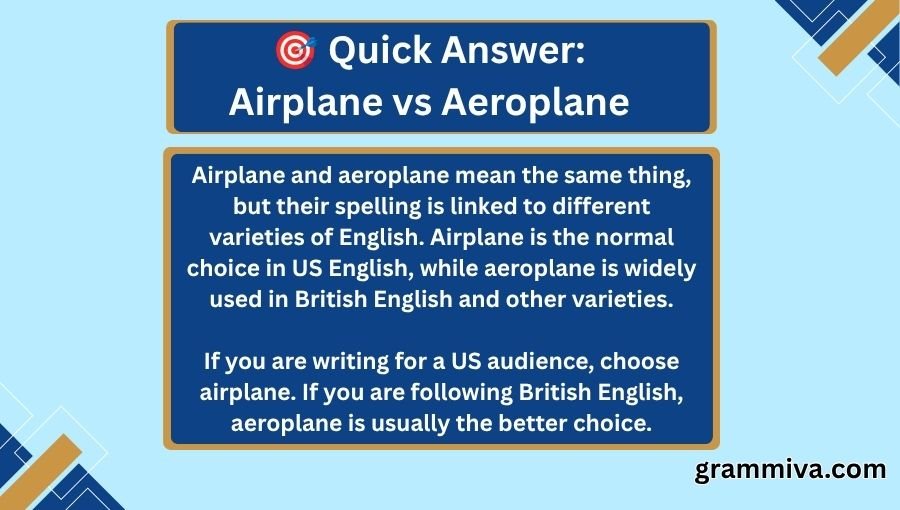
Airplane and aeroplane mean the same thing, but their spelling is linked to different varieties of English. Airplane is the normal choice in US English, while aeroplane is widely used in British English and other varieties.
If you are writing for a US audience, choose airplane. If you are following British English, aeroplane is usually the better choice.
| Word | Common English Variety | Meaning | Example |
|---|---|---|---|
| airplane | US English | A powered aircraft with wings | The airplane landed safely. |
| aeroplane | British English and some other varieties | A powered aircraft with wings | The aeroplane landed safely. |
Is Airplane the Same as Aeroplane?
Yes. Airplane and aeroplane refer to the same type of flying machine. The main difference is spelling and regional preference, not meaning.
Both words describe a powered aircraft that has fixed wings and is designed to fly through the air. The choice between them usually depends on the type of English you are using.
For example:
- ✅ US English: The airplane leaves at 7 p.m.
- ✅ British English: The aeroplane leaves at 7 p.m.
- ❌ US style: The aeroplane leaves at 7 p.m. — not necessarily wrong, but it does not match standard US spelling.
- ❌ British style: The airplane leaves at 7 p.m. — understandable, but it does not match the usual British spelling.
This is a regional spelling difference, much like “center” and “centre.”
Airplane: The US English Form
Airplane is the preferred spelling in standard US English. It is the form you should normally use in American school papers, business writing, websites aimed at US readers, and US news-style content.
Examples include:
- The airplane is ready for boarding.
- We watched the airplane disappear into the clouds.
- She works as an airplane mechanic.
- The airplane arrived twenty minutes early.
Aeroplane: The British English Form
Aeroplane is a common spelling in British English. It is also used in some countries and writing systems influenced by British English.
Examples include:
- The aeroplane is ready for boarding.
- We watched the aeroplane disappear into the clouds.
- He works as an aeroplane engineer.
- The aeroplane arrived early.
Neither spelling changes the basic meaning.
Airplane vs Aeroplane at a Glance
The easiest way to understand airplane vs aeroplane is to compare spelling, region, and style.
| Form | Type | Meaning | Example | Correct/Incorrect |
|---|---|---|---|---|
| airplane | US spelling | Powered aircraft | The airplane took off. | ✅ Correct |
| aeroplane | British spelling | Powered aircraft | The aeroplane took off. | ✅ Correct |
| air plane | Incorrect spacing in standard modern usage | Intended to mean airplane | The air plane took off. | ❌ Incorrect |
| aeroplane | US regional choice | Same meaning | The aeroplane took off. | ⚠️ Understandable, but not standard US style |
| airplane | British regional choice | Same meaning | The airplane took off. | ⚠️ Understandable, but not standard British style |
The key lesson is simple: both main spellings are correct, but your audience determines which one is best.
Why Do People Confuse Airplane and Aeroplane?
People confuse these words because English has developed different spelling habits in different countries. Both versions are familiar, and both can appear in books, news reports, travel materials, and online writing.
The difference is especially easy to miss because the two words sound essentially the same in normal speech.
I once reviewed a student essay about a family trip. The student used “airplane” in one paragraph and “aeroplane” in another. Neither word was wrong by itself. The problem was that the paper was supposed to follow US English throughout. I asked the student to choose one style and stay consistent. That small change made the essay look much more polished.
💡 Test Tip
Ask yourself one question:
Who is going to read this?
- Writing mainly for Americans? Use airplane.
- Writing mainly for British readers? Use aeroplane.
- Following a specific school, company, publication, or style guide? Follow its rules.
- Writing for an international audience? Pick one spelling and use it consistently.
Consistency is often more important than trying to decide which spelling is “more correct.”
Key Differences Between Airplane and Aeroplane
The main difference between airplane and aeroplane is regional spelling. The meaning, basic word class, and general use are the same.
| Feature | Airplane | Aeroplane |
|---|---|---|
| Main US form | Yes | No |
| Common British form | Less common | Yes |
| Part of speech | Noun | Noun |
| Refers to | Powered aircraft | Powered aircraft |
| Meaning changes? | No | No |
| Best choice for US English | Yes | Usually no |
| Best choice for British English | Usually no | Yes |
Noun Use
Both forms are nouns. They name a type of vehicle.
For example:
- ✅ The airplane is waiting on the runway.
- ✅ The aeroplane is waiting on the runway.
The grammatical role is identical.
Compound Words
The spelling can also appear in compounds.
Examples include:
- airplane seat
- airplane ticket
- airplane cabin
- airplane mode
- airplane engine
British English may use related compounds with aeroplane, depending on the term and local usage.
| Expression | US English | British English |
|---|---|---|
| airplane seat | Common | Less common |
| aeroplane seat | Uncommon | Possible |
| airplane mode | Common | Also widely understood |
| airplane ticket | Common | Understood |
| aeroplane ticket | Less common | Possible |
Notice that not every compound has a perfectly neat US-versus-British pair. Some expressions have become common internationally.
Correct Meanings and Uses of Airplane
The word airplane has one central meaning in ordinary modern English: a powered aircraft designed to fly through the air.
1. A Passenger Aircraft
You can use airplane when talking about a passenger flight.
We boarded the airplane at noon.
Here, “airplane” names the aircraft that carries the passengers.
2. A Small Private Aircraft
The word can also describe smaller powered aircraft.
My uncle owns a small airplane.
The exact size does not determine whether the word can be used.
3. An Aircraft in General Conversation
In everyday US English, people often use airplane as a general word for this kind of aircraft.
I have always loved watching airplanes at the airport.
This is natural US English.
| Meaning | Word Type | Example Sentence |
|---|---|---|
| Passenger aircraft | Noun | The airplane is boarding now. |
| Small powered aircraft | Noun | He learned to fly an airplane. |
| Aircraft in everyday speech | Noun | We saw three airplanes overhead. |
Correct Meanings and Uses of Aeroplane
Aeroplane carries the same basic meaning as airplane. The main difference is the spelling preferred by many British English writers.
For example:
The aeroplane flew over the village.
A British English reader would generally understand this as normal spelling.
The word can be used for passenger aircraft, private aircraft, and aircraft in general.
| Meaning | Word Type | Example Sentence |
|---|---|---|
| Passenger aircraft | Noun | The aeroplane is boarding now. |
| Small powered aircraft | Noun | He learned to fly an aeroplane. |
| Aircraft in general | Noun | Several aeroplanes were visible. |
The important point is that you should not treat aeroplane as a different machine. It is a different spelling of the same basic word.
📝 Case Study: Choosing the Right Spelling at Work
Imagine that an American travel company is preparing an email for its customers.
The first draft says:
“Please arrive at the airport two hours before your aeroplane leaves.”
The sentence is understandable. However, if the company uses standard US English, airplane would be the better choice:
“Please arrive at the airport two hours before your airplane leaves.”
Now imagine a British travel company. In that setting, aeroplane may fit the company’s house style better.
The lesson is not “one spelling is good and the other is bad.” The lesson is match your spelling to your English variety and keep it consistent.
| Audience | Preferred Form | Example |
|---|---|---|
| US customers | airplane | Your airplane departs at 8:00 a.m. |
| British customers | aeroplane | Your aeroplane departs at 8:00 a.m. |
| US school assignment | airplane | The airplane crossed the ocean. |
| British school assignment | aeroplane | The aeroplane crossed the ocean. |
Grammar Rules Explanation
Airplane and aeroplane are both nouns. They refer to the same general type of powered aircraft. The spelling difference is mainly based on regional English conventions.
There is no grammar rule saying that one spelling is always correct and the other is always incorrect. Instead, the main rule is regional consistency.
In standard US English, use airplane. In standard British English, aeroplane is commonly preferred.
Most major English dictionaries and style references recognize regional differences in spelling. This is a normal feature of English, not a sign that one group of speakers is using “bad English.”
Correct vs Incorrect at a Glance
| Sentence | Correct/Incorrect | Why |
|---|---|---|
| The airplane landed safely. | ✅ Correct | Standard US spelling |
| The aeroplane landed safely. | ✅ Correct | Standard British spelling |
| The air plane landed safely. | ❌ Incorrect | Standard spelling is normally one word |
| I bought an airplane ticket. | ✅ Correct | Natural US usage |
| I bought an aeroplane ticket. | ✅ Correct | Fits British-style usage |
The “incorrect” example above is different from the regional issue. Air plane is not simply another accepted regional spelling. In standard modern usage, the word is written as one word.
How To Remember the Difference
A simple memory trick can make this spelling choice much easier.
Think of the US spelling as “air + plane”:
air + plane = airplane
The British form keeps the older-looking aero- spelling:
aero + plane = aeroplane
You do not need to memorize a long grammar rule. Just connect the spelling with the variety of English you are using.
| If You Are Writing For… | Remember… | Use |
|---|---|---|
| American readers | US spelling | airplane |
| British readers | British spelling | aeroplane |
| US school or work | American style | airplane |
| British school or work | British style | aeroplane |
| Mixed international audience | Pick a consistent style | Either, depending on style |
⚠️ Common Mistakes With Airplane and Aeroplane
Most errors happen for simple reasons. Writers may switch between US and British English without noticing. Others may copy a spelling from a website, use autocorrect, or type too quickly.
I once caught myself typing “aeroplane” in a US-focused article after reading several British travel pages while researching another topic. I noticed the switch during editing. The word was spelled correctly, but it did not match the article’s chosen style. That is a good reminder that correct spelling and consistent style are two different things.
Common English Confusions
| Confusion | Correct Forms | Main Issue |
|---|---|---|
| it’s / its | it’s, its | Contraction vs possession |
| your / you’re | your, you’re | Possession vs “you are” |
| they’re / their / there | they’re, their, there | Different meanings |
| affect / effect | affect, effect | Different grammatical uses |
| airplane / aeroplane | airplane, aeroplane | Regional spelling |
Specific Airplane and Aeroplane Mistakes
| Wrong Form or Use | What’s Wrong | Correct Form |
|---|---|---|
| air plane | Usually written as two words | airplane / aeroplane |
| AirPlane | Unnecessary internal capital | airplane |
| AIRPLANE | All caps unless required by context | airplane |
| airplane in a British-style paper | Style mismatch | aeroplane |
| aeroplane in a US-style paper | Style mismatch | airplane |
| airplane and aeroplane mixed randomly | Inconsistent regional style | Choose one style |
The last two examples are worth stressing. A regional spelling is not automatically a spelling mistake. It becomes a style problem when it conflicts with the variety of English you have chosen.
Is Airplane More Correct Than Aeroplane?
No. Airplane is not universally more correct than aeroplane. It is the standard choice for US English, while aeroplane is a standard choice in British English and related varieties.
This is similar to several other English spelling differences.
| US English | British English |
|---|---|
| airplane | aeroplane |
| color | colour |
| center | centre |
| theater | theatre |
| traveling | travelling |
The important thing is to know your audience.
If your teacher asks for American English, use airplane. If your editor asks for British English, use aeroplane.
Which Spelling Should You Use in US English?
If your goal is standard US English, choose airplane.
This applies to:
- school assignments
- resumes
- business documents
- American websites
- US-focused blogs
- customer emails
- marketing copy
- general American writing
For example:
- ✅ The airplane arrived at 6:30 p.m.
- ❌ The aeroplane arrived at 6:30 p.m. — not wrong English, but not the normal US spelling.
A consistent American style will make your writing look more natural to US readers.
Which Spelling Should You Use in British English?
For British English, aeroplane is generally the natural choice.
For example:
The aeroplane landed shortly after sunset.
A British reader will usually recognize airplane, too. But if you are deliberately following British spelling conventions, aeroplane is the better fit.
This matters most in formal writing, where a consistent house style makes a document easier to read.
Usage in Different Contexts
The best spelling can depend on the audience and the style guide behind your writing.
| Context | Which Term to Use | Example |
|---|---|---|
| Everyday US conversation | airplane | The airplane was delayed. |
| Professional US writing | airplane | The airplane arrived on schedule. |
| British professional writing | aeroplane | The aeroplane arrived on schedule. |
| Creative writing | Match the setting and narrator | The airplane disappeared into the fog. |
| Social media | Either, depending on audience | Our airplane is finally boarding! |
Everyday Conversation
In US English, airplane is the natural everyday choice.
“What time does your airplane leave?”
In British English, aeroplane may be used instead.
Professional Writing
Professional writing should follow the spelling standard expected by the audience.
A US airline-related report would normally use airplane. A British publication may use aeroplane.
Creative Writing
Creative writers have more freedom. The setting, narrator, and character background can influence spelling.
If your story takes place in the United States and uses US English throughout, airplane will usually feel natural.
Social Media and Texting
Social media is more flexible. People from many countries read the same posts. Either spelling may appear.
Still, if you are building a professional brand, consistency is useful.
Common Phrases With Airplane
There are many everyday phrases that use airplane in US English.
| Phrase | Meaning |
|---|---|
| airplane ticket | A ticket for an airplane trip |
| airplane seat | A seat inside an airplane |
| airplane mode | A device setting that turns off or limits wireless connections |
| airplane cabin | The inside passenger area |
| airplane window | A window in an airplane |
You may also see British versions using aeroplane where that spelling fits the local style.
Not every fixed expression has to change, though. Some terms are influenced by technology, brands, or international usage rather than a simple US-versus-British rule.
What About Aircraft?
Aircraft is a useful alternative when you want a broader term.
Unlike airplane, the word aircraft can refer to different kinds of flying machines. Depending on context, it can include airplanes, helicopters, and other vehicles designed to fly.
For example:
The aircraft landed safely.
That sentence does not tell us exactly what type of aircraft it was.
This makes aircraft useful when the exact type does not matter.
| Alternative | Works When | Does Not Work When |
|---|---|---|
| aircraft | You want a broad technical term | You specifically need to name an airplane |
| plane | Informal everyday writing | Very formal technical writing may need more detail |
| passenger aircraft | You mean an aircraft carrying passengers | You mean a small private airplane |
| jet | You specifically mean a jet-powered aircraft | You mean every kind of airplane |
Is Plane a Good Alternative to Airplane?
Yes. Plane is a common shorter term in everyday US English.
For example:
The plane is boarding.
This is natural and clear.
However, “plane” can be less specific than “airplane.” In most casual situations, that does not matter. In technical writing, precision may matter more.
| Word | Level | Example |
|---|---|---|
| airplane | Standard | The airplane landed. |
| plane | Common and informal | The plane landed. |
| aircraft | Broad or technical | The aircraft landed. |
| jet | More specific | The jet landed. |
Why Does Getting the Spelling Right Matter?
Correct spelling helps readers understand your intended English variety. It also makes professional writing feel more controlled.
A reader will rarely misunderstand airplane versus aeroplane. The meaning is clear either way. But switching between regional styles can make an article, report, or website look poorly edited.
A useful writing rule is:
Choose the English style first, then keep your spelling consistent.
Clarity in Communication
Consistent spelling reduces small distractions. Readers can focus on your message instead of noticing style changes.
Professionalism
A consistent style suggests that your document has been reviewed carefully.
Digital Communication
Websites, newsletters, social posts, and emails often reach international readers. That makes regional spelling choices more visible.
| Situation | Why Getting It Right Matters |
|---|---|
| Resume | Shows careful attention to writing style |
| Client email | Creates a polished impression |
| Published article | Keeps the publication’s style consistent |
| Social post | Makes your chosen audience clear |
The goal is not to impress readers with a particular spelling. The goal is to make your writing feel natural and intentional.
Should You Use Airplane or Aeroplane in SEO Content?
For SEO content, use the spelling that matches your target audience and search intent.
If your page targets US readers, airplane should normally be your primary form. If you target British readers, aeroplane may be more appropriate.
Do not repeat both forms in every paragraph just to capture searches. That can make the writing awkward.
Instead, explain the difference naturally. Search engines and answer systems can understand that airplane and aeroplane are closely related regional forms.
For a US-focused article, a natural approach is:
- Use airplane as the main spelling.
- Mention aeroplane when explaining the British variation.
- Answer the spelling question directly.
- Include examples that show both forms.
- Keep the rest of the article easy to read.
This approach serves readers first.
How Do You Choose Between Airplane and Aeroplane?
Choose based on the variety of English your writing follows.
| Question | If Yes → Use |
|---|---|
| Is the content mainly for Americans? | airplane |
| Is the content mainly for British readers? | aeroplane |
| Does your company use US English? | airplane |
| Does your publication use British English? | aeroplane |
| Are you writing a US school paper? | airplane |
| Are you following a British style guide? | aeroplane |
When the answer is unclear, check the style used by the rest of your document. Look at words such as “color/colour,” “center/centre,” and “organize/organise.” They can show which English variety your document follows.
A Simple Editing Method
When I edit a document, I use a quick three-step check for regional spelling.
- Identify the audience.
- Choose the English variety.
- Search for inconsistent spellings.
For example, if a US article contains “color,” “center,” and “aeroplane,” I would check whether “aeroplane” was intentional. If the article is supposed to use American English, I would normally change it to “airplane.”
This method works beyond this one word.
Airplane vs Aeroplane: A Practical Writing Guide
If you only remember a few rules, remember these:
- Airplane is the standard US spelling.
- Aeroplane is common in British English.
- Both words have the same basic meaning.
- Neither spelling is universally “better.”
- Do not normally write air plane as two words.
- Match the spelling to your audience.
- Keep your regional spelling consistent.
- Follow a required school, workplace, publication, or style guide.
Practice Examples
Example 1
You are writing for an American travel website.
The ______ will begin boarding soon.
Answer: airplane.
The site uses US English.
Example 2
You are writing for a British travel magazine.
The ______ will begin boarding soon.
Answer: aeroplane.
The publication uses British English.
Example 3
You are writing a US school essay but found “aeroplane” in a British book.
You can quote the original spelling if you are quoting directly. In your own US English writing, use airplane.
FAQs About Airplane vs Aeroplane
Is airplane or aeroplane correct?
Both are correct. Airplane is the standard US spelling, while aeroplane is common in British English and some other varieties.
Is airplane American English?
Yes. Airplane is the standard spelling used in US English.
Is aeroplane British English?
Yes. Aeroplane is a common British English spelling for the same type of aircraft.
What is the difference between airplane and aeroplane?
The main difference is regional spelling. Both words have the same basic meaning and refer to a powered aircraft with wings.
Should I use airplane in American English?
Yes. If you are writing standard American English, airplane is normally the preferred spelling.
Should I use aeroplane in British English?
Yes. Aeroplane is generally the natural choice when following British English spelling conventions.
Is “air plane” correct?
Usually, no. In standard modern English, the word is normally written as one word: airplane or aeroplane.
Can I use airplane in British English?
People will understand it, and it may appear in international or mixed-language contexts. However, aeroplane is generally the more traditional British spelling.
Can I use aeroplane in American English?
People will understand it, but airplane is the normal US spelling. For a US-focused document, airplane is the better choice.
Which word is better for SEO, airplane or aeroplane?
Neither is automatically better. Use the spelling that matches your target audience. For US-focused SEO content, airplane is generally the better primary form. For British-focused content, aeroplane may be more suitable.
Quick Recap Checklist ✅
Here is the fastest way to remember the rule:
| Question | If Yes → Use |
|---|---|
| Are you writing standard US English? | airplane |
| Are you writing standard British English? | aeroplane |
| Is your audience mostly American? | airplane |
| Is your audience mostly British? | aeroplane |
| Does your style guide require US spelling? | airplane |
| Does your style guide require British spelling? | aeroplane |
| Are you mixing both forms without a reason? | Choose one and stay consistent |
Three Quick Practice Sentences
- US English: The airplane took off on time. ✅
- British English: The aeroplane took off on time. ✅
- Standard spelling: The airplane took off on time. / The aeroplane took off on time. ❌ Air plane is not the normal spelling.
Is Airplane Always the Best Choice for US Readers?
For standard US English, yes. Airplane is normally the safest and most natural choice.
There can be special cases, such as a direct quotation, a company name, a title, or a source that intentionally preserves another variety of English. In those cases, changing the spelling may alter the original text or style.
Otherwise, American writers should generally choose airplane.
Final Takeaway
Airplane vs aeroplane is a spelling difference, not a difference in the type of aircraft. ✈️ In US English, use airplane. In British English, aeroplane is the common choice. Both forms are understood, and both can be correct when they match the English variety being used.
When I teach this rule, I tell writers not to ask only, “Which spelling is right?” Ask a better question: “Which English style am I writing in?” That question solves the problem quickly.
If your audience is American, write airplane. If your audience is British, aeroplane is usually the natural choice. Most importantly, do not switch between the two without a reason.
Good writing is not just about knowing individual words. It is also about making consistent choices that help readers move smoothly through your message. Keep your audience in mind, choose your spelling, and stick with it.
Choose the right variety, keep your style consistent, and the spelling becomes easy. 🚀

I am Adam Wilson, an English language content writer with an interest in grammar and vocabulary. I work at Grammiva and focus on creating clear explanations and practical examples for English learners.



[…] Let’s break down the difference, look at real examples, and make the rule easy to remember. 🧠 Airplane vs Aeroplane | Color vs Colour | Possession vs […]