Have you ever typed a word, looked at it twice, and suddenly wondered if it looks right? 😅 The spelling of chief vs cheif causes this kind of doubt for many writers because the letters ie and ei can be easy to mix up. The good news is that the answer is simple: one spelling is standard English, while the other is a common spelling mistake.
I work with learners and writers who often know what a word means but still pause when they have to spell it. This is one of those words where a small letter switch can make a sentence look less polished. That matters in school work, emails, resumes, reports, and online posts.
In this guide, I will explain the correct spelling, show how to use the word, explain why the error happens, and give you easy ways to remember it. By the end, you should be able to choose the right form without stopping to think. ✍️ Definite vs Deffinite | Changeable vs Changable | Deceive vs Decieve |
🎯 Quick Answer: Which Spelling Is Correct?
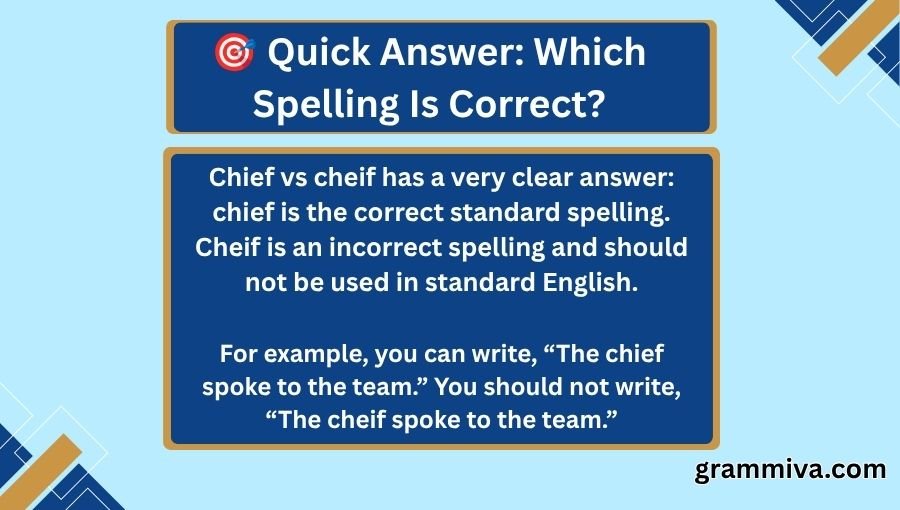
Chief vs cheif has a very clear answer: chief is the correct standard spelling. Cheif is an incorrect spelling and should not be used in standard English.
For example, you can write, “The chief spoke to the team.” You should not write, “The cheif spoke to the team.”
| Spelling | Status | Example |
|---|---|---|
| chief | Correct | The chief gave the order. |
| cheif | Incorrect | The cheif gave the order. |
The word chief can be a noun or an adjective. As a noun, it can mean a leader or person in charge. As an adjective, it can mean most important.
📚 Understanding Chief vs Cheif
When comparing chief vs cheif, the main difference is simple: chief is the correct spelling, while cheif is a common spelling mistake. The main difference is spelling. Chief uses the letter order ie, while cheif incorrectly reverses those letters.
| Form | Type | Meaning | Example | Correct/Incorrect |
|---|---|---|---|---|
| chief | Noun | A leader or person in charge | The chief addressed the group. | ✅ Correct |
| chief | Adjective | Most important | Safety was our chief concern. | ✅ Correct |
| cheif | Noun | Intended as a form of chief | The cheif addressed the group. | ❌ Incorrect |
| cheif | Adjective | Intended as a form of chief | It was our cheif concern. | ❌ Incorrect |
The easiest point to remember is that chief is the standard spelling. If you see cheif in ordinary English writing, treat it as a spelling error.
Why the Letter Order Matters
English has many words that contain ie and ei. That can make spelling patterns hard to remember.
For this particular word, do not rely on a broad rule such as “I before E.” English has many exceptions to simple spelling rules. Instead, remember the word as one complete unit:
chief
Then notice its middle:
ch + ie + f
Not:
ch + ei + f
That small visual check can prevent the mistake.
A Simple Visual Test
When I teach spelling, I often suggest looking at the word rather than trying to recall a complicated rule.
Compare:
- chief → ch + ie + f
- cheif → ch + ei + f
The first one is the standard form.
| Word | Middle Letters | Standard English? |
|---|---|---|
| chief | ie | Yes |
| cheif | ei | No |
| brief | ie | Yes |
| grief | ie | Yes |
| field | ie | Yes |
This does not mean every English word follows the same spelling pattern. It simply gives you a useful visual group for remembering chief.
🎯 Is Chief the Same as Cheif?
No. Chief is the correct English word, while cheif is a misspelling of it.
The two forms are not different words with different meanings. If someone writes cheif, they normally intend to write chief.
Here are some quick examples:
- “She became the chief of the department.” ✅
- “She became the cheif of the department.” ❌
- “That was his chief reason for leaving.” ✅
- “That was his cheif reason for leaving.” ❌
The spelling error does not create a useful new meaning. It simply changes the letters in the word incorrectly.
🧠 Why Do People Confuse Chief and Cheif?
People confuse the two spellings mainly because the letters ie and ei appear in many English words, and they are easy to reverse while writing.
There is also a strong visual reason. When people say chief, they hear the sound of the word but do not hear the order of the letters. Speaking the word correctly does not automatically tell you which letters to type.
A student once wrote cheif several times in a short report. When I asked why, the student said, “It looked right when I typed it.” That is exactly why this mistake can survive proofreading. The wrong version can look familiar even though it is not standard spelling.
The Three Most Common Reasons
| Reason | What Happens | Helpful Fix |
|---|---|---|
| Fast typing | Letters are entered in the wrong order | Slow down for tricky words |
| Autocorrect | Software may not catch every spelling error | Proofread important writing |
| Lack of knowledge | The writer has never learned the standard spelling | Memorize the correct form |
Fast Typing
When people type quickly, they often focus on meaning rather than individual letters. A familiar word can come out with letters in the wrong order.
This is especially common when the wrong spelling still looks believable.
Autocorrect
Autocorrect is helpful, but it is not perfect. A writing program may miss a word if the software does not recognize the error or if the word appears in a name, title, or unusual context.
That is why a final human check still matters.
Lack of Knowledge
Some writers simply have not learned that chief is the standard spelling. Once they see the correct version several times, the problem often disappears.
✍️ Correct Meanings and Uses of Chief
Understanding chief vs cheif also means knowing how the correct word chief works in different sentences. The word chief has several common uses. It can describe a leader, a person with authority, or something that is most important.
Chief as a Noun for a Leader
As a noun, chief can refer to a leader or person who has authority over a group.
Examples:
- “The chief met with the officers.” ✅
- “The cheif met with the officers.” ❌
Here, chief is a noun because it names a person.
Another example is:
- “The fire chief arrived at the station.” ✅
- “The fire cheif arrived at the station.” ❌
The word can appear before another noun as part of a title or job description.
Chief as an Adjective
Chief can also mean most important or main.
For example:
- “Her chief goal was to improve customer service.” ✅
- “Her cheif goal was to improve customer service.” ❌
Here, chief describes the noun goal. It tells us that the goal was the main or most important one.
Chief in Job Titles
You may see chief in professional titles such as:
- chief executive officer
- chief financial officer
- chief editor
- police chief
- fire chief
- chief engineer
The spelling stays chief in all of these expressions.
| Meaning | Word Type | Example Sentence |
|---|---|---|
| Leader | Noun | The chief spoke to the workers. |
| Person in authority | Noun | The police chief held a meeting. |
| Most important | Adjective | Her chief concern was safety. |
| Main reason | Adjective | Cost was the chief reason for the change. |
💡 Test Tip
If you are unsure, stop and type the word slowly:
C-H-I-E-F
Then check the middle letters.
If you wrote C-H-E-I-F, switch the e and i.
That simple check is often faster than trying to remember a long spelling rule.
📝 Case Study: A Workplace Email
This chief vs cheif example shows how a small spelling mistake can affect professional writing. Imagine that a manager is sending this email:
“Please send the report to the department chief before Friday.”
That sentence is correct. The writer is referring to a person who leads or has authority in the department.
Now imagine this version:
“Please send the report to the department cheif before Friday.”
The meaning is still easy to understand, but the spelling is wrong. In a workplace email, that small error can make the message look less polished.
I once caught myself typing cheif while editing a document. I knew the word well, but my fingers put the letters in the wrong order. I fixed it immediately, then added the word to my personal proofreading list. Even experienced writers can make small typing errors.
| Workplace Situation | Better Version | Why |
|---|---|---|
| Job title | Chief Executive Officer | Standard spelling |
| Department leader | Department chief | Clear and correct |
| Main concern | Chief concern | Correct adjective |
| Formal report | The chief approved the plan. | Professional and accurate |
📏 Grammar Rules Explanation
The grammar rule for chief vs cheif is straightforward: chief is the standard English spelling, while cheif is incorrect. The standard spelling is chief. It is a regular English word that can function as a noun or adjective depending on how it is used in a sentence.
The spelling cheif is not the standard form of this word. In normal English writing, it should be corrected to chief.
The word can act as a noun when it names a leader or person in charge:
“The chief spoke first.”
It can act as an adjective when it describes something as the main or most important:
“Safety was the chief concern.”
The grammatical role changes, but the spelling does not.
A useful spelling strategy is to memorize the exact sequence ie in chief rather than depending on a general “i before e” rule. English spelling has enough exceptions that a single broad rule cannot safely handle every word.
Most standard dictionaries and professional writing references list chief as the standard form. For formal writing, use chief.
Correct vs Incorrect at a Glance
| Sentence | Correct/Incorrect | Why |
|---|---|---|
| The chief called a meeting. | ✅ Correct | Chief is correctly spelled. |
| The cheif called a meeting. | ❌ Incorrect | The letters ie were reversed. |
| Safety is our chief concern. | ✅ Correct | Chief means most important here. |
| Safety is our cheif concern. | ❌ Incorrect | Cheif is a misspelling. |
| The fire chief arrived early. | ✅ Correct | The job title uses chief. |
⚠️ Common Mistakes With Chief
The most common mistake is simple: switching ie to ei.
Writers can also make errors by adding extra letters, removing letters, or assuming that a spelling checker will always catch the problem.
Here are some related spelling confusions:
| Confusion | Correct Form | Common Wrong Form | Why It Happens |
|---|---|---|---|
| chief | chief | cheif | Letter order |
| believe | believe | beleive | Letter order |
| receive | receive | recieve | Letter order |
| their | their | thier | Letter order |
| friend | friend | freind | Letter order |
These examples show why letter order can be difficult. A writer may know the word but still place two letters in the wrong sequence.
Common Wrong Spellings and Uses
| Wrong Form | What’s Wrong | Correct Form |
|---|---|---|
| cheif | ei is used instead of ie | chief |
| cheif officer | Misspelled job title | chief officer |
| police cheif | Misspelled noun | police chief |
| cheif concern | Misspelled adjective | chief concern |
| cheif reason | Misspelled adjective | chief reason |
| fire cheif | Misspelled job title | fire chief |
A good proofreading habit is to search your document for cheif before you submit it. If the search finds the word, replace it with chief unless it is intentionally part of a special name or quotation.
📖 Word History and Spelling Development
The history of chief vs cheif is mainly useful for understanding why the modern spelling of chief may not seem obvious at first. The history of chief helps explain why its spelling may look less predictable than some modern English words. The word entered English through older forms of French and ultimately traces back to a Latin word connected with the idea of a head or leader.
Over time, its spelling settled into the modern English form chief. The important lesson for modern writers is not the exact historical path but the spelling that standard English uses today.
| Period | Form | Note |
|---|---|---|
| Earlier Latin | caput-related form | Connected with the idea of a head or leader |
| Old French | chef | Used for a head or leader |
| Middle English | chief and related forms | English spelling developed over time |
| Modern English | chief | Standard spelling today |
The spelling history is also a reminder that English does not always spell words exactly as they sound. That is one reason memorizing a few tricky words can be useful.
🌎 Usage in Different Contexts
Chief works in everyday conversation, professional writing, creative writing, and digital Knowing chief vs cheif helps you use the correct spelling in everyday, professional, creative, and online writing. communication. The context may change, but the standard spelling remains the same.
| Context | Which Term to Use | Example |
|---|---|---|
| Everyday conversation | chief | The chief is coming to the meeting. |
| Professional writing | chief | The chief financial officer reviewed the report. |
| Creative writing | chief | The village chief watched from the doorway. |
| Social media/texting | chief | The chief just shared the update. |
Everyday Conversation
You may hear chief when people discuss leaders, departments, or people in charge.
For example:
“The police chief spoke with reporters.”
Professional Writing
In business and formal writing, chief appears often in job titles and descriptions.
Examples include:
- chief executive officer
- chief operating officer
- chief editor
- chief engineer
Because professional writing represents you or your organization, spelling the word correctly is especially useful.
Creative Writing
Authors may use chief when describing a leader in a story.
For example:
“The village chief stood near the gate.”
The word can fit modern or historical settings.
Social Media and Texting
Informal writing may contain more spelling mistakes, but chief is still the correct spelling.
Even when a message is casual, using the correct form makes your writing easier to trust.
💬 Common Phrases With Chief
The word chief appears in several common phrases and job titles. Learning these groups can help you remember the spelling.
| Phrase | Meaning |
|---|---|
| chief concern | The most important concern |
| chief reason | The main reason |
| chief executive officer | The top executive in an organization |
| police chief | The leader of a police department |
| fire chief | The leader of a fire department |
| chief goal | The main or most important goal |
Notice that every phrase uses chief, never cheif.
If you memorize the full phrase chief concern, for example, you are also practicing the correct spelling of the individual word.
🔄 Synonyms and Alternatives for Chief
Depending on the sentence, you can sometimes replace chief with another word. However, the replacement may not work in every context.
For example, main can replace chief when chief means most important. But you cannot normally replace a job title such as police chief with main.
| Alternative | Works When | Does Not Work When |
|---|---|---|
| main | Chief means most important | Referring to a specific leader |
| primary | Chief means first or most important | Used as a formal job title |
| leading | Describing a top position | Referring to every use of chief |
| head | Chief means person in charge | The sentence requires the formal title |
| principal | Chief means main or most important | Casual uses may sound too formal |
For example:
“Safety was the chief concern.”
can become:
“Safety was the main concern.”
But:
“The police chief spoke.”
cannot simply become:
“The police main spoke.”
This is why learning the meaning and spelling together is useful.
🏆 Why Getting Chief Right Matters
Getting chief vs cheif right matters because correct spelling makes your writing clearer and more professional. Correct spelling helps readers understand your message without distractions. A one-letter mistake may seem small, but repeated errors can affect how polished your writing appears.
A useful principle is:
Clear writing earns trust one small choice at a time.
That does not mean every typo is a serious problem. People make mistakes. The goal is to build habits that reduce avoidable errors.
| Situation | Why Getting It Right Matters |
|---|---|
| Resume | Shows care and attention to detail |
| Client email | Creates a professional impression |
| Published content | Protects clarity and credibility |
| Social post | Makes the message easier to read |
Clarity in Communication
The correct spelling lets readers move through your sentence without stopping to wonder whether a word is intentional.
Professionalism
A spelling error in an important email may distract from the message. Correct spelling supports a clean and professional tone.
Digital Communication
Messages are often read quickly on phones and computers. A familiar word such as chief should be easy for the reader to recognize.
🧩 How To Remember the Difference
The best way to remember the spelling is to focus on the exact middle of the word.
chief = IE
You can use a short memory phrase:
“The chief has IE.”
Or picture the word in two parts:
CH + IEF
Then compare it with the wrong version:
CH + EIF
The correct version has I before E in this word.
Another useful trick is to connect chief with words such as brief, grief, and belief. These words can help reinforce the visual pattern, even though English has many other spelling patterns.
| Memory Method | Example | Benefit |
|---|---|---|
| Visual pattern | ch + ie + f | Shows the correct letter order |
| Short phrase | “The chief has IE.” | Easy to repeat |
| Word family practice | chief, brief, grief | Builds visual memory |
| Proofreading search | Search for “cheif” | Finds errors quickly |
❓ Does Chief Always Mean a Leader?
No. Chief can mean a leader when it is a noun, but it can also mean the main or most important thing when it is an adjective.
Compare:
“The chief spoke to the group.”
Here, chief means a leader.
“Her chief concern was safety.”
Here, chief means most important.
| Sentence | Meaning of Chief |
|---|---|
| The chief spoke to us. | Leader |
| The chief approved the plan. | Person in charge |
| Safety was the chief concern. | Most important |
| Cost was the chief reason. | Main |
This distinction is useful because it shows that chief has more than one common grammatical role.
❓ Can Cheif Ever Be Correct?
In standard English, cheif is normally not correct. It is generally a misspelling of chief.
If you encounter cheif in ordinary writing, the safe correction is chief.
The only reason you might leave the unusual spelling unchanged is if it is deliberately being reproduced as part of a specific name, quotation, username, fictional spelling, or other special text. In normal writing, however, use chief.
❓ How Can You Check the Spelling of Chief?
You can check the spelling by looking at the middle letters. The correct form is chief, with ie.
A quick check is:
C-H-I-E-F
If your version contains ei in the middle, change it.
For important documents, you can also use a trusted dictionary or writing tool. Do not depend entirely on automatic correction, because software can miss errors.
❓ Is Chief a Noun or an Adjective?
It can be either one.
As a noun, chief can refer to a leader or person in charge:
“The chief called the meeting.”
As an adjective, chief can mean main or most important:
“That was the chief reason.”
The word’s role depends on how it functions in the sentence.
❓ Why Is Chief Spelled With IE?
The modern English spelling of chief developed through the history of the word and became established in its present form. For modern learners, the most useful point is simply that standard English spells it chief, not cheif.
It is better to memorize the standard spelling than to depend on a single spelling rule for every word containing ie or ei.
❓ What Is the Correct Spelling of Police Chief?
The correct phrase is police chief.
For example:
“The police chief spoke at the meeting.” ✅
Not:
“The police cheif spoke at the meeting.” ❌
The word chief remains unchanged when it appears in this job title.
❓ What Is the Correct Spelling of Chief Executive Officer?
The correct spelling is chief executive officer.
For example:
“The chief executive officer approved the plan.” ✅
The word chief uses ie, just as it does when used by itself.
❓ Is Cheif a Word?
Cheif is generally not the standard English spelling of a word. In ordinary writing, it should be treated as a misspelling of chief.
If you are writing a report, essay, email, resume, or article, use chief.
❓ What Is an Easy Way to Remember Chief?
Remember the middle letters:
chief = ie
A simple memory sentence is:
“The chief has IE.”
Then check the word before you submit important writing.
❓ Which Is Correct: Chief Concern or Cheif Concern?
Chief concern is correct.
It means the main or most important concern.
Example:
“Customer safety is our chief concern.” ✅
The spelling cheif concern is incorrect.
❓ Which Is Correct: Chief Reason or Cheif Reason?
Chief reason is correct.
It means the main or most important reason.
Example:
“Cost was the chief reason for the change.” ✅
The form cheif reason is a spelling error.
❓ Which Is Correct: Chief or Cheif in a Resume?
Use chief. Resumes often include formal job titles, so correct spelling is especially important.
For example:
Chief Financial Officer
or
Assistant to the Police Chief
Both use the standard spelling chief.
✅ Quick Recap Checklist
Use this checklist whenever you are unsure about the spelling.
| Question | If Yes → Use |
|---|---|
| Are you writing about a leader or person in charge? | chief |
| Do you mean main or most important? | chief |
| Are you writing a job title such as police chief? | chief |
| Did you type “cheif”? | Change it to chief |
| Are you proofreading a formal document? | Check for cheif |
Practice Examples
- The chief reviewed the report.
- Safety was our chief concern.
- The fire chief spoke to the team.
Try covering the answers and filling them in yourself. The goal is to make chief feel familiar enough that you no longer have to stop and think.
🔍 Chief vs Cheif at a Glance
The whole issue can be reduced to one simple spelling choice.
| Point | Chief | Cheif |
|---|---|---|
| Standard spelling | Yes | No |
| Can mean a leader | Yes | No |
| Can mean most important | Yes | No |
| Used in job titles | Yes | No |
| Suitable for formal writing | Yes | No |
| Correct letter order | ie | ei |
If you remember only one thing from this guide, remember this:
Chief is correct. Cheif is incorrect.
🎯 Final Rule for Chief vs Cheif
The correct spelling is chief, and the incorrect form cheif should normally be avoided. The key difference is the order of the two middle vowels: chief contains ie, while cheif contains the letters in the wrong order.
I recommend learning the word as a whole rather than trying to force it into a general spelling rule. When you write it, pause for a second and picture CH-I-E-F. That tiny habit can prevent a surprisingly common mistake.
Remember that chief can describe a leader, such as a police chief or fire chief. It can also describe something that is most important, as in chief concern or chief reason.
A spelling mistake does not always ruin a message, but correcting easy errors makes your writing cleaner and more confident. ✨
So when the choice appears, keep it simple: chief is the chief choice.

I am Ryan Mitchell, a writer focused on English grammar, vocabulary, and everyday language. I work at Grammiva, creating easy-to-understand articles that help readers improve their English with confidence.

[…] you learn that connection, definitely vs definatley becomes much easier to handle. 🎯 Chief vs Cheif | Definite vs Deffinite | Changeable vs […]