Have you ever typed a word, looked at it, and suddenly wondered, “Wait, does that spelling look right?” 😅 changeable vs changable is one of those spelling questions that can make even careful writers stop for a second. The two forms look almost identical, but there is a clear answer: changeable is the standard English spelling, while changable is an incorrect spelling in standard US English.
I have seen this mistake in school assignments, work emails, website copy, and quick online posts. The reason is easy to understand. The word change does not seem to need an extra letter when we add -able. Yet English spelling does not always work by simply joining two pieces together.
In this guide, I will explain the difference in plain English. You will learn why changeable is correct, why changable is wrong, how to remember the spelling, and how to use the word in real sentences. 🎯 By the end, the correct form should feel natural. Deceive vs Decieve | Cemetery vs Cemetary | Coolly vs Cooly
🎯 Quick Answer: Changeable vs Changable
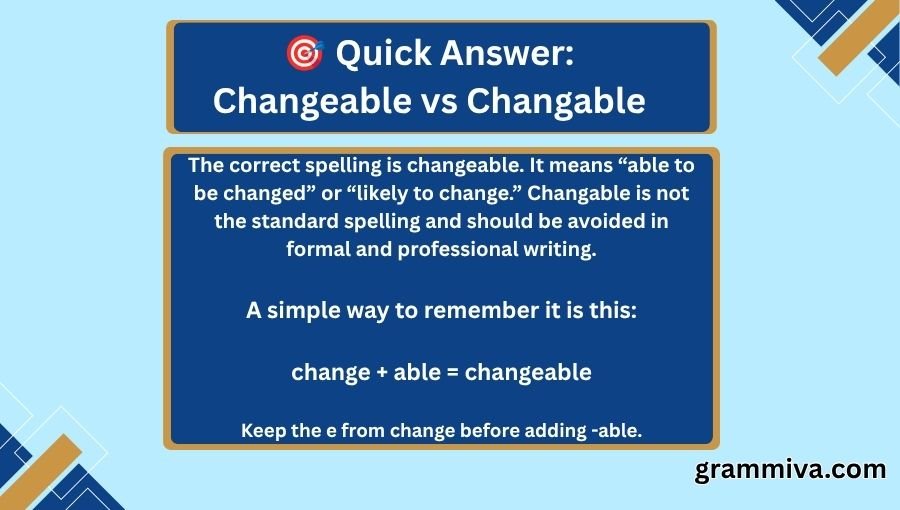
The correct spelling is changeable. It means “able to be changed” or “likely to change.” Changable is not the standard spelling and should be avoided in formal and professional writing.
A simple way to remember it is this:
change + able = changeable
Keep the e from change before adding -able.
🔤 Related Word Forms of Changeable
The word changeable has several useful related forms. These forms are not interchangeable, so learning them together can make your writing more accurate.
| Form | Type | Example |
|---|---|---|
| change | Verb/noun | We may change the plan. |
| changes | Verb/noun | The schedule changes often. |
| changed | Past tense/past participle | The policy was changed. |
| changing | Present participle/gerund | The weather is changing. |
| changeable | Adjective | The weather is changeable. |
| unchangeable | Adjective | The rule is unchangeable. |
Notice that changeable keeps the spelling of change. The final e stays in place.
🎯 Is Changeable the Correct Spelling?
Yes. Changeable is the correct standard spelling. It is an adjective that describes something that can change or something that often changes.
For example:
- The weather is changeable.
- The schedule is changeable.
- Her mood can be changeable.
- The price is changeable.
The incorrect form is:
- ❌ The weather is changable.
The correct version is:
- ✅ The weather is changeable.
The extra e is easy to overlook. That is why this word causes so many spelling errors.
📚 Understanding Changeable vs Changable
The core difference is spelling, not meaning. Changeable is the accepted standard form. Changable is a misspelling.
Here is the difference at a glance:
| Form | Type | Meaning | Example | Correct/Incorrect |
|---|---|---|---|---|
| changeable | Adjective | Able or likely to change | The weather is changeable. | ✅ Correct |
| changable | Intended adjective | Intended to mean able to change | The weather is changable. | ❌ Incorrect |
| change | Verb/noun | To make or become different; an alteration | We need to change the date. | ✅ Correct |
| changing | Verb form/adjective | Becoming different | The situation is changing. | ✅ Correct |
| unchanged | Adjective | Not altered | The price remains unchanged. | ✅ Correct |
The important point is that changable is not a second version of changeable. It is simply a spelling error.
Why the spelling feels confusing
When you see change, you may naturally think:
change + able → changable
That looks logical at first. But the standard spelling is:
change + able → changeable
The e remains.
This pattern is worth remembering because English has many words whose spelling does not behave exactly as a quick sound-based guess might suggest.
🧩 Why Do People Confuse Changeable and Changable?
People confuse these forms because the pronunciation can make the spelling hard to predict. When we say the word aloud, the final e in change does not stand out as a separate sound.
There is another problem: writers often spell by sound. If the spoken word sounds close to “change-uh-bul,” the spelling changable may seem reasonable.
I once edited a short business report in which the writer used changable three times. The writer knew the word perfectly well and understood its meaning. The problem was simply that the spelling had been guessed from the sound.
The role of fast typing
Typing quickly makes this error even more likely. Your brain may recognize the word while your fingers skip a letter.
The role of autocorrect
Autocorrect can help, but it is not perfect. Some software may flag an unfamiliar spelling, while other tools may not catch every mistake in a draft.
The role of memory
If you have seen changable online several times, your brain may start treating it as familiar. Familiarity does not make a spelling correct.
| Reason | What Happens | Helpful Fix |
|---|---|---|
| Fast typing | A letter gets skipped | Slow down during proofreading |
| Sound-based spelling | You write what you hear | Check the written form |
| Autocorrect | A tool may miss the error | Proofread manually |
| Limited exposure | The correct form is unfamiliar | Read more edited English |
| Visual confusion | Both forms look similar | Memorize the extra e |
A simple memory trick
Think of the word as:
CHANGE + ABLE
Do not remove the e.
That gives you:
CHANGEABLE ✅
Not:
CHANGABLE ❌
✍️ Changeable: Meaning and Correct Use
Changeable is an adjective. It describes something that can be changed or something that is likely to change.
The word can describe plans, conditions, moods, prices, opinions, settings, and many other things.
Use 1: Something that can be changed
A changeable thing is not fixed.
For example:
The meeting date is changeable.
This means the meeting date can be changed.
Another example:
The settings are changeable.
This means someone can alter the settings.
Use 2: Something that changes often
The word can also describe something that does not stay the same for long.
For example:
Spring weather can be changeable.
This means the weather may shift from one condition to another.
Use 3: A person or attitude that changes often
Changeable can also describe a person’s mood, opinion, or behavior.
For example:
His mood is quite changeable.
This tells the reader that his mood can shift frequently.
Here is a quick summary:
| Meaning | Word Type | Example Sentence |
|---|---|---|
| Able to be changed | Adjective | The appointment is changeable. |
| Likely to change | Adjective | The weather is changeable. |
| Frequently shifting | Adjective | Her opinions can be changeable. |
💡 How Can You Test the Spelling?
Use the base-word test.
First, identify the base word:
change
Then add:
able
Now put them together:
change + able = changeable
If you remove the e, you get changable, which is not the standard spelling.
💡 Test Tip: If you are unsure while writing, type changeable and check whether your spelling still shows the complete word change at the beginning.
Another useful trick is to say:
“I can change it, so it is changeable.”
The word change stays visible inside changeable.
📝 Changeable vs Changable in a Real-Life Case Study
Imagine that a manager sends this message to a team:
“The project deadline is changable depending on client feedback.”
The meaning is clear. Everyone understands the intended message. However, the spelling is still wrong.
The corrected version is:
“The project deadline is changeable depending on client feedback.”
That small correction matters in a professional setting. A typo does not always cause confusion, but repeated spelling errors can make a document look less polished.
I once caught myself typing changable in a quick note. I had written the sentence almost automatically. When I reread it, the missing e stood out. Since then, I have used the base-word test whenever I hesitate over this spelling.
The lesson is simple: understanding the meaning is not enough. You also need the standard written form.
📖 Grammar Rules Explanation
The standard adjective is changeable. It is formed from the word change with the suffix -able. In this spelling, the final e is retained.
The form changable does not follow the standard spelling used in formal English. It should therefore be treated as an error rather than as an alternative spelling.
This is a spelling rule rather than a difference in grammatical meaning. Both forms may be intended to express the same idea, but only one is standard.
Most major English dictionaries and standard writing references use changeable as the accepted spelling.
A useful point is that adding a suffix does not always mean that every letter at the end of the base word must disappear. Writers should learn the established spelling of the resulting word rather than rely only on a general suffix rule.
Correct vs Incorrect at a Glance
| Sentence | Correct/Incorrect | Why |
|---|---|---|
| The schedule is changeable. | ✅ Correct | Changeable is the standard spelling. |
| The schedule is changable. | ❌ Incorrect | The final e has been incorrectly removed. |
| The weather is changeable today. | ✅ Correct | The adjective is spelled changeable. |
| Our plans are changable. | ❌ Incorrect | Changable is a misspelling. |
| The price may be changeable after the review. | ✅ Correct | The standard adjective is used correctly. |
The key rule is short:
Always spell the adjective as changeable, with the e after g.
⚠️ Common Mistakes With Changeable
The most common mistake is simply leaving out the e.
Writers may also confuse this word with related forms such as changed and changing. Those words are correct, but they do different jobs in a sentence.
| Confusion | Correct Form | Example |
|---|---|---|
| it’s / its | its | The company changed its policy. |
| your / you’re | you’re | You’re right about the spelling. |
| their / there / they’re | their | Their plans are changeable. |
| affect / effect | effect | The change had an effect. |
| then / than | than | This option is better than that one. |
These mistakes have something in common. The wrong form often looks or sounds very close to the correct one.
Why these errors happen
Fast typing: You may know the word but skip a letter.
Autocorrect: A writing tool may not always identify the mistake.
Lack of knowledge: If you have never learned the correct spelling, the wrong version may seem natural.
Visual familiarity: Seeing an incorrect form repeatedly can make it look normal.
Specific spelling mistakes to avoid
| Wrong Form | What’s Wrong | Correct Form |
|---|---|---|
| changable | Missing the e | changeable |
| changeble | Missing a | changeable |
| changeabel | Letters are in the wrong order | changeable |
| changible | Incorrect spelling pattern | changeable |
| changeible | Incorrect letter sequence | changeable |
| changeablee | Extra e at the end | changeable |
Only changeable should be used as the standard spelling in ordinary US English.
🌎 Changeable vs Changable in Different Contexts
The correct spelling stays the same regardless of where you use it. Whether you are writing an email, a story, or a social post, use changeable.
Everyday conversation
You might say:
“The weather is really changeable this week.”
This sounds natural and clear.
Professional writing
In business writing, the word may describe a plan, price, schedule, deadline, or policy.
“The delivery date is changeable if the supplier reports a delay.”
Creative writing
Authors can use the word to describe people, emotions, weather, or settings.
“The sky was changeable, shifting from bright blue to gray.”
Social media and texting
Informal writing still benefits from correct spelling.
“Spring weather is so changeable! 🌦️”
| Context | Which Term to Use | Example |
|---|---|---|
| Everyday conversation | changeable | The weather is changeable. |
| Professional writing | changeable | The deadline is changeable. |
| Creative writing | changeable | Her mood was changeable. |
| Social media/texting | changeable | This weather is so changeable! |
The setting does not make changable correct. Informal writing may contain slang and shortcuts, but standard spelling remains changeable.
💬 Common Phrases With Changeable
There are no major idioms built around changeable, but the adjective commonly appears with certain nouns.
| Phrase | Meaning |
|---|---|
| changeable weather | Weather that can shift often |
| changeable conditions | Conditions that may become different |
| changeable plans | Plans that can be altered |
| changeable schedule | A schedule that can be adjusted |
| changeable mood | A mood that shifts easily |
| changeable settings | Settings that can be altered |
These phrases are useful because they show how the word naturally works in everyday English.
For example:
“The hiking trip may be difficult because of the changeable weather.”
Or:
“Our schedule is changeable, so we can move the meeting if needed.”
🔄 Synonyms and Alternatives to Changeable
Sometimes you can replace changeable with another word. The best choice depends on the exact meaning.
| Alternative | Works When | Does Not Work When |
|---|---|---|
| flexible | Something can be adjusted | You mean something changes unpredictably |
| variable | Something differs or shifts | You need a very casual tone |
| adjustable | Something can be altered by choice | You mean a person’s mood changes |
| shifting | Something is actively changing | You mean a fixed item that can be changed |
| unstable | Something changes in an unwanted or uncertain way | You simply mean that changes are allowed |
For example, a flexible schedule means the schedule can be adjusted. A changeable mood means the mood can shift.
The words overlap, but they are not always exact substitutes.
🎯 Key Differences Between Changeable and Changable
There is only one important distinction between the two forms: changeable is correct, while changable is incorrect in standard English.
| Feature | Changeable | Changable |
|---|---|---|
| Standard spelling | Yes | No |
| Uses the word change | Yes | No |
| Standard US English | Yes | No |
| Suitable for formal writing | Yes | No |
| Meaning | Able or likely to change | Intended to have the same meaning, but misspelled |
Do not treat these as two accepted spellings with slightly different meanings. They are not.
❓ Is Changable Ever Correct?
No, not as the standard spelling of the adjective meaning “able to be changed” or “likely to change.”
You may encounter changable online, in old user-generated text, or in unedited material. Seeing it does not make it an accepted alternative.
When writing an essay, email, report, resume, article, or school assignment, use changeable.
🧠 How To Remember the Difference
The easiest memory trick is to protect the base word.
Look at:
CHANGE
Now add:
ABLE
Together:
CHANGEABLE
You can also remember this sentence:
“If it can change, it is changeable.”
The word change remains intact.
A second memory trick
Picture the spelling in two parts:
CHANGE | ABLE
The vertical line is only a memory aid. It reminds you not to delete the final e.
A third memory trick
Compare these:
- change → changeable ✅
- chang → changable ❌
The first one keeps the complete base word. That is the spelling you want.
📌 Why Changeable vs Changable Matters
A single missing letter may seem minor. In a casual text, someone may understand you anyway. But accurate spelling matters when your writing represents you.
| Situation | Why Getting It Right Matters |
|---|---|
| Resume | Shows care and attention to detail |
| Client email | Creates a polished professional impression |
| Published content | Protects the quality of the writing |
| Social post | Makes the message easier to trust and read |
A spelling mistake does not define a writer’s skill. Everyone makes occasional errors. Still, fixing common mistakes is a simple way to make your writing stronger.
A useful rule I tell students is:
“Clear writing starts with small details.”
That applies especially when a word is easy to misspell.
❓ Does Changeable Mean the Same as Flexible?
Not always. Changeable means something can change or may change. Flexible often means something can be adjusted easily.
For example:
The meeting time is changeable.
This says the time can change.
The meeting schedule is flexible.
This suggests there is room to adjust the schedule.
The words can overlap, but they carry slightly different ideas.
❓ Is Changeable an Adjective?
Yes. Changeable is an adjective because it describes a noun.
Examples include:
- changeable weather
- changeable plans
- changeable conditions
- changeable moods
In the sentence “The weather is changeable,” the adjective describes weather.
❓ How Do You Spell Changeable Correctly?
Spell it:
C-H-A-N-G-E-A-B-L-E
The most important detail is the e after g.
Correct:
changeable ✅
Incorrect:
changable ❌
If you are unsure, write the base word change first. Then add able.
❓ Why Is Changable Wrong?
Changable is wrong because it drops the final e from the standard spelling of change when forming the adjective.
The accepted spelling is changeable.
This is a spelling issue, not a difference in meaning.
❓ Can I Use Changeable in Formal Writing?
Yes. Changeable is appropriate in formal, academic, business, and professional writing when its meaning fits the sentence.
For example:
“The policy contains several changeable conditions.”
However, choose a more precise word when another option better expresses your meaning.
For instance, adjustable may be better when you mean something can be deliberately set to a different level.
❓ Is Changeable Used in American English?
Yes. Changeable is standard in US English.
It can appear in everyday speech, professional writing, educational writing, journalism, and creative work.
The spelling does not become changable in American English.
❓ What Is the Difference Between Change, Changed, Changing, and Changeable?
These forms have different grammatical jobs.
| Word | Main Role | Example |
|---|---|---|
| change | Verb or noun | We need to change the plan. |
| changed | Past form/adjective | The plan changed yesterday. |
| changing | Present participle/gerund | The plan is changing. |
| changeable | Adjective | The plan is changeable. |
The simplest distinction is this:
change tells us about the act or idea of changing.
changed tells us something became different.
changing tells us something is becoming different.
changeable tells us something can or may change.
❓ Should I Write Changable in Informal Texts?
No. If you want to spell the adjective correctly, write changeable even in informal communication.
You can use shorter or casual language in a text message, but there is no need to use a misspelling.
For example:
“The schedule is changeable.”
is correct in both formal and casual writing.
❓ How Can I Stop Making This Spelling Mistake?
Use one repeatable habit: protect the base word.
When you hesitate, write:
change + able
Then check the result:
changeable
You can also add the word to a personal spelling list if you often use it. After seeing and writing the correct form several times, it becomes easier to recognize.
❓ What Is the Fastest Way To Check Changeable vs Changable?
Look for the e after g.
If you see:
changeable → ✅ Correct
If you see:
changable → ❌ Incorrect
That is the fastest check.
❓ Can Changeable Describe a Person?
Yes. It can describe a person’s mood, opinion, attitude, or behavior when that quality can shift.
For example:
“Her mood is changeable.”
This means her mood can change frequently.
Use the word carefully, though. If you simply mean that someone is willing to adapt, flexible or adaptable may be a better choice.
❓ What Is the Best Example of Changeable?
A very simple example is:
“The weather is changeable.”
It clearly shows the basic meaning. The weather can move from sunny to cloudy, warm to cool, or dry to wet.
Another useful example is:
“The meeting time is changeable.”
Here, the meaning is that the time can be altered.
❓ What Should I Remember About Changeable vs Changable?
Remember just three points:
- Changeable is correct.
- Changable is a misspelling.
- Keep the e in change before adding -able.
If you remember those three facts, you will avoid the most common error.
✅ Quick Recap Checklist
Use this quick check whenever you are unsure.
| Question | If Yes → Use |
|---|---|
| Do I mean “able to change”? | changeable |
| Do I mean “likely to change”? | changeable |
| Am I describing weather, plans, moods, or conditions? | changeable |
| Did I write “changable”? | Change it to changeable |
| Am I keeping the e in “change”? | changeable |
Practice examples
- The weather is changeable in spring.
- Our travel plans are changeable.
- The price is changeable until the final agreement.
Try covering the answers and spelling the word yourself. The goal is to make the correct form automatic.
🏁 Final Practice: Correct or Incorrect?
| Sentence | Answer |
|---|---|
| The weather is changeable. | ✅ Correct |
| The weather is changable. | ❌ Incorrect |
| The deadline is changeable. | ✅ Correct |
| Her mood is changable. | ❌ Incorrect |
| The settings are changeable. | ✅ Correct |
The pattern should now be easy to spot.
FAQs About Changeable vs Changable
Is changeable spelled with an e?
Yes. The correct spelling is changeable, with an e after the g.
Is changable a word?
Changable is not the standard spelling of the adjective. Use changeable instead.
Which is correct, changeable or changable?
Changeable is correct. Changable is a misspelling.
What does changeable mean?
Changeable means able to be changed or likely to change. It can describe things such as weather, plans, conditions, moods, and settings.
How do you remember the spelling of changeable?
Remember change + able = changeable. Keep the e from change.
Is changeable an adjective?
Yes. It is an adjective that describes something that can change or may change.
Can I use changeable in a business email?
Yes. It is perfectly suitable for professional writing when it accurately describes something that can or may change.
Is changeable the same as flexible?
Not exactly. The words can overlap, but flexible often suggests that something can be adjusted easily, while changeable focuses on the ability or tendency to change.
Why do people spell changeable as changable?
The error often comes from fast typing, spelling by sound, or assuming that the final e in change should disappear before -able.
What is the easiest way to check changeable vs changable?
Look for the e after g. Changeable is correct; changable is incorrect.
🌟 Conclusion: Changeable vs Changable Made Simple
Changeable vs changable has a very simple answer: changeable is the correct spelling, and changable is a misspelling. The key is to keep the e in the base word change when you form changeable.
I recommend remembering the word as two visible parts: change + able. That small memory trick can prevent the most common error. Use changeable when you mean something can be changed, may change, or tends to change. You can use it for weather, plans, schedules, settings, moods, opinions, and many other things.
Good spelling is not about never making a mistake. It is about noticing common trouble spots and building simple habits that catch them. ✨ Once you train yourself to look for the e, this word becomes much easier.
So the next time you pause over the spelling, do not guess from the sound. Think of the base word.
CHANGE + ABLE = CHANGEABLE.
Keep the e, trust the rule, and write with confidence. 🚀

I am Alex Morgan, an English grammar and vocabulary writer passionate about making language learning simple and useful. I work at Grammiva, where I create clear educational content and practical English examples for learners.
[…] spell definite correctly?” By the end, you should feel confident every time you write it. ✍️ Changeable vs Changable | Deceive vs Decieve | Cemetery vs […]