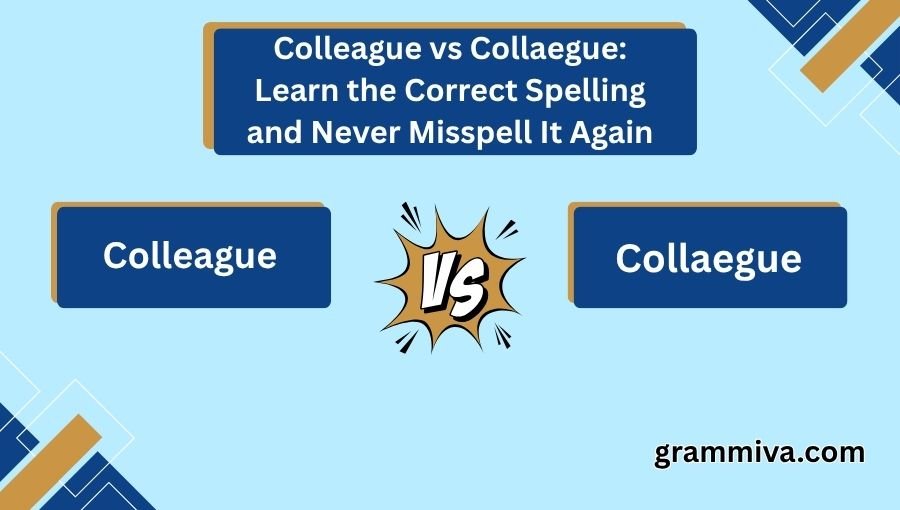
Have you ever typed a workplace email, paused over one word, and wondered, “Wait, how do I spell that?” If you are searching for colleague vs collaegue, you are not alone. The misspelling collaegue can look surprisingly close to the correct form, especially when you type quickly or hear the word more often than you see it.
The good news is simple: colleague is the correct English spelling. Collaegue is a misspelling and should not be used in standard US English.
The confusion often comes from the middle of the word. The letters can feel out of order when you type them from memory. I have seen this mistake in workplace drafts, school assignments, and casual messages. I have even caught myself stopping mid-sentence to check the spelling before sending a formal email.
In this guide, I will explain colleague vs collaegue in plain English. We will look at the correct spelling, meaning, grammar, common mistakes, workplace examples, memory tricks, and frequently asked questions. By the end, you should be able to spot the wrong spelling quickly and write the correct word with confidence. 😊 Definitely vs Definatley | Chief vs Cheif | Definite vs Deffinite
Quick Answer: Colleague vs Collaegue 🎯
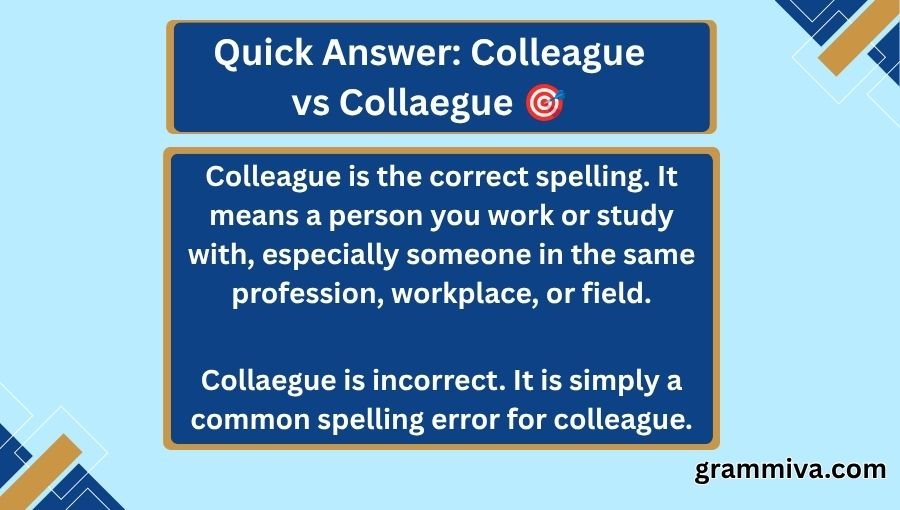
Colleague is the correct spelling. It means a person you work or study with, especially someone in the same profession, workplace, or field.
Collaegue is incorrect. It is simply a common spelling error for colleague.
| Word | Correct? | Meaning | Example |
|---|---|---|---|
| colleague | ✅ Yes | A person you work or study with | My colleague helped me finish the report. |
| collaegue | ❌ No | Misspelling of colleague | My collaegue helped me finish the report. |
The easiest rule is this: When you mean a person you work with, spell it colleague.
Related Word Forms of Colleague
When comparing colleague vs collaegue, only colleague is the correct standard spelling. The related forms, such as colleagues and colleague’s, keep the same correct base spelling.
| Form | Type | Example |
|---|---|---|
| colleague | Singular noun | My colleague called this morning. |
| colleagues | Plural noun | My colleagues joined the meeting. |
| colleague’s | Singular possessive | My colleague’s desk is near mine. |
| colleagues’ | Plural possessive | The colleagues’ meeting lasted an hour. |
Notice that none of these forms uses collaegue. Adding an ending does not change the correct spelling of the base word.
Understanding the Basics of Colleague vs Collaegue
The core difference is spelling, not meaning. Colleague is a standard English noun, while collaegue is not a standard English word.
A colleague is someone you work with or, in some settings, someone who works in the same profession or field. The word is common in offices, schools, hospitals, universities, businesses, and many other workplaces.
| Form | Type | Meaning | Example | Correct/Incorrect |
|---|---|---|---|---|
| colleague | Noun | A person you work with | Sarah is my colleague. | ✅ Correct |
| colleagues | Plural noun | Two or more coworkers or professional peers | My colleagues are helpful. | ✅ Correct |
| colleague’s | Possessive noun | Something belonging to one colleague | My colleague’s laptop is here. | ✅ Correct |
| colleagues’ | Plural possessive | Something belonging to several colleagues | The colleagues’ office is upstairs. | ✅ Correct |
| collaegue | Noun attempt | Misspelling of colleague | He is my collaegue. | ❌ Incorrect |
What Does Colleague Mean?
Colleague means a person you work with or a person in the same profession or field.
For example:
Maria is my colleague at the design company.
Here, colleague is a noun. Maria is the person who works with the speaker.
Another example is:
I asked a colleague for help with the spreadsheet.
The person is not necessarily a close friend. A colleague is simply someone connected to you through work or professional activity.
Is Colleague the Same as Coworker?
In many everyday situations, colleague and coworker can mean nearly the same thing. Both can describe someone you work with.
However, colleague can sometimes sound a little broader or more professional. A colleague may be someone in the same profession or academic field, even when you do not work in the exact same office.
| Word | Typical Meaning | Example |
|---|---|---|
| colleague | Person connected to you through work or a profession | I spoke with a colleague about the project. |
| coworker | Person who works with you | My coworker sits beside me. |
| teammate | Person who works with you on a team | My teammate finished the presentation. |
| associate | Person connected with a business or professional activity | She is a business associate. |
These words can overlap, but they are not always interchangeable in every sentence.
Colleague in a Professional Setting
Colleague is especially common in professional writing. You might use it in an email, report, meeting note, performance review, or business message. In professional writing, checking colleague vs collaegue is a simple way to avoid an unnecessary spelling mistake.
For example:
I discussed the issue with my colleague before responding to the client.
The word sounds natural and professional without being overly formal.
Colleague in Education
The word can also describe someone who works in education or someone in an academic field.
For example:
I shared the research with a colleague at the university.
The person does not have to sit in the same room or work on the same project. The word can describe a professional peer.
Why Do People Confuse Colleague and Collaegue? 🤔
People confuse these spellings because the letters in colleague do not always match the way people expect the word to look. The sequence -league is especially easy to mix up.
A common mistake is to remember the sound but not the exact letter order. When someone writes the word quickly, they may produce collaegue instead of colleague.
I once reviewed a short office document where the writer had used collaegue several times. The meaning was perfectly clear, but the repeated spelling error made the document look less polished. A quick search-and-replace fixed it.
The problem is usually not grammar knowledge. It is memory, typing speed, or uncertainty about letter order.
| Possible Cause | What Happens | Helpful Fix |
|---|---|---|
| Fast typing | Letters are entered in the wrong order | Slow down for tricky words |
| Autocorrect | The device may not catch the error | Proofread important messages |
| Weak spelling memory | The writer remembers the sound, not the letters | Memorize the word pattern |
| Visual confusion | Similar letter sequences are mixed up | Compare colleague with the correct pattern |
| Rare use | The word may not be written often | Practice it in short sentences |
Colleague vs Collaegue at a Glance
The spelling rule is straightforward: use colleague in standard English. Do not use collaegue in formal or informal writing.
| Feature | Colleague | Collaegue |
|---|---|---|
| Standard English word | Yes | No |
| Refers to a work peer | Yes | Intended to, but misspelled |
| Suitable for professional writing | Yes | No |
| Suitable for a resume | Yes | No |
| Suitable for a formal email | Yes | No |
| Correct spelling to memorize | Yes | No |
Correct Meanings and Uses 📝
A Person You Work With
The most common use refers to someone who works with you. The correct spelling of colleague stays the same whether you are talking about a coworker, professional peer, or academic peer.
My colleague sent me the updated file.
The noun identifies the person who sent the file.
A Person in the Same Profession
The word can also refer to a professional peer.
She met several colleagues at the conference.
These people may work for different organizations. They are connected by their profession or field.
A Person in an Academic or Professional Community
In universities and other professional settings, people often refer to peers as colleagues.
The professor discussed the idea with her colleagues.
The word fits naturally because the people share a professional or academic environment.
| Meaning | Word Type | Example Sentence |
|---|---|---|
| Work peer | Noun | My colleague helped with the report. |
| Professional peer | Noun | He spoke with colleagues in his field. |
| Academic peer | Noun | The researcher thanked her colleagues. |
Test Tip 💡
When you are unsure, ask yourself:
“Am I talking about a person I work with or a professional peer?”
If the answer is yes, colleague is likely the word you need.
Then check the spelling. The correct form contains -league:
colleague
Not:
collaegue
A useful visual trick is to think of the ending as league. The word contains the same letter sequence:
col + league = colleague
This is a memory aid, not a rule about how the word is pronounced.
A Workplace Case Study 📝
Imagine that you work on a sales team. You need to send a message to your manager about a report.
Your first draft says:
I asked my collaegue to check the numbers.
The meaning is easy to understand, but the spelling is wrong.
The corrected sentence is:
I asked my colleague to check the numbers.
Now imagine the same sentence in a client-facing email:
My colleague will send the final report this afternoon.
Here, the correct spelling matters because professional writing represents both you and your organization.
I once caught a similar mistake while preparing a formal document. The incorrect spelling appeared only once, which made it easy to miss during a quick read. I noticed it during a slower final proofread and corrected it before the document was shared. This is a practical example of why colleague vs collaegue matters in workplace writing. The wrong spelling may be understood, but the correct form looks more polished.
| Situation | Incorrect Version | Correct Version |
|---|---|---|
| Internal email | My collaegue will call you. | My colleague will call you. |
| Client message | I spoke with your collaegue. | I spoke with your colleague. |
| Report | A collaegue reviewed the data. | A colleague reviewed the data. |
| Meeting note | My collaegue attended. | My colleague attended. |
Grammar Rules Explanation
Colleague is a noun. It names a person who works with you or is connected to you through a shared profession or field.
Collaegue is not a standard spelling of that noun. It is a misspelling of colleague. The main rule for colleague vs collaegue is a spelling rule, not a change in meaning. When the intended word means a professional or work peer, the correct form is colleague.
The key issue is therefore spelling rather than a special grammar rule. If the sentence requires a noun meaning a work or professional peer, use colleague.
Standard English reference sources and major dictionaries recognize colleague as the established spelling. The incorrect form does not become correct simply because it is sometimes seen online.
There is no need to change the spelling based on whether the sentence is formal or casual. The correct spelling remains colleague in both.
Correct vs Incorrect at a Glance
| Sentence | Correct/Incorrect | Why |
|---|---|---|
| My colleague is joining the meeting. | ✅ Correct | Colleague is correctly spelled. |
| My collaegue is joining the meeting. | ❌ Incorrect | Collaegue is a misspelling. |
| I spoke with two colleagues. | ✅ Correct | Colleagues is the correct plural. |
| I spoke with two collaegues. | ❌ Incorrect | The base spelling is wrong. |
| My colleague’s office is nearby. | ✅ Correct | The possessive form is correctly built from colleague. |
Common Mistakes ⚠️
The most common mistake is simply putting the letters in the wrong order. The colleague vs collaegue mistake usually happens because writers remember the sound of the word but not the exact order of its letters.
People may write collaegue, collegue, or other forms because they remember roughly how the word sounds. Fast typing can make the problem worse.
Autocorrect can also create a false sense of safety. A writing app may not catch every spelling error, especially when a mistaken form is close to another valid sequence of letters.
Lack of spelling knowledge is another reason. If you rarely write the word, you may not have a strong visual memory of its correct form.
| Confusion | Correct Form | Incorrect Form | Quick Reminder |
|---|---|---|---|
| its / it’s | its / it’s | Mixing the two | It’s = it is |
| your / you’re | your / you’re | Mixing the two | You’re = you are |
| their / they’re | their / they’re | Mixing the two | They’re = they are |
| affect / effect | affect / effect | Choosing by sound | Check the sentence role |
| colleague / collaegue | colleague | collaegue | Remember -league |
Common Wrong Spellings of Colleague
| Wrong Form | What’s Wrong | Correct Form |
|---|---|---|
| collaegue | Letters in the middle are misplaced | colleague |
| collegue | Missing the second “a” pattern in the correct sequence | colleague |
| colleage | Incorrect letter order | colleague |
| colleguee | Extra letter and incorrect sequence | colleague |
| collague | Missing letters | colleague |
| collaguee | Missing and misplaced letters | colleague |
Not every incorrect form appears equally often, but all of these should be avoided.
How to Remember the Correct Spelling 🧠
The simplest memory trick is to break the word into two visual parts: If you often confuse colleague vs collaegue, remember the visual pattern col + league = colleague.
col + league
That gives:
colleague
The middle and ending can feel easier to remember when you see league inside the word.
Another useful trick is to write the word three times:
colleague
colleague
colleague
Then put it into a sentence:
My colleague sent the email.
Writing the word in a real sentence helps connect its spelling to its meaning.
| Memory Method | Example | Why It Helps |
|---|---|---|
| Split the word | col + league | Makes the letter pattern easier to see |
| Copy it | colleague | Builds visual memory |
| Use a sentence | My colleague called me. | Connects spelling with meaning |
| Compare forms | colleague → colleagues | Shows how endings are added |
| Proofread slowly | Check colleague before sending | Catches typing errors |
Usage in Different Contexts
Colleague works across many types of communication. The spelling does not change just because the context changes. Whether you are writing a text, email, report, or social post, colleague vs collaegue has the same answer: colleague is correct.
| Context | Which Term to Use | Example |
|---|---|---|
| Everyday conversation | colleague | I saw my colleague at lunch. |
| Professional writing | colleague | My colleague reviewed the proposal. |
| Creative writing | colleague | Her colleague walked into the room. |
| Social media/texting | colleague | A colleague helped me today. |
In very casual speech, coworker may sound more natural in some situations. Still, colleague remains correct.
In texting, people may type quickly and make spelling mistakes. That does not make collaegue an accepted alternative.
Common Phrases With Colleague
There are several natural phrases that use colleague.
| Phrase | Meaning |
|---|---|
| a close colleague | A professional peer you know well |
| a former colleague | Someone you used to work with |
| a trusted colleague | A professional peer you trust |
| a senior colleague | A colleague with more seniority |
| a new colleague | Someone who recently joined the workplace |
| a colleague at work | A person who works with you |
Examples include:
- “I spoke with a former colleague yesterday.”
- “A senior colleague helped me understand the process.”
- “My new colleague joined the team last week.”
These phrases all use the same correct spelling.
Synonyms and Alternatives
You can sometimes replace colleague with another word, but the best choice depends on the situation.
| Alternative | Works When | Does Not Work When |
|---|---|---|
| coworker | Someone works with you | The person is only a professional peer outside your workplace |
| teammate | You are part of the same team | The person works in your organization but not on your team |
| peer | You want to stress equal professional status | You need a word specifically tied to the workplace |
| associate | The person has a business or professional connection | You simply mean any person at work |
| professional peer | You want to stress shared professional status | You want a short, casual word |
For example, “my coworker” is natural when you share a workplace. “My colleague” can be better when discussing a professional peer more broadly.
Why Getting Colleague Right Matters 🎯
A single spelling error usually does not stop a reader from understanding your meaning. Still, correct spelling makes your writing clearer and more polished.
This matters most when the word appears in professional documents. A resume, cover letter, client email, report, or published article may be read by people who expect careful writing.
A useful principle is:
Clear writing helps the reader focus on your message instead of your mistakes.
That does not mean one typo defines your writing ability. Everyone makes occasional typing errors. The goal is to catch avoidable errors before they reach the reader.
| Situation | Why Getting It Right Matters |
|---|---|
| Resume | Shows care and attention to written detail |
| Client email | Supports a professional impression |
| Published content | Helps maintain clean, accurate copy |
| Social post | Makes the message easier to read and share |
Is Colleague More Formal Than Coworker?
Colleague can sound slightly more professional than coworker, but both are normal English words. The best choice depends on what you want to emphasize.
For example:
My coworker sits next to me.
This sounds natural and everyday.
My colleague reviewed the proposal.
This sounds natural in a workplace or professional setting.
Neither word is automatically better. What matters is context.
Is Collaegue Ever Correct?
No. Collaegue is not a standard alternative spelling of colleague.
If you are writing standard US English, use colleague. This applies to emails, reports, resumes, school assignments, social posts, and casual messages.
Seeing an incorrect spelling online does not make it an accepted spelling.
Does Colleague Have a Plural Form?
Yes. The plural is colleagues.
The spelling changes only by adding s:
one colleague
two colleagues
Do not write collaegues or collegues.
| Number | Correct Form | Example |
|---|---|---|
| One | colleague | My colleague is here. |
| Two | colleagues | My colleagues are here. |
| Several | colleagues | Several colleagues attended. |
Does Colleague Have a Possessive Form?
Yes. For one person, use colleague’s.
My colleague’s computer is on the desk.
For more than one colleague, use colleagues’.
The colleagues’ meeting started at noon.
| Meaning | Correct Form | Example |
|---|---|---|
| One colleague | colleague’s | My colleague’s report is finished. |
| More than one colleague | colleagues’ | The colleagues’ reports are finished. |
The apostrophe changes based on whether the noun is singular or plural. The basic spelling of colleague remains the same.
How Does Colleague Work in a Sentence?
Colleague normally functions as a noun.
It can be the subject:
My colleague arrived early.
It can be the object:
I called my colleague.
It can follow a possessive:
My colleague’s desk is nearby.
It can also appear in a plural form:
My colleagues helped me.
| Sentence Role | Example | Role of Colleague |
|---|---|---|
| Subject | My colleague called. | Subject |
| Object | I called my colleague. | Object |
| Possessive | My colleague’s phone rang. | Possessive noun |
| Plural | My colleagues arrived. | Plural noun |
Quick Recap Checklist ✅
Use this quick check whenever you are unsure.
| Question | If Yes → Use |
|---|---|
| Do you mean a person you work with? | colleague |
| Do you mean a professional peer? | colleague |
| Are you writing the plural? | colleagues |
| Are you showing possession for one person? | colleague’s |
| Are you showing possession for several people? | colleagues’ |
| Are you considering “collaegue”? | ❌ Do not use it |
Practice Examples
- My colleague helped me prepare the presentation. ✅
- Three colleagues joined the meeting. ✅
- I thanked my colleague’s manager. ✅
Remember the key pattern:
colleague = correct
collaegue = incorrect
FAQs About Colleague vs Collaegue
Is colleague the correct spelling?
Yes. Colleague is the correct standard English spelling for a person you work with or a professional peer.
Is collaegue a word?
No. Collaegue is a misspelling of colleague. It should not be used in standard English.
How do you spell colleague correctly?
Spell it colleague. A useful memory trick is to notice the league sequence at the end: col + league = colleague.
What does colleague mean?
A colleague is someone you work with or someone in the same profession or field. For example, “My colleague helped me with the report.”
What is the plural of colleague?
The plural is colleagues. For example, “My colleagues attended the meeting.”
What is the possessive form of colleague?
The singular possessive is colleague’s. For example, “My colleague’s office is upstairs.” The plural possessive is colleagues’.
Is colleague the same as coworker?
Often, yes. Both can describe someone you work with. However, colleague can have a broader professional meaning and may describe someone in the same field even when you do not work for the same employer.
Why do people spell colleague as collaegue?
The mistake usually happens because the letters in colleague are easy to rearrange when writing from memory. Fast typing, weak visual memory, and uncertainty about the middle of the word can all contribute.
Is colleague used in American English?
Yes. Colleague is a standard word in US English. It is common in workplaces, professional writing, education, and everyday conversation.
How can I remember the spelling of colleague?
Think of the word as col + league. The full spelling is colleague. Writing it several times and using it in a sentence can also strengthen your memory.
Conclusion
Colleague vs collaegue has a simple answer: colleague is correct, and collaegue is a misspelling. The word colleague refers to someone you work with or someone who shares your profession or field.
The most useful spelling trick is to remember the ending -league. Think col + league = colleague. Once that pattern becomes familiar, the incorrect form becomes much easier to spot.
Use colleague for one person, colleagues for more than one, colleague’s for one person’s possession, and colleagues’ for the possession of several people.
I recommend giving tricky words like this a quick final check before sending important emails, resumes, reports, or published content. A few extra seconds can remove a distracting error. ✨
When in doubt, remember the simplest rule: Your work peer is your colleague—not your collaegue. 👍

I am Alex Morgan, an English grammar and vocabulary writer passionate about making language learning simple and useful. I work at Grammiva, where I create clear educational content and practical English examples for learners.
[…] writing. By the end, you should be able to choose the right form without stopping to think. 🌟 Colleague vs Collaegue | Definitely vs Definatley | Chief vs […]