Have you ever typed a word, looked at it twice, and suddenly wondered whether it looks right? Buoyant vs bouyant is one of those spelling traps. The two forms look almost identical, but only one is standard English.
The correct spelling is buoyant. The spelling bouyant is a common misspelling. The confusion often happens because English has many words with the letters ou, and people may naturally expect bouyant to follow that pattern. The word also has a sound that can make its spelling less obvious when we hear it in conversation.
I have seen this mistake in schoolwork, emails, online posts, and even polished business writing. The good news is that the rule is simple once you learn the correct letter order.
In this guide, I will explain the difference between buoyant and bouyant, show how to use buoyant correctly, and give you easy ways to remember the spelling. You will also see examples, tables, common mistakes, practical writing tips, and FAQs. 😊 Calendar vs Calandar | Buoy vs Bouy | Bellwether vs Bellweather
Quick Answer: Buoyant vs Bouyant 🎯
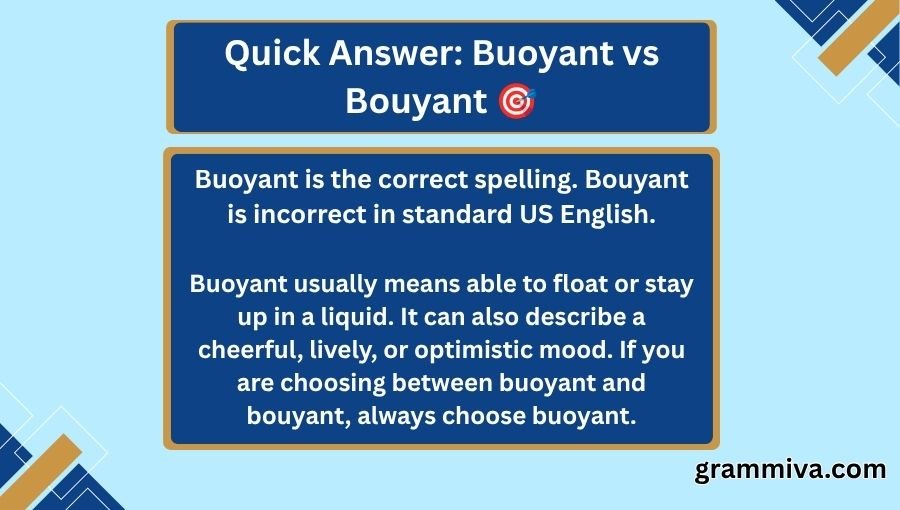
Buoyant is the correct spelling. Bouyant is incorrect in standard US English.
Buoyant usually means able to float or stay up in a liquid. It can also describe a cheerful, lively, or optimistic mood. If you are choosing between buoyant and bouyant, always choose buoyant.
| Form | Type | Example |
|---|---|---|
| buoyant | Correct adjective | The boat remained buoyant in rough water. |
| bouyant | Incorrect spelling | ❌ The boat remained bouyant. |
Is Buoyant the Same as Bouyant?
No. Buoyant and bouyant are not two accepted spellings of the same word. Buoyant is the standard form, while bouyant is a spelling error.
The mistake is easy to make because the letters seem to fit familiar English patterns. However, the correct spelling places u before o:
b-u-o-y-a-n-t → buoyant
A useful visual trick is to remember that buoyant starts with “buoy.”
A buoy is an object that floats on water. Add -ant, and you get buoyant.
The basic difference
| Form | Status | Meaning | Example | Correct/Incorrect |
|---|---|---|---|---|
| buoyant | Standard English | Able to float or remain supported | The raft was buoyant enough for two people. | ✅ Correct |
| bouyant | Misspelling | No standard meaning as this spelling | The raft was bouyant enough for two people. | ❌ Incorrect |
Buoyant vs Bouyant at a Glance 📌
The simplest rule is this: buoyant is correct, and bouyant is not.
When you need the word, write buoyant. Think of the smaller word buoy inside it. That connection makes the spelling easier to remember.
| Point | Buoyant | Bouyant |
|---|---|---|
| Standard spelling | Yes | No |
| Used in formal writing | Yes | No |
| Can describe floating objects | Yes | No |
| Can describe a cheerful mood | Yes | No |
| Suitable for professional writing | Yes | No |
| Recommended spelling | Use it | Avoid it |
What Does Buoyant Mean? 💡
When comparing buoyant vs bouyant, it is important to know that buoyant is the correct spelling and has several useful meanings. Buoyant is an adjective with two common meanings. It can describe something that floats well, or it can describe a person, mood, or situation that feels cheerful and positive.
Buoyant meaning: able to float
The most direct meaning relates to floating.
If something is buoyant, it tends to stay on the surface of water or another liquid instead of sinking easily.
For example:
- The wooden raft was buoyant.
- The life jacket helped keep him buoyant.
- The material is light and buoyant.
- The boat remained buoyant after taking on some water.
Here, buoyant describes physical behavior.
Buoyant meaning: cheerful or optimistic
The word can also describe a person’s mood or attitude.
For example:
- She was in a buoyant mood after receiving the good news.
- The team’s buoyant spirit helped them recover after the loss.
- His buoyant personality made people feel welcome.
- The crowd remained buoyant despite the delay.
Here, the word is not about literally floating. It describes a light, positive, energetic feeling.
Meaning summary
| Meaning | Word Type | Example Sentence |
|---|---|---|
| Able to float | Adjective | The small raft was buoyant. |
| Able to stay supported in water | Adjective | The vest kept the swimmer buoyant. |
| Cheerful or positive | Adjective | She had a buoyant mood after the announcement. |
| Lively or upbeat | Adjective | His buoyant attitude lifted the team. |
💡 Test Tip
If you are unsure about the spelling, remove -ant and look at the first part.
buoyant → buoy
That gives you the word buoy, which is spelled b-u-o-y.
So:
buoy + ant = buoyant
Do not rearrange the first four letters into bouy.
Why Do People Confuse Buoyant and Bouyant?
People confuse these spellings mainly because English spelling does not always match the way words sound. The letters in buoyant can also feel unusual because buoy is not a common letter pattern for many learners.
Another reason is visual memory. A person may have seen bouyant online several times and unconsciously store that spelling as correct.
I once reviewed a short school report in which a student had written bouyant several times. The student knew exactly what the word meant. The problem was not vocabulary. It was the order of two letters. Once we connected the word to buoy, the student corrected every instance in seconds.
Common causes include:
- Fast typing: You know the word but type the letters in the order that feels natural.
- Autocorrect: A device may not always catch an uncommon spelling error.
- Sound-based spelling: You spell the word from how it sounds rather than how it looks.
- Memory: You may remember seeing the wrong form somewhere.
- Lack of familiarity: If you rarely write the word, its letter pattern may not feel natural.
Buoyant and Bouyant spelling pattern
| What You Remember | What Happens |
|---|---|
| You remember the sound | You may guess the spelling. |
| You remember “buoy” | You are more likely to spell it correctly. |
| You type very quickly | Letters may switch places. |
| You see bouyant online | You may assume it is valid. |
| You check the word carefully | You can catch the error. |
How Do You Spell Buoyant Correctly?
You spell the word buoyant:
B-U-O-Y-A-N-T
The easiest memory aid is buoy + ant.
Think of a floating buoy on the water. Then attach -ant:
BUOY + ANT = BUOYANT
This is much easier than trying to memorize all six letters as one unfamiliar group.
Another helpful method is to focus on the first four letters:
BUOY
Not:
BOUY
That small difference is the heart of the spelling problem.
| Spelling Pattern | Result |
|---|---|
| B-U-O-Y | buoy |
| B-U-O-Y-A-N-T | buoyant |
| B-O-U-Y | ❌ Incorrect |
| B-O-U-Y-A-N-T | ❌ Incorrect |
Correct Meanings and Uses of Buoyant
Understanding buoyant vs bouyant also means understanding how buoyant works in different sentences and contexts. The word buoyant works in several everyday settings. Understanding these uses helps you recognize the correct spelling naturally.
Physical objects
Use buoyant when something can float or remain on the surface of water.
Examples:
- The cork is naturally buoyant.
- The rescue device is highly buoyant.
- The raft stayed buoyant throughout the test.
The word is especially useful when talking about boats, water equipment, materials, and objects placed in liquid.
People and moods
Use buoyant when describing a cheerful or positive state.
Examples:
- She sounded buoyant during the phone call.
- He returned home in a buoyant mood.
- The players were buoyant after their victory.
This meaning is figurative. Nobody is literally floating.
Business and economic writing
You may also see buoyant used to describe strong activity or confidence.
Examples:
- Consumer demand remained buoyant.
- The local market has been buoyant this year.
- Investor confidence stayed buoyant after the announcement.
Here, the word suggests strength, energy, or positive movement.
| Use | Example | Meaning |
|---|---|---|
| Water | The raft was buoyant. | It could float. |
| Clothing/equipment | The vest was buoyant. | It helped provide flotation. |
| Mood | She was buoyant. | She was cheerful. |
| Personality | He has a buoyant personality. | He is lively and positive. |
| Business | Demand remained buoyant. | Demand stayed strong. |
Can Buoyant Describe a Person? 👤
Yes. Buoyant can describe a person when you mean that the person is cheerful, lively, confident, or positive.
For example:
Maya remained buoyant even after the project was delayed.
This does not mean Maya was floating. It means she stayed positive.
You can also use the word with nouns such as:
- buoyant mood
- buoyant personality
- buoyant spirit
- buoyant attitude
- buoyant outlook
The exact meaning depends on the context.
Case Study: A Workplace Email 📝
Imagine that a manager sends this message after a successful product launch:
“The team has stayed buoyant despite the extra work. Thank you for keeping such a positive attitude.”
The manager is using buoyant correctly in its figurative sense. The word describes the team’s upbeat attitude.
Now imagine an employee writes:
“The team has stayed bouyant despite the extra work.”
The meaning is understandable, but the spelling is wrong. In a workplace email, that small error can make the writing look less polished.
I once caught myself typing bouyant while editing a draft late at night. I knew the correct spelling, but my fingers put the o and u in the wrong order. I stopped, thought of a floating buoy, and fixed it immediately. That is why I recommend using a memory link instead of relying only on visual recall.
Workplace example table
| Situation | Better Sentence | Why |
|---|---|---|
| Team mood | The team remained buoyant. | Correct figurative use |
| Project update | Morale stayed buoyant. | Positive mood |
| Customer email | Demand remains buoyant. | Strong demand |
| Equipment report | The device is buoyant. | Floating ability |
Grammar Rules Explanation
Buoyant is an adjective. It modifies a noun or follows a linking verb to describe a person, object, condition, or mood.
For physical use, it describes the ability of something to float or remain supported in a liquid. For figurative use, it describes a cheerful, lively, or positive condition.
The form bouyant is not the standard spelling of the adjective. It is a misspelling caused mainly by switching the positions of u and o.
The word is closely connected in spelling to buoy. Remembering that base word provides a reliable spelling guide.
Most standard English dictionaries and reference works use buoyant as the accepted spelling. When writing for school, work, publication, or public communication, buoyant is the form to use.
Correct vs Incorrect at a Glance
| Sentence | Correct/Incorrect | Why |
|---|---|---|
| The boat remained buoyant. | ✅ Correct | Buoyant correctly describes floating ability. |
| The boat remained bouyant. | ❌ Incorrect | Bouyant is a misspelling. |
| She has a buoyant personality. | ✅ Correct | Buoyant can describe a cheerful personality. |
| She has a bouyant personality. | ❌ Incorrect | The letters are in the wrong order. |
| Demand remained buoyant. | ✅ Correct | Buoyant can describe strong activity or demand. |
Common Mistakes ⚠️
The biggest mistake is simply writing bouyant instead of buoyant. Because the two forms look so similar, spell-check may not always be enough to prevent the error.
Similar spelling and grammar confusions
| Confusion | Correct Form | Common Error | Reason |
|---|---|---|---|
| its / it’s | its / it’s | Mixing them up | One is possessive; one means “it is.” |
| your / you’re | your / you’re | Mixing them up | One shows possession; one means “you are.” |
| affect / effect | affect / effect | Switching meanings | They have different common uses. |
| than / then | than / then | Switching letters | They have different functions. |
| buoyant / bouyant | buoyant | bouyant | The first letters are easy to reverse. |
Specific wrong spellings and uses
| Wrong Form | What’s Wrong | Correct Form |
|---|---|---|
| bouyant | The u and o are reversed. | buoyant |
| bouy | Incorrect spelling of the base word. | buoy |
| bouyantly | Built from the wrong spelling. | buoyantly |
| bouyancy | Built from the wrong spelling. | buoyancy |
| bouyant mood | Incorrect spelling in a figurative phrase. | buoyant mood |
| bouyant boat | Incorrect spelling in a physical context. | buoyant boat |
Notice an important pattern: once you learn buoy, you can recognize related words more easily.
How Can You Remember Buoyant? 🧠
A simple way to remember buoyant vs bouyant is to connect buoyant with the word buoy. The best memory trick is short:
BUOY → BUOYANT
Picture a little buoy floating on water. Then remember that buoyant begins with exactly the same four letters.
You can also use this sentence:
A buoy is buoyant.
The repeated spelling makes the connection strong.
Another trick is to say the letters slowly:
B-U-O-Y
Then add:
A-N-T
Together:
B-U-O-Y-A-N-T
Memory trick table
| Trick | What to Remember |
|---|---|
| Base-word trick | buoy → buoyant |
| Visual trick | Picture a buoy floating on water. |
| Sentence trick | A buoy is buoyant. |
| Letter trick | B-U-O-Y-A-N-T |
| Error check | Never write B-O-U-Y-A-N-T. |
Usage in Different Contexts ✍️
The difference between buoyant vs bouyant stays the same whether you are writing casually, professionally, or creatively. Buoyant is useful in many forms of writing. The meaning changes slightly depending on the context, but the spelling never changes.
Everyday conversation
In casual speech, you might use buoyant when talking about mood or floating objects.
“He was really buoyant after the good news.”
Professional writing
In business or technical writing, buoyant can describe materials, equipment, demand, confidence, or market conditions.
“The material remains buoyant in salt water.”
Creative writing
Writers can use buoyant to create an image of lightness or happiness.
“She walked into the room with a buoyant smile.”
Social media and texting
You can use buoyant online, although simpler words such as happy, upbeat, or positive may sound more natural in casual messages.
| Context | Which Term to Use | Example |
|---|---|---|
| Everyday conversation | buoyant | He seems buoyant today. |
| Professional writing | buoyant | Demand remains buoyant. |
| Creative writing | buoyant | Her buoyant spirit filled the room. |
| Social media/texting | buoyant | Feeling buoyant after that win! |
Common Phrases With Buoyant 🌊
Learning common phrases can make buoyant vs bouyant easier to recognize and remember. There are several natural combinations with buoyant. They usually relate to floating, mood, confidence, or strong activity.
| Phrase | Meaning |
|---|---|
| buoyant mood | A cheerful or positive mood |
| buoyant personality | A lively, cheerful personality |
| buoyant spirit | A positive and energetic attitude |
| buoyant demand | Strong or healthy demand |
| buoyant market | A market showing strength or confidence |
| buoyant material | Material that tends to float |
These phrases can help you become familiar with the correct spelling. The more often you see buoyant in natural phrases, the less likely you are to write bouyant.
What Are Some Synonyms for Buoyant? 💬
Sometimes you can replace buoyant with a simpler word. The best choice depends on the meaning.
If you are talking about floating, words such as floating, light, or able to float may work.
If you are describing mood, alternatives include cheerful, upbeat, positive, and lively.
If you are talking about business or demand, strong or healthy may work.
| Alternative | Works When | Does Not Work When |
|---|---|---|
| floating | Talking about an object on water | Describing a cheerful person |
| cheerful | Describing a happy mood | Describing a floating material |
| upbeat | Describing a positive attitude | Explaining physical flotation |
| lively | Describing energetic behavior | Describing water equipment |
| strong | Describing demand or activity | Directly describing a boat’s ability to float |
A synonym can replace a word only when it keeps the intended meaning. Do not replace buoyant automatically.
Why Does Getting the Spelling Right Matter? 🎯
Correct spelling helps readers understand your writing without distraction. A misspelled word may not change the meaning, but it can make the reader stop and wonder whether the word is correct.
This matters even more in professional writing.
A resume, client email, article, report, or public post represents you. A small spelling mistake can make the whole piece feel less polished.
A simple rule I use when editing is:
Clear writing earns trust one small detail at a time.
| Situation | Why Getting It Right Matters |
|---|---|
| Resume | Shows care and attention to detail |
| Client email | Keeps communication professional |
| Published content | Protects the quality of the article |
| Social post | Makes the message easier to trust and share |
Is There a Special Exception for Bouyant?
No. Bouyant is not a standard alternative spelling of buoyant in ordinary US English.
You may see bouyant in an online comment, an old document, an unedited page, or a typo. Seeing it in print does not make it an accepted spelling.
The same principle applies to related forms. Start with buoy, then build the word from there.
How Does Buoyant Compare With Other Similar Words?
The meaning of buoyant can overlap with several words, but those words are not always interchangeable.
For physical objects, buoyant focuses on the ability to float or remain supported by a liquid.
For people, buoyant often suggests a cheerful and energetic mood.
For business, it can suggest strength or positive activity.
| Word | Main Idea | Example |
|---|---|---|
| buoyant | Floating or positive | The raft was buoyant. |
| cheerful | Happy | She was cheerful. |
| upbeat | Positive | He felt upbeat. |
| floating | Staying on a surface | The leaf was floating. |
| optimistic | Expecting good results | She was optimistic. |
This comparison shows why context matters. A synonym may be close in meaning but still sound unnatural in a particular sentence.
How Can You Check Buoyant Before Publishing? 🔎
If you are editing an article, report, or email, use a quick three-step check.
- Look at the first four letters.
They should be BUOY. - Think of the noun “buoy.”
If the word relates to floating, this mental link is especially useful. - Check the whole sentence.
Make sure you mean floating, cheerful, lively, or strong activity.
For example:
“The team had a buoyant attitude.”
The spelling is correct, and the meaning is positive.
But:
“The team had a bouyant attitude.”
The meaning is understandable, yet the spelling is wrong.
Buoyant vs Bouyant: A Simple Decision Rule 🧩
When you face the choice, do not spend a long time thinking about which visual pattern looks familiar.
Use this rule:
If you mean the adjective related to floating, cheerfulness, liveliness, or strong activity, write “buoyant.”
Never choose bouyant in standard English.
| Question | If Yes → Use |
|---|---|
| Does the word describe something that floats? | buoyant |
| Does it describe a cheerful mood? | buoyant |
| Does it describe a lively attitude? | buoyant |
| Does it describe strong demand or activity? | buoyant |
| Are you tempted to write “bouyant”? | Stop and write buoyant |
Practice examples
- The life jacket helped keep the swimmer buoyant.
- She remained buoyant after the difficult meeting.
- Demand for the new product stayed buoyant.
If you can spell buoy, you can spell buoyant.
FAQs About Buoyant vs Bouyant
Is buoyant the correct spelling?
Yes. Buoyant is the correct standard spelling. Bouyant is a misspelling.
Why is bouyant wrong?
Bouyant places the o and u in the wrong order. The correct beginning is buoy, not bouy.
How do you spell buoyant?
The spelling is B-U-O-Y-A-N-T. A useful memory aid is buoy + ant.
What does buoyant mean?
Buoyant can mean able to float or remain supported in a liquid. It can also mean cheerful, lively, positive, or strong, depending on context.
Can buoyant describe a person’s mood?
Yes. For example, “She was in a buoyant mood” means she was cheerful, positive, or lively.
Can buoyant describe a business market?
Yes. In business writing, buoyant can describe strong demand, activity, or confidence.
Is bouyant ever acceptable in US English?
No. Bouyant is generally treated as a misspelling of buoyant in standard US English.
What is the easiest way to remember buoyant?
Remember the word buoy. The first four letters of buoyant are exactly the same: BUOY.
Is buoyant an adjective?
Yes. Buoyant is an adjective. It describes a noun, such as a buoyant boat, buoyant mood, or buoyant personality.
What is the difference between buoyant and buoyancy?
Buoyant is an adjective, while buoyancy is a noun. For example, “The material is buoyant,” but “The material has good buoyancy.”
Quick Recap Checklist ✅
| Question | If Yes → Use |
|---|---|
| Are you describing something that floats? | buoyant |
| Are you describing a cheerful mood? | buoyant |
| Are you describing a lively personality? | buoyant |
| Are you describing strong demand? | buoyant |
| Are you writing “bouyant”? | Change it to buoyant |
| Can you see “BUOY” at the start? | You have the correct spelling |
Remember these three examples:
- The boat was buoyant. ✅
- Her mood was buoyant. ✅
- The market remained buoyant. ✅
Conclusion
Buoyant vs bouyant becomes easy once you remember one small word: buoy. The correct spelling is buoyant, with u before o. The form bouyant is a common misspelling and should be avoided in standard US English.
The word buoyant has useful meanings. It can describe something that floats, a cheerful person or mood, or strong activity such as demand or market confidence. The meaning changes with the context, but the spelling does not.
When I need to check the word quickly, I think of a buoy floating on water. Then I add -ant. That simple connection removes the spelling guesswork.
So, if you are writing an email, school assignment, article, report, or social post, choose buoyant every time. 🌊
Remember: a buoy is buoyant—and the correct spelling stays afloat. 🚀

I am Alex Morgan, an English grammar and vocabulary writer passionate about making language learning simple and useful. I work at Grammiva, where I create clear educational content and practical English examples for learners.
[…] the correct pattern and a useful memory trick, the spelling becomes much easier to remember. 🌟 buoyant vs bouyant | Calendar vs Calandar | Buoy vs […]