Have you ever typed a word, looked at it twice, and wondered whether it looks right? That happens often with bellwether vs bellweather. The two spellings look almost identical, and the extra “a” in weather can make the wrong form feel perfectly natural.
But there is a simple rule: bellwether is the standard English word. Bellweather is a common misspelling.
The word bellwether is useful when you want to describe a person, group, event, product, or trend that serves as a strong sign of what others are likely to do. For example, you might call a major election a bellwether for public opinion. A popular product can also be a bellwether for changes in consumer taste.
I have seen this spelling mistake in school work, business writing, and online articles. It is especially easy to make because weather is a familiar word, while wether is much less common. 🌤️ Once you understand the difference, though, the correct spelling becomes much easier to remember. Believe vs Belive | Becoming vs Becomeing | Because vs Beacause
🎯 Quick Answer: Bellwether vs Bellweather
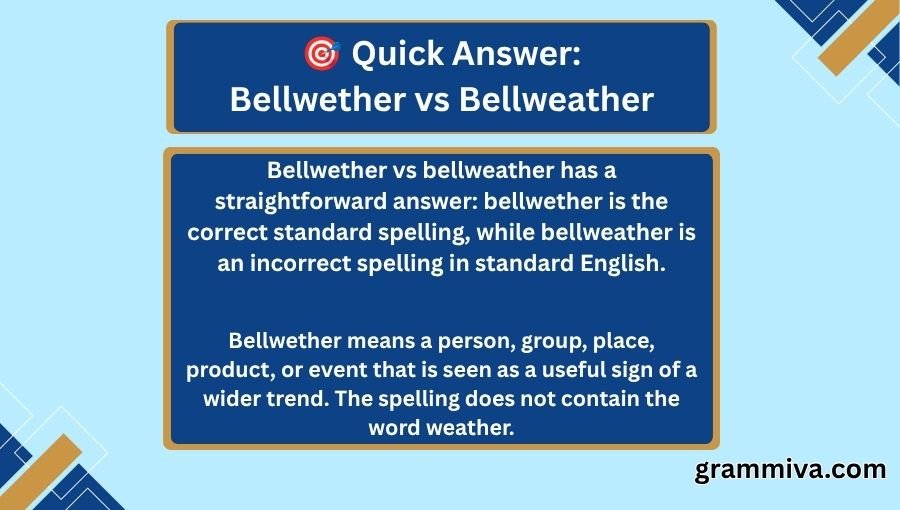
Bellwether vs bellweather has a straightforward answer: bellwether is the correct standard spelling, while bellweather is an incorrect spelling in standard English.
Bellwether means a person, group, place, product, or event that is seen as a useful sign of a wider trend. The spelling does not contain the word weather.
Related Word Forms
The main form is bellwether. It can also appear in plural form as bellwethers. The possessive form is bellwether’s, while the plural possessive is bellwethers’.
| Form | Type | Example |
|---|---|---|
| bellwether | Singular noun | The county is a bellwether for the state. |
| bellwethers | Plural noun | Several cities became bellwethers for the trend. |
| bellwether’s | Singular possessive | The bellwether’s results attracted attention. |
| bellwethers’ | Plural possessive | The bellwethers’ behavior was closely watched. |
| bellweather | Misspelling | ❌ The article used the wrong spelling. |
The word bellwether is normally used as a noun. It can describe something that gives people a clue about a larger movement or result.
🎯 Is Bellwether the Same as Bellweather?
No. Bellwether and bellweather are not two different standard spellings of the same word. Bellwether is the correct word, while bellweather is generally a spelling error.
The confusion comes from the familiar word weather. People often see bellwether and mentally divide it into bell + weather. That seems reasonable at first glance, but it is not how the word is spelled.
| Form | Type | Meaning | Example | Correct/Incorrect |
|---|---|---|---|---|
| bellwether | Noun | A sign of a larger trend | The district is a bellwether for the region. | ✅ Correct |
| bellweather | Noun attempt | Intended to mean bellwether | The district is a bellweather for the region. | ❌ Incorrect |
| bellwethers | Plural noun | More than one bellwether | These towns are political bellwethers. | ✅ Correct |
| bellweathers | Plural misspelling | Incorrect plural of bellwether | Several bellweathers were studied. | ❌ Incorrect |
Why the Wrong Spelling Looks Right
The word weather is common. You see it in phrases such as bad weather, weather forecast, and weather report. Your brain already knows that spelling.
The word wether, by contrast, is rare in everyday speech. A wether is a castrated male sheep. That older word is part of the history of bellwether, but most readers do not use it often.
That difference creates a spelling trap.
I once edited a short business report in which the writer used bellweather three times. The writer knew exactly what the word meant. The problem was simply that the familiar spelling of weather had taken over. After we changed all three instances, the rest of the report needed no editing for that issue.
Bellwether Meaning and Correct Use
Bellwether refers to something that acts as a sign or guide for a wider trend, result, or movement.
It can describe people, groups, locations, industries, products, or events. The key idea is that watching the bellwether can give you a useful clue about what may happen more broadly.
Bellwether in Politics
A place can be called a bellwether when its voting patterns are seen as a useful sign of a larger election result.
For example:
The county has become a bellwether in statewide elections.
This does not mean the county controls the election. It means observers think its results may offer a clue about the wider outcome.
Bellwether in Business
A company, product, or industry can also be a bellwether.
The company’s sales are a bellwether for the health of the retail market.
Here, the company’s sales are being treated as a signal. If they rise or fall, people may look at that change for clues about the larger market.
Bellwether in Culture and Trends
The word can also describe changing habits.
Streaming services became a bellwether for changes in how people watch television.
The point is not that one service represents every viewer. Instead, its behavior may reveal a broader shift.
| Meaning | Word Type | Example Sentence |
|---|---|---|
| Sign of a wider trend | Noun | The city is a bellwether for housing demand. |
| Indicator of political behavior | Noun | The county is a bellwether in national elections. |
| Indicator of market behavior | Noun | The company is a bellwether for the industry. |
| Sign of cultural change | Noun | The trend became a bellwether for younger buyers. |
💡 Test Tip: Use the “Signal” Test
When I am unsure whether a sentence uses bellwether naturally, I use a simple test:
Can I replace the word with “indicator,” “sign,” or “guide to a wider trend”?
If yes, bellwether may be a good choice.
For example:
The city’s housing market is a bellwether for the region.
Try replacing it:
The city’s housing market is an indicator for the region.
The wording changes slightly, but the main idea remains. That tells you that bellwether fits the meaning.
Why Do People Confuse Bellwether and Bellweather?
The confusion in bellwether vs bellweather usually comes from the familiar spelling of weather. Because weather is a common English word, writers may automatically insert the extra a when spelling bellwether.
There are three common reasons for the mistake:
- Visual similarity — the words look almost identical.
- Familiar spelling patterns — weather is a common English word.
- Unfamiliar vocabulary — many people rarely see or use wether.
A second memory from my editing work stands out. A student once wrote bellweather in an essay about voting trends. When I asked why, the student said, “Because I thought it had something to do with weather.” That answer made perfect sense from a spelling perspective. The student had simply connected the unfamiliar word to a familiar one.
That is why memorizing the correct spelling is more useful than simply memorizing that one version is wrong. 🧠
| Confusion | Why It Happens | Better Habit |
|---|---|---|
| bellwether / bellweather | Weather is familiar | Remember wether |
| its / it’s | Both sound alike | Check whether you mean “it is” |
| your / you’re | Same sound in many accents | Test for “you are” |
| their / there / they’re | Similar pronunciation | Check meaning and grammar |
| affect / effect | Related meanings | Identify the word’s role in the sentence |
Bellwether vs Bellweather at a Glance
The central difference is spelling, not meaning. When you mean an indicator of a wider trend, use bellwether.
| Feature | Bellwether | Bellweather |
|---|---|---|
| Standard spelling | Yes | No |
| Contains “weather” | No | Yes |
| Standard noun | Yes | No |
| Can mean an indicator | Yes | No |
| Plural | bellwethers | Not standard |
| Use in formal writing | Yes | No |
Case Study: A Workplace Email 📝
Imagine a manager writing an email about customer behavior:
“Our online sales may be a bellwether for demand during the holiday season.”
This is a strong use of the word. The manager is saying that online sales may provide a clue about wider demand.
Now compare it with:
“Our online sales may be a bellweather for demand during the holiday season.”
The intended meaning is clear, but the spelling is wrong. In a workplace email, that mistake may look minor. Still, repeated spelling errors can make professional writing appear less polished.
I once caught myself typing bellweather while preparing notes for an article. I knew the word well, but my fingers followed the spelling of weather. I stopped, removed the extra a, and remembered the key rule: bellwether has “wether,” not “weather.”
Grammar Rules Explanation
Bellwether is a noun. It names a person, group, place, product, event, or other thing that serves as a sign of a wider trend. When comparing bellwether vs bellweather, the main issue is spelling. Bellwether is the correct word for something that signals a wider trend, while bellweather is a misspelling.
The spelling bellweather is not the standard spelling of that noun. The presence of the extra a does not create a second accepted meaning.
The distinction is therefore mainly a matter of spelling and word identity. Standard reference works and major dictionaries recognize bellwether as the established English form.
In a sentence, bellwether often follows a form of be:
The county is a bellwether for the state.
It can also appear before a noun:
The bellwether county received national attention.
The word can take a plural ending:
Several bellwethers were studied.
There is no grammar rule that changes bellwether into bellweather. The latter is simply the wrong form for the intended word.
Correct vs Incorrect at a Glance
| Sentence | Correct/Incorrect | Why |
|---|---|---|
| The county is a bellwether for the region. | ✅ Correct | Bellwether means an indicator of a wider trend. |
| The county is a bellweather for the region. | ❌ Incorrect | The standard spelling has no “a.” |
| These towns are political bellwethers. | ✅ Correct | Bellwethers is the correct plural. |
| These towns are political bellweathers. | ❌ Incorrect | The plural keeps the correct base spelling. |
| The product became a bellwether for consumer demand. | ✅ Correct | The word is used as a noun meaning an indicator. |
⚠️ Common Mistakes With Bellwether
One of the most common mistakes in bellwether vs bellweather is adding the a from weather. This often happens during fast typing, editing, or proofreading because weather is much more familiar than wether.
Why These Errors Happen
Fast typing: When people type quickly, they often use familiar letter patterns instead of consciously checking each word.
Autocorrect: A spelling tool may not always understand the intended word from context. Some systems may also treat unusual words as suspicious.
Lack of knowledge: If someone has never learned the word’s correct spelling, bellweather can seem logical.
Sound-based spelling: In normal speech, the two forms may sound the same. Hearing the word does not reveal the missing a.
Common Grammar and Spelling Traps
| Confusion | Correct Choice | Quick Test |
|---|---|---|
| its / it’s | Depends on meaning | Try “it is” for it’s. |
| your / you’re | Depends on meaning | Try “you are” for you’re. |
| then / than | Depends on meaning | Compare time vs comparison. |
| affect / effect | Depends on sentence | Check whether you need a verb or noun. |
| bellwether / bellweather | bellwether | Remove the “a.” |
Specific Wrong Forms
| Wrong Form | What’s Wrong | Correct Form |
|---|---|---|
| bellweather | Adds “a” from weather | bellwether |
| bellweathers | Incorrect base spelling | bellwethers |
| bell-wether | Unnecessary hyphen in standard modern use | bellwether |
| bell wether | Incorrect separation | bellwether |
| bellwhether | Extra letters added to the word | bellwether |
What Is the History Behind Bellwether?
The history of bellwether helps explain its unusual spelling. The word is connected to wether, an older term for a castrated male sheep. A bell was traditionally associated with a lead sheep in a flock, making that animal a guide for the others.
Over time, the idea of a “leader” or “guide” developed into the modern figurative sense of something that indicates a broader trend.
The important spelling lesson is simple: the word contains “wether,” not “weather.”
| Period | Form | Note |
|---|---|---|
| Earlier English use | wether | A term connected with a male sheep. |
| Earlier compound use | bellwether | A bell-associated lead sheep. |
| Later figurative use | bellwether | A person or thing that serves as a guide or sign. |
| Modern English | bellwether | Common figurative use for an indicator of a wider trend. |
The history is useful because it explains why the spelling does not contain weather. The two words are easy to confuse today, but they are not simply alternate spellings.
How Is Bellwether Used in Different Contexts?
The bellwether vs bellweather difference is easy to apply in everyday, professional, creative, and online writing. Use bellwether when you mean something that provides a clue about a broader trend.
Bellwether works best when you are talking about something that gives clues about a larger pattern. It appears often in politics, business, economics, media, and social trends.
| Context | Which Term to Use | Example |
|---|---|---|
| Everyday conversation | bellwether | That store is a bellwether for local shopping trends. |
| Professional writing | bellwether | Sales figures may be a bellwether for market demand. |
| Creative writing | bellwether | The old theater became a bellwether for the town’s revival. |
| Social media/texting | bellwether | This release could be a bellwether for the whole industry. |
In casual conversation, you may hear simpler words such as sign or indicator. That does not make bellwether too formal. It simply gives your sentence a more specific meaning.
Common Phrases With Bellwether
There are several natural combinations that appear often in modern writing. These phrases usually connect bellwether to a field or trend.
| Phrase | Meaning |
|---|---|
| bellwether state | A state whose results may signal a wider political trend |
| bellwether county | A county viewed as a useful indicator of broader voting patterns |
| bellwether stock | A stock viewed as a sign of wider market conditions |
| bellwether company | A company whose performance may indicate industry trends |
| bellwether industry | An industry whose changes may signal broader economic movement |
| bellwether product | A product whose success may reveal changing consumer tastes |
These phrases are not special grammar rules. They are common ways to describe something that provides a wider signal.
How Can You Remember the Correct Spelling?
The easiest way to remember bellwether vs bellweather is to connect bellwether with the idea of a signal or trend. If you mean rain, storms, or outdoor conditions, you are thinking about weather. If you mean a trend indicator, use bellwether. The best memory trick is to separate bellwether from weather.
Think:
bell + wether = bellwether
Do not think:
bell + weather = bellweather
Another useful trick is to remember that the word is about a signal, not the sky. If you are talking about rain, clouds, storms, or temperature, you need weather. If you are talking about something that signals a wider trend, you may need bellwether.
| If You Mean… | Use This Word |
|---|---|
| Rain, wind, storms, or temperature | weather |
| A male sheep in the older term | wether |
| A sign of a wider trend | bellwether |
| A forecast about outdoor conditions | weather |
| A political or market indicator | bellwether |
Synonyms and Alternatives
You do not always need the word bellwether. In some sentences, a simpler word may be clearer.
| Alternative | Works When | Does Not Work When |
|---|---|---|
| indicator | You want a clear, general term | You want the stronger idea of a recognized trend leader |
| sign | You want simple everyday language | You need a more formal business or political term |
| signal | You want to stress a clue about what may happen | You mean a person or thing viewed as a long-term trend marker |
| guide | Something helps point toward a direction | You mean evidence rather than direction |
| leading indicator | You are discussing measurable trends | The subject is informal or does not truly predict future activity |
For example:
The city’s sales are a bellwether for the region.
Could become:
The city’s sales are an indicator of the region’s economic health.
The second sentence is clear. The first has a more specific sense of a recognized signal for a broader trend.
Why Does Getting Bellwether Right Matter?
Correct spelling matters because readers should not have to stop and decode what you mean. A misspelling such as bellweather usually does not destroy the meaning, but it can distract the reader.
This matters most in professional settings.
A resume should look polished. A client email should inspire confidence. Published content should be carefully edited. Even a social post benefits from clean spelling when the goal is to sound informed.
“Clear writing lets the idea take center stage.”
That principle applies to unusual words especially well.
| Situation | Why Getting It Right Matters |
|---|---|
| Resume | Shows attention to detail |
| Client email | Supports a professional impression |
| Published content | Protects writing quality and credibility |
| Social post | Makes the message easier to trust and share |
Is Bellwether Ever Spelled Bellweather?
No, not when you mean the standard English noun bellwether. Bellweather is generally a misspelling, not a legitimate alternate spelling of the word.
There is no need to treat the two forms as equal choices. If your sentence means “an indicator of a wider trend,” choose bellwether.
This is one of those cases where remembering the unusual spelling is safer than trusting what looks familiar.
How Should You Use Bellwether in a Sentence?
Use bellwether as a noun when one thing is being presented as a sign of a wider pattern.
Common sentence structures include:
- X is a bellwether for Y.
- X became a bellwether of Y.
- X is viewed as a bellwether in Y.
- The bellwether company reported strong results.
Examples:
The county is a bellwether for statewide elections.
Smartphone sales can be a bellwether for consumer demand.
The small retailer became a bellwether for changes in shopping habits.
Investors watched the bellwether stock closely.
| Pattern | Example |
|---|---|
| a bellwether for | The city is a bellwether for the region. |
| a bellwether of | The product became a bellwether of changing tastes. |
| a bellwether in | The company is a bellwether in the technology sector. |
| bellwether + noun | The bellwether company released its results. |
How Does Bellwether Compare With Similar Words?
The word bellwether is close to words such as indicator, signal, and leader, but they are not always interchangeable.
An indicator gives information about a condition. A signal provides a clue. A leader is ahead of others. A bellwether is something regarded as a useful sign of a broader trend.
That last idea is what makes bellwether special.
| Word | Main Idea | Example |
|---|---|---|
| bellwether | Sign of a wider trend | The county is a bellwether for the election. |
| indicator | Something that shows a condition | Sales are an indicator of demand. |
| signal | A clue or warning | The decline was a signal of trouble. |
| leader | One ahead of others | The company is a market leader. |
How Can Writers Avoid This Spelling Error?
The easiest method is to build a small mental check into your editing process.
When you see bellweather, pause.
Ask:
Am I talking about actual weather?
If the answer is no, and you mean a trend indicator, change the spelling to bellwether.
You can also search for the word in your document before publishing. A simple find-and-replace check can catch repeated mistakes.
| Step | Action |
|---|---|
| 1 | Find every use of “bellweather.” |
| 2 | Ask whether you mean a trend indicator. |
| 3 | Change it to “bellwether” when appropriate. |
| 4 | Check the plural form: “bellwethers.” |
| 5 | Read the sentence once more for meaning. |
🎯 Quick Recap Checklist
Use the following questions whenever you are unsure.
| Question | If Yes → Use |
|---|---|
| Do I mean a sign of a wider trend? | bellwether |
| Am I describing rain, wind, or temperature? | weather |
| Am I trying to spell the trend word? | bellwether |
| Did I accidentally type “bellweather”? | Change it to bellwether |
| Do I need the plural? | bellwethers |
Practice Examples
- The county is a bellwether for the state’s voting patterns.
- The company’s quarterly sales may be a bellwether for consumer demand.
- The hikers checked the weather before leaving.
The first two use bellwether. The third uses weather because it refers to outdoor conditions. ☀️
FAQs About Bellwether vs Bellweather
What is the correct spelling, bellwether or bellweather?
Bellwether is the correct standard spelling when you mean a person, group, place, product, or event that indicates a wider trend. Bellweather is a common misspelling. If you are searching for answers about bellwether vs bellweather, the most important point is simple: bellwether is correct, and bellweather is a common misspelling.
Is bellweather ever correct?
Generally, no, not when you mean the standard word bellwether. If your intended meaning is “an indicator of a wider trend,” spell it bellwether.
What does bellwether mean?
A bellwether is something that serves as a useful sign of a larger trend, movement, or result. For example, a county may be called a bellwether if its voting pattern often provides clues about a broader election.
Why is bellwether spelled without an “a”?
The word contains wether, not weather. Weather is a different word connected with outdoor conditions. The unusual spelling is easier to remember when you recognize that the two words are not the same.
How do you remember the spelling of bellwether?
Remember bell + wether. If you mean a trend indicator, leave the a out of weather. A useful mental reminder is: bellwether signals trends; weather describes the sky.
Is bellwether one word or two words?
Bellwether is normally written as one word. Do not write bell wether when you mean the modern term.
What is the plural of bellwether?
The plural is bellwethers. For example: “Several counties are political bellwethers.”
Can bellwether be used for a company?
Yes. A company can be called a bellwether when its performance is viewed as a useful sign of wider industry or market conditions.
Is bellwether only used in politics?
No. Although the word is common in political writing, it can also describe businesses, products, markets, industries, cities, consumer trends, and cultural changes.
What is the difference between bellwether and indicator?
Both words can describe something that provides a clue about a larger situation. Bellwether often suggests a person, group, place, company, or other subject whose behavior is watched as a sign of a wider trend. Indicator is broader and more general.
Conclusion
Bellwether vs bellweather becomes easy once you remember one key rule: bellwether is the correct spelling for a person, group, place, product, or event that serves as a sign of a wider trend. Bellweather is the common misspelling caused by the familiar word weather.
When you write the word, picture bell + wether. Do not add the a. If you are talking about rain, storms, temperature, or other outdoor conditions, use weather instead.
I recommend treating this as a spelling memory rather than a grammar puzzle. The meaning of the sentence can often tell you which word you need, but only careful spelling will give you the correct form.
The next time you see bellweather in a draft, stop and ask what you mean. If the answer is “a sign of a larger trend,” make the simple correction to bellwether. ✍️
Remember it this way: bellwether points to the trend; weather belongs in the forecast. 🌦️

I am Ethan Brooks, an English grammar and vocabulary writer. I work at Grammiva, where I create simple and helpful content to make English learning easier for students and everyday learners.

[…] and professional writing. By the end, you should be able to spot the wrong form immediately. ✨ Bellwether vs Bellweather | Believe vs Belive | Becoming vs […]
[…] form. By the end, you should be able to spot calendar vs calandar instantly. 😊 Buoy vs Bouy | Bellwether vs Bellweather | Believe vs […]
[…] In this guide, I will explain the difference between buoyant and bouyant, show how to use buoyant correctly, and give you easy ways to remember the spelling. You will also see examples, tables, common mistakes, practical writing tips, and FAQs. 😊 Calendar vs Calandar | Buoy vs Bouy | Bellwether vs Bellweather […]