Have you ever typed a word, looked at it twice, and suddenly wondered if it looks wrong? I have. One small spelling change can make a familiar word feel strange, especially when you add -ing to a verb. That is exactly what happens with becoming vs becomeing. The two forms look almost identical, but only one is correct in standard US English. ✨
The correct spelling is becoming. The spelling becomeing is incorrect because the final silent e in become is normally dropped before the -ing ending is added.
This rule is easy once you see the pattern. It also appears in other common verbs, such as make → making, take → taking, and write → writing. Understanding the pattern can help you avoid spelling errors in schoolwork, emails, resumes, social posts, and everyday writing.
I have taught and edited many sentences involving verb endings, and I find that the best way to learn this rule is not to memorize one word. Instead, learn the spelling pattern behind it. That way, you can use the same rule with many other verbs. 👍 Because vs Beacause | Acreage vs Acrage | Awful vs Awfull
🎯 Quick Answer: Becoming vs Becomeing
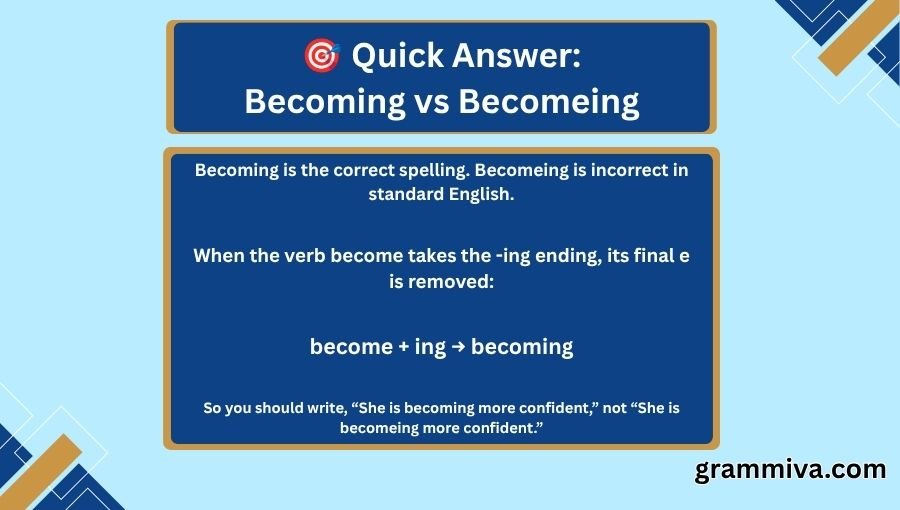
Becoming is the correct spelling. Becomeing is incorrect in standard English.
When the verb become takes the -ing ending, its final e is removed:
become + ing → becoming
So you should write, “She is becoming more confident,” not “She is becomeing more confident.”
Is Becoming the Same as Becomeing?
No. Becoming is the standard correct form, while becomeing is a misspelling.
The key point is that become ends in a silent e. When -ing is added, that final e is dropped. The same spelling pattern appears in many other English verbs.
| Form | Type | Example |
|---|---|---|
| become | Base verb | I want to become a teacher. |
| becoming | Present participle / gerund | She is becoming stronger. |
| became | Simple past | He became a doctor. |
| become | Past participle | They have become close friends. |
| becomeing | Incorrect spelling | ❌ Do not use this form. |
Becoming vs Becomeing at a Glance
The difference is simple: becoming follows the normal spelling rule for a verb ending in silent e, while becomeing incorrectly keeps the final e.
| Form | Type | Meaning | Example | Correct/Incorrect |
|---|---|---|---|---|
| become | Verb | To change into or develop into something | I want to become a pilot. | ✅ Correct |
| becoming | -ing form | Changing into or developing into something | He is becoming a pilot. | ✅ Correct |
| became | Past-tense verb | Changed into or developed into something | She became a leader. | ✅ Correct |
| becomeing | Misspelling | Intended to mean becoming | She is becomeing tired. | ❌ Incorrect |
The extra e is the entire problem. You do not write become + e + ing. You write become + ing after dropping the final e.
What Does Becoming Mean?
Becoming is the -ing form of become. It can describe a change, a process, or a developing condition.
For example:
She is becoming more confident.
Here, becoming shows that the change is happening over time. She is not simply confident at one fixed moment. Her confidence is growing.
Another example is:
The weather is becoming colder.
The word becoming tells us that the weather is changing.
Becoming as an Action in Progress
The word often appears with forms of be:
- I am becoming more patient.
- You are becoming a better writer.
- He is becoming more careful.
- We are becoming good friends.
- They are becoming more comfortable.
The pattern is easy to spot:
subject + be + becoming + description
Becoming as a Gerund
Becoming can also act like a noun.
For example:
Becoming a good writer takes practice.
Here, becoming names an activity or process. It is not simply describing what someone is doing at this exact moment.
| Meaning | Word Type | Example Sentence |
|---|---|---|
| Change in progress | Present participle | The child is becoming sleepy. |
| Developing into a role | Present participle | She is becoming a strong leader. |
| The process of changing | Gerund | Becoming skilled takes time. |
💡 How Can You Test the Spelling?
A quick test is to find the base verb and check whether it ends in a silent e.
If the base verb ends in a silent e, that e is usually removed before -ing is added.
Try these:
| Base Verb | + ing | Result |
|---|---|---|
| become | become + ing | becoming |
| make | make + ing | making |
| take | take + ing | taking |
| write | write + ing | writing |
| use | use + ing | using |
The same idea explains why becomeing looks wrong once you break it apart.
Test Tip
Say the base word first:
become
Then imagine adding -ing:
become + ing
Now remove the final silent e:
becoming
This simple three-step test is useful when you are writing quickly.
Why Do People Confuse Becoming and Becomeing?
Understanding becoming vs becomeing becomes easier when you learn the silent-e rule. People confuse these forms because the word become visibly contains an e at the end. When writers think, “I need to add -ing,” they may simply attach the ending without changing the original spelling.
I once reviewed a short student essay where the writer used becomeing several times. The student knew exactly what the word meant. The problem was not vocabulary. It was applying the spelling rule while writing quickly.
There are several common reasons for this mistake:
- The base word remains visible in your mind.
You see become and then add -ing without removing anything. - The extra e feels natural.
English has many unusual spelling patterns, so writers may hesitate when a letter disappears. - Fast typing can hide mistakes.
A misspelling may look normal until you slow down and read it. - Autocorrect may not catch every error.
Spell-check tools can miss words or fail to flag mistakes in certain situations. - The rule has not become automatic yet.
New writers often need repeated examples before the pattern feels natural.
Key Spelling Rules for Becoming
The spelling rule is straightforward. When become takes -ing, the final silent e is dropped.
So:
become → becoming
Not:
become → becomeing
This is not a special rule created only for become. It is part of a broader spelling pattern.
Silent E Before -Ing
Many verbs ending in silent e lose that e before -ing.
Examples include:
- make → making
- hope → hoping
- drive → driving
- move → moving
- save → saving
- write → writing
- come → coming
- become → becoming
The rule helps keep the spelling clean and follows a common pattern in standard English.
Correct vs Incorrect Examples
| Sentence | Correct/Incorrect | Why |
|---|---|---|
| She is becoming more confident. | ✅ Correct | The final e is dropped. |
| She is becomeing more confident. | ❌ Incorrect | The final e should not remain. |
| He is becoming a skilled cook. | ✅ Correct | Becoming is spelled correctly. |
| He is becomeing a skilled cook. | ❌ Incorrect | Becomeing is a misspelling. |
| The process is becoming easier. | ✅ Correct | The correct -ing form is used. |
📝 Case Study: A Workplace Example
Imagine that a manager writes an email about an employee’s progress:
“Jordan is becoming one of our strongest team members.”
That sentence is clear and professional. It tells the reader that Jordan’s progress is happening over time.
Now imagine this version:
“Jordan is becomeing one of our strongest team members.”
The meaning is still understandable, but the spelling error can distract the reader. In a professional setting, even a small error may make the writer appear less careful.
I once edited a workplace document in which a single misspelled -ing form appeared in an otherwise polished report. The writer had excellent ideas. The error was simply the result of typing quickly. A careful final read fixed it in seconds.
| Situation | Correct Example | Result |
|---|---|---|
| Performance review | Maria is becoming more independent. | Clear and professional |
| Team email | The project is becoming easier to manage. | Natural |
| School paper | The character is becoming more mature. | Correct |
| Conversation | You’re becoming really good at this. | Natural |
| Resume summary | I am becoming more skilled in data analysis. | Grammatically possible |
What Is the Grammar Rule Behind Becoming?
The difference between becoming vs becomeing is easy to remember once you see how the word changes before -ing. The grammar rule is that a final silent e is generally dropped when a verb ending in e takes the -ing suffix.
Therefore:
become + ing = becoming
The spelling becomeing incorrectly retains the final e.
The same rule applies to many verbs:
- write → writing
- dance → dancing
- hope → hoping
- close → closing
- create → creating
There are exceptions and special spelling patterns elsewhere in English, but become does not need a special exception here. Its -ing form is simply becoming.
Most standard English reference sources agree on the spelling becoming, and that is the form you should use in formal and informal writing.
⚠️ Common Mistakes With Becoming
The most common mistake is adding -ing without removing the final e.
Other spelling mistakes happen for similar reasons. Writers may type too quickly, trust autocorrect too much, or never learn the underlying pattern.
| Confusion | Correct Form | Why It Is Confusing |
|---|---|---|
| it’s / its | it’s / its | Both look and sound similar. |
| your / you’re | your / you’re | Both are common in speech. |
| they’re / their / there | they’re / their / there | The forms sound alike. |
| then / than | then / than | Fast reading can hide the difference. |
| become / becoming | become / becoming | The final e changes when -ing is added. |
Why Fast Typing Causes Problems
When people type quickly, they often think about meaning rather than individual letters. That is useful for getting ideas down, but it can cause spelling errors.
I once caught myself typing becomeing in a rushed note. I knew the correct form, but my fingers followed the base word too literally. That quick mistake is a good reminder that even experienced writers can make spelling errors.
Common Wrong Spellings and Uses
| Wrong Form | What’s Wrong | Correct Form |
|---|---|---|
| becomeing | Keeps the final e before -ing | becoming |
| become-ing | Uses an unnecessary hyphen | becoming |
| becomeingg | Adds an extra letter | becoming |
| becomming | Doubles the wrong consonant | becoming |
| becaming | Removes the wrong letters | becoming |
| becomein | Drops the final g | becoming |
How Does Becoming Work in Different Contexts?
Becoming works in everyday conversation, professional writing, creative writing, and digital communication. The spelling does not change based on the setting.
The main difference is how formal the sentence sounds.
| Context | Which Term to Use | Example |
|---|---|---|
| Everyday conversation | becoming | You’re becoming really good at cooking. |
| Professional writing | becoming | The company is becoming more efficient. |
| Creative writing | becoming | The quiet town was becoming strangely empty. |
| Social media/texting | becoming | I’m becoming obsessed with this song! |
The form remains becoming in every context. Informal writing may use shorter sentences or casual expressions, but the spelling itself does not change.
What Are Common Phrases With Becoming?
There are no special idioms that require the misspelled form becomeing. The correct form becoming appears naturally in phrases about change and development.
| Phrase | Meaning |
|---|---|
| becoming more confident | Growing in confidence |
| becoming a professional | Developing into a professional |
| becoming more common | Increasing in frequency |
| becoming easier | Growing less difficult |
| becoming familiar with | Learning through repeated experience |
| becoming aware | Starting to understand or notice something |
For example:
She is becoming familiar with the new software.
This means she is gradually learning how to use it.
How Can You Remember the Difference?
If you are checking becoming vs becomeing, remember that the final silent e is removed before -ing. The easiest memory trick is:
Drop the e before -ing.
Think:
become → becoming
You can also connect becoming with other familiar words:
come → coming
become → becoming
Notice that come loses its final e, and become follows the same pattern.
Another helpful trick is to picture the word in two steps:
BECOME
↓
Remove final E
↓
BECOM
↓
Add ING
↓
BECOMING
This works because the spelling change is visible.
Are There Similar Verbs That Follow the Same Pattern?
Yes. Many verbs ending in silent e drop that letter before -ing.
| Base Verb | Correct -ing Form | Incorrect Form |
|---|---|---|
| make | making | makeing |
| take | taking | takeing |
| write | writing | writeing |
| dance | dancing | danceing |
| hope | hoping | hopeing |
| use | using | useing |
This table shows why the correct spelling of becoming is not random. It belongs to a larger pattern.
Synonyms and Alternatives to Becoming
Sometimes you can replace becoming with another word or phrase. The best choice depends on what you mean.
For example, “She is becoming tired” can become “She is getting tired.” Both express a change in condition.
However, not every alternative works in every sentence.
| Alternative | Works When | Does Not Work When |
|---|---|---|
| getting | Describing a gradual change | You need a more formal tone in some contexts |
| growing | Describing an increase or development | The idea is not about gradual growth |
| turning | Describing a change into a state | The change is not naturally described as a transformation |
| developing into | Describing a longer process | A short, simple sentence is better |
| changing into | Describing a clear transformation | The change is more abstract |
For example:
The weather is becoming colder.
You could say:
The weather is getting colder.
But you would not normally replace every use of becoming with getting. Context matters.
Why Does Getting the Spelling Right Matter?
Correct spelling helps readers understand your writing without distractions. A single error rarely destroys meaning, but repeated errors can affect how polished a piece of writing feels.
This matters especially when writing for school, work, clients, or a public audience.
A useful rule is:
Clear writing makes the reader’s job easier.
You do not need fancy words to write well. You need accurate words, clear sentences, and careful proofreading.
| Situation | Why Getting It Right Matters |
|---|---|
| Resume | Shows attention to detail |
| Client email | Builds a professional impression |
| Published content | Protects readability and credibility |
| Social post | Makes your message easier to read |
Is Becomeing Ever Correct?
No. Becomeing is not the standard spelling of the -ing form of become.
There is no ordinary grammar situation in standard US English where you should choose becomeing instead of becoming. If you see becomeing in a sentence, it is almost certainly a spelling error.
This is different from a genuine spelling variation. English does have words with alternate forms in different regions or contexts. Becomeing, however, is not a standard alternate form of becoming.
How Does Becoming Compare With Become?
Become and becoming are related, but they do different jobs in a sentence.
Become is the base form. Becoming is the -ing form.
Compare:
I want to become a teacher.
and:
I am becoming a teacher.
The first uses the base form after want to. The second uses the -ing form after am.
| Word | Common Function | Example |
|---|---|---|
| become | Base verb | I hope to become a doctor. |
| becoming | -ing form | She is becoming a doctor. |
| became | Past tense | He became a doctor last year. |
| become | Past participle | She has become a doctor. |
Understanding the different forms helps prevent you from treating becomeing as though it were a normal spelling option.
What Should You Write in Formal Writing?
In formal writing, always choose becoming when you need the -ing form of become.
For example:
- The company is becoming more successful.
- The process is becoming more efficient.
- Students are becoming more independent.
- The problem is becoming easier to solve.
Avoid:
- The company is becomeing more successful.
- The process is becomeing more efficient.
- Students are becomeing more independent.
- The problem is becomeing easier to solve.
The correct form is short, clean, and standard.
How Can You Proofread Becoming Quickly?
A fast proofreading method can save time.
First, search your document for becomeing. If you find it, replace it with becoming.
Then check sentences that use become with -ing meaning. Make sure the verb form fits the sentence.
For digital writing, this method is especially useful because a quick search can find every occurrence.
Three-Question Check
Ask:
- Am I using the -ing form of become?
- Did I remove the final e?
- Does the sentence need becoming rather than become, became, or another form?
If the answer to all three is yes, becoming is the correct choice.
How Does Becoming Appear in Real Sentences?
Here are several practical examples.
Personal Growth
I am becoming more confident every day.
This describes gradual personal change.
Work
Our team is becoming more organized.
This describes development over time.
Weather
The days are becoming shorter.
This describes a change that occurs over time.
Relationships
They are becoming close friends.
This describes a relationship that is developing.
Skills
She is becoming better at public speaking.
This describes improvement.
| Sentence | Meaning |
|---|---|
| I am becoming more confident. | My confidence is growing. |
| The city is becoming busier. | The city is growing more busy. |
| He is becoming a better leader. | His leadership skills are improving. |
| We are becoming familiar with the process. | We are learning the process. |
| The task is becoming easier. | The task is growing less difficult. |
Quick Recap Checklist
The core rule is simple: use becoming, not becomeing.
| Question | If Yes → Use |
|---|---|
| Do you need the -ing form of become? | becoming |
| Does the base verb end in silent e? | Drop the e |
| Are you describing a change in progress? | becoming |
| Did you write “becomeing”? | Change it to becoming |
Practice Examples
- The child is becoming more independent.
- Our plans are becoming clearer.
- She is becoming an excellent writer.
Try covering the bold word and spelling it yourself. Then check your answer.
FAQs About Becoming vs Becomeing
Is becoming the correct spelling?
Yes. Becoming is the correct standard spelling of the -ing form of become. Becomeing is a misspelling.
Why is becoming spelled without the e?
The final silent e in become is dropped before the -ing ending is added. Therefore, become + ing becomes becoming.
Is becomeing ever correct?
No. In standard US English, becomeing is not the correct spelling. Use becoming instead.
How do I remember becoming vs becomeing?
Remember the simple rule: drop the final e before adding -ing. Think of come → coming and become → becoming.
What is the difference between become and becoming?
Become is the base verb. Becoming is its -ing form. For example, “I want to become a doctor” uses become, while “She is becoming a doctor” uses becoming.
Can I use becoming in formal writing?
Yes. Becoming is completely appropriate in formal writing. It can appear in reports, essays, business documents, emails, and professional articles.
What are some words like becoming?
Similar -ing forms include making, taking, writing, hoping, moving, and using. They also show the common pattern of dropping a final silent e before -ing.
Is becoming a verb or a noun?
It can function as a verb form or as a gerund. In “She is becoming stronger,” it is part of the verb phrase. In “Becoming skilled takes time,” it functions as a noun-like gerund.
What is the correct phrase: “becomeing more” or “becoming more”?
The correct phrase is “becoming more.” For example: “The work is becoming more difficult.”
Does the spelling change in British English?
The spelling becoming is standard in both US and British English. The form becomeing is not a standard alternative.
Conclusion
Becoming vs becomeing has a simple answer: becoming is correct, and becomeing is incorrect. The reason is the spelling rule for verbs that end in a silent e. Before adding -ing, the final e is usually removed.
So remember this pattern:
become → becoming
Once you understand that pattern, the spelling becomes much easier. You can also apply the same idea to words such as make → making, write → writing, and hope → hoping.
When you are unsure, slow down for one second. Look at the base verb. Remove the final silent e, then add -ing. That small habit can prevent a surprisingly common spelling mistake. ✨
Good grammar does not have to feel difficult. Learn the pattern, practice a few examples, and let the rule become automatic. The best spelling choice is the one that makes your writing clear, correct, and easy to trust. 🚀

I am Adam Wilson, an English language content writer with an interest in grammar and vocabulary. I work at Grammiva and focus on creating clear explanations and practical examples for English learners.
[…] the spelling. By the end, you should be able to choose the right form with confidence. 🌟 Becoming vs Becomeing | Because vs Beacause | Acreage vs […]