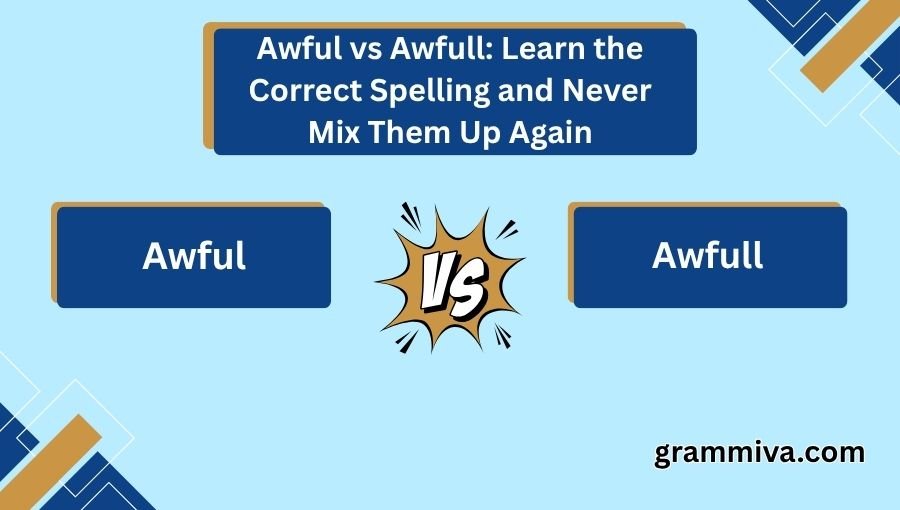
Have you ever typed a word that looks right, stared at it for a second, and suddenly wondered whether you spelled it correctly? 😅 The pair awful vs awfull can cause exactly that kind of doubt. Both forms look almost identical, but only one is standard English spelling.
If you are searching for awful vs awfull, the good news is that the rule is simple. Awful is the correct standard spelling. Awfull is not the standard English spelling of the word. The extra l is the problem.
I work with English learners and everyday writing, and I often see this kind of mistake because English spelling does not always behave the way we expect. A writer may think that adding another letter makes the ending look more complete. That idea can work with some words, but it does not work here.
In this guide, I will explain the difference in plain US English. You will see examples, common mistakes, spelling tips, tables, practical situations, and FAQs. By the end, you should be able to spot the correct form quickly. 🎯 Atheist vs Athiest | Acquire vs Aquire | achieve vs achive
🎯 Quick Answer: Awful vs Awfull
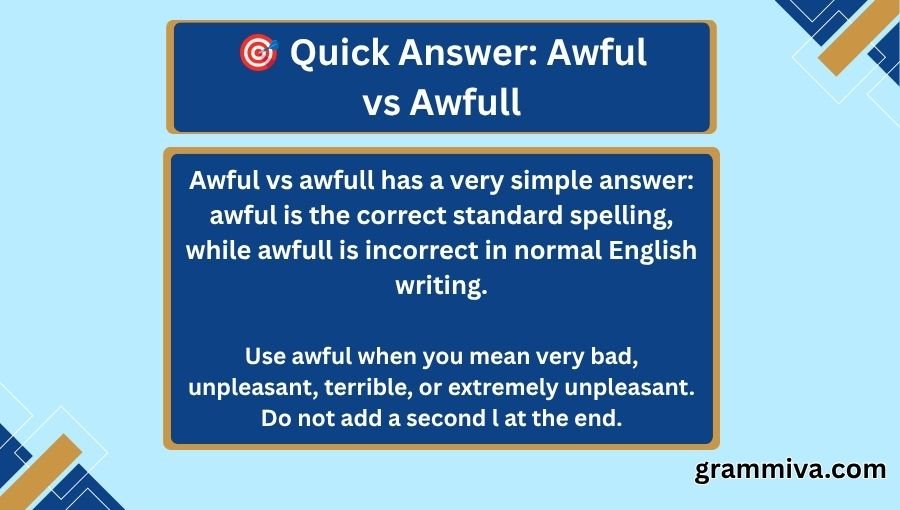
Awful vs awfull has a very simple answer: awful is the correct standard spelling, while awfull is incorrect in normal English writing.
Use awful when you mean very bad, unpleasant, terrible, or extremely unpleasant. Do not add a second l at the end.
| Form | Status | Example |
|---|---|---|
| awful | Correct | The weather was awful. |
| awfull | Incorrect | The weather was awfull. |
So, if you are writing an email, school assignment, article, text, or social media post, choose awful.
Related Word Forms and Close Variants
The word awful does not normally need an extra l to create another spelling form. However, it can appear in different grammatical forms depending on how it is used in a sentence.
| Form | Type | Example |
|---|---|---|
| awful | Adjective | That was an awful mistake. |
| awfully | Adverb | She was awfully tired. |
| awfulness | Noun | The awfulness of the situation was clear. |
Notice something important: awfully has two l letters because the word changes from awful to awfully. That does not mean the base adjective is spelled awfull.
For example:
- Correct: It was an awful day.
- Correct: It was awfully cold.
- Incorrect: It was an awfull day.
That small difference explains one reason people may become unsure about the spelling.
🎯 Understanding Awful vs Awfull
When comparing awful vs awfull, the main issue is spelling. Awful is the standard English adjective, while awfull is an incorrect spelling. The main difference between awful vs awfull is spelling, not meaning. Awful is a real and commonly used English adjective. Awfull is generally a spelling error.
Awful: The Correct Form
Awful is an adjective. It describes something very bad, unpleasant, upsetting, or extreme.
Examples include:
- The food tasted awful.
- We had an awful experience.
- That was an awful decision.
- I feel awful about what happened.
- The traffic was awful this morning.
The exact strength of the word depends on context. Someone may use it to describe something seriously bad, or they may use it casually to show strong dislike.
Awfull: The Incorrect Form
Awfull is not the standard spelling of the adjective. The usual problem is simply an unnecessary second l.
A writer may reason that because awfully has two l letters, awful should perhaps have two as well. That is not how the spelling works.
| Form | Type | Meaning | Example | Correct/Incorrect |
|---|---|---|---|---|
| awful | Adjective | Very bad or unpleasant | The movie was awful. | ✅ Correct |
| awfull | Intended adjective | Intended to mean “awful” | The movie was awfull. | ❌ Incorrect |
| awfully | Adverb | Very; extremely | The movie was awfully long. | ✅ Correct |
| awfulness | Noun | The quality of being awful | We discussed the awfulness of the event. | ✅ Correct |
Why the Extra L Does Not Belong
English spelling often creates confusion when words change form. Adding -ly to an adjective can produce a new spelling pattern. That does not mean the original adjective should be changed.
Think of it this way:
awful → awfully
Not:
awfull → awfully
The base word remains awful.
Awful vs Awfull at a Glance
| Feature | Awful | Awfull |
|---|---|---|
| Standard English spelling | Yes | No |
| Word class | Adjective | Not a standard form |
| Can describe something bad | Yes | No |
| Used in professional writing | Yes | No |
| Needs two final l’s | No | No |
| Example | an awful mistake | an awfull mistake |
The safest rule is short: awful has one l at the end.
Is Awful the Same as Awfull?
No. Awful is the correct English word, while awfull is normally an incorrect spelling of awful.
This is not a case where two spellings have different meanings. Instead, one is standard and the other is a misspelling.
| Sentence | Status | Reason |
|---|---|---|
| The noise was awful. | ✅ Correct | Uses the standard spelling. |
| The noise was awfull. | ❌ Incorrect | Adds an unnecessary final l. |
| She had an awful headache. | ✅ Correct | “Awful” correctly describes the headache. |
| She had an awfull headache. | ❌ Incorrect | “Awfull” is not the standard spelling. |
| That was an awful surprise. | ✅ Correct | Correct adjective form. |
💡 How Do You Remember the Correct Spelling?
The easiest memory trick is to remember that awful ends with one l. If you are tempted to add another l, stop and check the base word.
I sometimes tell students to say the word in their head as aw-ful. The ending is -ful, not -full.
That gives you this simple pattern:
aw + ful = awful
Not:
aw + full = awfull
This trick is especially useful when typing quickly.
Test Tip 💡
When you are unsure, replace the word with another adjective, then return to the original sentence.
For example:
The movie was terrible.
If you want to use the word in question, write:
The movie was awful.
Do not write awfull.
You can also remember this sentence:
An awful mistake has one l.
It is short enough to memorize and useful when proofreading.
What Does Awful Mean in Everyday English?
Awful usually means very bad, unpleasant, or disagreeable. It can describe things, events, experiences, feelings, conditions, and sometimes people or behavior.
| Meaning | Word Type | Example Sentence |
|---|---|---|
| Very bad | Adjective | The service was awful. |
| Very unpleasant | Adjective | We had awful weather. |
| Extremely unpleasant emotionally | Adjective | She felt awful after the argument. |
| Very serious or severe | Adjective | They faced an awful problem. |
The word can also appear in casual speech.
For example, someone might say:
“That sandwich was awful.”
They may simply mean they disliked it very much.
Another person might say:
“I feel awful.”
That can mean they feel physically sick, emotionally bad, or sorry about something. Context tells you which meaning is intended.
When Should You Use Awful?
Use awful before or after a noun when you need an adjective that describes something as very bad or unpleasant.
Before a Noun
We had an awful experience.
Here, awful describes the noun experience.
After a Linking Verb
The experience was awful.
Here, awful describes the subject through the verb was.
To Describe Feelings
I feel awful about the mistake.
Here, the word describes the speaker’s emotional state.
To Describe Conditions
The road conditions were awful.
Here, it describes the condition of the roads.
These uses are all standard.
Why Do People Confuse Awful and Awfull?
People often confuse awful and awfull because the word is closely connected in appearance to the word full. The ending can make writers expect two l letters.
Another source of confusion is awfully. Since awfully contains two consecutive l letters, someone may incorrectly transfer that spelling back to the adjective.
I once helped a student proofread a short story that used awfull several times. The student knew exactly what the word meant. The only issue was the extra l. We changed every instance to awful, and the rest of the story was fine. That experience is a good reminder that spelling mistakes do not always mean a writer lacks strong English skills.
Three Common Causes
| Cause | How It Leads to the Error | Example |
|---|---|---|
| Fast typing | The writer does not stop to check the word. | awfull |
| Autocorrect or typing habits | A device may not catch every unusual spelling. | awfull |
| Lack of spelling knowledge | The writer may assume “full” controls the ending. | awfull |
📝 Case Study: A Workplace Email
Imagine that a customer service employee needs to describe a difficult delivery. This workplace example shows why the awful vs awfull distinction matters. Even when the meaning is obvious, using the standard spelling makes the message look more polished.
The employee writes:
“I am sorry that you had an awfull experience with our delivery service.”
The meaning is clear, but the spelling is wrong.
A corrected version would be:
“I am sorry that you had an awful experience with our delivery service.”
That small correction matters in a workplace email. Customers may judge the quality of a business partly by how carefully its messages are written.
| Version | Result | Comment |
|---|---|---|
| I am sorry you had an awful experience. | ✅ Correct | Clear and professional. |
| I am sorry you had an awfull experience. | ❌ Incorrect | Contains a spelling error. |
| The delay was awful. | ✅ Correct | Standard adjective. |
| The delay was awfull. | ❌ Incorrect | Extra l. |
The lesson is simple: when the word is used as an adjective, write awful.
Grammar Rules Explanation
The grammar rule behind awful vs awfull is straightforward: awful is the standard adjective, and awfull is not the standard spelling. Awful is an adjective used to describe a noun or a state or condition. Its standard spelling ends with a single l.
Awfull is not the standard spelling of this adjective in ordinary English. Therefore, it should not be used in formal writing, schoolwork, business communication, or edited content.
The spelling of awfully can create confusion. When the adverb is formed, the ending produces awfully, with two consecutive l letters. That does not change the spelling of the base adjective.
The same pattern appears in other English words where a base form and an added suffix may look different. Writers should check the base word instead of assuming that every related form keeps exactly the same letter pattern.
Most standard English reference works agree on the basic distinction: awful is the standard spelling, and awfull is not.
Correct vs Incorrect at a Glance
| Sentence | Correct/Incorrect | Why |
|---|---|---|
| The weather was awful. | ✅ Correct | “Awful” is the correct adjective. |
| The weather was awfull. | ❌ Incorrect | The extra l is unnecessary. |
| I had an awful morning. | ✅ Correct | Standard spelling and usage. |
| I had an awfull morning. | ❌ Incorrect | “Awfull” is misspelled. |
| The movie was awfully long. | ✅ Correct | “Awfully” is the correct adverb form. |
⚠️ Common Mistakes With Awful
The most common mistake is adding a second l. But writers can make other errors when they are unsure about related forms. Most awful vs awfull mistakes happen because writers connect the word with full or confuse awful with awfully.
Here are some common English confusions that show why careful proofreading helps.
| Confusion | Correct Form | Main Difference |
|---|---|---|
| it’s / its | it’s / its | “It’s” means “it is” or “it has”; “its” shows possession. |
| your / you’re | your / you’re | “Your” shows possession; “you’re” means “you are.” |
| their / there / they’re | their / there / they’re | Possession, place, and “they are.” |
| then / than | then / than | Time or sequence versus comparison. |
| affect / effect | affect / effect | Different common grammatical roles and meanings. |
Specific Wrong Spellings of Awful
| Wrong Form | What’s Wrong | Correct Form |
|---|---|---|
| awfull | Extra final l | awful |
| awfullest | Incorrect base spelling | awful or most awful, depending on context |
| awfullly | Extra letters | awfully |
| awfuly | Missing l in the adverb | awfully |
| awfullness | Incorrect spelling | awfulness |
Not every unusual form will appear in normal writing, but these examples show how easily extra or missing letters can spread when the base spelling is misunderstood.
I once caught myself typing awfull in a quick message. I had typed the word without thinking because I was moving quickly. I noticed the red spell-check mark before sending it and changed it. Even experienced writers can make simple spelling errors when they type too fast.
How Does Awfully Relate to Awful?
Awfully is a real word, but awfull is not the correct base spelling of awful.
This distinction is worth learning because it explains a common source of confusion.
Compare:
| Word | Function | Example |
|---|---|---|
| awful | Adjective | That was an awful mistake. |
| awfully | Adverb | That was awfully kind of you. |
| awfulness | Noun | The awfulness of the event was hard to describe. |
The important point is that the extra l belongs in certain related forms because of the suffix. It does not belong in the base adjective.
Awful in Different Contexts
The rule for awful vs awfull does not change based on where you write. Whether you are texting a friend, writing an email, or publishing an article, the standard spelling is awful. The word awful works in many types of writing. The main rule does not change.
| Context | Which Term to Use | Example |
|---|---|---|
| Everyday conversation | awful | That traffic was awful. |
| Professional writing | awful | The customer reported an awful experience. |
| Creative writing | awful | An awful silence filled the room. |
| Social media/texting | awful | That was an awful movie! |
Everyday Conversation
In conversation, awful is common and natural.
“The weather was awful today.”
It can sound strong, but it is often used casually.
Professional Writing
In professional writing, awful is grammatically correct. However, writers should consider tone. In a formal report, a more precise word may sometimes be better.
Instead of:
The results were awful.
You might write:
The results were poor.
The choice depends on what you want to communicate.
Creative Writing
Creative writers can use awful to create emotion or tension.
An awful sound came from the empty room.
The word can make a description feel strong and direct.
Social Media and Texting
Informal digital writing often uses awful in short reactions.
“That was an awful idea.”
Even when the writing is casual, the standard spelling remains awful.
Common Phrases With Awful
There are several everyday phrases that naturally use awful.
| Phrase | Meaning |
|---|---|
| awful lot | A very large amount |
| feel awful | Feel very bad physically or emotionally |
| awful day | A very unpleasant day |
| awful mistake | A very bad mistake |
| awful experience | A very unpleasant experience |
| awful weather | Very unpleasant weather |
For example:
“I have an awful lot of work to finish.”
Here, awful lot is an established informal expression meaning a large amount.
Another example is:
“I feel awful about what I said.”
Here, awful describes the speaker’s emotional state.
How Can You Replace Awful?
Sometimes you can replace awful with another word. The best choice depends on the meaning and tone you want.
| Alternative | Works When | Does Not Work When |
|---|---|---|
| terrible | You want a strong negative description. | You need a mild or neutral tone. |
| unpleasant | You want a softer, more formal tone. | You want to show very strong emotion. |
| poor | You are discussing quality or performance. | You are describing an emotional state. |
| horrible | You want a very strong negative reaction. | You need a restrained professional tone. |
| bad | You want a simple, broad word. | You need a more vivid description. |
For example, these can all work:
The service was awful.
The service was terrible.
The service was poor.
But they do not always communicate exactly the same feeling. Poor can sound more measured. Terrible can sound stronger.
Why Does Correct Spelling Matter? 🎯
Getting awful vs awfull right is a small detail, but accurate spelling improves clarity and makes professional writing look more polished. Correct spelling helps readers understand your meaning without distractions. A single extra letter can make a word look careless, especially in professional or published writing.
A useful writing rule is:
Clear words build trust; careless spelling can weaken it.
That does not mean one typo ruins good writing. Everyone makes occasional mistakes. The goal is to catch them before the reader does.
| Situation | Why Getting It Right Matters |
|---|---|
| Resume | Shows care and attention to detail. |
| Client email | Supports a professional image. |
| Published content | Makes the writing easier to trust and read. |
| Social post | Keeps the message polished and clear. |
When you write awful instead of awfull, the reader can focus on your message rather than your spelling.
Can Awful Be Used in Formal Writing?
Yes. Awful is grammatically acceptable in formal writing, but its tone may be too emotional for some situations.
For example:
The organization experienced an awful decline in service.
This is grammatically correct, but a formal report might prefer:
The organization experienced a serious decline in service.
The choice depends on your purpose. Correct spelling does not automatically make a word the best style choice.
| Writing Goal | Possible Choice |
|---|---|
| Strong emotion | awful |
| Neutral description | unpleasant |
| Business evaluation | poor |
| Very strong criticism | terrible |
| Simple everyday language | bad |
How To Remember The Difference
The best way to remember awful vs awfull is to focus on the ending.
Awful = one l.
That is the core rule.
Try this quick mental check:
- Look at the word.
- Find the final letters.
- Ask whether you are writing awful or adding an unnecessary l.
- Keep only one final l.
- If you are writing awfully, remember that it is a different form.
A Simple Memory Line
Awful has one L, even when the situation is really bad.
That line is easy to repeat when proofreading.
Can You Say “Awfull” in English?
You may see awfull in informal posts, user names, typos, or other unedited material, but it is not the standard spelling to use in normal English.
A spelling that appears online is not automatically a correct dictionary form. People make typing errors every day.
| Where You See It | Should You Copy It? | Why |
|---|---|---|
| Edited article | No | It may be a typo. |
| Social media comment | No | Informal posts contain many errors. |
| Username or brand-style name | Not necessarily | Names can use unusual spellings. |
| School assignment | No | Use standard spelling. |
| Business email | No | Standard spelling is expected. |
If you encounter awfull, the safest assumption in ordinary English writing is that the writer intended awful.
Quick Recap Checklist ✅
Use this checklist whenever you are unsure.
| Question | If Yes → Use |
|---|---|
| Do I mean “very bad” or “very unpleasant”? | awful |
| Am I using the adjective before a noun? | awful |
| Am I describing how something is? | awful |
| Am I adding the adverb ending -ly? | awfully |
| Am I about to write “awfull”? | Stop and use awful |
Practice Examples
- The hotel room was awful.
- I feel awful about missing the meeting.
- The weather was awfully cold.
The first two use the adjective. The third uses the adverb.
FAQs About Awful vs Awfull
Is “awful” the correct spelling?
Yes. Awful is the standard spelling. It has one l at the end.
Is “awfull” a word?
Awfull is not the standard spelling of the English adjective awful. In ordinary writing, treat it as a spelling error.
Why do people spell awful with two Ls?
People may connect awful with full, or they may confuse it with awfully, which has two consecutive l letters. Fast typing can also cause the mistake.
Is “awfully” spelled with two Ls?
Yes. Awfully is spelled with two consecutive l letters. It is an adverb related to awful.
Should I write “awful” in a formal email?
Yes. Awful is correctly spelled and grammatically acceptable in a formal email. However, consider whether a softer or more precise word fits your professional tone better.
What is the difference between awful and awfully?
Awful is an adjective. Awfully is an adverb. For example, “The weather was awful” uses the adjective, while “It was awfully cold” uses the adverb.
Is “awful” an adjective?
Yes. Awful is an adjective. It can describe something that is very bad, unpleasant, or upsetting.
Can awful describe a person?
Yes, depending on the sentence. For example, “He was awful to his coworkers” uses awful to describe someone’s behavior. The word can sound harsh, so context and tone matter.
How do I remember the spelling of awful?
Remember this simple rule: awful has one final l. Think aw + ful, not aw + full.
Is “awfull” ever acceptable?
It may appear as part of a special name, username, artistic spelling, or other nonstandard label. But for ordinary English writing, use awful, not awfull.
Conclusion
Awful vs awfull is easier to remember than it first appears. Awful is the correct standard spelling, and it has one l at the end. Awfull is normally a misspelling caused by an extra letter.
The most useful rule is simple: when you mean “very bad,” “very unpleasant,” or “terrible,” write awful. When you need the adverb, write awfully, which has a different ending and two consecutive l letters.
I recommend keeping the base form in mind when you proofread. Do not let a related word such as awfully make you change the spelling of awful. A quick final check can catch the error before it reaches your reader. ✨
If you remember only one thing, remember this: awful has one L, and awfull is not the standard spelling. Get that small detail right, and you will never need to second-guess this pair again. ✅

I am Alex Morgan, an English grammar and vocabulary writer passionate about making language learning simple and useful. I work at Grammiva, where I create clear educational content and practical English examples for learners.
[…] can use in real writing. By the end, you should be able to spot the error almost instantly. ✍️ Awful vs Awfull | Atheist vs Athiest | Acquire vs […]
[…] end, you should be able to choose the right form without stopping to think. ✨ Acreage vs Acrage | Awful vs Awfull | Atheist vs […]