Have you ever typed a sentence, looked at the word in the middle, and suddenly thought, “Wait, is that spelling right?” 😅 because vs beacause is one of those small spelling questions that can stop a sentence in its tracks. The two forms look almost identical, but only one belongs in standard English.
If you are writing an email, school assignment, resume, blog post, or social media caption, this tiny spelling choice can affect how polished your writing looks. The good news is that the rule is simple. Because is the correct spelling. Beacause is a misspelling.
I have helped writers catch small errors like this for years, and I often tell students that spelling problems are easier to fix when you understand the pattern instead of trying to memorize every letter. In this guide, I will show you the difference, explain why people make the mistake, give you easy memory tricks, and walk through real examples. By the end, you should be able to choose the right form without stopping to think. ✨ Acreage vs Acrage | Awful vs Awfull | Atheist vs Athiest
🎯 Quick Answer: Because vs Beacause
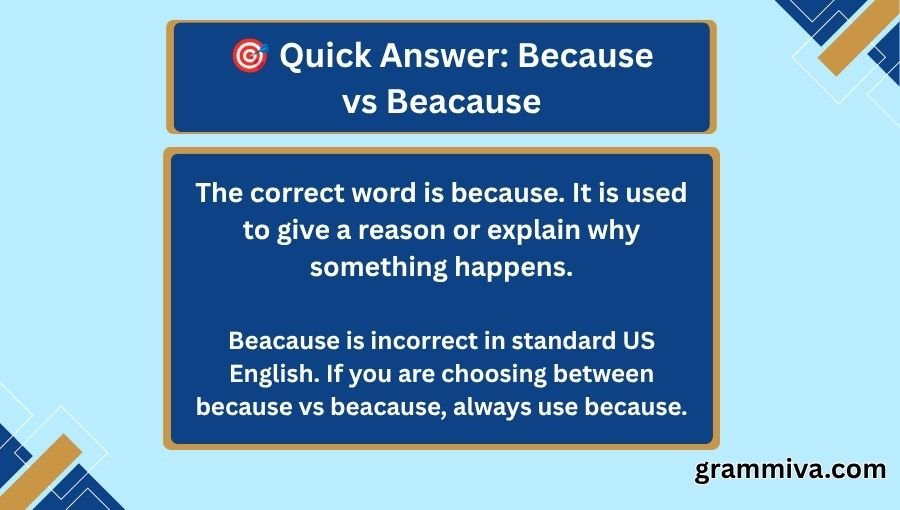
The correct word is because. It is used to give a reason or explain why something happens.
Beacause is incorrect in standard US English. If you are choosing between because vs beacause, always use because.
| Word | Correct? | Meaning | Example |
|---|---|---|---|
| because | ✅ Yes | Gives a reason | I stayed home because it was raining. |
| beacause | ❌ No | Misspelling of “because” | I stayed home beacause it was raining. |
The easiest rule is this: because has the letters “cause” after “be.” Think be + cause = because.
Is Because the Same as Beacause?
No. Because and beacause are not two different words with different meanings. Because is the standard English word, while beacause is simply a spelling error.
When writers compare because vs beacause, the main issue is spelling, not grammar. The meaning you want is expressed by because.
For example:
- ✅ I left early because I was tired.
- ❌ I left early beacause I was tired.
The first sentence is correct. The second sentence has one spelling error.
The mistake is easy to make because the letters in the middle of the word can feel out of order. Writers may accidentally place an extra a after be. That produces beacause, but standard English does not use that spelling.
The Core Difference
| Form | Type | Meaning | Example | Correct/Incorrect |
|---|---|---|---|---|
| because | Conjunction | Gives a reason | She smiled because she was happy. | ✅ Correct |
| beacause | Misspelling | No standard meaning | She smiled beacause she was happy. | ❌ Incorrect |
A Simple Spelling Pattern
Break because into two helpful parts:
be + cause = because
This is not meant as a history lesson about how the word was formed. It is simply a useful memory trick.
Compare these:
- because → correct
- beacause → incorrect
- becuase → incorrect
- becouse → incorrect
The spelling you want is always because.
Why Do People Confuse Because and Beacause?
People confuse because vs beacause mainly because the word contains several vowels close together. When typing quickly, it is easy to put an a in the wrong place.
I once edited a short workplace report where the writer had typed beacause four times. The writer knew the correct word but had made the same typing error each time. Once I pointed it out, the pattern was obvious.
Here are some common reasons for the mistake:
- Fast typing: Your fingers may move faster than your attention.
- Autocorrect: Some devices may not catch every spelling error.
- Memory confusion: You may remember the sound but not the exact letter order.
- Visual similarity: The two forms look very close.
- Lack of practice: If you rarely write the word, its spelling may not feel automatic.
| Cause of Error | What Happens | Easy Fix |
|---|---|---|
| Fast typing | Letters are swapped or added | Slow down for important writing |
| Autocorrect | A typo may go unnoticed | Proofread manually |
| Lack of knowledge | The writer does not know the correct form | Learn the spelling pattern |
| Visual confusion | Similar letters seem to blend together | Compare the two forms |
| Repeated habit | The same typo appears again and again | Save the correct form in memory |
The important point is that a spelling mistake does not always mean the writer does not understand English. Sometimes it is simply a typing habit.
Because vs Beacause: Key Differences
The biggest difference between because vs beacause is straightforward: one is correct and one is not.
Because is a standard English word. It commonly introduces a reason or cause.
Beacause is not a standard alternative spelling. It should not be used in formal or standard writing.
| Feature | Because | Beacause |
|---|---|---|
| Standard English word | Yes | No |
| Gives a reason | Yes | No |
| Acceptable in formal writing | Yes | No |
| Acceptable in school writing | Yes | No |
| Standard dictionary entry as this spelling | No | No |
| Correct spelling | Yes | No |
Correct Examples
- ✅ We canceled the trip because the weather was bad.
- ✅ I called because I needed help.
- ✅ She was late because her bus broke down.
- ✅ He studied because he wanted to pass the test.
Incorrect Examples
- ❌ We canceled the trip beacause the weather was bad.
- ❌ I called beacause I needed help.
- ❌ She was late beacause her bus broke down.
- ❌ He studied beacause he wanted to pass the test.
Notice that the sentence structure stays the same. Only the spelling of the word changes.
How Is Because Used Correctly?
Because is generally used to introduce a reason. It often connects an action or result with the reason behind it.
For example:
I wore a jacket because it was cold.
The first part tells us what happened: I wore a jacket.
The second part tells us why: it was cold.
That makes because useful when you want to answer the question Why?
Giving a Reason
Use because when you want to explain why something happened.
Maya stayed inside because it was raining.
The reason Maya stayed inside was the rain.
Explaining a Choice
Because can also explain a decision.
We chose the smaller room because it was cheaper.
The word connects the choice with its reason.
Explaining an Opinion
You can use because when explaining why you think or feel something.
I like this book because the story is easy to follow.
The second part supports the opinion in the first part.
| Meaning | Word Type | Example Sentence |
|---|---|---|
| Gives a reason | Conjunction | I left because I was tired. |
| Explains a choice | Conjunction | We stayed because it was comfortable. |
| Supports an opinion | Conjunction | I like it because it is simple. |
💡 Test Tip
When you are unsure about the spelling, ask yourself:
“Am I trying to write the word that gives a reason?”
If yes, write because.
Then check the letters:
b-e-c-a-u-s-e
If your version contains beacause, stop and correct it.
What Is the Best Memory Trick for Because?
The easiest memory trick is to remember the middle of the word: cause.
Think:
be + cause → because
This trick is useful because beacause contains an extra a after the e.
| Spelling | Memory Check | Result |
|---|---|---|
| because | be + cause | ✅ Correct |
| beacause | bea + cause | ❌ Incorrect |
| becuase | Missing the normal letter order | ❌ Incorrect |
| becouse | Incorrect vowel pattern | ❌ Incorrect |
Another useful trick is to type the word slowly three times:
because — because — because
Then use it in a sentence:
I stayed home because I was sick.
Writing the correct form several times can help make the letter order feel natural.
📝 Case Study: A Workplace Email
Imagine that an employee wants to send this message:
❌ I will not be able to attend the meeting beacause I have another appointment.
The meaning is clear, but the spelling error makes the email look less polished.
A corrected version is:
✅ I will not be able to attend the meeting because I have another appointment.
I once caught myself typing the wrong spelling while answering a quick message. I had written the sentence several times before, so my hands were moving almost automatically. I stopped, noticed the extra a, and fixed it before sending the message.
That small moment shows why proofreading matters. Even experienced writers can make simple typing errors.
| Workplace Situation | Better Form | Example |
|---|---|---|
| Explaining an absence | because | I am absent because I am ill. |
| Explaining a delay | because | The report is late because we needed more data. |
| Explaining a decision | because | We changed the plan because the deadline moved. |
| Explaining a problem | because | The file did not open because it was damaged. |
📚 Grammar Rules Explanation
Because is a standard conjunction used to connect a reason with the statement it explains. It can introduce a clause that tells the reader why something happened.
For example:
The game was canceled because it rained.
The main statement is The game was canceled. The clause because it rained gives the reason.
The spelling beacause does not represent a separate grammatical form. It is a misspelling of because. Standard English does not treat the two spellings as interchangeable.
Most standard dictionaries and grammar references use because as the accepted spelling. When writing in standard US English, because is the safe and correct choice.
Correct vs Incorrect at a Glance
| Sentence | Correct/Incorrect | Why |
|---|---|---|
| I stayed home because I was tired. | ✅ Correct | “Because” introduces the reason. |
| I stayed home beacause I was tired. | ❌ Incorrect | “Beacause” is misspelled. |
| She left because the store closed. | ✅ Correct | The spelling is standard. |
| He smiled beacause he won. | ❌ Incorrect | The word contains an extra “a.” |
| We waited because the bus was late. | ✅ Correct | “Because” correctly introduces the reason. |
The grammar is not difficult here. The key issue is spelling.
⚠️ Common Mistakes With Because
The most common mistakes happen when people type the word from memory instead of checking its letters.
Another common problem is assuming that a familiar-looking spelling must be correct. English contains many words that sound different from how they look, so visual guesses can be unreliable.
Common Grammar Confusions
| Confusion | Correct Form | Common Error |
|---|---|---|
| because vs beacause | because | beacause |
| its vs it’s | Depends on meaning | Mixing possession and contraction |
| your vs you’re | Depends on meaning | Mixing possession and contraction |
| their vs there | Depends on meaning | Mixing place and possession |
| then vs than | Depends on meaning | Mixing time and comparison |
These mistakes have different rules, but they share one lesson: small spelling differences can change whether a sentence is correct.
Why These Errors Happen
Fast typing is one major reason. Your fingers can create a typo before your brain notices.
Autocorrect can also create false confidence. A device may fix some mistakes but miss others.
Lack of knowledge is another reason. If someone has never learned the correct spelling, they may naturally guess.
Habit matters too. Once a person repeatedly types the wrong form, the error can become automatic.
Specific Wrong Spellings
| Wrong Form | What’s Wrong | Correct Form |
|---|---|---|
| beacause | Extra “a” after “be” | because |
| becuase | Letters are in the wrong order | because |
| becouse | Incorrect vowel pattern | because |
| becasue | Letters are rearranged | because |
| becaus | Final “e” is missing | because |
I once reviewed a student’s homework in which because appeared correctly in one paragraph and incorrectly in another. The student was not confused about the meaning. The problem was simply inconsistent spelling. That is a good reminder to check the whole document, not just the first few lines.
When Should You Use Because in Everyday Writing?
You should use because whenever you need to give a reason in standard English. This applies to casual speech, schoolwork, workplace writing, and online communication.
The setting may change the tone of your sentence, but it does not change the correct spelling.
| Context | Which Term to Use | Example |
|---|---|---|
| Everyday conversation | because | I stayed home because I felt tired. |
| Professional writing | because | The meeting changed because of a scheduling issue. |
| Creative writing | because | She ran because she heard a strange sound. |
| Social media/texting | because | I missed it because I was busy. |
In very casual texting, people sometimes shorten words. However, beacause is not a standard short form of because. If you want clear writing, use because.
How Does Because Work in a Sentence?
Because usually connects two parts of an idea. One part states an event, action, or result. The other gives its reason.
Consider:
The child cried because he was tired.
The result is The child cried.
The reason is he was tired.
You can also move the reason to the beginning:
Because he was tired, the child cried.
The word remains because in both positions.
| Sentence Pattern | Example |
|---|---|
| Main idea + because + reason | I left because I was tired. |
| Because + reason + main idea | Because I was tired, I left. |
| Main idea + because + explanation | She smiled because the joke was funny. |
| Because + explanation + main idea | Because the joke was funny, she smiled. |
This is one reason because is such a useful word. It helps readers understand the link between an action and its reason.
Can Because Start a Sentence?
Yes. Because can begin a sentence when it introduces a reason clause.
For example:
Because it was raining, we stayed inside.
This is a complete sentence because the main clause follows the reason clause.
A common mistake is writing only the reason clause:
❌ Because it was raining.
That is a fragment if it stands alone without a main clause.
A better version is:
✅ Because it was raining, we stayed inside.
| Example | Status | Reason |
|---|---|---|
| Because it was raining, we stayed home. | ✅ Correct | Complete sentence |
| We stayed home because it was raining. | ✅ Correct | Complete sentence |
| Because it was raining. | ❌ Usually a fragment | No main clause |
| We stayed home beacause it was raining. | ❌ Incorrect | Misspelled word |
How Does Because Compare With Similar Alternatives?
Sometimes you can replace because with another phrase, but the replacement depends on the sentence.
Since can sometimes introduce a reason, although it can also refer to time. Context tells the reader which meaning is intended.
As can also introduce a reason, but it may have other meanings.
Because of is useful before a noun or noun phrase.
Compare:
We stayed home because it rained.
and:
We stayed home because of the rain.
Both give a reason, but their sentence structures differ.
| Alternative | Works When | Does Not Work When |
|---|---|---|
| because | Introducing a reason clause | You need a noun phrase after it |
| because of | Introducing a noun or noun phrase | You want a full clause directly after it |
| since | The context clearly shows a reason | The meaning could be confused with time |
| as | A reason is clear from context | A stronger, clearer reason is needed |
| due to | A noun-based explanation fits | Used as a direct replacement in every sentence |
For example:
I stayed home because I was sick.
But:
I stayed home because of my illness.
That distinction is useful, but neither alternative makes beacause correct.
Common Phrases With Because
Because appears in many everyday expressions and sentence patterns. These are not special exceptions. They are simply common ways to use the word.
| Phrase | Meaning |
|---|---|
| because of | As a result of a reason or cause |
| just because | For that reason alone, often with emphasis |
| because I said so | A reason based on someone’s authority |
| because of this | Refers to a previously stated reason |
| mainly because | Shows the main reason |
| partly because | Shows one reason among several |
Because vs Because Of
This is a useful distinction for learners.
Use because before a clause:
We stayed home because it was raining.
Use because of before a noun or noun phrase:
We stayed home because of the rain.
| Form | What Follows | Example |
|---|---|---|
| because | Clause | because it was raining |
| because of | Noun/noun phrase | because of the rain |
| because | Clause | because she was busy |
| because of | Noun/noun phrase | because of her schedule |
Do not turn because of into beacause of. The first word must still be spelled because.
Why Does Correct Spelling Matter?
When learning because vs beacause, correct spelling matters because even a small typo can affect how polished your writing looks. In professional and academic writing, using because correctly helps keep your message clear.
This matters especially in professional and academic writing.
A typo in a text message may not matter much. A typo in a resume, report, or client email can make the writer seem less careful.
“Clear writing gives your ideas room to be understood.”
That principle applies even to very small words.
| Situation | Why Getting It Right Matters |
|---|---|
| Resume | Shows attention to detail |
| Client email | Supports a professional image |
| Published content | Builds reader trust |
| Social post | Makes the message easier to read |
This does not mean one typo defines a person. Everyone makes mistakes. The goal is simply to catch easy errors when you can.
How Can You Remember Because Every Time?
A simple way to remember because vs beacause is to focus on the letter order rather than the sound. The correct spelling is b-e-c-a-u-s-e. Think of it as be + cause.
Remember:
B-E-C-A-U-S-E
A useful visual trick is to highlight the middle:
BE + CAUSE
Now compare it with the mistake:
BEA + CAUSE
The incorrect version has an extra A in the wrong place.
You can also use a three-step check:
- Write because.
- Look at the letters b-e-c-a-u-s-e.
- Check that you did not add an a after be.
For important documents, run a spell-check and then read the sentence yourself. Automated tools are helpful, but they are not perfect.
Is Beacause Ever Correct?
No. Beacause is not a standard English spelling of because.
You may see it in online posts, comments, informal messages, or user-generated content. Seeing the spelling does not make it correct.
It may appear because someone made a typing mistake. It may also appear in copied text that was never proofread.
There is no need to treat beacause as a rare formal exception. For standard US English, use because.
| Situation | Correct Choice |
|---|---|
| School assignment | because |
| Business email | because |
| Resume | because |
| Blog article | because |
| Social media post | because |
| Formal report | because |
How Should You Correct a Sentence With Beacause?
Simply replace beacause with because. You usually do not need to change anything else.
Before:
❌ I stayed late beacause the project was unfinished.
After:
✅ I stayed late because the project was unfinished.
Before:
❌ She called me beacause she needed advice.
After:
✅ She called me because she needed advice.
| Incorrect Sentence | Corrected Sentence |
|---|---|
| ❌ We left beacause it was late. | ✅ We left because it was late. |
| ❌ He smiled beacause he was happy. | ✅ He smiled because he was happy. |
| ❌ I studied beacause I had a test. | ✅ I studied because I had a test. |
| ❌ They stayed inside beacause of the storm. | ✅ They stayed inside because of the storm. |
The correction is small, but it makes the sentence standard.
How Can You Check Because vs Beacause Quickly?
When you see beacause, do not overthink the sentence. Check the spelling first.
The correct sequence is:
b → e → c → a → u → s → e
If the word starts bea, you have probably made the common spelling error.
A Five-Second Check
Ask:
- Does the word mean “for the reason that”?
- Did I spell it because?
- Did I accidentally write beacause?
- Is there an extra a after be?
- Would a spell-check flag the word?
This quick check is especially useful before submitting schoolwork or sending professional messages.
🎯 Because vs Beacause: The Rule in Real Life
The rule is simple enough to apply without a grammar book: write because when you need the standard word that introduces a reason.
Whether you are writing “I stayed home because I was tired” or “The project changed because the deadline moved,” the spelling stays the same.
The context does not create a different spelling.
| Real-Life Example | Correct Form |
|---|---|
| Explaining why you are late | because |
| Explaining why you changed plans | because |
| Explaining why you like something | because |
| Explaining why something happened | because |
| Explaining a result | because |
If you remember only one thing from this article, remember the middle:
be + cause = because
How Do I Know Which Spelling to Use?
When deciding because vs beacause, choose because every time in standard English. Beacause is not an alternative spelling; it is simply a misspelling.
The second form is a typo, not a second spelling choice. The word is spelled:
because
Here are a few final examples:
- ✅ I am happy because I finished my work.
- ❌ I am happy beacause I finished my work.
- ✅ We canceled the event because of the storm.
- ❌ We canceled the event beacause of the storm.
The correct form works in both casual and formal writing.
How Can I Avoid This Mistake in the Future?
If because vs beacause is a spelling problem you make often, practice writing because in short sentences. Repeated correct use can help make the spelling automatic.
First, memorize because as one complete word. Second, use the be + cause memory trick. Third, proofread important writing before you send or submit it.
If you repeatedly make the same typo, practice the word in short sentences instead of simply staring at the spelling.
Try these:
I stayed because I wanted to help.
She left because she was tired.
We waited because the train was late.
After several correct uses, the spelling becomes easier to recognize.
How Does This Apply to Digital Communication?
The because vs beacause confusion is especially common in digital communication because people often type quickly on phones and computers. Even in casual messages, because remains the standard spelling.
Still, the standard spelling does not change online.
Whether you write a text, comment, post, email, or work message, because remains the correct spelling.
A casual setting may allow slang, abbreviations, or intentional misspellings. But beacause should not be treated as a normal abbreviation or alternate form.
| Digital Setting | Recommended Form | Example |
|---|---|---|
| Text message | because | I left because I was tired. |
| Work chat | because | I missed it because I was in a meeting. |
| Social media | because | I stayed home because of the rain. |
| Online article | because | The change happened because demand increased. |
FAQs About Because vs Beacause
Is “beacause” a correct spelling?
No. Beacause is a misspelling. The correct spelling is because.
Why do people spell because as beacause?
The error usually happens because the letters and vowel sounds are easy to mix up. Fast typing, weak spelling memory, and repeated typing habits can also cause it.
Is because a conjunction?
Yes. Because commonly works as a conjunction that introduces a reason clause.
Can because start a sentence?
Yes. For example: “Because it was raining, we stayed inside.” The sentence is complete because it contains a main clause.
What is the easiest way to remember because?
Think be + cause. The correct spelling is because, not beacause.
Is beacause an acceptable informal spelling?
No. Although you may see it online, it is still a misspelling in standard English.
What is the difference between because and because of?
Because normally introduces a clause, while because of is followed by a noun or noun phrase.
Example: “I stayed home because it rained.”
Example: “I stayed home because of the rain.”
Can I use because in professional writing?
Yes. Because is completely appropriate in professional writing when you need to explain a reason.
Is because the correct spelling in US English?
Yes. In standard US English, the correct spelling is because.
What should I do if I accidentally write beacause?
Replace it with because. Then check the rest of your document for the same typo, especially if you made the mistake more than once.
✅ Quick Recap Checklist
The central rule is easy: because is correct, while beacause is a spelling mistake.
| Question | If Yes → Use |
|---|---|
| Am I giving a reason? | because |
| Am I explaining why something happened? | because |
| Am I writing in standard English? | because |
| Did I type “beacause”? | Change it to because |
| Do I see an extra “a” after “be”? | Remove it |
Practice Examples
- I stayed home ___ I was tired.
Answer: because - She called ___ she needed help.
Answer: because - We left early ___ the weather was getting worse.
Answer: because
Try saying the word slowly while looking at its letters:
be-cause
That small habit can make the correct spelling much easier to remember.
Conclusion
Because vs beacause has a very simple answer: because is the correct spelling, and beacause is a misspelling. The correct word is used to give a reason, explain an action, or connect an event with why it happened.
The most useful memory trick is be + cause = because. When you type the word, watch for the extra a that turns the correct spelling into beacause.
I recommend using the same quick check whenever you proofread: look at the letter order, especially the middle of the word. If you see bea, stop and fix it.
Small spelling choices may seem minor, but clean writing helps your ideas come across with confidence. 🌟 Once because becomes familiar, this particular mistake is easy to leave behind.
Remember: when you mean “for the reason that,” spell it B-E-C-A-U-S-E—because clear writing starts with the right letters.

I am Ryan Mitchell, a writer focused on English grammar, vocabulary, and everyday language. I work at Grammiva, creating easy-to-understand articles that help readers improve their English with confidence.

[…] the spelling pattern behind it. That way, you can use the same rule with many other verbs. 👍 Because vs Beacause | Acreage vs Acrage | Awful vs […]
[…] the end, you should be able to choose the right form with confidence. 🌟 Becoming vs Becomeing | Because vs Beacause | Acreage vs […]
[…] I have seen this spelling mistake in school work, business writing, and online articles. It is especially easy to make because weather is a familiar word, while wether is much less common. 🌤️ Once you understand the difference, though, the correct spelling becomes much easier to remember. Believe vs Belive | Becoming vs Becomeing | Because vs Beacause […]