Have you ever typed a word and then stopped because it suddenly looked wrong? Savior vs saviour is one of those spelling questions that can make even a careful writer pause.
The two forms look almost identical, and they have the same basic meaning.
So why are they spelled differently? 🤔
The answer is simple: savior is the standard spelling in US English, while saviour is the standard spelling in British English and several other varieties of English.
Neither spelling is a different word with a different basic meaning.
The main difference is regional spelling style.
I have seen this issue come up in school papers, business writing, website copy, and even casual messages.
Once you know which form fits your audience, the choice becomes easy.
This guide explains the difference between the two spellings, shows when to use each one, and gives you simple ways to remember the rule.
By the end, you should be able to choose the right spelling without stopping to second-guess yourself. ✨ Dwarfs vs Dwarves | Skill Set vs Skillset | Elses vs Elses
🎯 Quick Answer: Savior vs Saviour
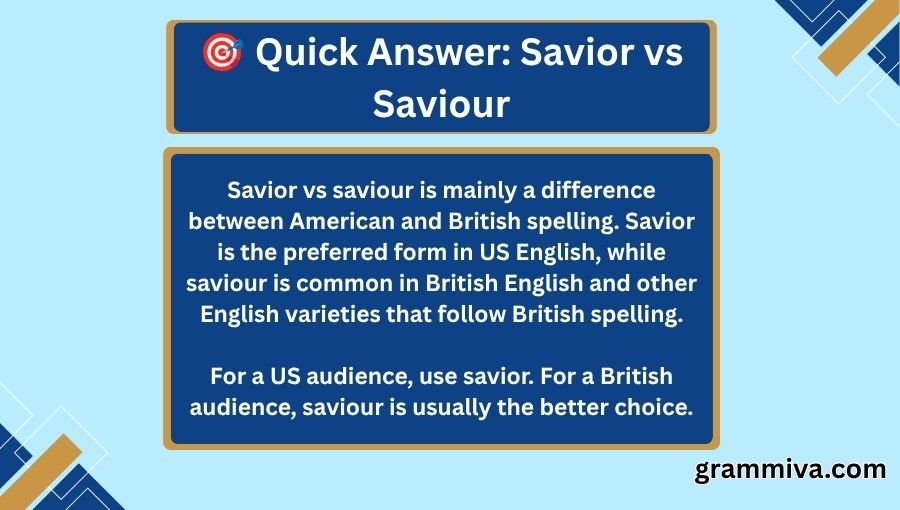
Savior vs saviour is mainly a difference between American and British spelling. Savior is the preferred form in US English, while saviour is common in British English and other English varieties that follow British spelling.
For a US audience, use savior. For a British audience, saviour is usually the better choice.
| Spelling | Main English variety | Basic meaning | Example |
|---|---|---|---|
| Savior | US English | A person who saves or rescues someone | The firefighter was called a hero and savior. |
| Saviour | British English and related varieties | A person who saves or rescues someone | The firefighter was called a hero and saviour. |
| SAVIOR | US-style capitalization | Same word in capital letters | The title read “Savior of the City.” |
| SAVIOUR | British-style capitalization | Same word in capital letters | The title read “Saviour of the City.” |
Is Savior the Same as Saviour?
Yes. Savior and saviour have the same basic meaning. The difference is spelling, not meaning.
Both words can describe someone who saves another person from danger, trouble, or harm. The word can also be used in religious writing, where it may refer to a figure believed to save people spiritually.
The main rule is regional:
- US English: savior
- British English: saviour
- Canadian English: saviour is widely used, although usage can vary by context.
- Australian English: saviour is generally preferred.
- Other English varieties: spelling may follow British conventions.
If you are writing for readers in the United States, savior is the safest standard choice.
If your audience follows British spelling, use saviour.
Why Are There Two Spellings?
The two spellings exist because English has developed different spelling conventions in different regions. Many words that end in -or in American English have -our forms in British English.
You can see a similar pattern in words such as:
- color / colour
- honor / honour
- favor / favour
- labor / labour
The same general spelling pattern helps explain savior / saviour.
I once reviewed a short school assignment in which a student used both spellings in the same paragraph. The student had not made a meaning mistake. The problem was consistency. Once we chose US English as the style, changing saviour to savior throughout fixed the issue.
Savior vs Saviour at a Glance
The easiest way to understand the difference is to compare the two forms directly. The meaning stays the same, but the preferred spelling changes with the variety of English.
| Form | Type | Meaning | Example | Correct/Incorrect |
|---|---|---|---|---|
| savior | US spelling | Someone who saves | The dog became his savior. | ✅ Correct in US English |
| saviour | British spelling | Someone who saves | The dog became his saviour. | ✅ Correct in British English |
| savior | British context | Same meaning | The dog became his savior. | ❌ Usually not preferred |
| saviour | US context | Same meaning | The dog became his saviour. | ❌ Usually not preferred |
| saviour/savior | Mixed usage | Same meaning | The article used both spellings. | ❌ Avoid mixing styles |
The key lesson is not that one form is always right and the other is always wrong. Both are established spellings. The better choice depends on the English variety you are using.
What Does Savior Mean?
Savior is a noun for a person or figure who saves someone from danger, difficulty, or harm. In religious contexts, it can also refer to a person regarded as a spiritual redeemer.
Here are a few common uses.
Savior as a Person Who Rescues Someone
You can use the word for someone who directly helps another person escape a dangerous situation.
For example:
The lifeguard was the swimmer’s savior.
The sentence says that the lifeguard saved the swimmer.
Another example:
The mechanic was our savior when the car broke down.
Here, the word is used more casually. The mechanic did not necessarily rescue someone from physical danger. The speaker is simply showing strong gratitude.
Savior as Someone Who Solves a Serious Problem
The word can also be used in a broader, less literal way.
The new software was a savior for our small team.
This means the software solved a major problem or made a difficult situation much easier.
The word can therefore sound dramatic when used in everyday speech. That can be intentional.
Savior in Religious Writing
The capitalized form Savior can appear in Christian religious writing as a title or reference to Jesus.
For example:
Christians believe Jesus is the Savior.
Capitalization depends on the particular religious writing style and context. The spelling in US English remains Savior.
| Meaning | Word Type | Example Sentence |
|---|---|---|
| Person who rescues someone | Noun | The nurse was his savior. |
| Person or thing that solves a major problem | Noun | The extra funding was a savior for the project. |
| Religious title or reference | Noun | The text refers to Jesus as the Savior. |
💡 Test Tip: How Can You Check the Spelling?
Ask yourself two questions:
- Who is my audience?
- Which English spelling system am I using?
If you are writing for a US audience, choose savior.
If you are writing for a British audience, choose saviour.
A quick memory trick is to connect the US spelling with other common -or forms:
favor → savior
And connect the British spelling with:
favour → saviour
That small pattern can make the choice much easier.
How Do You Use Savior Correctly in US English?
In US English, savior is the standard spelling. It works as a singular noun and can appear in ordinary, figurative, or religious contexts.
Here are several examples:
- The firefighter became a savior to the trapped family.
- The backup generator was a savior during the storm.
- She described her mentor as a savior during a difficult year.
- The team saw the new player as a potential savior.
- The story presents the main character as a savior.
Notice that the spelling does not change simply because the meaning changes. What matters is the audience and the context.
| Sentence | Usage | Why It Works |
|---|---|---|
| The firefighter was a savior. | Literal | The person rescued others. |
| That backup battery was a savior. | Figurative | It solved a serious problem. |
| He called his teacher a savior. | Figurative | The teacher provided major help. |
| The novel presents her as a savior. | Descriptive | The word describes her role. |
When Should You Use Saviour?
Use saviour when you are following British English spelling or another style guide that prefers the British form.
For example:
The rescue worker was hailed as a saviour.
This spelling is natural in British-style writing.
You may also encounter it in Canadian, Australian, and other forms of English. The exact preferences can vary by publication or organization, so a house style should take priority when one exists.
The most important point is consistency. If your article begins in British English, do not suddenly switch to the US spelling halfway through.
| Audience or Style | Preferred Form | Example |
|---|---|---|
| US readers | savior | He was called a savior. |
| British readers | saviour | He was called a saviour. |
| British-style publication | saviour | The headline used “saviour.” |
| US-style publication | savior | The headline used “savior.” |
Why Do People Confuse Savior and Saviour?
People confuse the two spellings because the words look and sound nearly the same. The extra u is easy to overlook, especially when a writer reads quickly.
Another reason is exposure. Someone who reads British books may naturally learn saviour first. That person may then see savior in an American article and wonder whether it is a typo.
The opposite can happen too.
A student once asked me why a British novel kept spelling “savior” incorrectly. The answer was a useful lesson: the spelling was not incorrect for that audience. The book was simply using British English.
Common causes of confusion include:
- reading both US and British English
- switching between websites from different countries
- copying text from different sources
- relying on autocorrect
- using a spelling checker set to the wrong language
- forgetting which style guide applies
- mixing regional spellings in one document
The problem is usually not grammar. It is language variety and consistency.
Grammar Rules Explanation
In US English, savior is the standard spelling of the noun. In British English, saviour is the standard spelling.
Both forms function as nouns. They can describe a person who saves someone or something that provides major help. The difference is primarily regional spelling.
The same pattern appears in several other English words. American English often uses -or, while British English often retains -our in related words.
There is no special grammatical rule that changes the meaning between these two spellings. You do not choose one because the sentence is formal or informal. You choose it mainly because of the English variety required by your audience or publication.
Standard dictionaries and style references recognize the regional nature of the distinction. When writing professionally, however, your organization’s style guide should always take priority.
Correct vs Incorrect at a Glance
| Sentence | Correct/Incorrect | Why |
|---|---|---|
| The firefighter was a savior. | ✅ Correct | Standard US English spelling. |
| The firefighter was a saviour. | ❌ Usually incorrect for US style | The British form is being used in a US-style sentence. |
| The firefighter was a saviour. | ✅ Correct | Standard British English spelling. |
| The firefighter was a savior. | ❌ Usually not preferred in British style | US spelling is being used instead of the local convention. |
| The hero became the town’s savior. | ✅ Correct | The possessive form and US spelling are both correct. |
The word itself does not become grammatically wrong just because the regional spelling changes. The key is matching the spelling to the style of the text.
Related Word Forms and Variations
The base noun has several useful forms and nearby expressions. The spelling distinction usually remains visible when the word is changed.
The plural is saviors in US English and saviours in British English.
The possessive can be formed as savior’s or saviour’s for one person or thing. For a plural possessive, use saviors’ or saviours’, depending on the spelling system.
| Form | Type | Example |
|---|---|---|
| savior | Singular noun, US | She called him her savior. |
| saviour | Singular noun, British | She called him her saviour. |
| saviors | Plural noun, US | The story has several saviors. |
| saviours | Plural noun, British | The story has several saviours. |
| savior’s | Singular possessive, US | The savior’s actions were praised. |
| saviour’s | Singular possessive, British | The saviour’s actions were praised. |
| saviors’ | Plural possessive, US | The saviors’ efforts mattered. |
| saviours’ | Plural possessive, British | The saviours’ efforts mattered. |
📝 Case Study: A Workplace Email
Imagine that a US company has a major software problem. An employee finds a simple fix and sends this message:
“The new backup system was our savior during the outage.”
That sentence is natural in US English.
Now imagine the same situation at a British company:
“The new backup system was our saviour during the outage.”
That version fits British spelling.
The meaning has not changed. The spelling has changed to match the workplace’s English style.
I once caught myself typing saviour in a US-focused article after spending several days reading British news. My first draft looked fine until I checked the style guide. I changed the spelling before publication. That experience is a good reminder that even experienced writers can switch styles without noticing.
For professional writing, the best approach is to choose your style before you begin. Then keep it consistent from the title to the final sentence.
What Are the Most Common Mistakes?
The biggest mistake is treating saviour as a spelling error in every situation. It is not. It is a valid regional spelling.
The second mistake is mixing the two forms in the same piece of writing without a reason.
Writers often make this mistake because of three simple problems:
- Fast typing: You type the form you have seen most recently.
- Autocorrect: Your device may be set to US or British English.
- Lack of knowledge: You may not realize that both forms are accepted in different varieties of English.
| Confusion | Common Mistake | Better Approach |
|---|---|---|
| it’s / its | Mixing contraction and possessive | Check whether you mean “it is.” |
| your / you’re | Using the wrong form | Check whether you mean “you are.” |
| they’re / their / there | Choosing by sound | Check the role of the word. |
| color / colour | Mixing regional spelling | Match the audience. |
| favor / favour | Switching styles | Follow one spelling system. |
| savior / saviour | Treating one regional form as a typo | Match the English variety. |
Common Wrong Spellings and Uses
Some mistakes go beyond the normal US/British difference. These forms should generally be avoided.
| Wrong Form | What’s Wrong | Correct Form |
|---|---|---|
| saviour in a US document | British spelling used in US style | savior |
| savior in a British document | US spelling used in British style | saviour |
| saviourr | Extra letter | saviour |
| saviour’ss | Incorrect possessive ending | saviour’s |
| saviorss | Incorrect plural spelling | saviors |
| saviors’s | Incorrect plural possessive construction | saviors’ |
Not every use of a regional form is technically an error. The first two rows are style problems when the surrounding document clearly follows the opposite regional standard.
Savior vs Saviour in Different Writing Contexts
The correct choice depends strongly on who will read your work. The same writer may correctly use both forms at different times.
For example, a US editor writing an American news article should normally choose savior. That same editor might use saviour when quoting or reproducing a British source according to the publication’s rules.
| Context | Which Term to Use | Example |
|---|---|---|
| Everyday US conversation | savior | You were my savior today. |
| Professional US writing | savior | The system was a savior for the team. |
| British professional writing | saviour | The system was a saviour for the team. |
| Creative writing | Match the setting and style | The British character called him a saviour. |
| Social media for US readers | savior | My coffee was a savior this morning! ☕ |
| Social media for British readers | saviour | That coffee was a real saviour! ☕ |
Everyday Conversation
In casual US speech and writing, savior is the natural choice.
“You brought an umbrella? You’re my savior!”
This is informal and often humorous. The speaker simply means, “You helped me a lot.”
Professional Writing
Professional US writing should normally use savior when the word is needed.
The emergency fund became a financial savior for the organization.
Still, writers should avoid overusing dramatic language in formal documents. A simpler phrase such as “major help” may be clearer.
Creative Writing
Creative writers have more freedom. If a story is set in Britain, saviour may help match the setting. If the story uses American English, savior may fit better.
Character voice can also matter.
Social Media and Texting
On social media, both forms may appear. Your audience is the main guide.
If your followers are mainly American, savior is the natural choice. If your audience is mainly British, saviour may feel more familiar.
Common Phrases With Savior and Saviour
There are several common ways to use the word. These expressions can be literal, figurative, religious, or humorous.
| Phrase | Meaning |
|---|---|
| my savior | Someone or something that helped greatly |
| a lifesaving savior | Someone who provides critical rescue or help |
| unlikely savior | An unexpected person who solves a problem |
| political savior | A person seen as rescuing a political group or cause |
| financial savior | A person or action that prevents financial trouble |
| Savior | A religious title in some Christian contexts |
The exact spelling depends on the English variety. A US publication would generally use savior, while a British publication would generally use saviour.
What Are Some Alternatives to Savior?
Sometimes you do not need either spelling. A simpler synonym may make your sentence clearer.
Possible alternatives include rescuer, helper, hero, lifesaver, and champion.
However, these words are not exact replacements in every context. The best choice depends on what you want to say.
| Alternative | Works When | Does Not Work When |
|---|---|---|
| rescuer | Someone physically saves another person | You mean a figurative problem-solver |
| lifesaver | Someone provides vital help | A formal, neutral tone is needed |
| hero | You want to praise someone’s courage | You only mean that someone solved a small problem |
| helper | You want simple, neutral language | You need a strong sense of rescue |
| champion | Someone strongly supports a person or cause | You mean someone who literally rescued another person |
For many everyday sentences, lifesaver sounds more natural than savior.
For example:
“Thanks for bringing the charger. You’re a lifesaver!”
That is common casual US English.
Why Does the Difference Matter? 🎯
A single extra letter can tell readers which English variety you are using. That matters because spelling choices affect consistency, professionalism, and reader expectations.
Using the correct regional form shows that you understand your audience. It also helps a document look carefully edited.
This matters especially in:
- school assignments
- resumes
- business emails
- websites
- marketing materials
- published articles
- books
- social media campaigns
The goal is not to make one spelling “better” than the other. The goal is to use the spelling that fits the language style of your audience.
Good writing makes the right choice clear before the reader has to think about it.
| Situation | Why Getting It Right Matters |
|---|---|
| Resume | Consistent spelling creates a polished impression. |
| Client email | Regional style can support clear, professional communication. |
| Published content | Editors expect consistent language conventions. |
| Social post | Audience expectations can influence which form feels natural. |
How Can You Remember the Difference?
The simplest memory trick is to remember that US English usually drops the u in this group of words.
Think:
US: favor → savior
British: favour → saviour
You can also remember the pair as a visual pattern:
-or = US
-our = British
This pattern is not universal across every English word, so it should not be applied blindly. But for words such as color/colour, honor/honour, favor/favour, and savior/saviour, it is useful.
If you are writing for a US audience, train yourself to scan for -our spellings. If you see one, ask whether your document should use the American -or version instead.
Is Savior More Correct Than Saviour?
No. Savior is more appropriate for US English, but saviour is not inherently wrong. It is the standard spelling in British English and related varieties.
Calling one spelling “more correct” without naming the English variety can create confusion. English has multiple accepted standards.
For a US article, however, savior is the correct choice.
For a British article, saviour is normally the correct choice.
The same idea applies to many regional spelling pairs. The right question is not always “Which spelling is correct?” Sometimes the better question is “Which spelling is correct for this audience?”
Does the Meaning Change Between Savior and Saviour?
No. The core meaning does not change because of the spelling.
Both words can describe:
- someone who rescues another person
- someone who provides major help
- someone viewed as a solution to a serious problem
- a religious figure or title in relevant contexts
The difference is primarily regional spelling.
| Feature | Savior | Saviour |
|---|---|---|
| Basic meaning | Same | Same |
| US English | Preferred | Usually not preferred |
| British English | Usually not preferred | Preferred |
| Noun | Yes | Yes |
| Plural | saviors | saviours |
| Possessive | savior’s | saviour’s |
Can You Use Both Forms in the Same Article?
Usually, you should not switch between them in ordinary prose. Pick the form that matches your main style and use it consistently.
There can be legitimate exceptions. For example, you may reproduce a quotation, title, or source exactly as it appears. A British source may use saviour even when your surrounding US article uses savior.
In that case, the difference is intentional.
For normal original writing, though, consistency is the better rule.
Should US Writers Always Use Savior?
For standard US English writing, yes, savior is the preferred spelling.
That includes most American:
- school writing
- business writing
- website content
- news writing
- marketing copy
- general nonfiction
There can still be exceptions when you are preserving a proper title, quotation, name, or source-specific spelling. Always follow the required style rules for the project.
Should British Writers Always Use Saviour?
For standard British English, saviour is generally the preferred spelling.
A British writer should therefore normally use:
The rescue worker was a saviour.
rather than:
The rescue worker was a savior.
Again, a direct quotation or official name can create an exception. The key is to avoid changing a source’s wording without a good reason.
FAQs About Savior vs Saviour
Is “savior” correct in American English?
Yes. Savior is the standard US English spelling. Use it when writing for an American audience unless a specific title, quotation, or style rule requires another form.
Is “saviour” wrong in American English?
It is not inherently wrong as a word. It is the British spelling. However, in standard US English writing, savior is normally preferred.
Is “saviour” British English?
Yes. Saviour is the standard British spelling of the word. It is also used in several other English varieties that follow British spelling conventions.
What is the difference between savior and saviour?
The main difference is regional spelling. Savior is the US form, while saviour is the British form. Their basic meaning is the same.
Which spelling should I use in a US essay?
Use savior. If your essay follows US English, keeping the spelling consistent throughout the paper is the best choice.
Which spelling should I use in a British essay?
Use saviour. British English normally keeps the u in this spelling.
Are saviors and saviours both correct?
Yes. Saviors is the US plural, while saviours is the British plural.
Is “Savior” capitalized?
It can be capitalized when it is used as a title or in a context where capitalization is part of the writing style, including some religious contexts. As an ordinary common noun, it is usually lowercase.
How do I remember savior vs saviour?
Remember the related pair favor/favour. US English uses favor and savior, while British English uses favour and saviour.
Can I use savior and saviour in the same document?
You generally should not mix them in ordinary writing. Choose the spelling that matches your audience and keep it consistent. A quotation or proper title may be an intentional exception.
✅ Quick Recap Checklist
Use this checklist whenever you are unsure which form to choose.
| Question | If Yes → Use |
|---|---|
| Am I writing standard US English? | savior |
| Am I writing standard British English? | saviour |
| Am I writing for a US school or workplace? | savior |
| Am I writing for a British publication? | saviour |
| Am I quoting a source that uses the other spelling? | Preserve the source’s form when appropriate |
| Am I trying to keep one style consistent? | Use one regional form throughout |
Practice Examples
1. The rescue worker became the family’s ___.
Answer: savior in US English; saviour in British English.
2. The backup generator was our ___ during the blackout.
Answer: savior in US English; saviour in British English.
3. The British newspaper described the firefighter as a ___.
Answer: saviour.
These examples show the most important point: the meaning stays the same while the spelling changes with the English variety.
Savior vs Saviour: The Final Rule
Savior vs saviour is not a fight between a correct word and an incorrect word. It is a regional spelling difference. Savior is the standard US English form, while saviour is the standard British English form.
If you are writing for American readers, choose savior. If you are writing for British readers, choose saviour. If you are working for a company, school, publisher, or website with its own style guide, follow that guide first.
The best writers do more than spell words correctly. They choose language that fits their readers. That means paying attention to regional spelling, keeping a document consistent, and understanding why two forms can both be valid.
Once you connect savior with US English and saviour with British English, this spelling question becomes much easier. 🌟
Remember the simple rule: US English uses “savior”; British English uses “saviour.” Choose your audience, choose your spelling, and stay consistent.

I am Ryan Mitchell, a writer focused on English grammar, vocabulary, and everyday language. I work at Grammiva, creating easy-to-understand articles that help readers improve their English with confidence.


[…] to use the word in sentences, why the mistake happens, and how to avoid it when writing quickly. Savior vs Saviour | Dwarfs vs Dwarves | Skill Set vs […]
[…] and memory tricks you can use whenever these two words appear in your writing. Noisy vs Noisey | Savior vs Saviour | Dwarfs vs […]