Have you ever started a sentence with “I’m going to lie down” and then wondered if it should be “lay down”? 😅 You are not alone. Lay vs lie is one of the most common grammar problems in American English, even for strong writers.
The confusion happens because lay and lie look and sound similar.
Their past-tense forms make things even harder.
The past tense of lie is lay, while the past tense of lay is laid.
That small detail causes a lot of trouble.
I teach grammar by looking for simple patterns rather than asking people to memorize long rules.
The good news is that this pair has one very useful test: lay needs an object, while lie does not.
Once you learn that test and practice a few examples, the difference becomes much easier.
In this guide, I’ll show you exactly when to use each word, explain the tricky past tense forms, and give you quick ways to check your sentence before you send it. ✨ People vs Peoples | Pieces vs Peices | Steer vs Stear
🎯 Quick Answer: Lay vs Lie
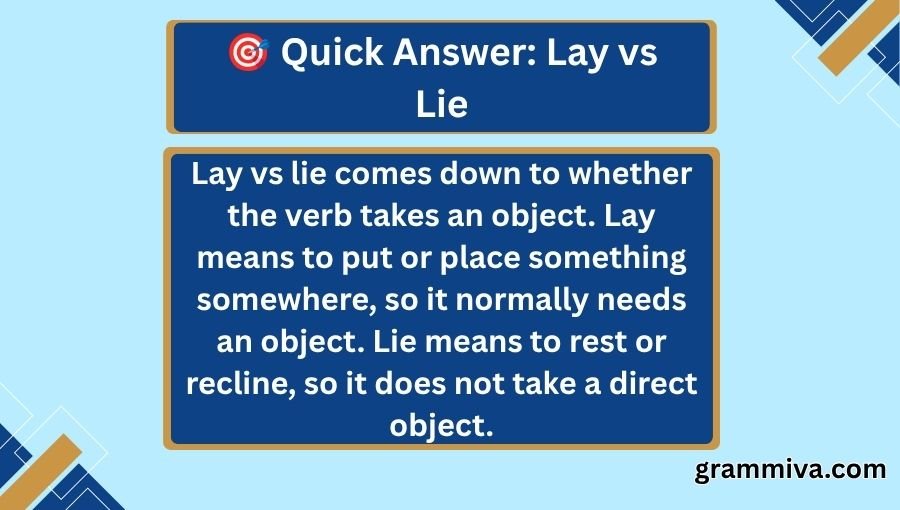
Lay vs lie comes down to whether the verb takes an object. Lay means to put or place something somewhere, so it normally needs an object. Lie means to rest or recline, so it does not take a direct object.
- Lay = put something somewhere.
- Lie = rest or recline.
Example:
- ✅ Please lay the book on the table.
- ✅ I need to lie down for a few minutes.
The confusing part is the past tense:
- Present: lie
- Past: lay
- Past participle: lain
For lay:
- Present: lay
- Past: laid
- Past participle: laid
So, “I lay down yesterday” can be correct because lay is the past tense of lie.
Related Word Forms and Forms You Need to Know
The main forms are easy once you put them into a chart. The key is to avoid treating lay and lie as interchangeable forms of the same verb.
| Form | Type | Example |
|---|---|---|
| lay | Present verb | I lay the keys on the desk. |
| laid | Past/past participle of lay | She laid the keys on the desk. |
| lie | Present verb | I lie on the couch. |
| lay | Past tense of lie | I lay on the couch yesterday. |
| lain | Past participle of lie | I have lain on this couch all afternoon. |
| lying | -ing form of lie | He is lying on the bed. |
| laying | -ing form of lay | She is laying the blanket on the floor. |
The repeated form lay is the source of much of the confusion. It can be a present-tense verb meaning “put,” or it can be the past tense of lie, meaning “rested.”
🎯 Understanding the Basics of Lay vs Lie
The simplest rule is this: use lay when you are putting or placing something, and use lie when someone or something is resting in a position.
Here is the core difference:
| Form | Type | Meaning | Example | Correct/Incorrect |
|---|---|---|---|---|
| lay | verb | put or place something | Lay the phone here. | ✅ Correct |
| lie | verb | rest or recline | Lie on the sofa. | ✅ Correct |
| lay | verb | rest or recline in present tense | I lay down every night. | ❌ Incorrect |
| lie | verb | put or place something | Lie the book here. | ❌ Incorrect |
| laid | past verb | put or placed | She laid the papers down. | ✅ Correct |
| lay | past verb | rested or reclined | She lay down earlier. | ✅ Correct |
When Should You Use Lay?
Use lay when one thing is being placed somewhere.
The easiest way to spot it is to ask:
What are you laying?
If you can answer that question, lay is often the right choice.
For example:
- “Lay the baby in the crib.”
What are you laying? The baby.
- “Lay your coat on the chair.”
What are you laying? Your coat.
- “Lay the cards on the table.”
What are you laying? The cards.
The item being placed is the direct object.
When Should You Use Lie?
Use lie when a person or thing is resting or reclining.
Ask:
Who or what is resting?
For example:
- “I need to lie down.”
- “The dog likes to lie in the sun.”
- “The book is lying on the desk.”
You do not need a direct object after lie.
That is the central grammar difference.
A Quick Meaning Table
| Meaning | Word Type | Example Sentence |
|---|---|---|
| Put something somewhere | lay | Lay the folder on my desk. |
| Rest or recline | lie | I want to lie down. |
| Put something somewhere in the past | laid | He laid the folder on my desk. |
| Rested or reclined in the past | lay | He lay on the couch. |
| Rested or reclined before another past action | had lain | She had lain there for an hour. |
💡 Test Tip: Ask “What?”
When you are unsure, try asking “What?” after the verb.
If the sentence has an object, lay may be correct.
- “Please lay ___ here.”
- “Please lay the towel here.”
If there is no object because the subject itself is resting, use lie.
- “I need to lie down.”
This test works well because lay normally transfers an action to something else.
Is Lay the Same as Lie?
No. Lay and lie have different meanings and grammatical jobs.
Lay means to put or place something. Lie means to rest or recline.
Compare these sentences:
- ✅ She laid the baby in the crib.
- ✅ The baby lay in the crib.
The first sentence describes someone putting the baby somewhere. The second describes the baby resting there.
| Sentence | Verb | Meaning |
|---|---|---|
| Lay the blanket on the bed. | lay | Put it there. |
| Lie on the bed. | lie | Rest there. |
| She laid the blanket down. | laid | She put it there. |
| She lay on the bed. | lay | She rested there. |
The tricky part is that lay appears in both the first and fourth examples, but for different reasons.
Why Do People Confuse Lay and Lie?
People confuse these verbs because the words are similar, and one form overlaps with the other verb’s tense.
The biggest problem is this:
lie → lay → lain
while
lay → laid → laid
So lay belongs to both systems.
I once reviewed a short office memo that said, “Please lay down until the technician arrives.” The writer knew that lay was connected with resting, but the sentence needed the present form lie. A tiny change fixed it.
Other mistakes happen because people remember phrases by sound instead of by grammar. They may have heard “lay down” in casual speech so often that it feels correct in every situation.
Fast typing adds another problem. Autocorrect can also make a writer less likely to stop and check the sentence.
| Reason | Why It Causes Confusion | Helpful Fix |
|---|---|---|
| Similar-looking words | Both words are short and familiar. | Focus on the meaning. |
| Past tense overlap | Lay is the past tense of lie. | Check the time of the action. |
| Fast typing | Writers often choose the first form that sounds right. | Pause and ask “What?” |
| Autocorrect | Software may not understand the grammar. | Proofread manually. |
| Lack of knowledge | The object rule may never have been taught. | Learn the simple object test. |
| Casual speech | Informal speech often blurs grammar rules. | Use the standard form in writing. |
Lay vs Lie at a Glance
Here is the fastest comparison to keep nearby when you write.
| Verb | Present | Past | Past Participle | Basic Meaning |
|---|---|---|---|---|
| lay | lay | laid | laid | put or place |
| lie | lie | lay | lain | rest or recline |
A simple memory trick is:
Lay = place. Lie = rest.
If you are placing a thing, choose lay.
If you are resting yourself, choose lie.
What Is the Correct Way to Say “Lay Down” or “Lie Down”?
The correct present-tense expression for resting is “lie down.”
- ✅ I need to lie down.
- ❌ I need to lay down.
However, “lay down” can be correct when it is the past tense of lie.
- ✅ Yesterday, I lay down after lunch.
- ❌ Yesterday, I lied down after lunch.
This is one of the most important distinctions to learn.
| Time | Correct Form | Example |
|---|---|---|
| Present | lie | I lie down after work. |
| Present progressive | am lying | I am lying down now. |
| Past | lay | I lay down earlier. |
| Present perfect | have lain | I have lain down for a while. |
| Future | will lie | I will lie down later. |
How Do You Use Laid Correctly?
Laid is the past tense and past participle of lay. It means that someone put or placed something somewhere.
For example:
- “She laid the book on the table.”
- “He laid the keys beside the phone.”
- “They laid the documents on the counter.”
Notice that each sentence has an object.
| Sentence | Object | Correct? |
|---|---|---|
| She laid the book down. | the book | ✅ |
| He laid the keys here. | the keys | ✅ |
| They laid the documents on the desk. | the documents | ✅ |
| She laid down after lunch. | none | ❌ |
| He laid on the couch. | none | ❌ |
In the last two examples, the person is resting. The standard forms are lay for past tense or lie for present tense.
How Do You Use Lain Correctly?
Lain is the past participle of lie. It normally appears with a helping verb such as has, have, or had.
Examples:
- “I have lain awake for hours.”
- “She had lain on the sofa all afternoon.”
- “The dog has lain beside the door.”
Do not replace lain with laid when the meaning is resting.
| Correct Form | Incorrect Form |
|---|---|
| I have lain here for an hour. | I have laid here for an hour. |
| She had lain on the couch. | She had laid on the couch. |
| The dog has lain beside me. | The dog has laid beside me. |
📝 Case Study: A Workplace Email
Imagine that an employee sends this message:
“I am feeling sick, so I am going to lay down for an hour.”
The intended meaning is that the employee will rest. Therefore, the standard form is:
- ✅ “I am feeling sick, so I am going to lie down for an hour.”
- ❌ “I am feeling sick, so I am going to lay down for an hour.”
Now change the sentence:
“I am going to lay the report on your desk.”
Here, lay is correct because the speaker is placing something.
- ✅ “I am going to lay the report on your desk.”
- ❌ “I am going to lie the report on your desk.”
I once caught a similar mistake in a message before it went to a client. The writer had typed “Please lie the papers on my desk.” We changed lie to lay. The meaning became clear immediately.
| Workplace Situation | Correct Sentence |
|---|---|
| Resting during a break | I need to lie down for a few minutes. |
| Placing a document | I will lay the document on your desk. |
| Describing yesterday’s rest | I lay down after the meeting. |
| Describing something placed earlier | I laid the document on your desk. |
Grammar Rules Explanation
The grammar rule is based on whether the verb takes a direct object.
Lay is a transitive verb. That means it normally acts on an object.
- “Lay the book on the table.”
Lie is an intransitive verb. It does not take a direct object.
- “Lie on the table.”
This distinction explains why “lay the book” works but “lie the book” does not.
The tense forms create the second layer of difficulty:
Lie:
- present: lie
- past: lay
- past participle: lain
Lay:
- present: lay
- past: laid
- past participle: laid
Standard English grammar references agree on this basic distinction. The rule is stable even though casual speech sometimes uses these verbs differently.
Correct vs Incorrect at a Glance
| Sentence | Correct/Incorrect | Why |
|---|---|---|
| Please lay the book on the desk. | ✅ Correct | Lay takes the object “book.” |
| I need to lie down. | ✅ Correct | The subject is resting. |
| I lay down yesterday. | ✅ Correct | Lay is the past tense of lie. |
| She laid on the sofa. | ❌ Incorrect | Laid needs an object when used as lay‘s past tense. |
| He has lain there all morning. | ✅ Correct | Lain is the past participle of lie. |
How Can You Remember the Difference?
Use this three-word memory rule:
Lay = place. Lie = rest.
You can also remember the object test:
Can you name what is being placed?
If yes, use lay or one of its tense forms.
What are you laying?
- Lay the plate.
- Lay the baby down.
- Lay the jacket on the chair.
If the subject is simply resting, use lie or one of its tense forms.
- I lie down.
- I lay down yesterday.
- I have lain down.
| Question | Answer | Likely Verb |
|---|---|---|
| Are you putting something somewhere? | Yes | lay |
| Is someone resting? | Yes | lie |
| Did someone place something earlier? | Yes | laid |
| Did someone rest earlier? | Yes | lay |
| Has someone rested already? | Yes | lain |
⚠️ Common Mistakes With Lay and Lie
Most mistakes happen because writers remember the words by sound instead of checking their role in the sentence.
The problem becomes worse with phrases such as lay down, laid down, and lie down.
Another common mistake is adding an object after lie.
- ❌ Lie the book on the desk.
- ✅ Lay the book on the desk.
Or using laid when you mean a person rested:
- ❌ I laid down for an hour.
- ✅ I lay down for an hour.
Similar Grammar Confusions
The confusion is not unique to these verbs. English has many pairs that sound alike or look similar.
| Confusion | Correct Difference |
|---|---|
| it’s / its | It’s = it is; its = belonging to it |
| your / you’re | Your = belonging to you; you’re = you are |
| their / there / they’re | Possession / place / they are |
| affect / effect | Usually verb / usually noun |
| then / than | Time or sequence / comparison |
| lay / lie | Put or place / rest or recline |
Fast typing is a major cause. Autocorrect can also hide mistakes instead of fixing them. And, of course, sometimes the writer simply has never learned the difference.
Specific Wrong Forms and Uses
| Wrong Form | What’s Wrong | Correct Form |
|---|---|---|
| I lay down every night. | Present resting action needs lie. | I lie down every night. |
| I laid down yesterday. | Laid means placed and needs an object. | I lay down yesterday. |
| Please lie the book here. | The book is being placed. | Please lay the book here. |
| I have laid here all day. | The meaning is resting. | I have lain here all day. |
| She is laying on the bed. | The meaning is resting. | She is lying on the bed. |
| He is lieing on the couch. | Incorrect spelling of the -ing form. | He is lying on the couch. |
Is “I Am Laying Down” Ever Correct?
Yes, but only when laying means placing something down.
For example:
- ✅ “I am laying the baby down.”
- ✅ “I am laying the blanket on the bed.”
If you mean that you are resting, use lying:
- ✅ “I am lying down.”
- ❌ “I am laying down.”
The object test makes the difference clear.
| Sentence | Object? | Meaning | Correct? |
|---|---|---|---|
| I am laying the baby down. | Yes | Putting the baby down | ✅ |
| I am lying down. | No | Resting | ✅ |
| I am laying down. | No | Intended as resting | ❌ |
| I am lying the baby down. | Yes | Intended as placing | ❌ |
Usage in Different Contexts
The same basic rule applies in everyday speech, professional writing, creative writing, and online messages.
| Context | Which Term to Use | Example |
|---|---|---|
| Everyday conversation | lay or lie based on meaning | I need to lie down. |
| Professional writing | Standard grammatical form | Please lay the file on my desk. |
| Creative writing | Correct form based on meaning | She lay beneath the tree. |
| Social media/texting | Standard form is still best | I’m lying on the couch. |
Everyday Conversation
People often hear nonstandard forms in casual speech. That does not mean those forms are the best choice in careful writing.
If you are speaking casually with friends, mistakes may go unnoticed. But knowing the standard rule gives you control over your writing.
Professional Writing
In emails, reports, applications, and workplace documents, precision matters.
Compare:
- “I will lay down after the meeting.”
- “I will lie down after the meeting.”
The second sentence follows standard grammar because the writer means “rest.”
Creative Writing
Creative writers often use these verbs to describe people, animals, objects, and scenes.
- “The old dog lay beside the fireplace.”
- “She laid the letter beside the lamp.”
Both are correct because they describe different actions.
Social Media and Texting
Short messages encourage fast writing. That makes mistakes more likely.
Even in a casual post, a quick mental check can help:
Place = lay. Rest = lie.
Common Phrases With Lay and Lie
Both verbs appear in many common expressions.
| Phrase | Meaning |
|---|---|
| lay the groundwork | Prepare the basic conditions for something |
| lay the foundation | Create a strong base for something |
| lay down the law | State rules firmly |
| lay it on the table | Present something openly |
| lie down | Rest in a horizontal position |
| lie low | Stay quiet or avoid attention |
The meaning of the phrase can help you remember the verb. Phrases involving placing, setting, or creating a base often use lay. Phrases involving resting or remaining in a position often use lie.
Are There Alternatives to Lay and Lie?
Sometimes you can replace these verbs with clearer words. This can be useful when a sentence feels confusing.
| Alternative | Works When | Does Not Work When |
|---|---|---|
| place | You mean put something somewhere | You mean rest |
| put | You mean move something into a position | You need to describe reclining |
| rest | Someone is relaxing or reclining | You mean placing an object |
| recline | Someone is leaning or resting back | You mean placing something |
| set | You mean put something in a particular position | You mean a person is resting |
For example, instead of “Lay the book here,” you could say “Place the book here.”
Instead of “Lie down,” you could say “Rest.”
These alternatives can sometimes make a sentence easier for a reader, but they do not replace the need to understand the original verbs.
🎯 Why Getting Lay and Lie Right Matters
Correct grammar improves clarity. It also helps your writing look careful and professional.
A single wrong verb usually does not ruin a sentence. But repeated mistakes can make readers question the quality of a document.
As I often remind students:
Clear writing starts with clear choices.
| Situation | Why Getting It Right Matters |
|---|---|
| Resume | Shows attention to detail |
| Client email | Supports a professional tone |
| Published content | Builds reader trust |
| Social post | Makes your message easier to understand |
The goal is not to make every sentence sound formal. The goal is to make your meaning easy to understand.
Does Lay vs Lie Change in Past Tense?
Yes. This is the part that causes the most confusion.
If the verb is lie, its past tense is lay.
- Present: “I lie down.”
- Past: “I lay down.”
If the verb is lay, its past tense is laid.
- Present: “I lay the book down.”
- Past: “I laid the book down.”
| Meaning | Present | Past |
|---|---|---|
| Rest | lie | lay |
| Put/place | lay | laid |
This is why “I lay down yesterday” is correct, even though “I lay down every day” is not correct in standard US English when lay is intended as the present form for resting.
What About Lying and Laying?
The -ing forms follow the same meaning rule.
Use lying when someone or something is resting.
- “The cat is lying on the rug.”
Use laying when someone is placing something.
- “The cat is laying the toy on the rug.”
The second sentence is unusual because cats do not normally place toys deliberately, but the grammar is possible. A more natural human example is:
- “She is laying the papers on the desk.”
| -ing Form | Meaning | Example |
|---|---|---|
| lying | resting | He is lying on the floor. |
| laying | placing | He is laying the books on the floor. |
Special Exception: Lay as a Verb for Producing Eggs
There is one useful edge case worth knowing.
Lay can also mean to produce an egg. This use still follows the same basic grammar pattern because something is being produced or placed.
For example:
- “The hen laid an egg.”
- “The turtle laid its eggs on the beach.”
Here, laid is correct because lay is the verb.
| Sentence | Meaning | Correct? |
|---|---|---|
| The hen laid an egg. | Produced an egg | ✅ |
| The hen lay an egg yesterday. | Wrong past form | ❌ |
| The hen lays an egg. | Produces an egg | ✅ |
| The hen lies an egg. | Wrong verb | ❌ |
This meaning is separate from the “rest” meaning of lie, so context matters.
How Do You Check a Sentence in Five Seconds?
When I proofread, I use a very short process.
Step 1: Find the verb
Look for lay, lie, laid, lain, lying, or laying.
Step 2: Ask what the verb means
Does it mean put/place?
Or does it mean rest/recline?
Step 3: Look for an object
If something is being placed, identify it.
“Lay the keys on the table.”
Step 4: Check the tense
Ask whether the action happens now, happened before, or is connected to another action.
Step 5: Read it aloud
If you still feel unsure, say the sentence slowly. Then compare it with the basic rule.
| Step | Question |
|---|---|
| 1 | What is the verb? |
| 2 | Does it mean place or rest? |
| 3 | Is there an object? |
| 4 | What tense is needed? |
| 5 | Does the sentence sound clear after applying the rule? |
How Do You Know Which Form to Choose?
Use this decision path:
If you mean “put something somewhere” → use lay.
If you mean “rest” → use lie.
Then check the tense:
- Present placement → lay
- Past placement → laid
- Present resting → lie
- Past resting → lay
- Past participle of resting → lain
| Question | If Yes → Use |
|---|---|
| Am I putting or placing something? | lay |
| Did I put or place something? | laid |
| Am I resting? | lie |
| Did I rest? | lay |
| Have I rested? | lain |
Practice Examples
- “Please ___ the towel on the chair.”
Answer: lay - “I want to ___ down for ten minutes.”
Answer: lie - “Yesterday, I ___ down after lunch.”
Answer: lay
FAQs About Lay vs Lie
What is the easiest way to remember lay vs lie?
Remember “lay = place, lie = rest.” If you are putting something somewhere, use lay. If someone or something is resting, use lie.
Is “I lay down” grammatically correct?
Yes, when you are talking about the past. “I lay down yesterday” is correct because lay is the past tense of lie.
Is “I lay down every day” correct?
Not in standard US English when you mean that you rest every day. The present-tense form is “I lie down every day.”
Is “laid” the past tense of lie?
No. Laid is the past tense of lay. The past tense of lie is lay.
Is “lying down” correct?
Yes. Lying is the -ing form of lie, which means resting or reclining.
For example: “I am lying down.”
Is “laying down” always wrong?
No. Laying is correct when it means placing something down.
For example: “She is laying the blanket on the bed.”
It is not the standard form when you mean that a person is resting.
What is the past participle of lie?
The past participle of lie is lain.
For example: “I have lain awake all night.”
Why is lay the past tense of lie?
English uses lay as the past-tense form of lie. This creates the unusual pattern lie → lay → lain.
Should I say “lie the book down”?
No. When you are placing a book somewhere, use lay.
Correct: “Lay the book down.”
Incorrect: “Lie the book down.”
Which is correct: “laying” or “lying”?
It depends on the meaning. Use laying for placing something and lying for resting.
- ✅ She is laying the clothes on the bed.
- ✅ She is lying on the bed.
Lay vs Lie: A Final Quick Recap
The entire rule can be reduced to two words:
Lay = place.
Lie = rest.
Then remember the tense forms.
| Meaning | Present | Past | Past Participle |
|---|---|---|---|
| Place | lay | laid | laid |
| Rest | lie | lay | lain |
Before you choose a word, ask:
- Am I putting something somewhere?
- Am I describing someone or something resting?
- What tense do I need?
- Is there a direct object?
If you can answer those four questions, most problems disappear.
Conclusion
Lay vs lie becomes much easier once you stop trying to memorize the words as a pair and focus on what the verb means. Use lay when you put or place something somewhere. Use lie when someone or something rests or reclines. In the past tense, remember that lie becomes lay, while lay becomes laid.
The most useful memory trick is simple: lay = place; lie = rest. If you are placing a book, coat, paper, or other object, think lay. If you are resting on a couch, bed, or floor, think lie.
I also recommend using the object test whenever you hesitate. Ask, “What am I laying?” If you can name the thing being placed, lay is probably the right choice.
Do not worry if this pair has confused you before. Even experienced writers pause over these verbs. The goal is to build a quick habit so that the correct form becomes automatic.
Place it with lay. Rest with lie. Once that rule sticks, this grammar trap loses its power. 🌟

I am Alex Morgan, an English grammar and vocabulary writer passionate about making language learning simple and useful. I work at Grammiva, where I create clear educational content and practical English examples for learners.


[…] the end, you should be able to make the choice quickly and confidently. ✍️ Lay vs Lie | People vs Peoples | Pieces vs […]
[…] and what to do when you see the two spellings in names or online writing. Midday vs Mid-Day | Lay vs Lie | People vs […]