Have you ever typed a word, looked at it, and suddenly wondered, “Wait, is that really how it is spelled?” 😅 exceed vs excede is one of those small spelling questions that can stop an otherwise clear sentence.
The good news is that the answer is simple. Exceed is the correct standard English spelling. Excede is not the standard spelling of the English verb. If you mean “to go beyond a limit,” “to be greater than,” or “to do more than expected,” you should write exceed.
This difference may seem tiny, but spelling matters. A single missing letter can make a sentence look careless, especially in a work email, school paper, resume, or published article. ✍️
In this guide, I will show you exactly when to use exceed, why excede causes confusion, how to remember the spelling, and how the word works in real sentences. By the end, you should be able to spot the correct form quickly and use it with confidence. foreign vs foriegn | Extreme vs Extreem | Exhilarate vs Exhilirate
🎯 Quick Answer: Exceed vs Excede
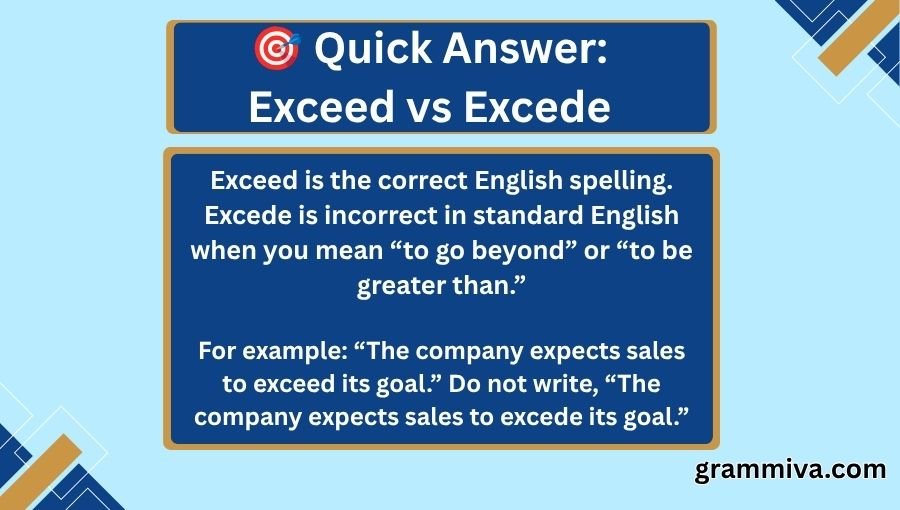
Exceed is the correct English spelling. Excede is incorrect in standard English when you mean “to go beyond” or “to be greater than.”
For example: “The company expects sales to exceed its goal.” Do not write, “The company expects sales to excede its goal.”
Related Word Forms
The word exceed has several useful forms. These forms change the word’s role or tense, but they keep the ee spelling in the base verb.
| Form | Type | Example |
|---|---|---|
| exceed | Base verb | Costs may exceed the budget. |
| exceeds | Third-person singular verb | The limit exceeds 50 miles per hour. |
| exceeded | Past tense/past participle | The team exceeded its goal. |
| exceeding | Present participle/gerund | Exceeding the limit may result in a penalty. |
| excessive | Related adjective | Excessive spending can create problems. |
The key point is simple: the base verb is exceed, not excede.
Understanding Exceed vs Excede
The core difference is spelling. Exceed is the standard English word, while excede is a misspelling when used as the English verb meaning “to go beyond.”
The word exceed usually describes something that goes past a number, limit, amount, level, expectation, or standard.
| Form | Type | Meaning | Example | Correct/Incorrect |
|---|---|---|---|---|
| exceed | Verb | Go beyond a limit or amount | Expenses may exceed $500. | ✅ Correct |
| excede | Verb | Not the standard English spelling | Expenses may excede $500. | ❌ Incorrect |
| exceeds | Verb | Goes beyond | The bill exceeds our budget. | ✅ Correct |
| exceeded | Verb | Went beyond | Sales exceeded expectations. | ✅ Correct |
| exceeding | Verb form | Going beyond | Exceeding the limit is not allowed. | ✅ Correct |
What Does Exceed Mean?
Exceed means to go beyond something in amount, number, size, quality, degree, or performance.
For example:
- “The temperature may exceed 100°F.”
- “Her test score exceeded mine.”
- “The project cost exceeded the original estimate.”
- “His work exceeded our expectations.”
The word can describe numbers and limits, but it can also describe performance.
If a student earns 98 points when the teacher expected 85, the student’s result exceeded the expectation.
Is Excede a Correct English Word?
No. Excede is not the standard English spelling for the verb exceed.
The most common reason people write it is that the ending may feel natural. English has many words that end in -cede, such as “proceed” and “recede.” That pattern can make excede look believable.
However, the correct spelling is exceed, with ee before the final d.
Exceed vs Excede at a Glance
If you remember only one rule, remember this: exceed has two e’s together before the final d.
| Word | Status | Example |
|---|---|---|
| exceed | Standard English | Do not exceed the speed limit. |
| excede | Misspelling | Do not excede the speed limit. |
| exceeds | Standard English | The total exceeds $1,000. |
| exceeded | Standard English | The cost exceeded the estimate. |
| exceeding | Standard English | Exceeding the limit may cause a problem. |
Correct Meanings and Uses of Exceed
Exceed is useful in several common situations. I teach students to think of it as a “go past” word.
1. Exceed a Number or Amount
Use exceed when something becomes greater than a stated number or amount.
Examples:
- “The bill may exceed $200.”
- “The population could exceed one million.”
- “The package cannot exceed 50 pounds.”
The structure is often:
subject + exceed + number or amount
For example, in “The package cannot exceed 50 pounds,” the package is the thing being measured, and 50 pounds is the limit.
2. Exceed a Limit
You can also use exceed with rules or limits.
Examples:
- “Do not exceed the speed limit.”
- “The file size must not exceed 10 MB.”
- “The noise level exceeded the legal limit.”
This use is especially common in signs, instructions, policies, and technical writing.
3. Exceed Expectations
The word also works with ideas rather than physical numbers.
“Exceed expectations” means to perform better than someone expected.
Examples:
- “The new employee exceeded expectations.”
- “The product exceeded customer expectations.”
- “Her final project exceeded my expectations.”
This phrase is common in workplaces, schools, reviews, and business writing.
4. Exceed a Goal or Target
When a person or organization does better than a planned goal, exceed is a natural choice.
Examples:
- “We exceeded our sales goal.”
- “The fundraiser exceeded its target.”
- “The team exceeded its annual target.”
This meaning is close to “surpass.”
Meaning Summary
| Meaning | Word Type | Example Sentence |
|---|---|---|
| Go beyond a number | Verb | Sales exceeded $2 million. |
| Go beyond a limit | Verb | Do not exceed the weight limit. |
| Perform better than expected | Verb | The service exceeded expectations. |
| Do better than a goal | Verb | We exceeded our target. |
| Be greater than something | Verb | Demand exceeded supply. |
💡 Test Tip: How Can You Check the Spelling?
Here is the quick test I use when helping writers.
Ask yourself:
Am I trying to say “go beyond,” “be greater than,” or “do better than expected”?
If yes, use exceed.
Then look for the double e:
exc + ee + d = exceed
A simple memory trick is:
Exceed has extra E’s.
The extra e can remind you that the correct word is exceed, not excede.
📝 Case Study: A Workplace Email
Imagine a manager writes this sentence:
“Please let me know if the final cost is expected to excede the approved budget.”
The meaning is clear, but the spelling is wrong.
I once edited a short project update where the writer had used “excede” several times. Nothing was wrong with the numbers or the message. The problem was simply that the writer had never stopped to check the spelling. We changed each instance to exceed, and the document immediately looked more polished.
The corrected sentence is:
“Please let me know if the final cost is expected to exceed the approved budget.”
Here, exceed works because the cost may go beyond a set amount.
| Workplace Situation | Correct Sentence |
|---|---|
| Budget | Costs must not exceed the approved budget. |
| Deadline | The project should not exceed the agreed timeline. |
| Sales | Sales exceeded the quarterly goal. |
| Customer service | The team exceeded customer expectations. |
Grammar Rules Explanation
Exceed is a standard English verb. It means to go beyond a stated amount, limit, level, expectation, or standard.
The form excede is not the standard spelling of this English verb. Therefore, when the intended meaning is “go beyond,” writers should use exceed.
The verb can appear in several normal grammatical forms:
- exceed — base form
- exceeds — present tense with a singular third-person subject
- exceeded — past tense and past participle
- exceeding — present participle or gerund
The spelling of the base verb is especially important because the related forms are built from it.
For example:
- “Costs exceed the budget.”
- “The cost exceeds the budget.”
- “The cost exceeded the budget.”
- “The cost is exceeding the budget.”
Standard English reference works agree on the spelling exceed for this meaning. The form excede should not be used as a substitute.
Correct vs Incorrect at a Glance
| Sentence | Correct/Incorrect | Why |
|---|---|---|
| The cost may exceed $500. | ✅ Correct | Exceed is the standard spelling. |
| The cost may excede $500. | ❌ Incorrect | Excede is a misspelling. |
| Sales exceeded our goal. | ✅ Correct | The past form is exceeded. |
| Sales exceded our goal. | ❌ Incorrect | The base spelling is wrong. |
| Do not exceed the limit. | ✅ Correct | Exceed means go beyond the limit. |
⚠️ Common Mistakes With Exceed
People usually confuse these forms because excede looks like it could be a real English word.
There are several reasons for this mistake.
Fast Typing
When people type quickly, they may leave out one of the repeated letters. Double letters are easy to miss.
Autocorrect
Spell-check tools can sometimes help, but they should not replace careful reading. A writer may also learn an incorrect spelling if a keyboard suggestion is accepted without thinking.
Lack of Knowledge
If someone has rarely seen the word in print, excede may look reasonable. English contains many words with similar letter patterns, so guessing can be tempting.
Similar Spelling Patterns
Words such as “recede,” “proceed,” and “concede” may influence how someone spells the word. However, exceed follows its own spelling pattern.
I once caught myself typing “excede” while writing a quick note. I recognized the mistake because the word looked strange when I reread it. That small pause was enough to catch it.
Similar Grammar and Spelling Confusions
| Confusion | Correct Form | Common Wrong Form | Main Reason |
|---|---|---|---|
| its / it’s | its, it’s | mixing them | Apostrophe confusion |
| your / you’re | your, you’re | mixing them | Similar sound |
| their / there / they’re | their, there, they’re | mixing them | Same or similar sound |
| affect / effect | affect, effect | mixing them | Similar meaning and sound |
| then / than | then, than | mixing them | Fast writing |
| exceed / excede | exceed | excede | Missing or misplaced letter |
Common Wrong Spellings of Exceed
| Wrong Form | What’s Wrong | Correct Form |
|---|---|---|
| excede | Missing the second e | exceed |
| exced | Missing the second e and final d pattern | exceed |
| exeed | Missing the c | exceed |
| excee d | Incorrect spacing | exceed |
| exceede | Extra e at the end | exceed |
| exceded | Wrong base spelling | exceeded |
The safest solution is to learn the base form first: exceed.
Why Do People Confuse Exceed and Excede?
People confuse the two forms mainly because excede looks like a plausible English spelling. The ending -cede appears in several real words, so writers may apply that pattern where it does not belong.
Another reason is that the middle sounds of the word can make the spelling less obvious. When we hear a word, we do not always hear every letter clearly.
A useful strategy is to stop relying only on sound. Think about the written form.
exceed = e-x-c-e-e-d
There are two e’s together before the final d.
This is especially useful when proofreading. If you see “excede,” pause and ask whether you mean “go beyond.” If you do, change it to exceed.
Exceed vs Excede in Different Contexts
The correct choice does not change based on whether you are writing casually or formally. If you mean the standard English verb, use exceed in every context.
| Context | Which Term to Use | Example |
|---|---|---|
| Everyday conversation | exceed | The bill might exceed $100. |
| Professional writing | exceed | Expenses must not exceed the budget. |
| Creative writing | exceed | Her courage seemed to exceed all expectations. |
| Social media/texting | exceed | I think the total will exceed our estimate. |
Even in informal texting, excede is still not the standard spelling.
Common Phrases With Exceed
Exceed appears in several useful phrases. These expressions are common because they describe going beyond a limit, goal, or expectation.
| Phrase | Meaning |
|---|---|
| exceed expectations | Perform better than expected |
| exceed the limit | Go beyond an allowed level |
| exceed the budget | Cost more than planned |
| exceed the target | Perform above a planned goal |
| exceed the maximum | Go beyond the highest allowed amount |
| exceed demand | Be greater than the level of demand |
Examples:
- “The restaurant exceeded our expectations.”
- “The load must not exceed the maximum weight.”
- “The project exceeded its original budget.”
- “The campaign exceeded its target.”
These phrases are useful in both everyday and professional English.
How to Remember the Correct Spelling
The best way to remember exceed is to connect the spelling to its meaning.
Think:
Exceed = go beyond.
Then remember:
exceed → extra E
The word contains two consecutive e’s before the final d.
Another useful trick is to compare it visually:
- ✅ exceed
- ❌ excede
The correct version has ee in the middle.
When proofreading, you can also replace the word with “go beyond.” If the sentence still makes sense, exceed is probably the word you need.
For example:
“Costs may go beyond the budget.”
That becomes:
“Costs may exceed the budget.”
Synonyms and Alternatives for Exceed
Several words can replace exceed, but they do not always work in exactly the same way.
| Alternative | Works When | Does Not Work When |
|---|---|---|
| surpass | Something performs or measures higher | The wording needs a formal limit instruction |
| go beyond | You want very simple language | A short formal term is preferred |
| top | Something reaches a higher level | The context requires precise formal writing |
| outdo | One person or thing performs better | You are discussing a strict numerical limit |
| overtake | One person or thing moves ahead | The meaning is simply “be greater than” |
For example:
“Sales exceeded expectations.”
You could write:
“Sales surpassed expectations.”
You could also write:
“Sales went beyond expectations.”
However, you would usually keep exceed in a formal instruction such as:
“Do not exceed the maximum load.”
That sentence is direct and standard.
Why Getting Exceed Right Matters
Spelling may seem like a small issue, but small errors can affect how readers judge a piece of writing.
Clear spelling helps readers focus on your message. Professional writing also benefits from consistency and accuracy.
Consider a resume, for example. A typo in a common word can distract a hiring manager from an otherwise strong application.
| Situation | Why Getting It Right Matters |
|---|---|
| Resume | Shows care and attention to detail |
| Client email | Builds trust and professionalism |
| Published content | Protects the quality of the final work |
| Social post | Makes the message easier to read |
A useful rule is:
Clear writing makes your message easier to trust.
You do not need complicated words to sound professional. You need accurate words used in the right places.
Is Exceed More Formal Than Go Beyond?
No. Exceed is not necessarily more formal in every situation, but it is often shorter and more precise.
For example:
- “The cost went beyond the budget.”
- “The cost exceeded the budget.”
Both sentences are clear. The second is more compact.
In everyday speech, “go beyond” may feel very natural. In reports, policies, instructions, and business writing, exceed is often a useful choice.
Can Exceed Be Used for People?
Yes. Exceed can describe a person’s performance, results, or expectations.
For example:
- “She exceeded her sales target.”
- “He exceeded expectations.”
- “The student exceeded the teacher’s expectations.”
It usually does not mean simply “pass someone” in a physical sense. The exact meaning depends on the sentence.
For instance, if one runner moves ahead of another during a race, overtake may be more natural than exceed.
Can Exceed Be Used With Expectations?
Yes. This is one of the most common uses.
“Exceed expectations” means to perform better than someone expected.
Examples include:
- “The hotel exceeded our expectations.”
- “The employee exceeded expectations.”
- “The product exceeded customer expectations.”
The phrase can describe quality, performance, service, results, or achievement.
Is Excede Ever Correct?
For standard English writing, excede should not be used as the spelling of the verb meaning “go beyond.”
If you are writing an English sentence and want that meaning, choose exceed.
A foreign-language word, name, title, or specialized proper noun could have a different spelling in another context. That does not make excede the correct English spelling of this verb.
How Does Exceed Work in a Sentence?
The most common sentence pattern is:
Subject + exceed + object
Examples:
- “Sales exceeded expectations.”
- “Demand exceeded supply.”
- “The cost exceeded the estimate.”
- “The temperature exceeded 100°F.”
The object is what has been passed or surpassed.
You can also use forms such as:
- “Sales exceed expectations.”
- “Sales exceeds expectations.” ❌
- “Sales exceeded expectations.”
- “Sales are exceeding expectations.”
Remember that verb agreement still matters. A singular subject takes exceeds in the simple present:
“The cost exceeds the estimate.”
A plural subject takes exceed:
“The costs exceed the estimate.”
How Do You Know When to Use Exceed?
Use exceed when the idea is that something goes beyond a number, limit, goal, expectation, or standard.
A quick decision guide:
- Is something going beyond a limit? → exceed
- Is something greater than an amount? → exceed
- Is a result better than expected? → exceed
- Is a goal being surpassed? → exceed
- Are you tempted to write “excede”? → Stop and use exceed.
This works in most everyday situations.
Quick Recap Checklist
Use this checklist when proofreading your writing.
| Question | If Yes → Use |
|---|---|
| Do you mean “go beyond”? | exceed |
| Do you mean “be greater than”? | exceed |
| Do you mean “perform better than expected”? | exceed |
| Are you talking about the past? | exceeded |
| Is the subject singular in the present tense? | exceeds |
| Are you describing an action in progress? | exceeding |
Practice Examples
- The final cost may exceed the original estimate.
- Our sales exceeded the quarterly goal.
- The weight must not exceed 50 pounds.
Now compare:
- ❌ The final cost may excede the original estimate.
- ❌ Our sales exceded the quarterly goal.
- ❌ The weight must not excede 50 pounds.
The solution is the same each time: use the correct exceed spelling and build the other forms from it.
FAQs About Exceed vs Excede
Is exceed or excede correct?
Exceed is correct. Excede is a misspelling when you mean “to go beyond” or “to be greater than” in standard English.
What does exceed mean?
Exceed means to go beyond a number, limit, amount, goal, expectation, or standard. For example, “The cost may exceed $500.”
Why is excede wrong?
Excede is not the standard English spelling of the verb exceed. The correct spelling contains two consecutive e’s before the final d.
How do you spell exceed correctly?
Spell it e-x-c-e-e-d. A simple memory aid is “exceed has extra E’s.”
Is exceeded the past tense of exceed?
Yes. Exceeded is the past tense and past participle of exceed.
Example: “The company exceeded its sales goal.”
Is exceeds correct?
Yes. Exceeds is the present-tense form used with a singular third-person subject.
Example: “The total exceeds our budget.”
Can I say exceed expectations?
Yes. Exceed expectations is a common and correct phrase. It means to perform better than someone expected.
Example: “The new service exceeded our expectations.”
What is another word for exceed?
Depending on the sentence, alternatives include surpass, go beyond, outdo, top, and overtake. They are not interchangeable in every context.
Is exceed used in formal writing?
Yes. Exceed is common in professional, academic, technical, and everyday writing. It is especially useful when discussing limits, amounts, targets, and expectations.
How can I remember exceed vs excede?
Remember the phrase “extra E.” The correct word is exceed, with ee before the final d. If you see excede, check it carefully.
Final Takeaway: Exceed vs Excede
Exceed vs excede has a very simple answer: exceed is the correct standard English spelling. Use it when something goes beyond a limit, number, goal, amount, expectation, or standard.
The spelling is e-x-c-e-e-d. The double e is the part worth remembering. Forms such as exceeds, exceeded, and exceeding all grow from that same base.
If you are writing an email, report, school assignment, resume, website, or social post, choose exceed, not excede. A quick spelling check can prevent a tiny error from distracting readers from your main idea. 👍
My favorite memory trick is simple: exceed has extra E’s. Once that pattern sticks, this spelling problem becomes much easier to avoid.
When in doubt, remember: go beyond = exceed. Get the spelling right, and let your writing go beyond expectations. 🚀

I am Alex Morgan, an English grammar and vocabulary writer passionate about making language learning simple and useful. I work at Grammiva, where I create clear educational content and practical English examples for learners.


[…] the spelling, look at common mistakes, and give you practical examples you can use right away. Exceed vs Excede | foreign vs foriegn | Extreme vs […]