Have you ever typed a sentence and stopped because discreet vs discrete suddenly looked confusing? You are not alone.
These two words look almost identical, but they do not mean the same thing.
One describes someone or something that avoids drawing attention.
The other describes things that are separate or distinct. ✨
I teach and edit English writing, and I see this mix-up often.
The good news is that you do not need a complicated grammar rule to fix it.
You only need to connect each spelling with its main idea.
Think of discreet as careful and private. Think of discrete as separate and distinct.
Once you make that mental link, the difference becomes much easier to spot.
In this guide, I will explain the difference between the two words, show you how they work in real sentences, cover common mistakes, and give you simple tests you can use when you are unsure.
By the end, you should be able to choose the right word quickly and confidently. 😊 Deep-Seated vs Deep-Seeded | Sisters vs Sisters | Photo Shoot vs Photoshoot
🎯 Quick Answer: Discreet vs Discrete
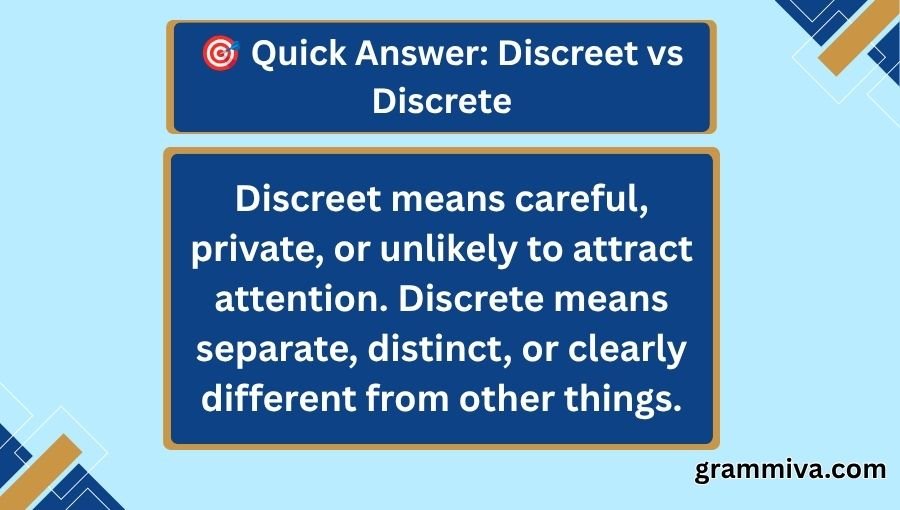
Discreet means careful, private, or unlikely to attract attention. Discrete means separate, distinct, or clearly different from other things.
Here is the fastest way to remember them:
- Discreet = careful, quiet, private
- Discrete = separate, distinct, individual
For example, you can ask a friend to be discreet about a private matter. You can also describe three discrete parts of a project because each part is separate.
| Word | Basic Meaning | Memory Clue | Example |
|---|---|---|---|
| discreet | Careful or private | Think “keep it quiet” | Please be discreet about the surprise. |
| discrete | Separate or distinct | Think “different units” | The report has three discrete sections. |
Is Discreet the Same as Discrete?
No. Discreet and discrete have different meanings and should not be treated as interchangeable.
The easiest distinction is based on what the word describes. Discreet often describes behavior, actions, or choices. Discrete usually describes things, parts, groups, or units that are separate.
Consider these examples:
- She was discreet when discussing the private matter.
- The machine has five discrete settings.
In the first sentence, the person is being careful not to attract attention. In the second, the settings are separate options.
Discreet: Meaning and Correct Use
Discreet is an adjective that describes someone or something that is careful, tactful, private, or not likely to attract attention.
You might be discreet when:
- you avoid embarrassing someone,
- you keep private information private,
- you act quietly,
- you do something without making it obvious,
- or you choose a subtle approach.
For example:
The assistant was discreet when asking about the sensitive issue.
The assistant did not make a public scene. The person acted carefully.
Another example:
We need a discreet way to discuss the problem.
Here, discreet means that the discussion should not attract unwanted attention.
Discrete: Meaning and Correct Use
Discrete is an adjective that means separate, distinct, or clearly apart from something else.
For example:
The survey divides customers into four discrete groups.
The groups are treated as separate groups.
Another example:
The course contains six discrete units.
Each unit is a separate part of the course.
The word is especially common in technical, scientific, business, and academic writing. However, you can also use it in everyday writing whenever you need to describe separate things.
| Word | Word Type | Main Idea | Example Sentence |
|---|---|---|---|
| discreet | Adjective | Careful or private | He was discreet about the family matter. |
| discrete | Adjective | Separate or distinct | The data fall into three discrete groups. |
🔎 Discreet vs Discrete at a Glance
The core difference is simple: discreet is about being careful or unobtrusive, while discrete is about being separate or distinct.
| Form | Type | Meaning | Example | Correct/Incorrect |
|---|---|---|---|---|
| discreet | Adjective | Careful, private, unobtrusive | Please be discreet about the news. | ✅ Correct |
| discrete | Adjective | Separate, distinct | The program has four discrete stages. | ✅ Correct |
| discreet | Adjective | Separate or distinct | The report contains three discreet sections. | ❌ Incorrect |
| discrete | Adjective | Quiet or private | Please be discrete about my situation. | ❌ Incorrect |
| discreet | Adjective | Careful and tactful | She gave him a discreet warning. | ✅ Correct |
A useful trick is to ask what kind of idea you are expressing.
If the idea is “Do not attract attention,” choose discreet.
If the idea is “Keep these things separate,” choose discrete.
How Do You Use Discreet Correctly?
Use discreet when the focus is on privacy, tact, quiet behavior, or avoiding attention.
Here are several common patterns.
1. Discreet About Private Information
You can be discreet when you know something that should not be shared openly.
Maria was discreet about her coworker’s personal problem.
Maria did not spread the information.
2. A Discreet Action
A discreet action is subtle and does not attract much notice.
He made a discreet exit before the meeting ended.
The person left quietly rather than making a dramatic departure.
3. A Discreet Question
A discreet question is asked carefully, often because the subject may be sensitive.
I asked a discreet question about the missing file.
The speaker tried not to embarrass anyone or draw attention to the issue.
4. A Discreet Location or Service
The word can also describe something designed to avoid unwanted attention.
The hotel offers a discreet entrance for guests who want extra privacy.
The entrance is designed to be less noticeable.
| Use of Discreet | What It Suggests | Example |
|---|---|---|
| Discreet person | Tactful and private | She is very discreet. |
| Discreet conversation | Quiet and private | We had a discreet conversation. |
| Discreet action | Subtle and unobtrusive | He made a discreet gesture. |
| Discreet question | Carefully asked | She asked a discreet question. |
| Discreet service | Designed to protect privacy | The company offers discreet service. |
💡 Test Tip
Replace discreet with private, tactful, quiet, or subtle.
If the sentence still makes sense, discreet is probably the correct choice.
For example:
Please be discreet.
Try:
Please be private.
The exact wording changes, but the basic idea works.
Now try:
The report has three discreet sections.
Replacing the word with private makes no sense. The intended meaning is separate, so discrete is needed.
How Do You Use Discrete Correctly?
Use discrete when you mean that something exists as a separate or distinct unit.
It is common when discussing:
- categories,
- groups,
- steps,
- parts,
- values,
- objects,
- systems,
- or units of information.
For example:
The experiment has four discrete stages.
Each stage is treated as a separate part.
Another example:
The application stores the information in discrete fields.
The fields are separate rather than being one undivided item.
Discrete Parts
Use discrete when a larger thing can be divided into clearly separate parts.
The machine has three discrete components.
Each component is identifiable as its own part.
Discrete Groups
Use discrete when groups are separate from one another.
The study examined two discrete age groups.
The groups are treated as distinct categories.
Discrete Values
In technical writing, discrete can describe values that are separate rather than continuously varying.
For example:
The system records discrete values such as 1, 2, 3, and 4.
The key idea remains the same: the values are distinct units.
| Use of Discrete | What It Suggests | Example |
|---|---|---|
| Discrete parts | Separate components | The device has discrete parts. |
| Discrete groups | Distinct categories | We identified three discrete groups. |
| Discrete stages | Separate steps | The process has five discrete stages. |
| Discrete values | Separate values | The system records discrete values. |
| Discrete units | Individual sections | The book contains ten discrete units. |
Why Do People Confuse Discreet and Discrete?
People confuse these words because they look almost identical and are pronounced similarly in ordinary speech.
The spelling difference is easy to miss:
- discreet → has ee near the end
- discrete → has ete at the end
Their meanings are also close enough to create uncertainty because both can involve the idea of things being apart in some way. But modern standard usage keeps their main meanings distinct.
I once marked a student’s essay in which the student wrote that a teacher had given a “discrete warning.” The student clearly meant that the teacher had spoken quietly and privately. We changed it to discreet, and the sentence immediately made sense.
That small correction shows why spelling matters. A reader may understand your meaning from context, but the wrong word can still make your writing look careless.
What Is the Best Memory Trick for Discreet vs Discrete?
The best memory trick is to connect each word with a short phrase.
Discreet = keep it secret.
Discrete = keep it separate.
The two phrases are short enough to remember while writing.
You can also look at the letters:
discreet → think secret
Both words contain the long ee sound in the key part of the word. More importantly, secret reminds you of privacy.
For discrete, think:
discrete = distinct
Both ideas involve things that are separate or clearly different.
| Word | Memory Phrase | Main Question |
|---|---|---|
| discreet | Keep it secret | Am I being careful or private? |
| discrete | Keep it separate | Am I describing separate things? |
📝 Case Study: A Workplace Email
Imagine that a manager needs to talk to an employee about a sensitive issue.
The manager writes:
Please be discreet when discussing this matter with the team.
That is correct because the manager wants the employee to protect private information.
Now imagine a project plan:
The project has four discrete phases: planning, testing, launch, and review.
That is also correct. The four phases are separate parts of the project.
Here is the contrast:
| Situation | Correct Word | Example |
|---|---|---|
| Private workplace issue | discreet | Please be discreet about the complaint. |
| Separate project phases | discrete | The project has four discrete phases. |
| Quiet conversation | discreet | They had a discreet conversation. |
| Separate departments | discrete | The company has three discrete departments. |
| Avoiding public attention | discreet | She made a discreet request. |
The important point is that the two words can appear in the same workplace document. Their meanings still remain different.
What Does Grammar Say About Discreet and Discrete?
Both discreet and discrete are adjectives. The choice between them is based mainly on meaning, not on a special sentence structure.
Use discreet to describe careful or private behavior and things that are not meant to attract attention.
Use discrete to describe separate or distinct things.
Standard English reference works agree on this basic distinction. The important part for everyday writing is to focus on the meaning you need.
There is no general rule saying that one word belongs only in formal writing or that the other belongs only in technical writing. Context matters, but meaning comes first.
Correct vs Incorrect at a Glance
| Sentence | Correct/Incorrect | Why |
|---|---|---|
| Please be discreet about the meeting. | ✅ Correct | The person should keep the matter private. |
| The report has five discrete sections. | ✅ Correct | The sections are separate. |
| He was discrete about the family issue. | ❌ Incorrect | The intended meaning is private or tactful. |
| The software has several discreet settings. | ❌ Incorrect | The settings are separate options. |
| She gave a discreet signal to leave. | ✅ Correct | The signal was subtle and unobtrusive. |
⚠️ Common Mistakes With Discreet and Discrete
Most mistakes happen because writers remember the sound but not the meaning.
There are several reasons this happens:
- Fast typing: You may type the first spelling that comes to mind.
- Autocorrect: Software may not know which meaning you intend.
- Lack of knowledge: You may have heard the word many times without seeing it in writing.
- Similar spelling: The two forms differ by only a few letters.
- Context pressure: When you are writing quickly, you may not stop to test the meaning.
I once caught myself typing discrete in an email when I meant discreet. I had written the sentence quickly and focused on the sound rather than the meaning. I noticed it during a final read-through and fixed it before sending the message.
That is why proofreading is useful even when a sentence looks fine at first.
Similar Word Confusions
| Confusing Pair | Correct Difference | Example |
|---|---|---|
| its / it’s | Possession vs. “it is” | The dog wagged its tail. |
| your / you’re | Possession vs. “you are” | You’re holding your phone. |
| their / they’re | Possession vs. “they are” | They’re in their office. |
| affect / effect | Usually verb vs. noun | The noise affected the result. |
| discreet / discrete | Private vs. separate | Be discreet; use discrete categories. |
Common Wrong Forms and Uses
| Wrong Form or Use | What’s Wrong | Correct Form |
|---|---|---|
| discrete about a secret | “Separate” does not fit the meaning | discreet |
| discreet categories | Categories are separate, not private | discrete |
| discreet data points | Data points are distinct units | discrete |
| discrete conversation | A private conversation needs the privacy sense | discreet |
| discreet sections | Sections are separate units | discrete |
| discrete behavior | If the meaning is quiet or tactful, the word is wrong | discreet |
Does Discreet Have Related Word Forms?
Yes. Discreetly and discretion are related forms that can appear in standard English, but they should not be confused with discrete.
Discreetly is an adverb. It describes an action performed in a careful or unobtrusive way.
She discreetly left the room.
Discretion is a noun. It can refer to careful judgment or the ability to avoid causing embarrassment or revealing private information.
He handled the matter with discretion.
The related forms do not change the basic idea of privacy, care, or tact.
| Form | Type | Example |
|---|---|---|
| discreet | Adjective | She was discreet. |
| discreetly | Adverb | He discreetly checked the message. |
| discretion | Noun | She handled it with discretion. |
| discrete | Adjective | The system has discrete units. |
Word Origin and History
The two words have a shared history, which helps explain why they look so much alike. Over time, English developed separate standard uses for the two spellings.
The important point is not to memorize a long history lesson. Their modern meanings are what matter when you write.
| Period | Form/Development | General Note |
|---|---|---|
| Earlier English use | Related forms | Similar ideas of distinction and judgment existed. |
| Later development | Separate spellings became established | The two spellings developed clearer uses. |
| Modern English | discreet | Commonly linked with privacy, care, and tact. |
| Modern English | discrete | Commonly linked with separation and distinct units. |
Because the modern distinction is much more useful than a long history lesson, writers should focus first on meaning.
How Are Discreet and Discrete Used in Different Contexts?
The correct word depends on the situation, but the same meaning rule works across almost every context.
Everyday Conversation
Use discreet when talking about privacy or quiet behavior.
Can you be discreet about the gift?
Use discrete when talking about separate things.
The puzzle has several discrete pieces.
Professional Writing
Both words are common in professional writing.
Please be discreet when handling customer information.
The report divides the results into four discrete categories.
Creative Writing
Writers may use discreet to describe subtle actions or behavior.
She gave him a discreet nod.
Discrete can describe separate objects or ideas.
Three discrete lights appeared in the distance.
Social Media and Texting
In casual messages, discreet is more likely to appear when discussing privacy.
Keep this discreet, okay?
Discrete may appear when someone is talking about separate parts, especially in school, work, technology, or science.
| Context | Which Term to Use | Example |
|---|---|---|
| Everyday conversation | discreet for privacy | Keep this discreet. |
| Professional writing | Either, depending on meaning | Use discrete categories. |
| Creative writing | Either, depending on meaning | She gave a discreet smile. |
| Social media/texting | Usually discreet for privacy | Please keep it discreet. |
Common Phrases With Discreet
There are several natural combinations that make discreet easier to remember.
| Phrase | Meaning |
|---|---|
| be discreet | Keep information private or act carefully |
| discreet manner | A quiet and careful way of acting |
| discreet conversation | A private or tactful discussion |
| discreet inquiry | A careful question or investigation |
| discreet service | Service designed to avoid unwanted attention |
You may also see phrases such as discreet location, discreet approach, and discreet request.
The common idea is always similar: the action or thing avoids unnecessary attention.
What Are Good Alternatives to Discreet?
Depending on the sentence, you can sometimes replace discreet with words such as private, tactful, subtle, or quiet.
These are not exact replacements in every sentence. Always check the meaning first.
| Alternative | Works When | Does Not Work When |
|---|---|---|
| private | The focus is on confidentiality | The meaning is simply separate |
| tactful | The focus is on avoiding offense | The action is merely quiet |
| subtle | Something is not obvious | You specifically mean confidential |
| quiet | The action avoids noise or attention | The issue is about sensitive information |
| careful | Someone acts with caution | The sentence needs a specific privacy sense |
For example, private can often replace discreet:
Please be discreet about the issue.
Please keep the issue private.
But you cannot replace discrete with private when describing separate categories.
What Are Good Alternatives to Discrete?
The closest alternatives to discrete include separate, distinct, individual, and sometimes independent.
Again, the best choice depends on the sentence.
| Alternative | Works When | Does Not Work When |
|---|---|---|
| separate | Parts are physically or conceptually apart | You mean private behavior |
| distinct | Things are clearly different | You mean tactful behavior |
| individual | Parts are treated as units | The focus is confidentiality |
| independent | Parts operate without depending on each other | Things are merely different categories |
For example:
The study uses three discrete groups.
You could write:
The study uses three separate groups.
That keeps the basic meaning.
Why Does Getting This Difference Right Matter?
Correct word choice improves clarity, professionalism, and trust.
A reader may understand a sentence even when you use the wrong word. But the mistake can still make your writing look rushed or poorly edited.
This matters especially in:
- resumes,
- business emails,
- client documents,
- reports,
- published articles,
- school assignments,
- and online content.
A simple rule I often give writers is this:
“Choose the word that matches the idea, not the sound.”
That rule works especially well for confusing word pairs.
| Situation | Why Getting It Right Matters |
|---|---|
| Resume | Small word errors can weaken a professional impression. |
| Client email | The right word prevents confusion. |
| Published content | Correct usage supports credibility. |
| Social post | Clear wording helps readers understand the message quickly. |
Can Context Change Which Word You Need?
Yes. Context determines whether you are describing privacy or separation.
Consider this sentence:
The manager asked for a discreet report.
This could mean the report should be handled privately or carefully.
Now compare:
The manager divided the report into discrete sections.
Here, the sections are separate.
The surrounding words often give you the answer. Look for clues such as private, secret, quiet, and tactful for discreet. Look for separate, groups, parts, categories, and units for discrete.
| Clue Word | Likely Choice | Reason |
|---|---|---|
| private | discreet | Privacy is the main idea. |
| secret | discreet | The information should not spread. |
| tactful | discreet | Careful behavior is involved. |
| separate | discrete | Things are divided. |
| category | discrete | Categories are distinct groups. |
| unit | discrete | Each unit is separate. |
How Can You Check the Word in Seconds?
When you are unsure, use a two-step test.
Step 1: Ask what the sentence means.
Is it about someone being careful, private, quiet, or subtle?
If yes, choose discreet.
Is it about separate things, categories, parts, or units?
If yes, choose discrete.
Step 2: Replace the word mentally.
Try private for discreet.
Try separate for discrete.
If one replacement fits naturally, you have probably found the right word.
| Question | If Yes → Use |
|---|---|
| Does it mean private? | discreet |
| Does it mean tactful? | discreet |
| Does it mean quiet or unobtrusive? | discreet |
| Does it mean separate? | discrete |
| Does it mean distinct? | discrete |
| Does it describe separate units? | discrete |
✅ Quick Recap Checklist
Here is the rule I want you to remember:
Discreet = careful and private.
Discrete = separate and distinct.
Try these practice examples:
- Please be ______ about the surprise party.
- The data were divided into four ______ groups.
- She made a ______ request because the topic was sensitive.
The answers are:
- discreet
- discrete
- discreet
| Practice Question | Answer |
|---|---|
| Private conversation? | discreet |
| Separate categories? | discrete |
| Tactful behavior? | discreet |
| Distinct units? | discrete |
FAQs About Discreet vs Discrete
What is the difference between discreet and discrete?
Discreet means careful, private, tactful, or unlikely to attract attention. Discrete means separate, distinct, or treated as an individual unit.
Is it discreet or discrete about a secret?
Use discreet.
Please be discreet about the secret.
The sentence is about keeping information private.
Is it discreet or discrete data?
Usually, use discrete when you mean separate or distinct data values or units.
The system records discrete data values.
The word describes the data as separate values.
Is it discreet or discrete information?
The answer depends on the meaning. If you mean information that should be kept private, use discreet in a phrase such as “handle the information discreetly.” If you mean separate categories or units of information, discrete may be appropriate.
Is “discreet” a noun?
No. Discreet is an adjective.
For example:
She was discreet.
The related noun discretion is used when you need a noun.
She handled the matter with discretion.
Is “discrete” an adjective?
Yes. Discrete is an adjective meaning separate or distinct.
The system contains five discrete units.
How do you remember discreet vs discrete?
Remember:
Discreet = secret.
Discrete = separate.
If you mean privacy or tact, choose discreet. If you mean separate parts or categories, choose discrete.
Which word is correct: “discreet categories” or “discrete categories”?
Use discrete categories when you mean categories that are separate or distinct.
The survey has four discrete categories.
Which is correct: “a discreet conversation” or “a discrete conversation”?
Use a discreet conversation when you mean a private or tactful conversation.
We had a discreet conversation about the issue.
Can discreet and discrete be used in the same sentence?
Yes. They can appear together when a sentence describes both privacy and separation.
For example:
The manager discreetly discussed the four discrete stages of the project.
Here, discreetly describes how the manager talked, while discrete describes the separate stages.
Conclusion
Discreet vs discrete becomes easy once you connect each word with its core meaning. Discreet describes careful, private, tactful, or unobtrusive behavior. Discrete describes things that are separate, distinct, or treated as individual units.
When I proofread these words, I do not focus on their similar spelling first. I ask what the writer means. If the idea is privacy, I choose discreet. If the idea is separation, I choose discrete.
Keep two short phrases in mind: discreet means keep it secret, while discrete means keep it separate. That simple test can save you from one of the most common spelling and word-choice mix-ups in English. ✅
The next time these two words look almost identical on your screen, pause for one second and ask: Am I talking about privacy, or am I talking about separate things? Once you answer that question, the correct spelling is usually clear.
Discreet keeps things quiet. Discrete keeps things apart. Remember that, and you will rarely confuse them again.

I am Adam Wilson, an English language content writer with an interest in grammar and vocabulary. I work at Grammiva and focus on creating clear explanations and practical examples for English learners.
[…] honour, how their related forms work, which mistakes to avoid, and how to remember the difference. Discreet vs Discrete | Deep-Seated vs Deep-Seeded | Sisters vs […]