
Have you ever typed a sentence, stopped, and wondered whether the word should end in ves or fs? You are not alone. The choice between calves vs calfs looks small, but it can cause a surprising amount of doubt. 🐄
The good news is that the rule is simple.
Calves is the standard plural form of calf.
Calfs is not the standard plural spelling when you mean more than one calf.
Once you learn the pattern, you can make the right choice without stopping to think.
I teach spelling and grammar by looking for simple patterns instead of asking students to memorize long lists. This is a good example.
The singular word is calf, but its plural changes the ending to ves.
The same type of change appears in words such as half halves and leaf leaves.
In this guide, I will explain the rule, show you how it works in real sentences, cover common mistakes, and give you quick tests you can use when writing.
By the end, the spelling should feel natural. ✨ All of a sudden vs all of the sudden | One and the Same vs One in the Same | Bachelors Degree vs Bachelors Degree
🎯 Quick Answer: Calves vs Calfs
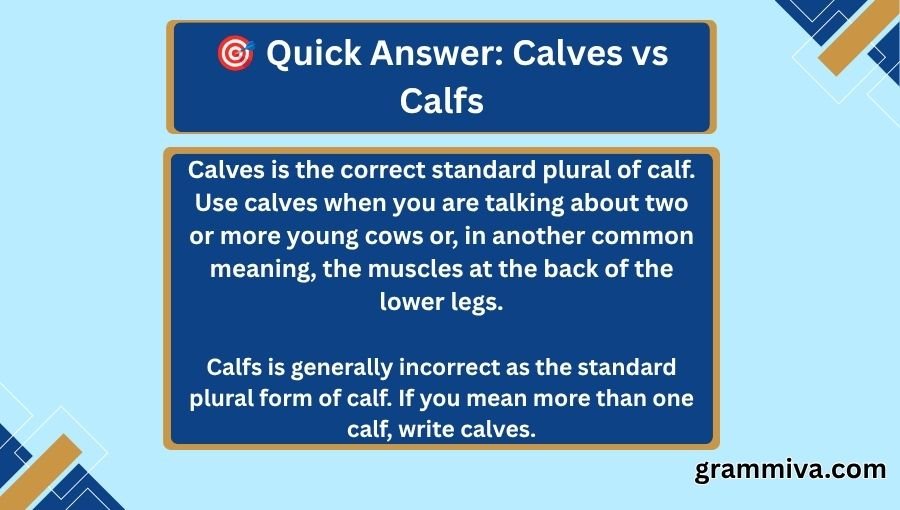
Calves is the correct standard plural of calf. Use calves when you are talking about two or more young cows or, in another common meaning, the muscles at the back of the lower legs.
Calfs is generally incorrect as the standard plural form of calf. If you mean more than one calf, write calves.
| Singular | Correct Plural | Incorrect Plural |
|---|---|---|
| calf | calves | calfs |
| one calf | two calves | two calfs |
| a calf muscle | calf muscles | — |
The easiest rule to remember is: calf → calves, not calf → calfs.
Is Calves the Plural of Calf?
Yes. Calves is the standard plural form of calf. The spelling changes from -f to -ves rather than simply adding -s.
This is one of the English plural patterns that learners often need to memorize. English has many regular plurals, such as book → books, but it also has irregular or changing plural forms.
For example:
- one calf → two calves
- one half → two halves
- one leaf → two leaves
- one knife → two knives
The pattern is useful, but it is not a rule you should apply to every word ending in -f. English has exceptions. That is why it is safest to learn familiar word pairs rather than assume every -f word changes in exactly the same way.
Calf as a Noun
The word calf is a noun. It can refer to a young animal, especially a young cow, or to the fleshy muscle on the back of the lower part of a person’s leg.
When you make the noun plural, the standard spelling is calves.
| Form | Type | Meaning | Example | Correct/Incorrect |
|---|---|---|---|---|
| calf | singular noun | One young animal or one leg muscle | The calf stayed close to its mother. | ✅ Correct |
| calves | plural noun | More than one calf | The calves ran across the field. | ✅ Correct |
| calfs | attempted plural | Intended to mean more than one calf | The farmer fed three calfs. | ❌ Incorrect |
| calf’s | singular possessive | Something belonging to one calf | The calf’s coat was wet. | ✅ Correct |
| calves’ | plural possessive | Something belonging to several calves | The calves’ shelter was clean. | ✅ Correct |
Notice the apostrophe difference. Calf’s means something belongs to one calf. Calves’ means something belongs to more than one calf.
🐄 Calves vs Calfs at a Glance
The core difference is spelling: calves is the standard plural, while calfs is not the standard plural of calf.
| Form | Type | Meaning | Example | Correct/Incorrect |
|---|---|---|---|---|
| calf | singular | One calf | I saw a calf. | ✅ Correct |
| calves | plural | Two or more calves | I saw three calves. | ✅ Correct |
| calf’s | singular possessive | Belonging to one calf | The calf’s food was ready. | ✅ Correct |
| calves’ | plural possessive | Belonging to multiple calves | The calves’ food was ready. | ✅ Correct |
| calfs | nonstandard attempted plural | Intended as the plural of calf | We saw five calfs. | ❌ Incorrect |
A useful way to see the pattern is to compare the singular and plural side by side:
calf → calves
The final f changes to v, and -es is added.
Why Does Calf Become Calves?
Calf becomes calves because its standard plural form changes the final consonant from f to v and adds -es. This is simply the established spelling of the plural.
You do not need to create the plural yourself each time. Treat calves as a word form that you know.
This matters because English spelling does not always follow one perfect rule. Some nouns take -s, some take -es, and some change their spelling in other ways.
For example:
| Singular | Plural | Pattern |
|---|---|---|
| calf | calves | f → v + es |
| half | halves | f → v + es |
| leaf | leaves | f → v + es |
| knife | knives | f → v + es |
| roof | roofs | simply adds s |
| chief | chiefs | simply adds s |
This table shows why you should not assume every word ending in -f must change to -ves.
🎯 How Can You Remember Calves vs Calfs?
The easiest memory trick is to connect calf with a few familiar words that follow a similar plural pattern.
Think:
calf → calves
half → halves
leaf → leaves
knife → knives
You can remember the group as words that change f to v before the plural ending.
A Simple Memory Sentence
Try this:
“The calf has friends called calves.”
The singular form has f. The plural form has ves.
Another trick is to look at the ending:
- One calf
- Many calves
The word calves visually contains ves, which can remind you that the f changes to v.
💡 Test Tip
When you are unsure, say the sentence in your head with a number.
If you write:
I saw four ___.
The blank needs a plural noun. Since the standard plural is calves, the sentence becomes:
I saw four calves.
This quick test works well because a number such as two, three, or four tells you that you need a plural.
What Does Calves Mean?
Calves has two common noun meanings. It can mean multiple young animals, or it can mean the muscles at the backs of the lower legs.
The meaning depends on the sentence.
Calves as Young Animals
A calf can be a young cow or another young animal in certain animal groups. The plural is calves.
Examples:
The farmer checked the calves before sunrise.
Here, calves refers to multiple young animals.
Three calves were resting near the fence.
Again, the word means more than one young animal.
Calves as Leg Muscles
Calves can also refer to the muscles on the back of the lower legs.
For example:
My calves are sore after the hike.
Here, the sentence is about leg muscles, not animals.
This second meaning is common in exercise, sports, fitness, and everyday conversation.
| Meaning | Word Type | Example Sentence |
|---|---|---|
| Young animals | Plural noun | The calves stayed near the barn. |
| Lower-leg muscles | Plural noun | Her calves were tired after the run. |
The meaning changes, but the spelling does not. In both cases, the correct plural is calves.
🏃 How Is Calves Used for Leg Muscles?
The word calves refers to the plural of the body-part noun calf. Each leg has a calf, so when you refer to both legs, you normally use calves.
For example:
My calves hurt after climbing the stairs.
Strong calves can help during running and jumping.
He stretched his calves after the workout.
Do not write calfs when referring to these muscles.
Correct:
My calves are tight. ✅
Incorrect:
My calfs are tight. ❌
The spelling stays the same whether you are talking about animals or body parts.
Why Do People Confuse Calves and Calfs?
People often confuse the forms because the normal plural pattern in English is to add -s. Since calf looks like many regular nouns, a writer may naturally think that calfs should be correct.
That first guess is understandable, but standard English uses calves.
I once worked with a student who wrote “three calfs” in a short farm story. When I asked how she made the plural, she said, “I just added s because that usually works.” That was a good example of how a sensible English rule can lead to the wrong answer when a word has a special plural form.
Other factors can also cause the mistake:
- Fast typing can make people choose the first spelling that comes to mind.
- Autocorrect can sometimes reinforce an incorrectly typed form.
- Writers may not have learned the plural form yet.
- The spelling calves may look unusual if you have not seen it often.
- People may confuse the word with other nouns that simply add -s.
| Confusion | Correct Form | Basic Rule |
|---|---|---|
| its / it’s | its / it’s | Possession vs. “it is” |
| your / you’re | your / you’re | Possession vs. “you are” |
| their / they’re | their / they’re | Possession vs. “they are” |
| calf / calves | calf / calves | Singular vs. standard plural |
| woman / women | woman / women | Irregular plural spelling |
These mistakes have something in common: the writer knows what they want to say but chooses the wrong form while typing.
📝 Calves vs Calfs in a Real-Life Case Study
Imagine a small farm manager writing an email to a local animal-care team.
The manager needs to report that four young animals have been checked and moved to a clean area.
A careless version might say:
“The four calfs were moved to the east pen.”
The corrected version is:
“The four calves were moved to the east pen.”
Why is the second sentence better? Calves is the established plural form of calf. The number four also tells us that the noun must be plural.
The same principle works in a workplace report:
“Two calves need additional care.”
It also works in casual speech:
“We saw a few calves on the drive home.”
And it works when talking about exercise:
“My calves are sore after yesterday’s workout.”
The context changes. The spelling does not.
Grammar Rules Explanation
The standard plural of calf is calves. It is not formed by simply adding -s to the singular noun.
The spelling change is:
calf → calves
The final f changes to v, and the plural ending -es is added.
This is an established English plural form. Standard reference sources and major dictionaries list calves as the normal plural form of calf.
It is helpful to separate three forms:
- calf — singular
- calves — plural
- calf’s / calves’ — possessive forms
The apostrophe does not create the plural. The plural is already calves.
For example:
One calf is sleeping.
Two calves are sleeping.
The calf’s bed is clean.
The calves’ beds are clean.
The difference between calf’s and calves’ is possession, not plural spelling.
Correct vs Incorrect at a Glance
| Sentence | Correct/Incorrect | Why |
|---|---|---|
| The farmer owns six calves. | ✅ Correct | Calves is the standard plural of calf. |
| The farmer owns six calfs. | ❌ Incorrect | Calfs is not the standard plural form. |
| My calves hurt after the race. | ✅ Correct | Calves is the plural body-part noun. |
| My calfs hurt after the race. | ❌ Incorrect | The standard plural spelling is calves. |
| The calves’ shelter needs repair. | ✅ Correct | Calves’ is the plural possessive form. |
The rule is not based on how the word sounds alone. It is based on the standard spelling of the plural noun.
⚠️ Common Mistakes With Calves vs Calfs
The most common mistake is writing calfs because the writer expects a regular plural.
A second mistake is forgetting the difference between calves and calves’. The apostrophe matters when you show ownership.
Compare:
The calves are outside.
This says the animals are outside.
The calves’ food is outside.
This says the food belongs to the calves.
A third mistake is using calf’s when the writer means more than one calf.
The calf’s are outside. ❌
This is wrong because calf’s is not a plural. The correct sentence is:
The calves are outside. ✅
I once caught myself typing “calfs” in a quick note about a workout. I knew the rule, but my fingers followed the simple “add s” pattern. I fixed it before sending the note. That small slip reminded me that even familiar words can cause errors when we type quickly.
Common Wrong Spellings and Uses
| Wrong Form | What’s Wrong | Correct Form |
|---|---|---|
| calfs | Incorrect standard plural | calves |
| calf’s | Singular possessive, not plural | calves |
| calves’s | Incorrect possessive construction | calves’ |
| two calf | Singular noun after a plural number | two calves |
| three calfs’ | Incorrect plural spelling before possessive apostrophe | three calves’ |
| the calf are | Singular noun used with a plural verb | the calves are |
Why These Mistakes Happen
Fast typing: Your hands may follow the most common plural pattern before your brain checks the word.
Autocorrect: A phone or computer may suggest a form that looks familiar. Writers should still proofread.
Lack of knowledge: If you have not learned the plural, calfs can look perfectly reasonable.
Rare exposure: Someone who does not often read or write about calves may simply not have seen the correct form enough times.
The solution is simple: learn the pair calf → calves and use it until the pattern becomes automatic.
Does Calves Have an Apostrophe?
No, calves does not need an apostrophe when it is simply the plural noun. An apostrophe is added only when the word shows possession.
Compare these examples:
| Form | Function | Example |
|---|---|---|
| calf | Singular | The calf is hungry. |
| calves | Plural | The calves are hungry. |
| calf’s | Singular possessive | The calf’s mother is nearby. |
| calves’ | Plural possessive | The calves’ mothers are nearby. |
A useful question is: Am I showing ownership?
If the answer is no, you usually do not need an apostrophe.
The calves are sleeping. ✅
If the answer is yes:
The calves’ shelter is warm. ✅
🧠 How To Remember the Correct Spelling
The best way to remember the plural is to memorize the complete pair rather than trying to rebuild the word every time.
Write this pair:
calf → calves
Then connect it to another familiar pair:
half → halves
The shared visual pattern can make the spelling easier to recall.
You can also use a three-step check:
- Find the singular noun.
- Ask whether you mean one or more than one.
- If the word is calf and you mean more than one, write calves.
Here is a quick practice set:
- one calf
- two calves
- one calf’s blanket
- two calves’ blankets
If you can write those four forms correctly, you understand the basic pattern.
Where Should You Use Calves?
You should use calves whenever calf is being used as a plural noun. This includes animal writing, fitness writing, school assignments, workplace documents, and casual messages.
| Context | Which Term to Use | Example |
|---|---|---|
| Everyday conversation | calves | We saw several calves near the road. |
| Professional writing | calves | The report lists eight calves in the group. |
| Creative writing | calves | The calves followed their mother across the field. |
| Social media/texting | calves | My calves are sore after that hike! |
The only major question is whether you mean one or more than one. If you mean one, use calf. If you mean more than one, use calves.
What Are the Correct Forms of Calf?
The main related forms are calf, calves, calf’s, and calves’. Each one has a different grammatical job.
| Form | Type | Example |
|---|---|---|
| calf | Singular noun | The calf is resting. |
| calves | Plural noun | The calves are resting. |
| calf’s | Singular possessive | The calf’s coat is soft. |
| calves’ | Plural possessive | The calves’ coats are soft. |
These forms are worth learning as a group because they prevent several common mistakes.
Remember that calf’s is not the plural. The apostrophe and s show possession by one calf.
Likewise, calves’ shows possession by more than one calf.
Are There Common Phrases With Calves?
There are several ordinary phrases that use calves, especially when the word refers to animals or leg muscles. These are not special idioms. They are common combinations of words.
| Phrase | Meaning |
|---|---|
| newborn calves | Very young calves that have recently been born |
| young calves | Calves that are still young |
| herd of calves | A group of calves |
| calf muscles | Muscles at the back of the lower leg |
| strong calves | Well-developed lower-leg muscles |
| sore calves | Calves that feel painful or tired after activity |
For example, a fitness article might say:
Stretch your calf muscles after exercise.
If the sentence refers to both legs, it may say:
Stretch your calves after exercise.
The exact form depends on whether the writer is talking about one calf or multiple calves.
Can Other Words Replace Calves?
Sometimes you can replace calves with another phrase, but the best choice depends on the meaning.
For young animals, you might use young cattle in some contexts. For body parts, you might say lower-leg muscles. However, these alternatives are not always exact replacements.
| Alternative | Works When | Does Not Work When |
|---|---|---|
| young cattle | You need a broader term for young cattle | You specifically need the noun calves |
| young animals | The exact animal type is not important | You need to identify calves specifically |
| lower-leg muscles | You mean the body part | You are talking about young animals |
| leg muscles | The context clearly refers to the legs | You need the specific calf muscles |
| young cows | You are speaking generally about young cows | You need a precise term for the animal |
For clear writing, the specific word is often best. If you mean calves, there is no need to replace it with a longer phrase.
Why Does Getting Calves Right Matter?
Correct spelling improves clarity, trust, and professionalism. A single spelling error rarely changes the meaning completely, but repeated errors can make writing look careless.
I once edited a short business report that used the wrong plural form several times. Nothing about the report was difficult to understand, but the repeated spelling mistake made the document look less polished. After correcting the word, the report immediately looked more professional.
Think about where your writing appears:
| Situation | Why Getting It Right Matters |
|---|---|
| Resume or job application | Shows care with basic written English |
| Client email | Creates a professional impression |
| Published content | Builds reader trust and credibility |
| Social post | Makes the message easier to read and share |
A useful rule is:
“Small spelling choices can make a big difference in how clear your writing feels.”
You do not need perfect grammar to communicate every idea. But when you know the correct form, using it helps your writing look careful and confident.
Is Calfs Ever the Standard Plural?
For ordinary modern US English, calves is the standard plural of calf. Writers should not use calfs as the normal plural.
You may occasionally encounter unusual spellings in historical texts, names, specialized records, or other contexts where a word is being used in a nonstandard way. Such cases do not change the normal rule for everyday writing.
If you are writing an email, article, school assignment, report, caption, or conversation, choose calves when you mean more than one calf.
How Does Calves Work in a Sentence?
The plural form can serve several normal noun roles in a sentence.
As the Subject
The calves are sleeping.
Here, calves is the subject of the sentence.
As the Object
The farmer fed the calves.
Here, calves receives the action of the verb fed.
After a Number
Five calves were in the field.
The number five requires the plural form.
After Words Such as Several and Many
Several calves were near the fence.
Many calves need shelter during cold weather.
These examples show why recognizing singular and plural forms matters. The word must agree with the rest of the sentence.
How Do Calves and Calf’s Differ?
Calves is plural. Calf’s is singular possessive.
This distinction is easy once you separate number from ownership.
Compare:
The calves are hungry. ✅
This means more than one calf is hungry.
The calf’s bowl is empty. ✅
This means the bowl belongs to one calf.
Now compare:
The calves’ bowls are empty. ✅
This means the bowls belong to multiple calves.
| Sentence | Meaning |
|---|---|
| The calf is hungry. | One calf is hungry. |
| The calves are hungry. | More than one calf is hungry. |
| The calf’s food is ready. | Food belongs to one calf. |
| The calves’ food is ready. | Food belongs to multiple calves. |
This is one of the most useful distinctions to remember when editing your own writing.
📝 Practice Examples for Calves vs Calfs
Try correcting these sentences before looking at the answers.
Example 1
The farmer counted seven calfs.
Correct version:
The farmer counted seven calves. ✅
The number seven tells us that a plural noun is needed.
Example 2
My calfs hurt after the long walk.
Correct version:
My calves hurt after the long walk. ✅
Here, the word refers to the muscles on the lower legs.
Example 3
The calf’s are resting.
Correct version:
The calves are resting. ✅
The original incorrectly used a possessive form instead of the plural.
| Practice Sentence | Correct Form | Reason |
|---|---|---|
| We saw two ___ in the field. | calves | A plural noun is needed. |
| My ___ hurt after running. | calves | The sentence refers to both leg muscles. |
| The ___ is sleeping. | calf | Only one animal is meant. |
| The ___’ shelter is clean. | calves’ | The shelter belongs to multiple calves. |
🔎 A Fast Editing Test
When proofreading, look for the word calf and ask one question:
Does the sentence mean one or more than one?
If it means one, keep calf.
If it means more than one, change it to calves.
Then ask a second question:
Does the word show ownership?
If not, do not add an apostrophe.
If one calf owns something, use calf’s.
If several calves own something, use calves’.
This two-question test catches most errors.
Can Calves Refer to Human Body Parts?
Yes. Calves can refer to the muscles at the back of the lower legs.
For example:
My calves feel tired after the workout.
She stretched her calves before the race.
The cyclist has strong calves.
In these sentences, the word has nothing to do with animals. The plural form is still calves because the singular body-part noun is calf.
That makes the spelling especially easy to remember: whether you are talking about animals or muscles, the plural remains calves.
FAQs About Calves vs Calfs
Is calves the correct plural of calf?
Yes. Calves is the standard plural form of calf. Use it when referring to two or more young animals or two or more calf muscles.
Is calfs ever correct?
Calfs is not the standard plural spelling of calf in ordinary US English. In normal writing, use calves.
Why is the plural calves instead of calfs?
The standard plural changes the final f to v and adds -es. The resulting form is calves.
What is the singular of calves?
The singular form is calf.
For example:
One calf.
Two calves.
Is calves a noun?
Yes. Calves is the plural form of the noun calf. It can refer to young animals or the muscles at the backs of the lower legs.
What is the possessive form of calves?
The plural possessive form is calves’.
Example:
The calves’ shelter was clean.
The apostrophe comes after the s because the word is already plural.
Is calf’s the plural of calf?
No. Calf’s is the singular possessive form. It means that something belongs to one calf.
Example:
The calf’s mother stayed nearby.
Which is correct: “two calves” or “two calfs”?
Two calves is correct. The word two requires the plural form, and the standard plural of calf is calves.
Which is correct: “my calves hurt” or “my calfs hurt”?
My calves hurt is correct. Here, calves refers to the muscles at the backs of the lower legs.
How can I remember the spelling of calves?
Memorize the pair calf → calves. You can also connect it with familiar pairs such as half → halves and leaf → leaves.
✅ Quick Recap Checklist
Use this checklist whenever you are unsure about the correct form.
| Question | If Yes → Use |
|---|---|
| Do you mean one young animal or one leg muscle? | calf |
| Do you mean more than one? | calves |
| Does one calf own something? | calf’s |
| Do multiple calves own something? | calves’ |
| Are you tempted to write calfs as the plural? | Change it to calves |
Three Final Practice Examples
1. We watched four ___ playing near the fence.
Answer: calves ✅
2. My ___ were sore after the hike.
Answer: calves ✅
3. The ___ mother stayed nearby.
Answer: calf’s ✅
The key is simple: calf is singular, calves is plural, calf’s is singular possessive, and calves’ is plural possessive.
Calves vs Calfs: The Rule to Keep
The most useful rule is short enough to memorize in a few seconds:
One calf. Two calves. Never use “calfs” as the normal plural.
When you mean more than one young animal, write calves. When you mean more than one calf muscle, write calves as well. When ownership is involved, choose calf’s for one calf and calves’ for more than one.
The spelling may seem unusual at first because many English nouns form their plurals by simply adding -s. But once you learn this word pair, the choice becomes automatic.
If you are proofreading, use the number test. Words such as two, three, many, and several signal that you need the plural. For calf, that plural is calves.
The next time you pause over calves vs calfs, do not guess. Think of the pair:
calf → calves
That one small pattern is enough to keep your spelling correct, your sentences clear, and your writing polished. 🐄✨

I am Adam Wilson, an English language content writer with an interest in grammar and vocabulary. I work at Grammiva and focus on creating clear explanations and practical examples for English learners.

[…] the end, you should be able to write abscess with confidence. 🧠 Calves vs Calfs | All of a sudden vs all of the sudden | One and the Same vs One in the […]