Have you ever stopped in the middle of a sentence and wondered about sang vs sung “Which one should I use?” 🎵 You are not alone.
These two forms come from the same verb, sing, and both are correct words.
The tricky part is knowing when each one belongs.
The difference between sang vs sung becomes much easier once you learn one simple rule: sang is normally used as the simple past form, while sung is normally used as the past participle.
That means the helping verb often tells you which form you need.
I teach grammar by looking for patterns rather than asking students to memorize long lists.
This pair is a great example.
Once you understand the pattern, sentences such as “She sang beautifully” and “She has sung beautifully” stop feeling confusing.
In this guide, I will explain the difference in plain US English.
You will see clear examples, common mistakes, memory tricks, tables, and real-world situations.
By the end, you should be able to choose the right form quickly and confidently. 👍 Began vs Begun | Absence vs Abscence | Attorneys vs Attornies
🎯 Quick Answer: Sang vs Sung
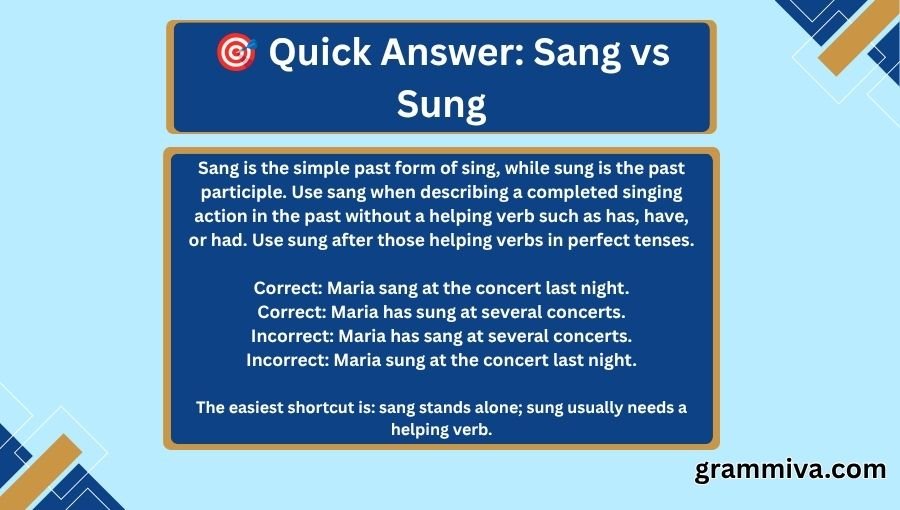
Sang is the simple past form of sing, while sung is the past participle. Use sang when describing a completed singing action in the past without a helping verb such as has, have, or had. Use sung after those helping verbs in perfect tenses.
- Correct: Maria sang at the concert last night.
- Correct: Maria has sung at several concerts.
- Incorrect: Maria has sang at several concerts.
- Incorrect: Maria sung at the concert last night.
The easiest shortcut is: sang stands alone; sung usually needs a helping verb.
🧩 Related Forms of Sing
The verb sing has several forms that learners may mix up. Knowing all of them makes the difference between the two past forms much clearer.
| Form | Type | Example |
|---|---|---|
| sing | Base form | I like to sing. |
| sings | Third-person singular present | She sings every Sunday. |
| sang | Simple past | She sang yesterday. |
| sung | Past participle | She has sung before. |
| singing | Present participle/gerund | She is singing now. |
A useful pattern is sing → sang → sung.
Do not treat sang and sung as interchangeable spellings. They perform different jobs in standard English.
🔎 Is Sang the Past Tense of Sing?
Yes. Sang is the simple past form of sing. It describes an action that happened in the past.
For example:
James sang at the school event.
The action happened in the past. The sentence does not need has, have, or had.
Other examples include:
- We sang together on the bus.
- She sang a beautiful song yesterday.
- The children sang during the ceremony.
- I sang in the choir when I was younger.
The key point is that sang can normally carry the past tense by itself.
How Sang Works in a Sentence
Consider this sentence:
Elena sang at the wedding.
- Elena = subject
- sang = simple past verb
- at the wedding = information about where or when the action happened
You do not need another helping verb.
💡 Test Tip
Remove any helping verb and ask whether the sentence describes one completed past action.
If the sentence works naturally with a past-time word such as yesterday, last night, last year, or when I was young, sang is often the right choice.
I sang yesterday. ✅
I sung yesterday. ❌
🎵 Is Sung the Past Tense of Sing?
No. Sung is the past participle of sing. In standard English, it normally appears with a helping verb in perfect constructions.
Examples include:
- I have sung that song before.
- She has sung in several shows.
- They had sung for an hour before dinner.
- We have never sung together.
Notice the helping verbs:
- have sung
- has sung
- had sung
That is the main pattern to remember.
Why Sung Needs Help
The word sung does not normally work alone as the simple past verb.
She sung at the party. ❌
Instead:
She sang at the party. ✅
But when you add has, have, or had, sung becomes correct:
She has sung at the party before. ✅
This is why learners sometimes feel that sung is “more past.” It is not simply a more-past version of sang. It has a different grammatical role.
📊 Sang vs Sung at a Glance
The core difference is simple: sang is simple past, while sung is a past participle.
| Form | Type | Meaning | Example | Correct/Incorrect |
|---|---|---|---|---|
| sang | Simple past | Singing happened in the past | She sang yesterday. | ✅ Correct |
| sung | Past participle | Used with a helping verb | She has sung before. | ✅ Correct |
| sung | Simple past | Used alone to show past singing | She sung yesterday. | ❌ Incorrect |
| sang | Past participle | Used after has/have/had | She has sang before. | ❌ Incorrect |
| singing | Present participle | Singing is happening or functioning as a noun | She is singing now. | ✅ Correct |
A quick memory line is:
Yesterday, I sang.
I have sung before.
📝 What Are the Correct Meanings and Uses?
The two forms are both connected to the act of making music with your voice, but grammar determines which form you need.
Sang for a Completed Past Action
Use sang when the action happened in the past and you are simply reporting it.
Marcus sang at the talent show.
The sentence tells us what Marcus did. The event is presented as a past action.
More examples:
I sang with my friends last Friday.
She sang the national anthem before the game.
We sang three songs during the trip.
Sung With Have, Has, or Had
Use sung after have, has, or had when forming a perfect tense.
I have sung that song many times.
She has sung professionally for years.
They had sung before the guests arrived.
Here, the helping verb creates the grammatical structure. Sung completes it.
Sung in Passive Constructions
The participle can also appear in passive structures.
The song was sung by the entire class.
Here, was sung is correct. The sentence focuses on the song rather than the people who performed it.
Compare:
The class sang the song. ✅
The song was sung by the class. ✅
Both are correct, but the sentence structures are different.
Summary of the Main Uses
| Meaning | Word Type | Example Sentence |
|---|---|---|
| Completed past singing | Simple past | He sang at the event. |
| Past action connected to now | Past participle | He has sung at many events. |
| Earlier past action | Past participle | He had sung before the show ended. |
| Passive action | Past participle | The song was sung by the choir. |
A Simple Question to Ask Yourself
Before choosing a form, look at the words around the verb.
If you see:
- yesterday
- last night
- last year
- when I was young
- two hours ago
you will often need sang.
If you see:
- has
- have
- had
- was
- were
check whether the sentence calls for the participle sung.
This is not a rule that works mechanically in every sentence with was or were, but it is a useful starting point.
🧠 Why Do People Confuse Sang and Sung?
People confuse these forms because English has many irregular verbs. The usual pattern of adding -ed does not apply here.
For regular verbs, we can say:
walk → walked
But sing changes internally:
sing → sang → sung
I once worked with a student who wrote, “I have sang this song before.” When I asked her to remove have, she immediately noticed the problem. “I sang this song before” sounded natural. Adding have made her choose the wrong form because she was thinking about meaning instead of sentence structure.
That small change helped her see the pattern.
Common Reasons for the Confusion
| Reason | What Happens | Example |
|---|---|---|
| Fast typing | The writer chooses the first form that comes to mind. | “I have sang it.” |
| Autocorrect | Software may not understand the intended grammar. | A wrong form survives editing. |
| Lack of knowledge | The writer has not learned the past-participle rule. | “She sung yesterday.” |
| Sound-based thinking | The writer focuses on what sounds familiar. | “I have sang” feels familiar. |
| Irregular verb patterns | The forms do not follow a simple -ed pattern. | sing → sang → sung |
The good news is that this mistake is easy to fix once the pattern becomes automatic.
🧾 Case Study: A Workplace Email
Imagine that an employee is writing an email about a company event.
The first draft says:
“Sarah has sang at three company events this year.”
That sentence needs sung, because has is a helping verb.
The corrected sentence is:
“Sarah has sung at three company events this year.” ✅
Now imagine a different sentence:
“Sarah sang at Friday’s company event.” ✅
This time, there is no perfect-tense helping verb. The writer is simply describing a completed event in the past.
The difference is small, but it can make professional writing look much more polished.
| Workplace Situation | Correct Form | Example |
|---|---|---|
| Reporting a past event | sang | Sarah sang on Friday. |
| Describing experience | sung | Sarah has sung at three events. |
| Describing an earlier past action | sung | Sarah had sung before the guests arrived. |
| Passive report | sung | The song was sung by Sarah. |
⚙️ Grammar Rules Explanation
The main grammatical rule is straightforward. Sang functions as the simple past form of sing. Sung functions as the past participle.
The simple past can normally appear without a helping verb:
She sang yesterday.
The past participle normally works with an auxiliary or helping verb:
She has sung before.
The same distinction appears in other irregular verbs.
For example:
go → went → gone
write → wrote → written
eat → ate → eaten
In each case, the simple past and past participle have different jobs.
Standard English grammar references and major dictionaries agree on this basic distinction. The important thing is not memorizing a dictionary entry. It is recognizing the sentence pattern.
Correct vs Incorrect at a Glance
| Sentence | Correct/Incorrect | Why |
|---|---|---|
| She sang at the concert. | ✅ Correct | Sang is simple past. |
| She has sung at the concert. | ✅ Correct | Sung follows has. |
| She sung at the concert. | ❌ Incorrect | Sung cannot normally stand alone as simple past. |
| She has sang at the concert. | ❌ Incorrect | Sang is not the past participle. |
| They had sung before we arrived. | ✅ Correct | Sung follows had. |
A useful formula is:
Simple past = sang
Perfect tense = have/has/had + sung
Passive construction = be + sung
⚠️ Common Mistakes With Sang and Sung
The most common mistake is switching the two forms.
Writers may know both words but not know which grammatical structure controls the choice.
I once caught myself typing “They have sang it already” while editing a quick note. I saw have on the screen and corrected the verb before sending it. The mistake happened because I was typing quickly, not because I did not know the rule.
Similar Grammar Confusions
| Confusion | Correct Choice | Quick Rule |
|---|---|---|
| it’s / its | it’s = it is; its = possession | Check whether “it is” fits. |
| your / you’re | your = possession; you’re = you are | Try “you are.” |
| their / there / they’re | Different meanings | Check the sentence’s meaning. |
| then / than | Time vs comparison | Use than for comparisons. |
| affect / effect | Usually verb vs noun | Check the role in the sentence. |
Common Wrong Forms for This Specific Pair
| Wrong Form | What’s Wrong | Correct Form |
|---|---|---|
| I sung yesterday. | Simple past needs sang. | I sang yesterday. |
| She has sang before. | Has needs the participle. | She has sung before. |
| They sung last night. | No helping verb is present. | They sang last night. |
| We have sang together. | Have needs the participle. | We have sung together. |
| He had sang already. | Had needs the participle. | He had sung already. |
| She sung beautifully at school. | Simple past is required. | She sang beautifully at school. |
🧪 How To Remember the Difference
A simple memory trick can make this much easier.
Think of SANG = single past action.
I sang yesterday.
Then think of SUNG = supported by another verb.
I have sung before.
The first letter can also help:
SANG stands alone.
SUNG needs support.
This is not a formal grammar rule. It is simply a memory tool.
The Three-Step Test
When you are unsure, use these steps:
- Find the main verb.
- Look for a helping verb.
- Choose the form that matches the structure.
For example:
We ___ at the party last night.
There is no helping verb. Choose sang.
We have ___ at this party before.
There is a helping verb: have. Choose sung.
🌎 How Is Sang vs Sung Used in Different Contexts?
The basic rule stays the same in conversation, work, creative writing, and digital communication. The context may change, but the grammar does not.
| Context | Which Term to Use | Example |
|---|---|---|
| Everyday conversation | sang or sung, depending on structure | I sang last night. |
| Professional writing | sang or sung, depending on structure | She has sung at several events. |
| Creative writing | sang or sung, depending on structure | He sang beneath the stars. |
| Social media/texting | sang or sung, depending on structure | We sang all night! |
In casual texting, people sometimes ignore grammar rules. That does not change standard English.
If you want your writing to be clear and correct, keep the normal distinction.
💬 What Are Common Phrases With Sang and Sung?
There are many natural expressions involving sing, sang, and sung. These are not fixed idioms in every case, but they are common phrases that show how the forms work.
| Phrase | Meaning |
|---|---|
| sang a song | Performed a song in the past |
| sang along | Joined someone else in singing |
| sang at a wedding | Performed or participated in singing at a wedding |
| has sung before | Has previous experience singing |
| has sung for years | Has a history of singing over time |
| sung by the choir | A song performed by a choir |
Notice that the form changes with the grammar.
The children sang along. ✅
The children have sung along before. ✅
The phrase stays similar, but the verb form changes because the sentence structure changes.
🔄 What Alternatives Can Replace Sang or Sung?
Sometimes you can avoid the problem by changing the sentence. However, alternatives are not always exact replacements.
| Alternative | Works When | Does Not Work When |
|---|---|---|
| performed | You mean someone performed music generally. | You specifically mean vocal singing. |
| performed a song | You want a clear, formal phrase. | The exact action of singing matters. |
| sang a song | You need the simple past. | You need a perfect tense. |
| has performed | You are describing past experience. | You specifically need the verb sing. |
| used their voice to sing | You need an explanatory phrase. | You want natural, concise writing. |
For most everyday sentences, sang or sung is the most natural choice.
🎯 Sang vs Sung in Questions
Questions can make the distinction seem harder because the helping verb may move to the beginning.
Compare:
Did she sing yesterday?
and:
Has she sung before?
After did, use the base form sing, not sang.
After has, use sung.
This gives us another useful pattern:
| Question Structure | Correct Verb | Example |
|---|---|---|
| Did + subject + base verb | sing | Did she sing yesterday? |
| Has + subject + participle | sung | Has she sung before? |
| Have + subject + participle | sung | Have they sung together? |
| Had + subject + participle | sung | Had he sung before dinner? |
| Did + subject + base verb | sing | Did you sing at school? |
This is an important extra point. If you see did, do not automatically choose sang. The word did already carries the past tense.
❓ Can You Say “I Have Sang”?
No. In standard English, “I have sang” is incorrect.
The correct sentence is:
I have sung before. ✅
The reason is that have requires the past participle in this construction. The past participle of sing is sung.
Compare:
I sang yesterday. ✅
I have sung before. ✅
The two sentences both talk about past singing, but they use different grammar.
📚 Is “She Sung a Song” Correct?
No, not in standard English when sung is being used as the simple past verb.
Say:
She sang a song. ✅
You can use sung if you add the needed structure:
She has sung a song. ✅
Or:
The song was sung by her. ✅
So the problem is not that sung is a wrong word. The problem is that it is being placed in the wrong grammatical position.
🤔 Is Sang or Sung Used With “Yesterday”?
Use sang with yesterday when you are making a simple past statement.
I sang yesterday. ✅
I sung yesterday. ❌
The word yesterday points to a completed past time. A simple past verb is the natural choice.
However, you could create a different structure:
I have sung every day this week.
Here, sung is correct because have creates a perfect construction.
🏆 Does “Have Sung” Mean the Same as “Sang”?
Not exactly. Both refer to singing in the past, but the grammar and meaning can differ.
Sang normally presents the action as a completed past event:
She sang at the concert last night.
Has sung connects the past action to the present in some way:
She has sung at many concerts.
The second sentence focuses more on experience or a past action that matters now.
| Sentence | Main Focus |
|---|---|
| She sang last night. | A specific past event |
| She has sung many times. | Past experience |
| She had sung before dinner. | An action completed before another past event |
| The song was sung by her. | The action performed on the song |
🧠 Why Does Getting Sang vs Sung Right Matter?
Grammar choices affect how easily readers understand your writing. A small verb error may not change the meaning completely, but it can make your writing look rushed or unfinished.
“Clear grammar makes clear ideas easier to trust.”
That principle matters in school, work, publishing, and everyday communication.
| Situation | Why Getting It Right Matters |
|---|---|
| Resume | Shows attention to language and detail. |
| Client email | Helps create a polished professional impression. |
| Published content | Supports credibility and readability. |
| Social post | Makes your message easier to understand. |
Correct grammar is not about sounding fancy. It is about making your meaning easy to follow.
✍️ How To Use Sang vs Sung in Professional Writing
Professional writing benefits from simple, direct grammar.
Compare:
“The team sang at the charity event last Friday.” ✅
with:
“The team has sung at several charity events.” ✅
Both are professional. The correct choice depends on what you want to say.
Avoid trying to sound formal by using sung when sang is required. A more unusual word is not automatically a better word.
When editing a business email, I recommend checking every irregular verb that follows have, has, or had. These small words often reveal whether the participle is needed.
🗣️ How To Use Sang vs Sung in Everyday Conversation
In conversation, native speakers usually make the distinction naturally.
You might hear:
“We sang in the car.”
But:
“We’ve sung that song a hundred times.”
The second sentence uses we’ve, which means we have. That is your signal to use sung.
If you are speaking quickly and become unsure, mentally expand the contraction:
I’ve = I have → sung
We’ve = we have → sung
She’s = she has → sung
This trick can be especially helpful when speaking.
📱 How To Use Sang vs Sung in Texting and Social Media
Informal writing often drops punctuation or uses shortcuts, but standard grammar still follows the same rule.
Examples:
“We sang all night 😂” ✅
“I’ve sung this song so many times!” ✅
Avoid:
“I’ve sang this song so many times.” ❌
Even though a reader may understand the meaning, the standard form is still sung.
🧩 What Happens After “Did”?
This is a common trap.
You should say:
Did you sing yesterday? ✅
Not:
Did you sang yesterday? ❌
Why? Because did already marks the past tense. The main verb returns to its base form.
This creates a useful three-part pattern:
| Structure | Verb Form | Example |
|---|---|---|
| Past statement | sang | I sang yesterday. |
| Question with did | sing | Did you sing yesterday? |
| Perfect statement | sung | I have sung before. |
Learning this pattern can prevent several mistakes at once.
📌 Sang vs Sung: Three Rules to Memorize
If you only remember three things, remember these:
- Sang = simple past.
- I sang yesterday.
- Sung = past participle.
- I have sung before.
- After did, use sing.
- Did you sing yesterday?
These three rules cover most everyday situations.
✅ Quick Recap Checklist
Use the following checklist whenever you are unsure.
| Question | If Yes → Use |
|---|---|
| Is this a simple past statement? | sang |
| Does the sentence contain have? | sung |
| Does it contain has? | sung |
| Does it contain had? | sung |
| Does it contain did? | sing |
| Is the sentence passive, such as “was ___”? | sung |
Practice Examples
1. We ___ at the party last night.
Answer: sang
We sang at the party last night. ✅
2. We have ___ this song before.
Answer: sung
We have sung this song before. ✅
3. Did you ___ at the event?
Answer: sing
Did you sing at the event? ✅
❓ FAQs About Sang vs Sung
Is sang the past tense of sing?
Yes. Sang is the simple past form of sing. For example, “She sang yesterday” is correct.
Is sung the past tense of sing?
No. Sung is the past participle of sing. It normally appears with a helping verb, such as has, have, or had.
Which is correct: “I sang” or “I sung”?
Both forms can be correct in different structures, but “I sang” is correct for a simple past statement. For example, “I sang at the party.”
Which is correct: “I have sang” or “I have sung”?
“I have sung” is correct. The word have is followed by the past participle, so sung is required.
Is “She sang a song” correct?
Yes. “She sang a song” is correct because sang is the simple past form.
Is “She sung a song” grammatically correct?
No, not as a simple past sentence in standard English. Say “She sang a song.”
Should I say “I have sang before”?
No. Say “I have sung before.” The helping verb have requires the past participle sung.
What is the difference between “I sang” and “I have sung”?
“I sang” presents a simple past action. “I have sung” uses the present perfect and often describes past experience or an action connected to the present.
What comes after “did,” sang or sung?
Neither. After did, use the base form sing.
Did you sing yesterday? ✅
How can I remember sang and sung?
Use this short memory trick: Sang stands alone; sung needs support. Think “I sang” but “I have sung.”
🎯 Final Takeaway: Sang vs Sung
Sang vs sung becomes easy once you stop treating the words as interchangeable forms. Sang is the simple past form, while sung is the past participle. Use sang for a basic past statement: “I sang yesterday.” Use sung with a helping verb in perfect or passive structures: “I have sung before” or “The song was sung by the choir.”
When you see have, has, or had, think sung. When you are simply describing something that happened in the past, think sang. When you see did, remember to go back to sing.
I use one final mental check when editing: “I sang, but I have sung.” 🎵 Once that sentence feels natural, the rest of the pattern usually follows.
Grammar does not have to feel like a list of confusing rules. Find the pattern, test the sentence, and choose the form that fits. ✨
Remember: yesterday you sang, but you have sung before.

I am Ethan Brooks, an English grammar and vocabulary writer. I work at Grammiva, where I create simple and helpful content to make English learning easier for students and everyday learners.

[…] examples, cover common mistakes, and give you simple tests you can use whenever you are unsure. Sang vs Sung | Began vs Begun | Absence vs […]
[…] to choose confidently without stopping to second-guess yourself. ✍️ A Unique vs An Unique | Sang vs Sung | Began vs […]