Have you ever typed a word, looked at the red underline, and wondered whether your keyboard was wrong? 😄 labeling vs labelling is one of those spelling questions that can make even careful writers stop and think.
The good news is that both spellings are real. The difference is mainly tied to the variety of English being used.
Labeling is the standard spelling in US English, while labelling is the standard spelling in British English and several other forms of English.
As an editor, I see this mix-up often.
The tricky part is that the words look almost identical, and both follow a logical spelling pattern in the English varieties where they are used.
Once you know which version belongs to US English, the choice becomes simple.
In this guide, I will explain the difference, show you real sentence examples, cover related word forms, and give you easy memory tricks.
By the end, you should be able to choose the right spelling without stopping to second-guess yourself. ✍️ Everyone vs Every One | Harass vs Haras | anise vs aniseed
🎯 Quick Answer: Labeling vs Labelling
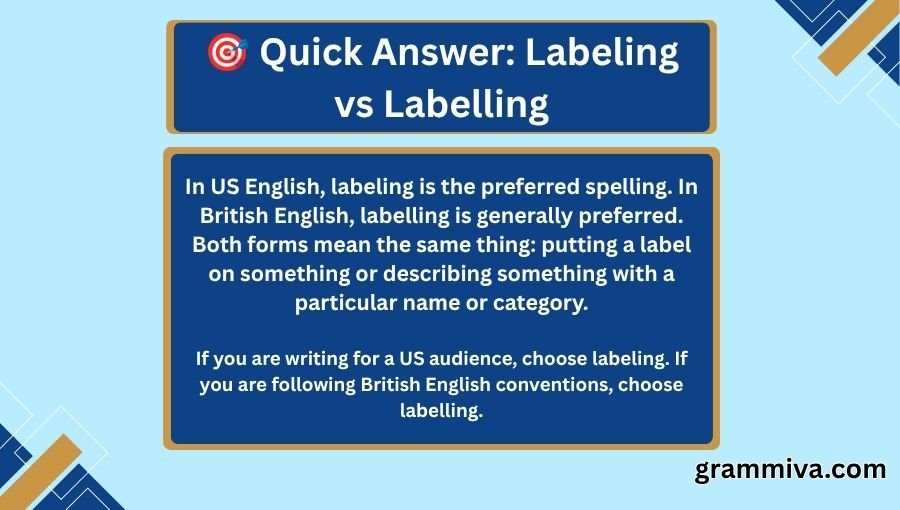
In US English, labeling is the preferred spelling. In British English, labelling is generally preferred. Both forms mean the same thing: putting a label on something or describing something with a particular name or category.
If you are writing for a US audience, choose labeling. If you are following British English conventions, choose labelling.
| Spelling | Main English variety | Example |
|---|---|---|
| labeling | US English | The team is labeling the boxes. |
| labelling | British English | The team is labelling the boxes. |
The key point is simple: the meaning does not change because of the extra “l.” The spelling convention changes.
Is Labeling the Correct US English Spelling?
Yes. Labeling is the standard US English spelling of the present participle and gerund form of label.
The same US spelling pattern appears in related forms such as labeled and labeler. American English often keeps the final consonant single when adding endings to words like label.
For example:
- ✅ Correct: The company is labeling each package.
- ❌ Incorrect for standard US spelling: The company is labelling each package.
This does not mean labelling is a bad word. It is a normal spelling in British English and other varieties that follow that convention.
What Does Labeling Mean?
Labeling means putting a label on something or giving something a name, category, or description.
The word can describe a physical action:
The worker is labeling the containers.
It can also describe an idea or judgment:
The article warns against labeling people too quickly.
In both cases, the basic idea is the same. Something is being identified or described.
Why Does Labelling Have Two Ls?
The spelling labelling follows a common British English spelling pattern in which the final consonant is doubled before certain endings.
American English usually does not double the final l in labeling.
| Form | US English | British English |
|---|---|---|
| Present participle | labeling | labelling |
| Past tense | labeled | labelled |
| Person who labels | labeler | labeller |
| Base verb | label | label |
The base word stays the same. The main difference appears when an ending is added.
🔎 Labeling vs Labelling at a Glance
The difference between the two forms is spelling convention, not meaning. Labeling fits standard US English, while labelling fits standard British English.
| Form | Type | Meaning | Example | Correct/Incorrect |
|---|---|---|---|---|
| labeling | US English present participle/gerund | Putting a label on something | We are labeling the files. | ✅ Correct in US English |
| labelling | British English present participle/gerund | Putting a label on something | We are labelling the files. | ✅ Correct in British English |
| labelling | US English spelling | Same meaning | We are labelling the files. | ❌ Usually not preferred in US English |
| labeling | British English spelling | Same meaning | We are labeling the files. | ❌ Usually not preferred in British English |
The Core Rule
Think of the choice this way:
US English → labeling
British English → labelling
This is a spelling difference caused by different English writing conventions.
How Do Labeling and Labelling Differ?
They do not differ in meaning. They differ in spelling and regional style.
Both forms come from the verb label. They can describe the physical act of adding a label or the broader act of assigning a name or category.
Consider these pairs:
- ✅ US: The store is labeling the shelves.
- ❌ US: The store is labelling the shelves.
- ✅ British: The store is labelling the shelves.
- ❌ British: The store is labeling the shelves.
Notice that the action remains exactly the same. Only the spelling changes.
This matters when you are trying to keep a document consistent. A US report should normally use labeling throughout. A British report should normally use labelling throughout.
A Simple Comparison
| Feature | Labeling | Labelling |
|---|---|---|
| Meaning | Same | Same |
| US English | Preferred | Usually avoided in formal US writing |
| British English | Usually avoided in formal British writing | Preferred |
| Extra “l” | No | Yes |
| Example | labeling a box | labelling a box |
Why Do People Confuse Labeling and Labelling?
People confuse these spellings because both are accepted forms of English. The problem becomes harder when writers read American and British material side by side.
I once edited a training guide that switched between labeling and labelling from one page to the next. The writer had not made a meaning error. The problem came from copying examples from two different sources. Once we chose US English as the style, I changed the spelling throughout the document.
Several other factors also make the confusion common:
- English has multiple regional spelling systems.
- Word processors may use different language settings.
- Websites may mix US and British sources.
- Writers may learn one spelling and later encounter the other.
- Autocorrect can change a word without making the difference obvious.
- Readers may assume that a different spelling is automatically wrong.
The best solution is not to memorize both spellings as competing words. Instead, connect each spelling to its English variety.
💡 Test Tip
When you see labelling, ask yourself:
“Am I writing in British English?”
If the answer is no and your document follows US English, change it to labeling.
That quick question can prevent most mistakes.
📝 Related Word Forms and Their Uses
The spelling difference affects more than just the word labeling. Related forms can also change depending on the English variety.
| Form | US English | British English | Example |
|---|---|---|---|
| Base verb | label | label | Please label the folder. |
| Present participle | labeling | labelling | She is labeling the folder. |
| Past tense | labeled | labelled | She labeled the folder yesterday. |
| Noun for a person | labeler | labeller | The labeler checked the boxes. |
| Noun | label | label | The label is damaged. |
The base noun and verb label do not change between these varieties. The difference appears mainly when certain endings are added.
Label
Label can be a noun or a verb.
As a noun:
The label is hard to read.
As a verb:
Please label the box.
Labeled and Labelled
The same regional spelling rule applies to the past tense.
- US: labeled
- British: labelled
So if your US document says labeling, it will normally also use labeled.
Consistency matters more than trying to mix the two systems.
What Are the Correct Meanings and Uses?
The word can be used for both physical labels and descriptions assigned to people, things, or ideas.
Physical Labels
This is the most direct use. Someone places information on an object.
Examples include:
- labeling food containers
- labeling folders
- labeling wires
- labeling products
- labeling storage bins
Example:
The technician is labeling each cable before installation.
Here, labeling describes a real physical task.
Names and Categories
The word can also describe assigning a category or description.
For example:
The researcher was careful about labeling the results.
The label does not have to be a sticker or printed tag. It can be a word or category used to describe something.
Describing People or Ideas
The word may also appear when someone assigns a broad description to a person.
Labeling someone as lazy without knowing the full story can be unfair.
This use is common in everyday speech, education, journalism, and social discussions.
| Meaning | Word Type | Example Sentence |
|---|---|---|
| Adding a physical label | Verb form | We are labeling the boxes. |
| Assigning a category | Verb form | The system is labeling the files. |
| Giving someone a description | Verb form | Avoid labeling people too quickly. |
📧 Case Study: A Workplace Email
Imagine a US company preparing hundreds of shipping boxes.
The manager sends this message:
“Please finish labeling the boxes before 3 p.m.”
That spelling is appropriate for a US workplace.
Now imagine the same message in a British office:
“Please finish labelling the boxes before 3 p.m.”
Both sentences communicate the same instruction.
I once caught myself typing labelling in a US client report after spending several days reading British technical material. I noticed the extra l during proofreading and changed it before sending the report. The lesson was simple: exposure to another English variety can affect spelling even when you know the rule.
The issue was not grammar. It was style consistency.
Grammar Rules Explanation
The base word label can take several endings. English spelling conventions differ across major varieties of English when the final l is involved.
In standard US English, the usual forms are:
- label
- labeling
- labeled
- labeler
In standard British English, the usual forms are:
- label
- labelling
- labelled
- labeller
The difference is not caused by a change in meaning or grammatical function. Both labeling and labelling function as the present participle or gerund form of label.
For US English, the preferred spelling is labeling. For British English, labelling is preferred.
Most major English dictionaries and style references recognize regional spelling differences of this kind. A well-known dictionary can be useful when you need to check which form is standard for a particular variety of English.
The most useful rule is therefore a style rule:
Choose the spelling that matches the English variety used by the rest of your document.
Do not switch between the forms simply because both appear online.
Correct vs Incorrect at a Glance
| Sentence | Correct/Incorrect | Why |
|---|---|---|
| The staff is labeling the packages. | ✅ Correct | Standard US English spelling |
| The staff is labelling the packages. | ❌ Usually incorrect in US English | Uses the British spelling |
| The staff is labelling the packages. | ✅ Correct | Standard British English spelling |
| The staff is labeling the packages. | ❌ Usually incorrect in British English | Uses the US spelling |
| We finished labeling the samples. | ✅ Correct | Appropriate for a US document |
The word itself is not grammatically wrong when you cross varieties. The issue is whether the spelling matches the style you have chosen.
⚠️ Common Mistakes With Labeling and Labelling
Most errors happen because writers forget that English has regional spelling rules.
Fast Typing
When people type quickly, they often rely on muscle memory. If they have recently read British English, the extra l may appear automatically.
Autocorrect
Autocorrect can make the issue confusing. A computer may accept both forms because both are legitimate English spellings.
Your software’s approval does not necessarily mean the spelling matches your chosen style.
Lack of Knowledge
Some writers simply do not know that the two forms belong to different spelling conventions. They may think one is correct and the other is a typo.
Learning the regional rule solves the problem.
Other Common English Confusions
| Confusion | Correct Use | Common Error |
|---|---|---|
| it’s / its | it’s = it is; its = belonging to it | Mixing them up |
| your / you’re | your = belonging to you; you’re = you are | Using the wrong form |
| they’re / their / there | Different meanings and functions | Choosing by sound |
| then / than | then = time; than = comparison | Mixing them in comparisons |
| affect / effect | Usually verb vs noun, with exceptions | Treating them as interchangeable |
These mistakes are different from labeling/labelling because the two spellings here have the same meaning. The main issue is regional spelling.
Common Wrong Forms for This Word
| Wrong Form | What’s Wrong | Correct Form |
|---|---|---|
| labelling | Not the usual US spelling | labeling |
| labelingg | Extra letter added by mistake | labeling |
| labelinng | Incorrect ending | labeling |
| lableing | Letters placed in the wrong order | labeling |
| labelin | Missing the final “g” | labeling |
| labling | Missing letters | labeling |
If you are writing in British English, the correct target in these examples may instead be labelling. Always check the style of the document first.
Is There a Special Exception to the Rule?
There is no major meaning-based exception where the extra l suddenly changes what the word means. The main exception is the English variety being used.
You may also see a company, product, publication, or organization follow its own house style. In that case, follow the required style guide.
For example, a global company may choose US English for all of its internal documents, even when its offices are in countries where British English is common.
The practical rule remains:
Follow the style guide first. If there is no special style guide, match the English variety used by your audience.
🌎 Usage in Different Contexts
The right spelling depends on the English variety, but the choice becomes especially important in professional and published writing.
| Context | Which Term to Use | Example |
|---|---|---|
| Everyday conversation | Match your usual English variety | I am labeling the jars. |
| Professional writing | Follow the organization’s style | The team is labeling all files. |
| Creative writing | Match the setting, narrator, or publication style | She was labeling the old photographs. |
| Social media/texting | Either may appear, but consistency helps | Labeling everything before the move! |
Everyday Conversation
In casual speech, nobody can hear the difference between the spellings. The distinction matters only when the word is written.
If you live in the US, labeling is the natural choice for standard writing.
Professional Writing
Professional documents should use one consistent spelling system.
This matters in:
- reports
- resumes
- manuals
- proposals
- emails
- company websites
- training documents
A document that mixes labeled and labelled can look as if it was assembled from different sources.
Creative Writing
Creative writers have more freedom. A US writer creating a British character may choose British spelling as part of the character’s setting or voice.
Still, the choice should be intentional.
Social Media and Texting
Casual posts do not always follow strict style rules. However, if you are representing a business or professional brand, consistency is still a good idea.
🧭 How to Remember the Difference
The easiest memory trick is to connect the single l with US English.
Think:
US → labeling
UK → labelling
You can also remember the matching past forms:
US → labeled
UK → labelled
Once you remember one pair, the other usually follows.
| English Variety | Present Form | Past Form |
|---|---|---|
| US English | labeling | labeled |
| British English | labelling | labelled |
Another useful trick is to check the rest of your document.
If you have written words such as color, center, and organize, you are probably using US English. In that style, labeling is the natural choice.
If your document uses colour, centre, and organise, it likely follows British English. In that style, labelling fits better.
This is not an absolute test for every document, but it is a helpful clue.
Common Phrases With Labeling
There are no special idioms that require labeling, but the word appears in many useful everyday phrases.
| Phrase | Meaning |
|---|---|
| labeling a box | Putting a label on a box |
| labeling products | Adding identifying information to products |
| labeling files | Giving files names or categories |
| labeling ingredients | Identifying what is in food or another product |
| labeling someone | Giving a person a broad description |
| labeling data | Assigning names or categories to data |
These phrases can be used with labelling when the surrounding document follows British English.
✏️ Synonyms and Alternatives
Sometimes you can replace labeling with another word. The best choice depends on what you mean.
| Alternative | Works When | Does Not Work When |
|---|---|---|
| naming | You are giving something a name | You are physically attaching a tag |
| marking | You are identifying something with a mark | You need to describe a category clearly |
| tagging | You are adding a tag or identifier | The context is formal and “tagging” sounds too casual |
| identifying | You are showing what something is | You specifically mean attaching a physical label |
| classifying | You are placing things into groups | You simply mean putting a sticker on something |
For example, “The system is classifying the records” may work if the system places records into groups. But “The worker is classifying the boxes” may not communicate the same physical action as “The worker is labeling the boxes.”
Choose the replacement based on meaning, not just spelling.
💼 Why Getting the Spelling Right Matters
Spelling may seem small, but consistent spelling makes writing easier to trust.
Clarity in Communication
A consistent style tells readers that the document was checked carefully.
Professionalism
Clients, teachers, editors, and employers may notice inconsistent regional spelling. One difference will rarely ruin a document, but repeated inconsistencies can make the writing look less polished.
Digital Communication
Web content can reach readers from many countries. That makes English variety especially important.
If your website targets Americans, use US spelling throughout. If it targets a British audience, use British spelling.
A useful writing principle is:
“Good writing makes the reader’s job easier.”
That includes making spelling choices consistent and predictable.
| Situation | Why Getting It Right Matters |
|---|---|
| Resume | Shows careful attention to written details |
| Client email | Creates a polished and consistent impression |
| Published content | Keeps the publication’s style consistent |
| Social post | Supports a consistent brand voice |
What Should US Writers Choose?
US writers should normally choose labeling.
That means you would write:
- labeling a product
- labeling a folder
- labeling a diagram
- labeling a chart
- labeling a person
- labeling information
You should also normally use the related US forms labeled and labeler.
For example:
The technician labeled every wire before starting the repair.
And:
We are labeling the new files today.
The same rule applies whether the writing is formal or casual. The level of formality does not change the US spelling.
When Should a Writer Choose Labelling?
A writer should choose labelling when following British English spelling conventions or another style that uses the doubled l.
This can include documents intended for readers in places where British spelling is standard.
The important point is not to think of labelling as “wrong.” It is correct in the appropriate variety of English.
For a US publication, however, changing labelling to labeling will usually improve consistency.
Can You Use Both Spellings in One Document?
You generally should not mix them in the same document unless you have a clear reason.
For example, this looks inconsistent:
The staff is labeling the boxes. Later, another team is labelling the samples.
If both sentences belong to the same US document, use:
The staff is labeling the boxes. Later, another team is labeling the samples.
If both belong to a British document, use:
The staff is labelling the boxes. Later, another team is labelling the samples.
A consistent style is easier for readers to follow.
Quick Recap Checklist
Use this checklist whenever you are unsure.
| Question | If Yes → Use |
|---|---|
| Am I writing standard US English? | labeling |
| Am I writing standard British English? | labelling |
| Does my style guide specify US spelling? | labeling |
| Does my style guide specify British spelling? | labelling |
| Am I mixing both forms in one document? | Choose one style and stay consistent |
Practice Examples
- US company: “We are ___ the new inventory.”
Answer: labeling ✅ - British publication: “The team is ___ the photographs.”
Answer: labelling ✅ - US report: “The samples were ___ by date.”
Answer: labeled ✅
The fastest test is still the simplest: US English uses labeling; British English uses labelling.
FAQs About Labeling vs Labelling
Is labeling correct in American English?
Yes. Labeling is the standard spelling used in US English.
Is labelling wrong?
No. Labelling is a standard spelling in British English and related English varieties. It is not simply a misspelling.
What is the difference between labeling and labelling?
The difference is spelling convention. Both words have the same meaning and grammatical use, but labeling is standard in US English while labelling is standard in British English.
Which is correct for a US resume, labeling or labelling?
Use labeling for a US resume. It matches standard American spelling conventions.
Is labeling or labelling correct in American English?
Labeling is the preferred American English spelling.
Is labeling or labelling correct in British English?
Labelling is the preferred British English spelling.
Why does British English add an extra l in labelling?
British English commonly uses a doubled l in this form, while standard US English normally uses a single l. The difference is a spelling convention rather than a difference in meaning.
Is labeled or labelled correct?
Both are correct in the appropriate English variety. Labeled is standard US English, while labelled is standard British English.
Should I use labeling or labelling in a US academic paper?
Use labeling unless your institution or publication requires a different style. Academic papers should also keep spelling consistent throughout.
How can I remember labeling vs labelling?
Use this simple memory pair: US = labeling; British = labelling. The same pattern appears in the past tense: US = labeled; British = labelled.
Conclusion
Labeling vs labelling is a spelling difference, not a difference in meaning. If you are writing standard US English, choose labeling with one l before the ending. If you are writing British English, choose labelling with two ls.
The best way to avoid mistakes is to decide which English variety your document follows before you begin. Then keep that choice consistent. If your document uses US spellings such as color and center, labeling will normally fit. If it follows British spellings such as colour and centre, labelling is the better choice.
Remember that neither spelling is universally “wrong.” Each belongs to a recognized English spelling system. The real mistake is switching between systems without a reason.
When in doubt, ask one simple question: Which English variety am I using? 🎯
Choose the spelling that matches your audience, keep it consistent, and you will never need to second-guess this word again. ✨

I am Alex Morgan, an English grammar and vocabulary writer passionate about making language learning simple and useful. I work at Grammiva, where I create clear educational content and practical English examples for learners.
[…] you see the pattern, this tiny spelling problem becomes much easier. ✨ Labeling vs Labelling | Everyone vs Every One | Harass vs […]