
Have you ever seen anise on one label and aniseed on another and wondered about the difference between anise vs aniseed? You are not alone.
I have seen this mix-up in recipes, food labels, menus, and even cooking notes.
The two words are closely connected, so it is easy to assume they are interchangeable in every situation.
The good news is that anise vs aniseed is not a difficult language problem once you know what each word points to.
Both terms are used for a plant with a sweet, licorice-like flavor.
However, they can refer to different parts or uses of that plant, and usage can also vary by region.
If you are writing a recipe, shopping for a spice, editing food content, or simply trying to spell the word correctly, this guide will make the difference clear. 🌱
I will explain the meanings, common uses, grammar, spelling, and practical examples so you can choose the right word with confidence. Putting vs Puting | Repast vs Repass | Humor vs Humour
🎯 Quick Answer: What Is the Difference Between anise vs aniseed?
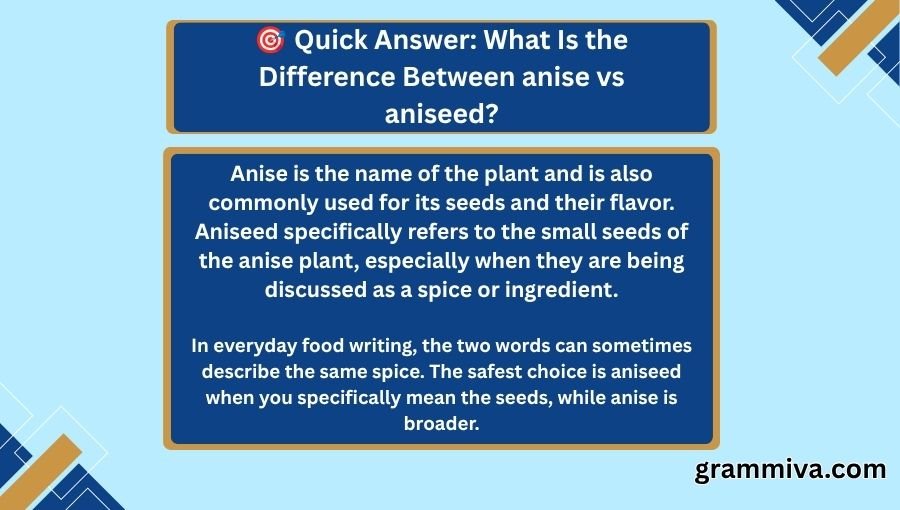
Anise is the name of the plant and is also commonly used for its seeds and their flavor. Aniseed specifically refers to the small seeds of the anise plant, especially when they are being discussed as a spice or ingredient.
In everyday food writing, the two words can sometimes describe the same spice. The safest choice is aniseed when you specifically mean the seeds, while anise is broader.
| Word | Basic Meaning | Best Use |
|---|---|---|
| Anise | The plant, its seeds, or their flavor | General references |
| Aniseed | The seed of the anise plant | A specific spice or seed |
| Anise seeds | The seeds of the plant | Clear, plain English |
| Anise flavor | A licorice-like taste | Taste or food descriptions |
🌿 Related Word Forms and Close Variants
The main words do have useful related forms. Knowing them can prevent spelling and usage mistakes.
| Form | Type | Example |
|---|---|---|
| anise | Noun | Anise has a sweet, licorice-like flavor. |
| aniseed | Noun | Add one teaspoon of aniseed to the dough. |
| anise seeds | Noun phrase | The recipe calls for anise seeds. |
| anise-flavored | Compound adjective | She bought anise-flavored candy. |
| anise seed | Singular noun phrase | One anise seed fell onto the counter. |
The spelling anise is especially useful when talking about the plant, its general flavor, or an ingredient without stressing that the seeds themselves are meant.
🔎 Understanding anise vs aniseed
The basic difference is simple: anise is the broader word, while aniseed is more specific. Both can be connected to the same plant and its sweet-smelling seeds.
Think of it this way:
- Anise can name the plant or refer broadly to the spice and its flavor.
- Aniseed points specifically to the seeds.
- Anise seeds is a very clear phrase when you want to remove all doubt.
- Neither word should automatically be treated as a completely different spice.
| Form | Type | Meaning | Example | Correct/Incorrect |
|---|---|---|---|---|
| anise | Noun | Plant or broader spice reference | Anise is common in some baked goods. | ✅ Correct |
| aniseed | Noun | Seeds used as a spice | The recipe needs aniseed. | ✅ Correct |
| anise seeds | Noun phrase | Seeds from the anise plant | Toast the anise seeds first. | ✅ Correct |
| aniseeds | Plural noun | More common in some varieties of English | The packet contains aniseeds. | ✅ Correct in contexts where this plural is used |
| anised | Spelling variant/error | Incorrect spelling for the spice | Add two teaspoons of anised. | ❌ Incorrect |
Is anise the plant or the spice?
Anise can refer to the plant itself or, in food-related writing, to the seeds or spice associated with it. Context tells the reader which meaning is intended.
For example:
The anise plant grows small seeds used in cooking.
Here, anise names the plant.
Now consider:
Add a little anise to the cookie dough.
Here, anise most likely refers to the spice or flavor rather than the entire plant.
This broader use is why the word can sometimes cause confusion.
Does aniseed specifically mean the seeds?
Yes. Aniseed is used for the seeds of the anise plant, particularly when those seeds are treated as a cooking spice.
For example:
Sprinkle aniseed over the bread before baking.
The sentence clearly refers to the seeds.
If you want maximum clarity in American English, anise seeds is also a strong choice. It is plain and easy for almost every reader to understand.
Can anise and aniseed be used interchangeably?
Sometimes, especially when discussing cooking. However, they are not always equally precise.
If a recipe says:
Add anise.
The reader may need to infer whether the recipe means the seeds, another form of the flavor, or an ingredient sold under that name.
If it says:
Add aniseed.
The intended ingredient is much clearer.
| Situation | Preferred Term | Reason |
|---|---|---|
| Naming the plant | anise | Broad plant reference |
| Naming the seeds | aniseed | Specific seed reference |
| Writing a very clear recipe | anise seeds | Easy for all readers |
| Describing a flavor | anise | Natural flavor reference |
| Describing a spice packet | aniseed or anise seeds | Both can be clear |
🧪 Correct Meanings and Uses
The best word depends on what you are trying to say. I recommend thinking about the object first and the spelling second.
1. Use anise for the plant
When the sentence is about the plant itself, anise is the natural choice.
Anise produces small seeds that are used in cooking.
The word identifies the plant, not simply a spoonful of spice.
2. Use aniseed for the seeds
When the focus is on the seeds as an ingredient, aniseed is more specific.
The baker added aniseed to the bread mixture.
The sentence tells us exactly what ingredient was added.
3. Use anise when describing flavor
Anise is common when describing a taste or flavor.
The candy has a strong anise flavor.
Here, the word describes the familiar sweet, licorice-like taste.
4. Use anise seeds for maximum clarity
If you are writing for a broad audience, anise seeds can be the easiest option.
Crush the anise seeds before adding them to the sauce.
There is little room for misunderstanding.
| Meaning | Word Type | Example Sentence |
|---|---|---|
| The plant | Noun | Anise grows as a flowering herb. |
| The seeds as a spice | Noun | Add aniseed to the mixture. |
| A flavor | Noun used descriptively | The tea has anise flavor. |
| The specific seeds | Noun phrase | Grind the anise seeds gently. |
💡 Test Tip: How can you choose the right word?
Use this quick test:
Ask yourself, “Am I talking about the plant, the general flavor, or the actual seeds?”
- Plant → anise
- General flavor → anise
- Actual seeds → aniseed or anise seeds
- Need maximum clarity → anise seeds
This simple test works well when you are editing recipes or food descriptions.
📝 Case Study: A Recipe Editor’s Choice
I once edited a short baking recipe that told readers to “add anise” after the dough had already been mixed. The recipe did not say whether the writer meant seeds, extract, or flavoring. The safest edit was to name the exact ingredient.
I changed the instruction to:
Add one teaspoon of anise seeds and mix well.
That small change made the recipe easier to follow.
Imagine a home cook reading the original instruction. If the pantry contains anise seeds, an anise-flavored ingredient, and an extract, the word anise alone may not give enough information.
This is a useful lesson for all food writing: specific nouns make instructions easier to follow.
| Original Wording | Improved Wording | Why |
|---|---|---|
| Add anise. | Add one teaspoon of anise seeds. | Identifies the ingredient |
| Use anise in the tea. | Add aniseed to the tea. | Makes the spice clear |
| Add anise flavor. | Add anise-flavored syrup. | Gives a more exact ingredient |
| Sprinkle anise. | Sprinkle aniseed over the dough. | Makes the form clear |
📚 Grammar Rules Explanation
The grammar rule is straightforward. Anise and aniseed are nouns, but they do not always have exactly the same scope of meaning.
Anise can work as a broad noun for the plant and is also used in food writing to describe the spice or its characteristic flavor. Aniseed is more narrowly focused on the seeds used as a spice.
Neither word is a verb. Neither should be changed simply because a sentence needs a different grammatical form.
Standard reference sources and common US English usage support treating these as related terms rather than assuming that one is simply a misspelling of the other.
The key point is meaning, not a complicated grammar rule.
Correct vs Incorrect at a Glance
| Sentence | Correct/Incorrect | Why |
|---|---|---|
| Add aniseed to the cookie mixture. | ✅ Correct | The sentence refers to the seeds as a spice. |
| The plant is called anise. | ✅ Correct | The word names the plant. |
| Add anised to the dough. | ❌ Incorrect | “Anised” is not the standard spelling. |
| The candy has anise flavor. | ✅ Correct | Anise describes the flavor. |
| Sprinkle aniseeds over the bread. | ✅ Correct in some English usage | The plural form can be used, though “anise seeds” is often clearer in US writing. |
The most important grammar lesson is this: do not choose a word simply because it looks familiar. Choose it based on what the sentence means.
❓ Why Do People Confuse anise and aniseed?
People confuse these terms because they are closely related and often appear in the same food context. Both words point readers toward the same plant and its familiar sweet flavor.
There is also a regional factor. Food terminology can differ between countries and publishing markets. A recipe written for one audience may use a form that feels less common to another audience.
I once caught myself typing aniseed in a US-focused recipe and then stopped to check the sentence. The word was not wrong, but the phrase anise seeds was clearer for the readers I had in mind.
Other mistakes happen for simple reasons:
- Fast typing can produce missing letters.
- Autocorrect may change unfamiliar words.
- A writer may have heard the word but never seen it written.
- A reader may assume one form is simply a spelling mistake.
- Regional English can affect which form feels natural.
| Confusion | Correct Choice | Main Reason |
|---|---|---|
| its / it’s | Depends on meaning | Possession vs. “it is” |
| your / you’re | Depends on meaning | Possession vs. “you are” |
| affect / effect | Depends on sentence role | Different meanings and uses |
| then / than | Depends on meaning | Time/order vs. comparison |
| anise / aniseed | Depends on meaning | Broad term vs. seed-focused term |
⚠️ Common Mistakes With anise vs aniseed
Specific spelling mistakes are usually easy to fix once you recognize them.
| Wrong Form | What’s Wrong | Correct Form |
|---|---|---|
| anised | Incorrect spelling | anise or aniseed |
| aniseed spice seeds | Unnecessarily repetitive | aniseed or anise seeds |
| anice | Common spelling error | anise |
| anisse | Extra letter | anise |
| anise seedsed | Incorrect combination | anise seeds |
| anised seeds | Incorrect form | anise seeds |
One useful rule is to avoid creating your own hybrid form. If you mean the seeds, write aniseed or anise seeds. If you mean the broader plant or flavor, anise is usually the better choice.
🧭 How To Remember the Difference
A simple memory trick can make the distinction much easier.
Think:
Anise = broad word.
Aniseed = seed word.
The ending -seed gives you a useful clue. When you see aniseed, think about the actual seeds used as a spice.
You can also use a three-step check:
- Am I naming the plant?
- Am I describing the flavor?
- Am I naming the seeds?
If the answer to number three is yes, choose aniseed or anise seeds.
| Question | Best Choice |
|---|---|
| Am I talking about the plant? | anise |
| Am I describing a flavor? | anise |
| Am I naming the seeds? | aniseed |
| Do I want the clearest wording? | anise seeds |
| Am I writing a recipe for a broad US audience? | anise seeds is often the clearest option |
🏠 Usage in Different Contexts
The preferred wording can change slightly depending on where you are writing.
Everyday Conversation
In casual speech, people may use anise when talking about the spice or flavor. The context usually makes the meaning clear.
I don’t like the strong anise taste.
That sounds natural because the speaker is talking about flavor.
Professional Writing
Professional food writing should be more specific.
If a recipe requires the seeds, aniseed or anise seeds helps the reader understand exactly what to buy or use.
Creative Writing
Creative writers have more freedom. Anise can work well when describing scent, flavor, food, or a setting.
For example:
The kitchen smelled of warm bread and anise.
The word creates a sensory image without needing to explain the exact ingredient.
Social Media and Texting
Short posts often favor familiar wording.
These cookies have the best anise flavor! 🍪
There is no need to force a highly technical distinction into a casual post.
| Context | Which Term to Use | Example |
|---|---|---|
| Everyday conversation | anise | I love the smell of anise. |
| Professional recipe | aniseed or anise seeds | Add one teaspoon of anise seeds. |
| Creative writing | anise | The room smelled faintly of anise. |
| Social media | anise | This dessert has a bold anise flavor! |
🗣️ Common Phrases With anise
There are several natural phrases that appear in food and flavor writing. These are not strict idioms, but they are useful combinations.
| Phrase | Meaning |
|---|---|
| anise flavor | The characteristic taste associated with anise |
| anise seeds | Seeds used as a cooking spice |
| anise extract | A concentrated ingredient used to add anise flavor |
| anise tea | Tea flavored with or made using anise |
| anise candy | Candy containing or flavored with anise |
| anise-flavored | Having an anise-like taste |
Notice that these phrases do not all refer to exactly the same physical thing. Anise flavor is about taste, while anise seeds identifies a particular ingredient.
🔄 Synonyms and Alternatives
Sometimes you do not need either term. You can choose a clearer phrase based on the context.
For example, anise seeds is often preferable when writing a recipe because it tells the reader exactly what to look for.
Other alternatives can work, but only when they preserve the intended meaning.
| Alternative | Works When | Does Not Work When |
|---|---|---|
| anise seeds | You mean the actual seeds | You mean the plant generally |
| anise flavor | You are describing taste | You are naming a physical ingredient |
| anise spice | You mean the spice in general | You need to specify seeds |
| licorice-like flavor | You are explaining the taste to readers | You are naming the ingredient |
| anise extract | You specifically mean extract | You mean whole seeds |
Be careful with licorice. It can describe a similar flavor, but it is not simply another name for the anise plant or its seeds.
🎯 Key Differences Between anise and aniseed
The main difference is one of scope and precision. Anise is broader, while aniseed is focused on the seeds.
| Feature | Anise | Aniseed |
|---|---|---|
| Can name the plant | Yes | No |
| Can describe flavor | Yes | Less common for this purpose |
| Refers to seeds | Can, depending on context | Yes |
| Useful in recipes | Yes | Yes |
| Very specific about seeds | Not always | Yes |
| Common alternative | Anise seeds | Anise seeds |
This is why a sentence such as “The plant is anise” works naturally, while “The plant is aniseed” does not.
Likewise, if a recipe says “add aniseed,” the reader can reasonably understand that the seeds are intended.
❓ Is anise the Same as Aniseed?
They are closely related terms, but they are not identical in every use. Anise can refer to the plant and can also be used broadly for the spice or flavor. Aniseed specifically points to the seeds.
In cooking, the distinction may seem small because the seeds are the part commonly used as a spice.
For clear writing, however, it helps to keep the broader and narrower meanings separate.
❓ Is Aniseed One Word or Two?
Aniseed is normally written as one word. If you prefer a very transparent phrase, anise seeds is also clear.
Avoid inventing forms such as “anise seed” when you actually mean the general ingredient name unless the sentence is clearly using “seed” as a separate noun.
Compare:
The store sells aniseed.
and:
The store sells anise seeds.
Both make the ingredient clear.
❓ Should I Write Anise or Aniseed in a Recipe?
Use aniseed when you specifically mean the seeds as a spice. You can also use anise seeds, which is especially clear for a broad US audience.
For example:
Add one teaspoon of anise seeds.
is very easy for a reader to understand.
If the recipe is discussing flavor rather than a physical ingredient, anise may be better:
Add anise flavoring to the frosting.
The best choice depends on what the reader needs to do.
❓ Is Aniseed a Spice?
Yes. Aniseed can refer to the seeds of the anise plant when they are used as a spice. They are commonly associated with a sweet, licorice-like flavor.
In a recipe, the term normally points to an ingredient rather than the entire plant.
❓ What Is the Plural of Aniseed?
In US English, anise seeds is a clear plural phrase. You may also encounter aniseeds, especially in varieties of English outside the United States.
For American readers, “anise seeds” is often the easiest wording because the two words make the meaning immediately obvious.
| Singular | Plural | Example |
|---|---|---|
| anise seed | anise seeds | Add two tablespoons of anise seeds. |
| aniseed | aniseeds | Some labels may use aniseeds. |
| anise | anise | Anise can describe the plant or flavor. |
❓ Does Anise Mean Licorice?
No. Anise and licorice are different plants, although their flavors can be similar. Anise is often described as having a sweet, licorice-like taste.
That distinction matters in ingredient lists. Replacing one with the other may change the recipe.
A good description is:
The cookies have a mild licorice-like anise flavor.
That tells the reader that the flavor resembles licorice without claiming that the ingredients are identical.
❓ Which Is Better for American English: Anise or Aniseed?
For American readers, anise is a familiar broad term, while anise seeds is often the clearest way to identify the actual seeds. Aniseed is also a valid term and may appear on labels, recipes, and other food writing.
If clarity is your top goal, choose the phrase that tells the reader exactly what you mean.
For a recipe, I would often write:
1 teaspoon anise seeds
rather than relying on the broader word alone.
❓ How Do You Use Anise in a Sentence?
Use anise as a noun when referring to the plant, spice in a broad sense, or characteristic flavor.
Examples include:
Anise has a sweet flavor.
The recipe uses anise.
The dessert has a strong anise aroma.
The context determines whether the word refers to the plant, ingredient, or flavor.
❓ How Do You Use Aniseed in a Sentence?
Use aniseed as a noun when referring specifically to the seeds used as an ingredient or spice.
Examples include:
Add aniseed to the dough.
The soup contains a small amount of aniseed.
I bought a packet of aniseed for baking.
When the physical seeds are the focus, this word gives the sentence a narrower meaning.
❓ Why Do Recipes Use Both Anise and Aniseed?
Recipes use both because food language is flexible and regional. A recipe may use anise as a broad name for the flavor or ingredient, while another may use aniseed to identify the seeds.
This does not automatically mean that one recipe is wrong.
When editing a recipe, I would look at the actual ingredient before changing the word. If the writer means whole seeds, I would usually make that clear with aniseed or anise seeds.
🧠 A Simple Editing Method for Food Writers
If you edit recipes, menus, blogs, or product descriptions, use this method before publishing.
Step 1: Find the noun.
Look at the word and ask what physical thing it describes.
Step 2: Check the context.
Is the sentence about the plant, the seeds, or the flavor?
Step 3: Choose the narrowest clear term.
If the seeds are meant, use aniseed or anise seeds.
Step 4: Read the sentence aloud.
If a reader could misunderstand the ingredient, make it more specific.
Step 5: Keep your wording consistent.
Do not switch randomly between forms when the same ingredient is meant.
| Editing Question | Action |
|---|---|
| Is the plant being discussed? | Use anise |
| Is the flavor being discussed? | Usually use anise |
| Are whole seeds being added? | Use aniseed or anise seeds |
| Could the reader misunderstand the ingredient? | Use anise seeds |
| Is the audience mainly American? | Prefer simple, clear wording |
⚠️ Why Getting the Spelling Right Matters
A spelling mistake can make a writer look careless even when the underlying idea is correct. Food writing is especially sensitive to this because readers need to know exactly what an ingredient is.
Clear wording helps in several areas:
- Recipes are easier to follow.
- Product descriptions look more professional.
- Emails and work documents appear carefully edited.
- Search engines can better understand the subject.
- Readers are less likely to misread an ingredient.
A short quote captures the idea well:
“Clear words make clear instructions.”
| Situation | Why Getting It Right Matters |
|---|---|
| Recipe | Readers need the correct ingredient |
| Client email | Accurate wording supports professionalism |
| Published content | Spelling errors reduce trust |
| Social post | Clear wording prevents confusion |
The difference may seem tiny, but small language choices can have a large effect on how easy a piece of writing is to understand.
❓ Why Does Clear Food Vocabulary Matter?
Clear food vocabulary matters because readers often act on what they read. A recipe is not just information. It is an instruction.
If a writer says “add anise,” some readers may know exactly what is meant. Others may wonder which form of the ingredient they should use.
When the writer says “add one teaspoon of anise seeds,” the instruction is much more direct.
That is the real value of choosing the right word: clarity beats guesswork.
📋 Quick Recap Checklist
Use this checklist whenever you are unsure which form belongs in your sentence.
| Question | If Yes → Use |
|---|---|
| Are you naming the plant? | anise |
| Are you describing the flavor? | anise |
| Are you specifically naming the seeds? | aniseed |
| Do you want maximum clarity for US readers? | anise seeds |
| Are you describing an extract? | anise extract |
Practice Examples
1. The cookies have a sweet anise flavor.
2. Add one teaspoon of aniseed to the mixture.
3. Toast the anise seeds before grinding them.
A useful final test is to replace the word with “the plant” or “the seeds.” If “the seeds” fits your meaning, aniseed or anise seeds is probably the better choice.
FAQs About Anise vs Aniseed
Is aniseed the same thing as anise?
They are closely related, but the terms are not identical in every context. Anise is broader and can refer to the plant, spice, or flavor. Aniseed specifically refers to the seeds used as a spice.
Which is correct, anise or aniseed?
Both are correct words. The right choice depends on meaning. Use anise for the plant or a broad reference to its flavor or spice. Use aniseed when you specifically mean the seeds.
Is aniseed one word?
Yes. Aniseed is normally written as one word. Anise seeds is also a clear two-word phrase, especially when you want to make the meaning obvious.
Is aniseed a seed or a spice?
Aniseed refers to the seeds of the anise plant, especially when they are used as a spice. In cooking, it is therefore both a seed and a spice ingredient.
Can I use anise instead of aniseed?
Sometimes. In recipes and general food writing, anise may be used as a broad name for the ingredient or flavor. However, if the recipe specifically requires the seeds, aniseed or anise seeds is more precise.
What is the clearest term for American readers?
Anise seeds is often the clearest phrase when you mean the actual seeds. It removes uncertainty because the word “seeds” directly identifies the ingredient.
Is anise the same as licorice?
No. Anise and licorice are different plants, although their flavors can be similar. Anise is often described as having a licorice-like flavor.
What is the plural of aniseed?
You may encounter aniseeds, but anise seeds is a very clear plural form for US English readers. The latter makes the meaning easy to understand.
Should a recipe say anise or anise seeds?
If the recipe calls for the actual seeds, anise seeds is usually the clearest wording. Aniseed is also suitable when it is being used as the name of the spice.
How can I remember the difference?
Remember this simple rule: anise is broad; aniseed is seed-specific. If you are talking about the actual seeds, think of the “seed” part of the word aniseed.
🌱 Final Takeaway
anise vs aniseed becomes easy once you focus on meaning rather than spelling. Anise is the broader term and can refer to the plant, the spice in general, or its characteristic flavor. Aniseed is more specific and refers to the seeds used as a spice. When you want the clearest possible wording for American readers, anise seeds is an excellent choice.
I recommend using the word that gives your reader the least room for doubt. In casual writing, anise may be perfectly natural. In a recipe, aniseed or anise seeds can tell the reader exactly what to use. 🌿
The best language choice is not always the longest or most formal one. It is the one that makes your meaning clear on the first read.
Remember: anise is broad, aniseed points to the seeds, and clear writing leaves no room for guesswork. ✨

I am Ethan Brooks, an English grammar and vocabulary writer. I work at Grammiva, where I create simple and helpful content to make English learning easier for students and everyday learners.


[…] end, you should be able to choose the right form without stopping to second-guess yourself. 👍 anise vs aniseed | Putting vs Puting | Repast vs […]
[…] can use when you are writing an email, essay, report, text, or social post. 😊 Harass vs Haras | anise vs aniseed | Putting vs […]