Have you ever typed a word that looks right, only to stop and wonder whether you chose the correct spelling? repast vs repass is one of those tricky pairs.
The words look almost identical, but they do not mean the same thing.
One is mainly connected with a meal. The other is connected with passing again.
I teach and edit English, and I see this kind of spelling mix-up often.
The problem is easy to understand.
The words share most of the same letters, and both sound like they could fit in formal writing.
That makes them easy to confuse, especially when you are typing quickly.
The good news is that the difference is simple once you connect each word with its main meaning.
In this guide, I will show you how to use each word correctly, explain the grammar behind the difference, and give you clear examples you can remember. 🍽️ Humor vs Humour | Barbecue vs Barbeque | Flies vs flys
🎯 Quick Answer: Repast vs Repass
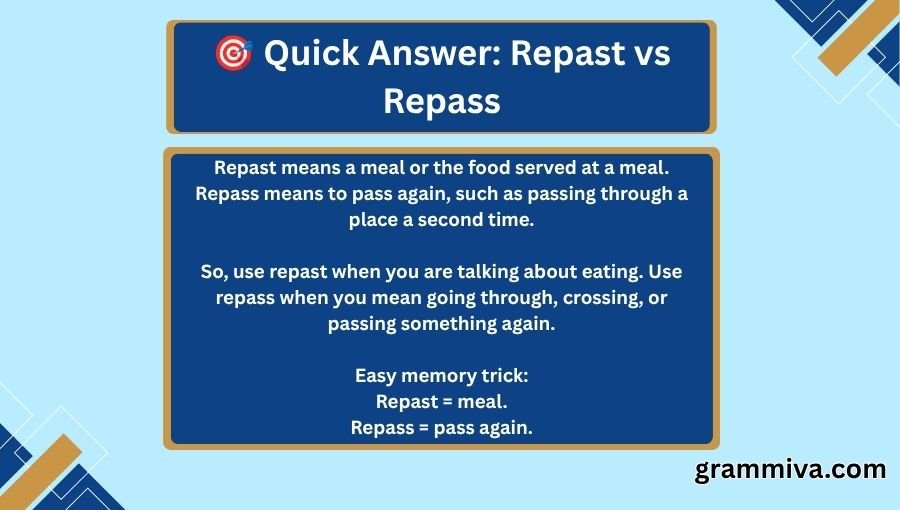
Repast means a meal or the food served at a meal. Repass means to pass again, such as passing through a place a second time.
So, use repast when you are talking about eating. Use repass when you mean going through, crossing, or passing something again.
Easy memory trick:
Repast = meal.
Repass = pass again.
Repast and Its Related Word Forms
The main word repast is a noun. Its plural form is repasts, meaning more than one meal. The possessive form repast’s can be used when something belongs to or is connected with a particular meal.
Repass is usually a verb. Its forms include repasses, repassed, and repassing.
| Form | Type | Example |
|---|---|---|
| repast | Noun | The family enjoyed a quiet repast. |
| repasts | Plural noun | The book describes several royal repasts. |
| repast’s | Possessive noun | The repast’s final course was dessert. |
| repass | Verb | We may repass the same gate later. |
| repasses | Verb | She repasses the building every morning. |
| repassed | Past-tense verb | He repassed the old bridge. |
| repassing | Present participle | They were repassing the checkpoint. |
The key point is that the two base words have different jobs. Repast names a meal. Repass describes passing again.
🔎 Is Repast the Same as Repass?
No. Repast and repass have different meanings and should not be treated as interchangeable words.
If you are writing about breakfast, lunch, dinner, or another meal, repast is the word you want. If you are describing someone going through a place or crossing something again, repass is the better choice.
Compare these two sentences:
- ✅ The guests enjoyed a formal repast.
- ❌ The guests enjoyed a formal repass.
The first sentence works because the writer is talking about a meal. The second uses the wrong word.
Now look at the other meaning:
- ✅ We had to repass the same doorway to find the exit.
- ❌ We had to repast the same doorway to find the exit.
Here, repass works because the meaning is “pass again.”
Repast vs Repass at a Glance
| Form | Type | Meaning | Example | Correct/Incorrect |
|---|---|---|---|---|
| repast | Noun | A meal | They shared a pleasant repast. | Correct |
| repass | Verb | Pass again | We will repass the gate. | Correct |
| repast | Noun | A meal | We enjoyed a family repast. | Correct |
| repass | Verb | A meal | We enjoyed a family repass. | Incorrect |
| repast | Noun | Pass again | We must repast the bridge. | Incorrect |
The fastest way to choose is to ask what the sentence is describing. Is it food and eating? Choose repast. Is it passing again? Choose repass.
🍽️ Repast: Meaning and Correct Use
Repast is a noun that means a meal. It is more formal than everyday words such as “meal,” “lunch,” or “dinner.”
You might see it in formal writing, historical writing, literary prose, or descriptions of a special meal.
When Repast Means a Meal
The most common use is simple: a repast is a meal.
For example:
The travelers stopped beside the river for a simple repast.
The word “repast” is the noun. It tells us what the travelers stopped to have: a meal.
Another example:
The host prepared a generous repast for the visitors.
Here, repast refers to the food and meal provided for the visitors.
Notice that you could replace repast with meal in both sentences. The meaning would stay almost the same, but the tone would become more ordinary.
- ✅ The family shared a warm repast.
- ❌ The family shared a warm repass.
Why Repast Sounds Formal
You would not normally say, “I am going to have a repast” when texting a friend about lunch. That sounds unusually formal.
Instead, you might say:
I’m going to grab lunch.
In a story or formal description, however, repast can create a more polished tone:
After the ceremony, the guests gathered for a formal repast.
So the word is correct, but its style depends on the situation.
Meanings at a Glance
| Meaning | Word Type | Example Sentence |
|---|---|---|
| A meal | Noun | The travelers shared a modest repast. |
| Food served as part of a meal | Noun | The inn provided a hearty repast. |
| A formal or literary way to refer to a meal | Noun | The guests sat down for an evening repast. |
🚶 Repass: Meaning and Correct Use
Repass is generally a verb meaning to pass again. It combines the idea of “again” with the verb “pass.”
The action may involve moving through a location again, crossing something again, or going past something another time.
For example:
We may repass this road on our way home.
The speaker means that the group may pass along the road again.
Another example is:
She repassed the old house later that afternoon.
The sentence tells us that she went past the house again.
- ✅ The hikers repassed the same trail marker.
- ❌ The hikers repasted the same trail marker.
The incorrect sentence changes the action into a word associated with a meal. That does not make sense in this context.
Repass Is Less Common in Everyday Speech
There is an important style point here. Although repass is a real English word, many speakers would naturally say pass again instead.
For example:
We passed the store again.
This is more common and more conversational than:
We repassed the store.
Both can express the idea of passing again, but the first sounds more natural in ordinary speech.
That means you should not feel that you need to use repass simply because it exists. Choose it when its concise form fits the sentence and tone.
💡 How Can You Remember the Difference?
The easiest memory trick is to focus on the middle of each word.
Repast → think “past” and food? Not quite. A better memory aid is to connect repast with feast. Both can describe a meal.
Repass → think “pass again.”
The second word is especially easy to remember because re- often carries the idea of doing something again.
My Test Tip
When I teach confusing word pairs, I recommend replacing the difficult word with a very simple one.
Try these substitutions:
- If you can replace the word with meal, choose repast.
- If you can replace the word with pass again, choose repass.
For example:
The king enjoyed a grand ______.
Try “meal.” It works. Therefore:
The king enjoyed a grand repast.
Now try:
We had to ______ the gate.
Try “pass again.” It works. Therefore:
We had to repass the gate.
Test Tip: If “meal” fits, use repast. If “pass again” fits, use repass.
📝 Case Study: A Small Mistake in a Formal Email
I once edited a short event announcement that said, “Guests will gather for a formal repass after the ceremony.” The writer meant to describe a dinner, but the word choice changed the meaning.
I suggested:
Guests will gather for a formal repast after the ceremony.
The correction was small, but it mattered. The announcement was going to a large group, so a strange word choice could make the writer look careless.
Here is the difference in context:
| Original Idea | Word Needed | Correct Example |
|---|---|---|
| A meal after a ceremony | repast | Guests will share a formal repast. |
| Passing through a gate again | repass | Guests may repass through the gate later. |
| A family dinner | repast | The family enjoyed a quiet repast. |
| Crossing the same path again | repass | The hikers repassed the path. |
This is a useful lesson: spelling alone does not tell you which word is right. Meaning decides the choice.
Grammar Rules Explanation
The basic grammar rule is straightforward. Repast normally functions as a noun, while repass normally functions as a verb.
A noun names a person, place, thing, or idea. A meal is a thing, so repast works as a noun.
A verb describes an action. Passing again is an action, so repass works as a verb.
That difference explains why these words cannot normally replace each other.
Consider:
The guests enjoyed a repast.
The word repast is the thing they enjoyed. It is a noun.
Now consider:
The guests repassed the gate.
The word repassed describes what the guests did. It is a verb.
Most standard English dictionaries agree on this basic distinction. The important point is not memorizing a dictionary entry. It is recognizing the role and meaning of the word in your sentence.
Correct vs Incorrect at a Glance
| Sentence | Correct/Incorrect | Why |
|---|---|---|
| The travelers shared a simple repast. | Correct | Repast means a meal. |
| The travelers shared a simple repass. | Incorrect | Repass does not mean meal. |
| We had to repass the bridge. | Correct | Repass means pass again. |
| We had to repast the bridge. | Incorrect | Repast does not mean pass again. |
| The guests enjoyed an evening repast. | Correct | The sentence refers to a meal. |
One useful grammar check is to look at the word immediately around the term. If the sentence says someone had, enjoyed, prepared, served, or shared something, a noun such as repast may be needed. If the sentence says someone passed, crossed, or went through something again, repass may fit.
⚠️ Why Do People Confuse Repast and Repass?
People confuse these words because they look extremely similar. They also appear in formal writing more often than in casual conversation, which means some readers may know the words without having strong everyday experience using them.
There are three common causes:
- Fast typing: Your fingers may produce a familiar-looking spelling before you think about meaning.
- Autocorrect: A writing app may not understand the meaning you intend.
- Lack of knowledge: If you have rarely seen either word, the difference can be hard to remember.
I once caught myself typing repass when I meant repast while reviewing a formal invitation. I noticed it only because the sentence was about dinner. That quick substitution test—”Does this mean meal?”—caught the error.
Similar Grammar and Spelling Confusions
| Confusing Pair | Correct Choice | Basic Difference |
|---|---|---|
| it’s / its | Depends on meaning | “It is” vs. possession |
| your / you’re | Depends on meaning | Possession vs. “you are” |
| they’re / their / there | Depends on meaning | They are vs. possession vs. place |
| affect / effect | Depends on use | Usually verb vs. noun |
| then / than | Depends on meaning | Time/order vs. comparison |
| repast / repass | Depends on meaning | Meal vs. passing again |
These pairs teach the same lesson. Do not choose a word because it looks right. Choose it because its meaning fits.
Common Wrong Forms for This Specific Pair
| Wrong Form | What’s Wrong | Correct Form |
|---|---|---|
| repass, meaning meal | Wrong word | repast |
| repast, meaning pass again | Wrong word | repass |
| repast dinner | Usually awkward if intended as a verb | have a repast / have dinner |
| repast the road | Wrong action word | repass the road |
| a repass | Incorrect when referring to a meal | a repast |
| repasted the gate | Wrong form for passing again | repassed the gate |
Some of these errors are not simply spelling mistakes. They happen because the writer has selected the wrong word for the intended meaning.
🕰️ A Brief Look at the History of the Words
The two words have different histories and meanings, but you do not need to memorize their full histories to use them correctly.
Repast developed as a word for a meal and is now mainly used as a formal or literary noun.
Repass is built around the idea of passing again. Its meaning is much easier to connect with the familiar word pass.
Because the words look so similar today, modern readers can easily assume that they are related in meaning. They are not interchangeable simply because their spellings overlap.
| Stage | Form | General Note |
|---|---|---|
| Earlier English use | repast | Used for the idea of a meal. |
| Earlier English use | repass | Used for the idea of passing again. |
| Later formal English | repast | Continued as a formal word for a meal. |
| Modern English | repass | Remains a verb meaning to pass again. |
The practical lesson is more useful than the history: repast is about a meal; repass is about passing again.
🌎 Usage in Different Contexts
The right choice can depend on context, but the basic meaning never changes. Use repast for a meal and repass for passing again.
Everyday Conversation
In casual speech, people usually say meal, lunch, dinner, or pass again instead. Both words can sound formal.
- “We had dinner together” is more natural than “We shared a repast.”
- “We passed the house again” is more natural than “We repassed the house.”
Professional Writing
Both words can appear in professional writing, but they should fit the tone.
Repast may work in event descriptions, formal invitations, historical material, or polished prose. Repass may work when a concise formal verb is appropriate.
Creative Writing
Creative writers may choose repast to create a formal, old-fashioned, elegant, or literary mood.
For example:
The travelers gathered around the fire for a warm repast.
The word adds a particular tone that “meal” does not always provide.
Social Media and Texting
Neither word is especially common in casual texting. Most people would use simpler words.
| Context | Which Term to Use | Example |
|---|---|---|
| Everyday conversation | Usually meal/pass again | We had a great meal. |
| Professional writing | repast or repass when appropriate | The guests enjoyed a formal repast. |
| Creative writing | Often repast for a formal tone | They gathered for a grand repast. |
| Social media/texting | Usually simpler alternatives | We ate dinner together! |
The goal is not to use the more unusual word. The goal is to use the right word.
Common Phrases With Repast
There are no major everyday idioms built around repast. However, the word appears naturally in several formal phrases.
| Phrase | Meaning |
|---|---|
| a formal repast | A formal meal |
| a hearty repast | A filling or substantial meal |
| a simple repast | A modest meal |
| a communal repast | A meal shared by a group |
| an evening repast | A meal eaten in the evening |
| a lavish repast | A rich or impressive meal |
These phrases are most useful in formal, literary, historical, or descriptive writing.
For example:
The travelers were grateful for the hearty repast.
This sounds more formal than:
The travelers were grateful for the hearty meal.
Both are grammatically correct. The style is different.
🔄 Synonyms and Alternatives
You do not always need to use repast. In many sentences, a simpler alternative will sound more natural.
| Alternative | Works When | Does Not Work When |
|---|---|---|
| meal | You want a normal everyday word | You specifically want a formal literary tone |
| dinner | The meal is specifically dinner | The meal is not dinner |
| lunch | The meal is lunch | The meal is not lunch |
| feast | The meal is large or special | The meal is ordinary |
| pass again | You mean to go past something another time | You are talking about a meal |
The same idea applies to repass. In many everyday sentences, pass again is clearer.
For example:
We had to pass the building again.
This may be better for a general audience than:
We had to repass the building.
Choose the word that gives readers the clearest meaning with the least effort.
🎯 Repast vs Repass: Key Differences
The core difference can be reduced to two ideas: meal and passing again.
Repast is a noun. It refers to a meal. Repass is generally a verb. It means to pass again.
| Feature | Repast | Repass |
|---|---|---|
| Main role | Noun | Verb |
| Main meaning | Meal | Pass again |
| Related simple word | Meal | Pass again |
| Common in casual speech | Less common | Less common |
| Common in formal writing | Yes | Yes |
| Example | We shared a repast. | We repassed the gate. |
| Main memory clue | Food | Movement |
If you remember only one table from this article, remember this one.
💼 Why Getting the Difference Right Matters
Choosing the correct word helps readers understand your message without stopping to figure out what you meant.
Clarity in Communication
A word such as repast can tell readers that you mean a meal. A word such as repass can tell them that someone passed through a place again.
A wrong choice can create a confusing sentence.
Professionalism
Small word errors can stand out in emails, reports, invitations, resumes, and published material. A correct word choice shows that you took time to check your writing.
Digital Communication
Online writing moves quickly. People often type on phones, rely on autocorrect, or copy text from older documents. That makes look-alike words especially easy to mix up.
A simple rule is worth remembering:
Clear writing starts with choosing the word that matches the meaning.
| Situation | Why Getting It Right Matters |
|---|---|
| Resume | Shows care and writing skill |
| Client email | Prevents confusion |
| Published content | Protects accuracy and credibility |
| Social post | Helps readers understand your message |
The mistake may be tiny, but clear writing is built from tiny choices.
💡 How to Choose the Right Word Every Time
When you are unsure, stop and ask one question:
What am I trying to describe?
If you are describing food, eating, or a meal, choose repast.
If you are describing someone going through a place again, choose repass.
You can also use a two-word test:
Test 1: Replace It With “Meal”
They enjoyed a grand ______.
“Meal” fits.
Therefore:
They enjoyed a grand repast.
Test 2: Replace It With “Pass Again”
We had to ______ the entrance.
“Pass again” fits.
Therefore:
We had to repass the entrance.
Test 3: Check the Grammar
Ask whether the word is acting as a thing or an action.
- A meal is a thing → repast
- Passing again is an action → repass
This three-step check takes only a few seconds.
🚫 When Should You Avoid These Words?
You do not need to use an uncommon word simply because it is technically correct.
If your audience is broad, simple words are often better.
Instead of:
We gathered for a repast.
You could write:
We gathered for a meal.
Instead of:
We repassed the same location.
You could write:
We passed the same location again.
The simpler version may be easier for readers. Use repast when its formal tone helps your writing. Use repass when it gives you a useful concise verb.
Good writing is not about choosing the fanciest word. It is about choosing the clearest one.
🧠 Quick Recap Checklist
Use this checklist whenever you are unsure which form belongs in your sentence.
| Question | If Yes → Use |
|---|---|
| Am I talking about a meal? | repast |
| Am I describing food served as a meal? | repast |
| Am I describing a formal or literary meal? | repast |
| Do I mean “pass again”? | repass |
| Am I describing someone going through a place again? | repass |
| Would “pass again” make sense? | repass |
Practice Examples
- The guests sat down for a formal repast.
- We may repass the same bridge on our return.
- The travelers shared a simple repast before continuing.
A quick check gives you the answer every time: meal = repast; pass again = repass.
FAQs About repast vs repass
What is the difference between repast and repass?
Repast means a meal, while repass generally means to pass again. They look similar but have different meanings and grammatical roles.
Is repast a noun or a verb?
Repast is mainly used as a noun. It refers to a meal or food served as a meal.
Example:
The family enjoyed a peaceful repast.
Is repass a noun or a verb?
Repass is generally used as a verb. It means to pass again or go through something again.
Example:
We may repass the same gate later.
Can I use repast to mean pass again?
No. Repast does not mean pass again. When you mean that someone goes past something another time, use repass or the clearer phrase pass again.
Can repass mean a meal?
No. Repass should not be used to mean a meal. If you need a formal word for a meal, repast is the correct choice.
Is repast a common word in American English?
Repast is a valid English word, but it is less common in everyday American speech than meal, lunch, or dinner. It is more likely to appear in formal, literary, historical, or descriptive writing.
Is repass common in everyday English?
Repass is less common than the phrase pass again. Both can express the idea of going past something another time, but pass again is often more natural in casual writing and conversation.
Which word should I use for a formal dinner?
Use repast if you want a formal or literary term for the meal.
Example:
The organization hosted a formal repast for its guests.
How can I remember repast and repass?
Use this simple rule:
Repast = meal.
Repass = pass again.
If you can replace the word with “meal,” choose repast. If you can replace it with “pass again,” choose repass.
Is “a repass” ever correct?
It can be correct when repass is being used in a grammatical role supported by the sentence or in a specialized use, but it should not be used simply as another spelling of repast. For the ordinary meaning of a meal, repast is the correct choice.
🎯 Repast vs Repass: The Rule to Remember
The easiest way to master repast vs repass is to stop looking at the spelling and focus on meaning.
Repast = a meal.
Repass = pass again.
If you are writing about people eating, a formal dinner, food, or a shared meal, choose repast. If you are describing someone passing through a place, crossing something, or going past something again, choose repass.
I recommend using the simplest word that gives your reader the exact meaning you intend. In casual writing, meal and pass again may be more natural. In formal or literary writing, repast and repass can be useful when they fit the tone.
The next time these two nearly identical words cause you to pause, use the quick test: Is it a meal? Repast. Is it passing again? Repass. 🍽️
Once you connect each spelling to its meaning, the confusion becomes much easier to avoid. Remember the meaning first, choose the word second—and your writing will stay clear. ✨

I am Adam Wilson, an English language content writer with an interest in grammar and vocabulary. I work at Grammiva and focus on creating clear explanations and practical examples for English learners.
[…] the end, you should be able to spot the correct spelling without stopping to think. ✍️ Repast vs Repass | Humor vs Humour | Barbecue vs […]