If you have ever typed a restaurant name, recipe, invitation, or social post and paused over barbecue vs barbeque, you are not alone.
The two spellings look almost identical, and both appear in real-world writing. That makes the choice surprisingly tricky. 🍖
In my editing work, I treat this as a spelling and usage question rather than a meaning question. Barbecue is the standard spelling to choose in normal US English.
Barbeque is a recognized alternative spelling in some reference sources, but it is much less common and is usually not the best choice for formal or general writing.
Merriam-Webster, for example, gives barbeque as a variant, while Cambridge uses barbecue as its main form.
So, if you are writing an article, school paper, email, recipe, or business document, there is a simple answer: choose barbecue.
This guide explains why, when the other spelling may appear, and how to remember the difference. Flies vs flys | Hygiene vs Hygene | Organizing vs Organising
🎯 Quick Answer: Barbecue vs Barbeque
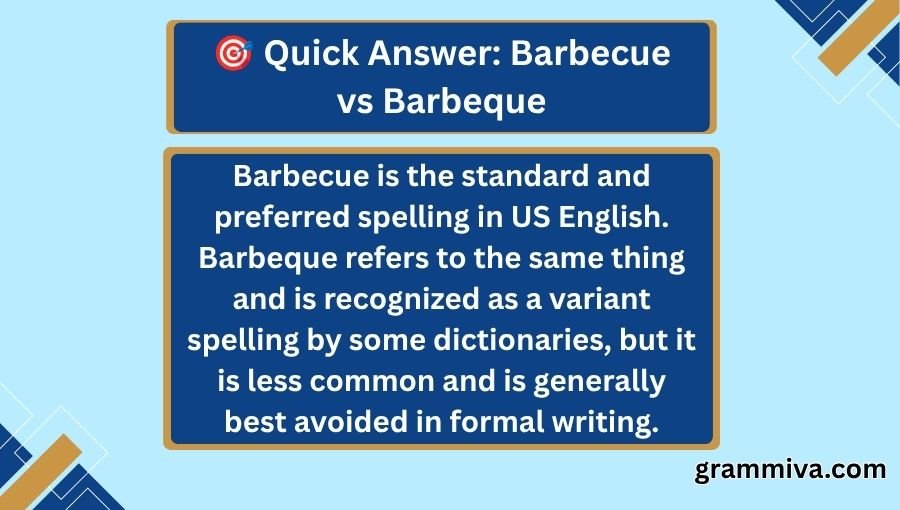
Barbecue is the standard and preferred spelling in US English. Barbeque refers to the same thing and is recognized as a variant spelling by some dictionaries, but it is less common and is generally best avoided in formal writing.
For everyday writing, use barbecue:
- We are having a barbecue on Saturday. ✅
- The restaurant serves excellent barbecue. ✅
- We will barbecue chicken tonight. ✅
If you see barbeque in a restaurant name, product name, or sign, keep it exactly as the business spells its official name.
Barbecue vs Barbeque at a Glance
The main difference is spelling, not meaning. Both forms can refer to the cooking method, the food, the equipment, the event, or the act of cooking food this way.
| Form | Type | Meaning | Example | Correct/Incorrect |
|---|---|---|---|---|
| barbecue | Standard spelling | Outdoor cooking, food, grill, or gathering | We planned a barbecue. | ✅ Correct |
| barbeque | Variant spelling | Same general meaning | We planned a barbeque. | ⚠️ Variant; avoid in formal writing |
| BBQ | Abbreviation | Short form of barbecue | We are having a BBQ. | ✅ Common informal form |
| barbecued | Past participle/adjective | Cooked using barbecue methods | We ate barbecued chicken. | ✅ Correct |
| barbecuing | Present participle | Cooking with barbecue methods | She is barbecuing ribs. | ✅ Correct |
| barbecues | Plural or third-person verb | More than one barbecue or cooks this way | The town hosts two barbecues. | ✅ Correct |
Cambridge lists barbecue as both a noun and a verb and gives related forms such as barbecued and barbecuing.
Is Barbecue the Same as Barbeque?
Yes, in ordinary use, the two spellings point to the same word and the same basic meanings. The difference is that barbecue is the standard spelling most writers should choose.
The word can describe several things:
- A cooking device or grill.
- Food cooked using barbecue methods.
- An outdoor meal or gathering.
- The act of cooking food this way.
For example:
- We bought a new barbecue for the patio. ✅
- We bought a new barbeque for the patio. ⚠️
The reader will probably understand both. However, the first version follows the standard spelling used in general edited English.
Barbecue as a Noun
As a noun, barbecue can refer to the equipment, the food, or the gathering.
- The barbecue is sitting on the deck. ✅
- We are hosting a barbecue this weekend. ✅
- The restaurant is famous for its barbecue. ✅
Cambridge’s US English entry includes the outdoor cooking equipment and the meal or gathering among the noun’s uses.
Barbecue as a Verb
Barbecue can also be a verb. It means to cook food using a barbecue or barbecue-style cooking method.
- We will barbecue the chicken tonight. ✅
- Dad likes to barbecue ribs on Sundays. ✅
The verb has standard forms such as barbecued and barbecuing.
A Quick Meaning Table
| Meaning | Word Type | Example Sentence |
|---|---|---|
| Cooking equipment | Noun | The barbecue needs more charcoal. |
| Outdoor meal or event | Noun | Their family barbecue starts at noon. |
| Cooked food | Noun | The restaurant is known for barbecue. |
| Cooking action | Verb | We barbecue chicken in the summer. |
💡 Test Tip
When you are unsure, ask yourself:
Am I writing normal English, rather than copying a brand or business name?
If the answer is yes, write barbecue.
That one test will solve most spelling questions.
Why Do People Confuse Barbecue and Barbeque?
People confuse these spellings because they sound the same in normal speech. When we hear the word, we do not see the letters c-u-e at the end.
The spelling also feels unusual. The sequence cue can look strange inside a word, so some writers naturally replace the c with q and produce barbeque.
There is another reason for the confusion: BBQ is extremely common. Cambridge identifies BBQ as a written abbreviation of barbecue.
I once caught myself typing barbeque in a quick message after seeing the spelling on a restaurant sign earlier that day. I stopped, checked the word, and changed it to barbecue. That small mistake is a good reminder that seeing a spelling often can make it feel correct.
Similar Confusions in English
| Confusion | Correct Form | Why People Confuse Them |
|---|---|---|
| it’s / its | Depends on meaning | Same sound |
| your / you’re | Depends on meaning | Same sound |
| their / there / they’re | Depends on meaning | Similar sound |
| then / than | Different meanings | Similar pronunciation |
| barbecue / barbeque | barbecue preferred | Same pronunciation |
| affect / effect | Depends on grammar and meaning | Similar sound and use |
The key point is that not every common spelling is equally suitable for formal writing.
What Are the Related Forms of Barbecue?
The main word has several normal grammatical forms. These forms are different from barbeque, because they change the word for grammar rather than changing its spelling preference.
| Form | Type | Example |
|---|---|---|
| barbecue | Noun/verb | We planned a barbecue. |
| barbecues | Plural noun/verb | The park hosts summer barbecues. |
| barbecued | Past tense/past participle | She served barbecued chicken. |
| barbecuing | Present participle | He is barbecuing outside. |
| BBQ | Abbreviation | We are bringing BBQ sauce. |
Notice the spelling of barbecuing. The final e in barbecue is dropped before -ing.
That gives us:
- barbecue → barbecuing
- barbecue → barbecued
The same basic pattern appears in standard dictionary entries.
Barbecue: Meaning and Correct Use
Barbecue works as both a noun and a verb. Its exact meaning depends on how it appears in the sentence.
As Equipment
When barbecue refers to the cooking equipment, it is a noun.
We cleaned the barbecue before the party.
Here, barbecue names the object.
As an Event
The word can also name a social event.
Our neighbors invited us to a barbecue.
Here, barbecue means an outdoor gathering involving barbecue food.
As Food
In US English, barbecue can refer to food prepared through barbecue cooking.
This restaurant makes excellent barbecue.
The word does not always mean the metal cooking device.
As an Action
As a verb, barbecue describes the cooking action.
We barbecue burgers when the weather is warm.
This use is standard in US English.
Grammar Rules Explanation
The important rule is simple: barbecue is the standard spelling for the noun and verb in general English, while barbeque is a less common variant spelling.
This is primarily a spelling issue, not a grammar difference. Changing barbecue to barbeque does not normally create a different grammatical category or meaning.
For standard US English, barbecue is the safest form in:
- School assignments
- Business writing
- Professional articles
- News-style writing
- Recipes
- General web content
- Formal correspondence
At the same time, it would be too strong to say that barbeque is never seen or never recognized. Merriam-Webster lists barbeque as a variant of the noun, and Dictionary.com also labels it a variant of barbecue.
That distinction matters. A word can exist as a recognized variant while still being a poor choice when you want the standard spelling.
Correct vs Incorrect at a Glance
| Sentence | Correct/Incorrect | Why |
|---|---|---|
| We are having a barbecue tonight. | ✅ Correct | Uses the standard spelling. |
| We are having a barbeque tonight. | ⚠️ Variant | Understandable, but less preferred. |
| She will barbecue the ribs. | ✅ Correct | Standard verb form. |
| The barbeque starts at six. | ⚠️ Variant | Same meaning, nonpreferred spelling. |
| We ordered barbecued chicken. | ✅ Correct | Standard past participle. |
So, when a teacher, editor, employer, or client asks for polished US English, barbecue is the better choice.
📝 Case Study: A Restaurant Invitation
Imagine that a small company is sending this invitation to customers:
Join us for our annual summer barbecue this Saturday.
That sentence looks natural and professional.
Now imagine the company writes:
Join us for our annual summer barbeque this Saturday.
Most readers will understand it immediately. Nothing about the event has changed. Yet the spelling looks less standard.
I once edited a community event flyer that used barbeque several times. The organizer had copied the spelling from a local sign. We changed the general text to barbecue but left the spelling of the venue’s official name untouched. That was the right editorial choice because ordinary prose and official names follow different rules.
The lesson is useful beyond this word: standardize ordinary writing, but preserve official names accurately.
When Should You Use Barbecue in Professional Writing?
Use barbecue whenever you are writing for a general professional audience.
This includes:
- Business emails
- Company websites
- Newsletters
- Articles
- Reports
- Menus
- Recipes
- School papers
- Resumes
- Marketing copy
For example:
Our team will host a summer barbecue for employees.
That is clean, simple, and standard.
A professional writer usually has no reason to choose the less common spelling when the standard form is available.
How Does Barbecue Work in Different Contexts?
The standard spelling stays the same across most contexts, but the level of formality changes.
| Context | Which Term to Use | Example |
|---|---|---|
| Everyday conversation | barbecue | We are going to a barbecue. |
| Professional writing | barbecue | The company will host a barbecue. |
| Creative writing | barbecue, unless preserving a name | The smell of barbecue filled the yard. |
| Social media/texting | barbecue or BBQ | BBQ tonight! |
| Restaurant name | Preserve official spelling | Joe’s Barbeque Shack |
| Formal article | barbecue | Barbecue is popular across the United States. |
Social media is more flexible. BBQ is common in short posts, advertisements, and casual messages. Cambridge specifically lists BBQ as an abbreviation for barbecue.
Is Barbeque Ever Acceptable?
Yes. The spelling barbeque can appear as a recognized variant and in real-world names and branding. Dictionary.com labels it a variant, and Merriam-Webster’s entry for barbecue gives barbeque as a variant form.
However, there is an important difference between acceptable in some contexts and best choice for ordinary writing.
Use barbeque when:
- It is part of an official business name.
- You are reproducing a brand exactly.
- You are quoting a source.
- A specific organization intentionally uses that spelling.
Otherwise, use barbecue.
This is especially useful for writers who work with business names. You should not silently “correct” an official name just because its spelling is unusual.
⚠️ Common Mistakes With Barbecue and Barbeque
Most mistakes happen because the word sounds the same no matter how you spell it.
Here are three common causes:
- Fast typing: Writers type the letters that seem natural.
- Autocorrect: A phone or browser may learn unusual spellings from repeated use.
- Lack of knowledge: Writers may never have been told which spelling is preferred.
Another problem is visual memory. If you have seen barbeque on signs or menus many times, your brain may store it as familiar.
Common Spelling Confusions
| Wrong or Confusing Form | What Happens | Better Choice |
|---|---|---|
| barbeque | Variant spelling used in ordinary prose | barbecue |
| barbaque | Missing the correct letter pattern | barbecue |
| barbeq | Incomplete form | barbecue |
| BBQ | Not wrong, but informal abbreviation | barbecue in formal prose |
| bar-b-q | Stylistic abbreviation | barbecue in standard prose |
Specific Barbecue Mistakes
| Wrong Form | What’s Wrong | Correct Form |
|---|---|---|
| barbeque | Less common variant | barbecue |
| barbaque | Misspelling | barbecue |
| barbequed | Nonstandard variant in polished prose | barbecued |
| barbequing | Nonstandard variant in polished prose | barbecuing |
| bar-b-que | Informal/stylized spelling | barbecue |
| BBQ | Abbreviation, not the full standard word | barbecue |
The goal is not to panic whenever you see barbeque. The goal is to know which form to choose when you are writing.
How Can You Remember the Correct Spelling?
I teach this with a simple visual trick:
barbe-CUE
Think of the ending as cue.
bar + be + cue → barbecue
You do not need a complicated rule. Just remember that the standard word contains cue, not que.
Another helpful method is to connect the word with its abbreviation:
barbecue → BBQ
The abbreviation does not tell you every letter, but it can remind you that the full word is barbecue.
A Memory Table
| If You Remember… | Write… |
|---|---|
| The standard form | barbecue |
| The ending sounds like “cue” | barbecue |
| A casual abbreviation | BBQ |
| A business officially uses “Barbeque” | Keep its name unchanged |
| You are unsure in formal writing | barbecue |
Where Did the Word Barbecue Come From?
The history of barbecue is well established in broad outline, although the early history of the word has some details that are debated.
Merriam-Webster traces the noun to American Spanish barbacoa, referring to a wooden framework for supporting food, and connects that word to an Indigenous language of the Antilles. Its entry also records early English uses going back centuries.
The spelling changed over time as the word moved between languages and into English. Historical forms were not always identical to today’s spelling. That helps explain why English has ended up with several forms and abbreviations.
The important point for modern writers is simple: barbecue is the established standard spelling today.
A Short History Timeline
| Period | Form | Note |
|---|---|---|
| Earlier history | barbacoa | Spanish form connected with the word’s history |
| Early English use | Several spellings | Historical English records show spelling variation |
| Later English | barbecue | The modern standard form became established |
| Modern period | barbeque | Appears as a less common variant |
| Modern casual use | BBQ | Widely used abbreviation |
Because historical spellings vary, it is safer to focus on the broad development rather than claim that one exact spelling appeared suddenly on one specific date.
Common Phrases With Barbecue
There are many ordinary phrases built around barbecue. These phrases are useful because they show how naturally the standard spelling works in real sentences.
| Phrase | Meaning |
|---|---|
| backyard barbecue | A barbecue held at someone’s home |
| barbecue sauce | Sauce served with or used on barbecue food |
| barbecue grill | Equipment used for barbecue cooking |
| barbecue chicken | Chicken prepared with barbecue methods or sauce |
| barbecue ribs | Ribs prepared using barbecue cooking |
| summer barbecue | A barbecue event held during summer |
For example:
We bought barbecue sauce for the backyard barbecue.
Notice that the same standard spelling works naturally in both phrases.
What Alternatives Can You Use Instead?
Sometimes you can replace barbecue with another word, but the meaning may change slightly.
| Alternative | Works When | Does Not Work When |
|---|---|---|
| cookout | Referring to an outdoor meal or gathering | You specifically mean barbecue cooking |
| grilling | Referring to a cooking method | You mean the entire event |
| grill | Referring to cooking equipment | You mean the food or gathering |
| outdoor meal | Explaining the event simply | You need the specific food tradition |
| BBQ | Casual writing or short messages | Formal prose needs the full word |
For example, cookout can work for an outdoor gathering, but it is not always an exact replacement for barbecue. A cookout may include many kinds of grilled food.
Likewise, grill is not always interchangeable with barbecue. In US food writing, the two words can describe different cooking methods.
Why Does Getting the Spelling Right Matter? 🎯
One letter may seem small, but spelling affects how polished your writing looks.
The reader may not stop to think, “That is a variant spelling.” Instead, they may simply see barbeque as a mistake. In professional content, avoiding that moment of doubt is worthwhile.
As I tell writers, clear writing should make the reader think about your message, not your spelling.
“Good spelling removes a small obstacle between the writer and the reader.”
Why Accuracy Matters
| Situation | Why Getting It Right Matters |
|---|---|
| Resume | Shows care with written details |
| Client email | Creates a polished impression |
| Published content | Supports consistent editorial style |
| Social post | Makes the message easier to read |
| Recipe | Keeps instructions clear and familiar |
This matters even more when you are writing for search engines. If your article is targeting a specific phrase, you should use the standard spelling naturally while also addressing the alternate spelling people may search for.
That is why a well-written article can discuss barbecue vs barbeque without treating both spellings as equally preferred.
How Does Barbecue vs Barbeque Affect SEO and Online Writing?
Search engines can usually understand spelling variations, but writers should still use a clear primary form.
For a US English article, barbecue should normally be the main spelling. The alternative can appear naturally when you are answering a spelling question or discussing the variant.
For example:
Is it barbecue or barbeque?
That is a natural search question.
Then:
Barbecue is the standard spelling. Barbeque is a recognized variant, but it is less common.
This approach helps both readers and search systems understand the topic.
Avoid repeating the same keyword in every paragraph. Good SEO writing answers the reader’s question first.
Is Barbecue the American Spelling?
Yes. Barbecue is used in American English and is the standard spelling there. It is not a British-only form.
Cambridge’s American English entry uses barbecue as both a noun and a verb.
The idea that barbecue is British while barbeque is American is a common misunderstanding. The difference is better described as standard spelling versus a less common variant, not as a simple US-versus-UK split.
| Belief | Reality |
|---|---|
| barbecue is British only | ❌ No |
| barbeque is the American spelling | ❌ No |
| barbecue is standard in US English | ✅ Yes |
| barbeque may appear as a variant | ✅ Yes |
| BBQ is a common abbreviation | ✅ Yes |
Is Barbeque Wrong or Just Less Common?
The best answer is: it depends on the context.
Calling barbeque simply “wrong” is too absolute because major reference sources recognize it as a variant. Merriam-Webster and Dictionary.com both provide evidence of that usage.
But calling the two spellings equally good for all purposes is also misleading.
For standard US English:
barbecue = preferred
barbeque = less common variant
This distinction gives writers a practical rule without pretending that the alternative never exists.
How Do You Spell Barbecue Correctly in a Sentence?
The safest approach is to use barbecue whenever the word is part of your own ordinary writing.
Here are several examples:
- We are planning a backyard barbecue. ✅
- The restaurant serves smoked barbecue. ✅
- He likes to barbecue chicken. ✅
- We bought barbecue sauce. ✅
- She invited us to a summer barbecue. ✅
Compare the less preferred spelling:
- We are planning a backyard barbeque. ⚠️
- He likes to barbeque chicken. ⚠️
- We bought barbeque sauce. ⚠️
The meaning remains clear, but barbecue is the stronger choice for polished writing.
How Should You Handle Brand Names and Restaurant Names?
This is the most useful exception to remember.
If a business officially spells its name Barbeque, do not change it when referring to the business.
For example, suppose a restaurant officially calls itself “Jane’s Barbeque.” In a sentence about that business, write:
Jane’s Barbeque opened a new location.
You are not making a spelling mistake. You are reproducing a proper name.
The same rule applies to:
- Product names
- Restaurant names
- Event titles
- Company names
- Logos
- Official slogans
I once reviewed a local event listing where the organizer’s title used Barbeque in its official event name. Changing it would have made the listing less accurate, even though barbecue was the better spelling in the surrounding prose.
How Can You Avoid the Mistake Every Time?
Use this three-step method:
- Stop at the word.
- Ask whether you are writing ordinary English or copying a name.
- If it is ordinary English, choose barbecue.
You can also remember:
The standard spelling has CUE at the end.
That is enough for most writers.
How Does Barbecue Compare With BBQ?
BBQ is simply a short written form of barbecue. It is especially common in casual communication, advertising, restaurant branding, menus, and social media. Cambridge explicitly identifies BBQ as a written abbreviation for barbecue.
| Form | Best Use | Example |
|---|---|---|
| barbecue | Standard writing | We are hosting a barbecue. |
| BBQ | Casual/short writing | BBQ this Saturday! |
| barbeque | Variant or official name | Joe’s Barbeque |
| barbecued | Describes cooked food | barbecued ribs |
| barbecuing | Describes the action | We are barbecuing outside. |
For a formal article, barbecue is usually better than BBQ because the full word is clearer and more professional.
🧠 Practice: Choose the Better Form
Try these before looking at the answers.
Example 1
We are having a ___ in the backyard.
- barbecue
- barbeque
Answer: barbecue ✅
Example 2
The restaurant’s official name is “Sam’s ___.”
- barbecue
- barbeque
Answer: Use the spelling in the official business name. If the name is officially “Sam’s Barbeque,” keep it that way. ✅
Example 3
She is ___ chicken for dinner.
- barbecue
- barbeque
Answer: barbecue ✅
Example 4
The company sent an invitation to its annual ___.
- barbecue
- barbeque
Answer: barbecue ✅
Quick Recap Checklist ✅
Use this checklist whenever you hesitate.
| Question | If Yes → Use |
|---|---|
| Am I writing normal US English? | barbecue |
| Am I writing a formal document? | barbecue |
| Am I writing an article or school paper? | barbecue |
| Am I sending a professional email? | barbecue |
| Am I using a casual abbreviation? | BBQ |
| Am I copying an official business name? | Keep the official spelling |
| Am I quoting someone exactly? | Keep the original spelling |
Practice Examples
- We are hosting a barbecue next Friday. ✅
- The chef is barbecuing ribs outside. ✅
- The restaurant is officially called Joe’s Barbeque. ✅
The first two use standard English. The third preserves a proper name.
FAQs About Barbecue vs Barbeque
Is barbecue or barbeque correct?
Barbecue is the standard and preferred spelling in general US English. Barbeque is a recognized variant in some dictionaries, but it is much less common.
Is barbeque an acceptable spelling?
Yes, it can be an accepted variant, depending on the reference source and context. However, barbecue is the safer choice for formal and general writing.
Is barbecue the American spelling?
Yes. Barbecue is standard in American English. It is not simply a British spelling. Cambridge’s US English entry uses barbecue as the main form.
Why do people spell barbecue as barbeque?
The two spellings sound the same, and barbeque can feel more natural because of the letters in the sound. Restaurant names, signs, branding, and casual writing also expose people to the variant.
Is BBQ short for barbecue?
Yes. BBQ is a common written abbreviation of barbecue.
Should I use barbecue in a formal essay?
Yes. Barbecue is the best choice for a formal essay, school assignment, article, report, or other polished writing.
Can barbeque be used as a verb?
The variant spelling may be used as a verb in some real-world writing, but barbecue is the standard form to choose in polished US English.
Is barbecue one word?
Yes. Barbecue is normally written as one word. The abbreviation BBQ is also written as a single short form.
What is the correct spelling of barbecue sauce?
The standard spelling is barbecue sauce. In ordinary writing, avoid barbeque sauce unless you are reproducing an official product name.
Should I correct a restaurant that uses Barbeque in its name?
No. If Barbeque is part of the restaurant’s official name, preserve the name as the business uses it. Use barbecue in your own surrounding prose.
Barbecue vs Barbeque: The Final Rule
Barbecue vs barbeque is mainly a question of spelling preference, not meaning. Barbecue is the standard form you should normally use in US English, while barbeque is a less common variant that can appear in branding, names, quotations, and informal writing.
If you are writing an email, article, school paper, recipe, report, or professional website, choose barbecue. If you encounter barbeque in an official name, do not “fix” it unless you are editing the name itself.
The easiest memory trick is also the simplest: barbe-CUE.
When in doubt, write barbecue. It is familiar, clear, standard, and widely understood. And once you remember that little CUE, you will never need to second-guess the spelling again. 🍖✨

I am Ethan Brooks, an English grammar and vocabulary writer. I work at Grammiva, where I create simple and helpful content to make English learning easier for students and everyday learners.

[…] the end, you should be able to choose the right form quickly and confidently. Barbecue vs Barbeque | Flies vs flys | Hygiene vs […]
[…] behind the difference, and give you clear examples you can remember. 🍽️ Humor vs Humour | Barbecue vs Barbeque | Flies vs […]