If you have ever typed a sentence such as “I am organizing the files” and then wondered whether it should be “organising,” you are not alone. organizing vs organising is a common spelling question because both forms are correct.
The difference is mainly about which variety of English you are using. 🇺🇸🌎
As an editor, I see this issue often in school papers, business emails, websites, and resumes.
The good news is that the rule is simple once you know which English standard you need.
In this guide, I will explain when to use organizing and when to use organising.
I will also show you how the spelling works in different settings, why people mix the forms, and how to avoid switching between them by accident.
You will see clear examples, comparison tables, memory tips, and answers to the most common questions.
By the end, you should be able to choose the right spelling quickly and confidently. Per Se vs Per Say | Honor vs Honour | Discreet vs Discrete
🎯 Quick Answer: Organizing vs Organising
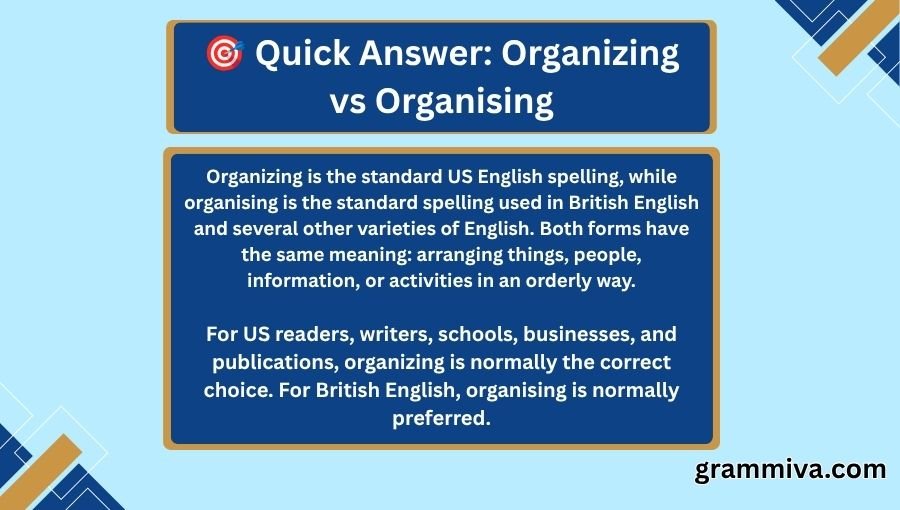
Organizing is the standard US English spelling, while organising is the standard spelling used in British English and several other varieties of English. Both forms have the same meaning: arranging things, people, information, or activities in an orderly way.
For US readers, writers, schools, businesses, and publications, organizing is normally the correct choice. For British English, organising is normally preferred.
| Spelling | Main English Variety | Example |
|---|---|---|
| organizing | US English | I am organizing the meeting. |
| organising | British English | I am organising the meeting. |
🧩 Related Word Forms of Organizing and Organising
The spelling difference continues across several related forms. The key pattern is the use of -ize in US English and commonly -ise in British English.
| Form | Type | Example |
|---|---|---|
| organize | Base verb | We need to organize the files. |
| organizing | Present participle | She is organizing the event. |
| organized | Past tense/past participle | They organized the records. |
| organizer | Noun | The event organizer called me. |
| organization | Noun | The organization helps families. |
| organise | British base verb | We need to organise the files. |
| organising | British present participle | She is organising the event. |
| organised | British past tense/past participle | They organised the records. |
| organiser | British noun | The event organiser called me. |
The important point is that organizing and organising are not different meanings. They are spelling variants used by different English standards.
📚 Understanding Organizing vs Organising
The core difference is regional spelling. US English generally uses organizing, while British English generally uses organising.
The word itself means putting things into a planned or orderly arrangement. It can describe physical objects, information, events, groups, schedules, or activities.
| Form | Type | Meaning | Example | Correct/Incorrect |
|---|---|---|---|---|
| organizing | US English verb form | Arranging or planning | I am organizing my desk. | ✅ Correct in US English |
| organising | British English verb form | Arranging or planning | I am organising my desk. | ✅ Correct in British English |
| organiseing | Incorrect spelling | No standard form | I am organiseing my desk. | ❌ Incorrect |
| organizsing | Incorrect spelling | No standard form | She is organizsing the files. | ❌ Incorrect |
| organzing | Misspelled form | Missing a letter | He is organzing the event. | ❌ Incorrect |
What Does Organizing Mean?
In US English, organizing is the present participle of organize. It can also appear after forms of “be” to create a progressive verb phrase.
For example:
- “I am organizing the books.”
- “She is organizing the conference.”
- “They are organizing their notes.”
In each case, the action is happening now or around the current time.
The word can also describe an ongoing effort rather than one single action. You might say, “We are organizing a charity drive,” even though the work may take several weeks.
What Does Organising Mean?
Organising has the same meaning as organizing, but it follows the spelling convention commonly used in British English.
For example:
- “I am organising the books.”
- “She is organising the conference.”
- “They are organising their notes.”
If you are writing for a British audience, this spelling is usually the natural choice.
Why Is the Difference Only One Letter?
The difference comes from a wider spelling pattern. US English often uses -ize where British English often uses -ise in words such as organize/organise.
This pattern appears in related forms as well:
| US English | British English |
|---|---|
| organize | organise |
| organizing | organising |
| organized | organised |
| organizer | organiser |
Not every word ending in these letters follows exactly the same pattern, so it is better to learn common words as complete forms rather than assume every -ize/-ise pair works identically.
🇺🇸 Is Organizing the Correct US English Spelling?
Yes. Organizing is the standard US English spelling.
If you are writing a college assignment for a US school, a US business email, a US resume, or an article aimed at American readers, use organizing.
For example:
“I am organizing the project files before Friday.”
That spelling fits standard US English.
US English Examples
| Sentence | Correct? | Reason |
|---|---|---|
| We are organizing the workshop. | ✅ | Standard US spelling |
| She is organizing her schedule. | ✅ | Standard US spelling |
| They are organising the workshop. | ❌ | British spelling in a US context |
| He is organizeing the papers. | ❌ | Misspelling |
The last two examples show an important distinction. Organising is not a bad English word. It is simply not the usual US spelling.
🇬🇧 Is Organising the Correct British English Spelling?
Yes. Organising is widely used as the standard British English spelling.
If your audience follows British English conventions, this form is appropriate.
For example:
“We are organising the annual meeting.”
The same sentence in US English would normally use organizing.
This difference can appear in international workplaces. A company may have American employees using organizing while British employees use organising. Neither writer is necessarily making a spelling mistake.
🧐 Why Do People Confuse Organizing and Organising?
People confuse the two forms because both are accepted English spellings, and the difference is tied to regional writing standards rather than meaning.
I once edited a document written by a student who had started with US spelling but later copied several sentences from a British website. The paper contained both forms. Nothing was wrong with the meaning, but the spelling looked inconsistent. We chose one English standard and changed the document to match it.
That is the main problem: consistency.
Common reasons for confusion include:
- Reading American and British websites at the same time.
- Working with an international team.
- Using different spell-check settings.
- Copying text from several sources.
- Learning English from teachers who use different regional standards.
- Writing quickly without checking the final draft.
| Situation | Why Confusion Happens | Best Solution |
|---|---|---|
| School paper | Student reads mixed sources | Follow the teacher’s required style |
| Business email | Team members use different English varieties | Match the company’s style |
| Website | Audience may be international | Choose one regional standard |
| Social media | Users see both forms online | Pick the form that fits your audience |
| Resume | Employer may expect a local standard | Match the job market and employer |
💡 How Can You Remember the Difference?
A simple memory trick is to connect the spelling with the English variety you are using.
US English → organize → organizing
British English → organise → organising
You can also remember the endings:
-ize → organizing
-ise → organising
If you are writing for an American audience, think “organizing with Z.”
If you are writing for a British audience, think “organising with S.”
Test Tip 💡
When you are unsure, look at the other spelling choices in your document.
If you have written:
- color
- center
- favorite
- organize
you are clearly following US English.
If you have written:
- colour
- centre
- favourite
- organise
you are following British English.
Do not switch styles halfway through the same document unless you have a specific reason.
✍️ Correct Meanings and Uses
The word can be used in several everyday ways. The meaning stays connected to the idea of arranging, planning, or bringing order to something.
Organizing Things
You can use the word for physical objects.
“I am organizing the books by subject.”
Here, the speaker is arranging books into groups.
Organizing Information
The word can also describe arranging ideas or information.
“She is organizing her notes before the exam.”
The notes are being placed into a useful order.
Organizing an Event
People also use the word when planning an event.
“Our team is organizing a company picnic.”
The team is handling the planning and preparation.
Organizing People
The word may describe bringing people together for a shared activity or goal.
“The volunteers are organizing a food drive.”
Here, the volunteers are planning and coordinating the activity.
| Meaning | Word Type | Example Sentence |
|---|---|---|
| Arranging objects | Verb form | I am organizing the boxes. |
| Arranging information | Verb form | She is organizing her notes. |
| Planning an event | Verb form | We are organizing a conference. |
| Coordinating people | Verb form | They are organizing volunteers. |
📝 Case Study: A Workplace Email
Imagine that you work for a US company. Your manager asks you to prepare a meeting.
You write:
“I am organizing the meeting for Thursday. I am also organizing the presentation files.”
That is natural US English.
Now imagine the same message is being sent by an employee at a company in the UK:
“I am organising the meeting for Thursday. I am also organising the presentation files.”
That version is natural British English.
I once caught myself typing the British form in a US client email after spending several hours reading British news articles. I noticed the spelling before sending the message and changed it. The mistake was tiny, but it reminded me how easily regional spelling can carry over from one task to another.
The lesson is simple: check the audience before you check the spelling.
📖 Grammar Rules Explanation
The spelling difference does not change the grammatical role or basic meaning of the word. Both forms are present participles of their respective base verbs.
In US English, the base verb is organize, and its present participle is organizing. In British English, the common spelling is organise, and its present participle is organising.
The final e in the base form is dropped before adding -ing. Thus, US English has organize → organizing, while British English has organise → organising.
Both forms can appear in progressive verb constructions:
- “She is organizing the files.”
- “She is organising the files.”
Both sentences have the same grammatical structure and meaning. The spelling choice depends on the English variety being used.
General dictionaries and standard writing references recognize regional spelling differences of this kind. The key for writers is to follow the spelling standard appropriate for the intended audience.
Correct vs Incorrect at a Glance
| Sentence | Correct/Incorrect | Why |
|---|---|---|
| I am organizing the files. | ✅ Correct | Standard US English |
| I am organising the files. | ✅ Correct | Standard British English |
| I am organizeing the files. | ❌ Incorrect | The spelling incorrectly keeps the final e |
| We are organizsing the files. | ❌ Incorrect | The spelling adds an unnecessary s |
| She is organzing the files. | ❌ Incorrect | The spelling leaves out i |
⚠️ Common Mistakes With Organizing and Organising
Most mistakes happen because writers are moving quickly or using more than one English variety.
Fast Typing
When people type quickly, they often write based on sound instead of checking each letter. Since organizing and organising sound the same in many varieties of English, the spelling can slip through.
Autocorrect
Spell-check tools can also create confusion. A device set to British English may prefer organising, while a US English setting may prefer organizing.
Autocorrect is useful, but it should not replace proofreading.
Lack of Knowledge
Some writers believe one form must be wrong because they have only seen the other form. That is not the case here.
The two forms belong to different spelling standards.
| Common Confusion | Correct Forms | Main Reason |
|---|---|---|
| it’s / its | it’s, its | Apostrophe changes meaning |
| your / you’re | your, you’re | Possessive vs contraction |
| their / there / they’re | their, there, they’re | Different meanings |
| then / than | then, than | Time vs comparison |
| organize / organise | organize, organise | Regional spelling |
| organizing / organising | organizing, organising | Regional spelling |
Specific Wrong Spellings and Uses
| Wrong Form | What’s Wrong | Correct Form |
|---|---|---|
| organizeing | Final e should be removed | organizing |
| organiseing | Final e should be removed | organising |
| organizsing | Extra s creates a misspelling | organizing |
| organiszing | Mixed spelling patterns | organising |
| organzing | Missing i | organizing |
| organisng | Missing i | organising |
A useful proofreading trick is to search your document for both -izing and -ising. If you find both, ask whether the mixture is intentional.
🌍 Usage in Different Contexts
The right choice depends on your audience and the English style required by the setting.
Everyday Conversation
In casual conversation, the spelling usually matters only when you write the word. When texting friends, people may not care which regional form you use.
Professional Writing
Professional writing requires more consistency. Use the spelling standard expected by your employer, client, publication, or audience.
Creative Writing
Authors can use either form depending on the setting, narrator, characters, and intended audience. A British novel may naturally use British spelling, while an American novel may use US spelling.
Social Media and Texting
Social platforms are international, so both forms appear often. If you have a personal style, choose one and stay consistent.
| Context | Which Term to Use | Example |
|---|---|---|
| US school paper | organizing | We are organizing the research notes. |
| US business email | organizing | I am organizing the files now. |
| British business email | organising | I am organising the files now. |
| Creative writing | Depends on audience/style | The character was organising the books. |
| Social media | Either, depending on audience | I spent all morning organizing my desk. |
🔎 Organizing vs Organising in Professional Writing
Professional documents benefit from a consistent spelling system. A single regional spelling choice can make an entire document look more polished.
If you are preparing a US resume, use US spellings throughout when appropriate.
For example:
“Organizing project files and coordinating team schedules.”
A British-style version would be:
“Organising project files and coordinating team schedules.”
Neither version is automatically more professional. The professional choice is the one that matches the expected English standard.
| Document | Recommended US Form | Why |
|---|---|---|
| US resume | organizing | Matches US spelling |
| US cover letter | organizing | Maintains consistency |
| US business report | organizing | Fits US style |
| British application | organising | Matches British style |
| International document | Follow stated style guide | Avoids mixed conventions |
🗣️ How Does Organizing Work in Everyday Sentences?
The word fits naturally into sentences when an action is happening or continuing.
Here are some common patterns:
- “I am organizing my closet.”
- “She is organizing the files.”
- “We are organizing a fundraiser.”
- “They are organizing the event.”
- “He spent the afternoon organizing his desk.”
The British versions simply use organising instead.
The key is not to change the meaning. Change the spelling only when the English variety calls for it.
🧠 Common Phrases With Organizing
There are no major idioms that depend specifically on the spelling organizing or organising. However, the word appears in many useful everyday phrases.
| Phrase | Meaning |
|---|---|
| organizing a meeting | Planning and arranging a meeting |
| organizing an event | Planning an event |
| organizing files | Putting files into a useful order |
| organizing information | Arranging information clearly |
| organizing a team | Bringing people together for a task |
| organizing a schedule | Planning activities by time |
These phrases can be used with either regional spelling.
🔄 Synonyms and Alternatives
Sometimes you can replace the word with another expression. The best choice depends on what you mean.
| Alternative | Works When | Does Not Work When |
|---|---|---|
| arranging | You are putting things into order | You mean broader event planning |
| planning | You are preparing for something | You simply mean sorting objects |
| sorting | You are separating things into groups | You mean managing an entire event |
| coordinating | You are managing people or activities | You only mean putting books in order |
| preparing | You are getting something ready | You specifically mean arranging information |
For example, “I am sorting the files” may work if you are placing files into categories. But “I am organizing the conference” is usually broader than simply sorting something.
🎯 Why Does the Spelling Difference Matter?
The spelling difference matters because good writing should fit its audience. A single regional spelling is rarely a serious communication problem, but consistent spelling makes writing easier to read and more professional.
Clarity in Communication
Readers usually understand both forms. Still, consistent spelling helps them recognize that your document follows one clear style.
Professionalism
A US company may expect US spelling. A British publication may expect British spelling. Matching the expected standard shows attention to detail.
Digital Communication
Websites, emails, resumes, and social posts often reach people from different countries. Knowing the difference helps you make deliberate choices instead of accidental ones.
A useful writing principle is:
“Choose your English style before you choose your final spelling.”
| Situation | Why Getting It Right Matters |
|---|---|
| Resume | Shows attention to language and local standards |
| Client email | Creates a polished and consistent impression |
| Published content | Keeps the publication’s style consistent |
| Social post | Helps match the intended audience |
🌐 When Should You Use Organizing Instead of Organising?
Use organizing when you are writing in US English or for an audience that expects US spelling.
Typical examples include:
- US schools
- US colleges and universities
- American businesses
- US government-related writing
- American news and media
- Websites targeting US readers
If the style guide for your organization says otherwise, follow that guide.
🇬🇧 When Should You Use Organising Instead of Organizing?
Use organising when you are following British English spelling conventions or writing for an audience that expects them.
This commonly includes writing for:
- The United Kingdom
- British publications
- British schools
- Many organizations that use British English
- Audiences specifically instructed to follow British spelling
The important point is not that one form is “more correct.” The important point is that each form belongs to a different spelling convention.
❓ Can You Mix Organizing and Organising?
You can, but you generally should not mix them within the same document unless there is a clear reason.
For example, a US report that uses color, center, and organising has mixed spelling conventions.
A British report that uses colour, centre, and organizing has the same problem.
Consistency is usually the better choice.
| Document Style | Better Pattern |
|---|---|
| US English | organize, organizing, color, center |
| British English | organise, organising, colour, centre |
| Mixed intentionally | Only when a quoted or branded source requires it |
📋 Quick Recap Checklist
Use these questions before you finish your document.
| Question | If Yes → Use |
|---|---|
| Am I writing for a US audience? | organizing |
| Am I writing for a British English audience? | organising |
| Does my style guide require US English? | organizing |
| Does my style guide require British English? | organising |
| Am I using one spelling consistently? | Keep that regional style |
Practice Examples
- US: “I am organizing the meeting.” ✅
- British: “I am organising the meeting.” ✅
- US document: “We are organising the files.” ❌ — use organizing for a consistent US style.
🧪 A Simple Five-Second Test
If you are still unsure, use this quick test:
Step 1: Identify your audience.
Step 2: Decide whether the document uses US or British English.
Step 3: Look at the base verb.
US: organize → organizing
British: organise → organising
Step 4: Check the rest of your document for mixed spelling.
This takes only a few seconds and prevents many small editing problems.
❓ Why Is Organizing Spelled With a Z in American English?
US English commonly spells the base verb as organize, so the present participle becomes organizing. The British spelling commonly uses organise, producing organising.
The difference is a regional spelling convention, not a difference in meaning.
❓ Why Is Organising Spelled With an S?
British English commonly uses organise, so its present participle is organising. The spelling follows the base form used in that variety of English.
❓ Is Organising Wrong in the United States?
Not in the sense that it is an invalid English word. However, organising is normally treated as a British-style spelling. For standard US English, organizing is the preferred form.
❓ Is Organizing Wrong in the UK?
No. Organizing is recognized as an English spelling associated with US English and other styles that use -ize. However, writers following traditional British house style may prefer organising.
❓ Which Is Correct for a US Resume, Organizing or Organising?
For a US resume, use organizing. It matches standard US spelling and keeps the document consistent with other common American spellings.
For example:
“Organizing team schedules and maintaining project records.”
❓ Which Is Correct in American Academic Writing?
Organizing is the normal choice in American academic writing. If your professor, school, publisher, or style guide gives a specific requirement, follow that requirement.
❓ Do Organizing and Organising Mean the Same Thing?
Yes. They have the same basic meaning. Both describe arranging, planning, or coordinating something. The main difference is the spelling convention.
❓ How Do I Know Which English Spelling to Use?
Look at your audience, location, employer, school, publication, or style guide. If the audience is American, use organizing. If the audience follows British English, use organising.
❓ Should I Use Organizing or Organising on an International Website?
Choose the form that matches your target audience and keep it consistent. If the website is mainly aimed at US readers, use organizing. If it follows British English, use organising.
❓ Does the Difference Affect Grammar?
No. The difference is primarily spelling. Both forms can perform the same grammatical job in their respective English varieties.
❓ What Is the Easiest Way to Remember Organizing vs Organising?
Remember the base forms:
US English: organize → organizing
British English: organise → organising
Think Z for US English and S for British English.
❓ Can Spell-Check Help Me Choose the Right Form?
Yes. Set your spell-check language to the English variety you need. A US English setting can help you catch British-style spellings in an American document, while a British English setting can do the reverse.
Still, check the document yourself. Spell-check cannot always understand your intended audience.
❓ Is Organizing More Correct Than Organising?
No. Neither is universally “more correct.” Organizing is the standard US form, while organising is the standard British form. Correctness depends on the English variety being used.
🏁 Conclusion
Organizing vs organising is a spelling difference between English varieties, not a difference in meaning. For US English, use organizing. For British English, use organising.
The best way to avoid mistakes is to decide which English standard you need before you start editing. Then keep that choice consistent throughout the document. If you are writing for an American school, company, website, or publication, organizing is normally the form you want. If you are following British English, organising is the natural choice.
I recommend one final proofreading step: scan for both -izing and -ising endings. If they appear together, check whether that mixture is intentional.
Once you connect Z with US English and S with British English, this spelling question becomes much easier. ✨
Choose your audience, choose your English style, and keep your spelling consistent.

I am Ryan Mitchell, a writer focused on English grammar, vocabulary, and everyday language. I work at Grammiva, creating easy-to-understand articles that help readers improve their English with confidence.
[…] examples, covers related words, and gives you practical ways to remember the right form. 💡 Organizing vs Organising | Per Se vs Per Say | Honor vs […]
[…] people ask most often. By the end, the spelling should feel automatic. ✍️ Hygiene vs Hygene | Organizing vs Organising | Per Se vs Per […]