Have you ever written an email and stopped because you were unsure whether to type per se or per say? You are not alone. Per se vs per say is a common spelling and usage question because the two phrases sound very similar when spoken aloud.
The problem is that only one is the standard expression used in English. ✍️
When I edit writing, I often see this mistake in otherwise strong work.
A person may know exactly what they want to say but choose the wrong spelling because they are writing from sound.
That is easy to understand. English has many words that do not look the way they sound.
The good news is that this one is easy to fix.
Once you understand what per se means and connect it with its usual purpose, you will be much less likely to write per say by mistake. 😊
In this guide, I will explain the difference, show correct and incorrect examples, cover professional and casual use, and give you simple memory tricks that you can use whenever you hesitate. Honor vs Honour | Discreet vs Discrete | Deep-Seated vs Deep-Seeded
🎯 Quick Answer: Per Se vs Per Say
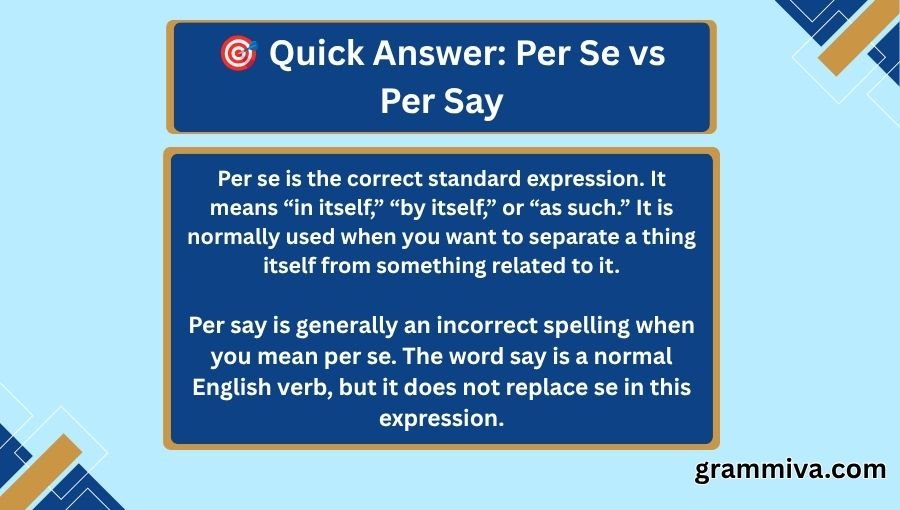
Per se is the correct standard expression. It means “in itself,” “by itself,” or “as such.” It is normally used when you want to separate a thing itself from something related to it.
Per say is generally an incorrect spelling when you mean per se. The word say is a normal English verb, but it does not replace se in this expression.
For example:
- The job is not difficult per se; it is just time-consuming. ✅
- The job is not difficult per say; it is just time-consuming. ❌
The key point is simple: write per se, not per say, when you mean “in itself.”
Is Per Se the Same as Per Say?
No. Per se is the standard expression, while per say is usually a spelling mistake caused by the similar sound of the two forms.
Per se is used to focus on something in its own right. For example, “I do not dislike the movie per se” means that the speaker does not dislike the movie itself. There may be another problem with it.
Per say does not carry that meaning. If you see it in ordinary writing, the writer almost certainly intended per se.
Correct and Incorrect Examples
| Sentence | Status | Reason |
|---|---|---|
| I do not dislike the plan per se. | ✅ Correct | Per se means “in itself.” |
| I do not dislike the plan per say. | ❌ Incorrect | Per say is not the standard expression. |
| The color is not bad per se. | ✅ Correct | The color itself is not the problem. |
| The color is not bad per say. | ❌ Incorrect | Say does not belong in this expression. |
Per Se vs Per Say at a Glance
The fastest way to understand the difference is to remember that per se has a meaning, while per say is normally just a mistaken spelling of that expression.
| Form | Type | Meaning | Example | Correct/Incorrect |
|---|---|---|---|---|
| per se | Fixed expression | in itself; by itself; as such | The idea is not wrong per se. | ✅ Correct |
| per say | Mistaken form in this context | No standard meaning as a replacement for per se | The idea is not wrong per say. | ❌ Incorrect |
| say | Verb | Speak or express words | What did she say? | ✅ Correct |
| said | Past-tense verb | Spoke or expressed words | He said he was ready. | ✅ Correct |
Notice that say is not an incorrect English word. The problem is using it as part of the expression per se.
What Does Per Se Mean?
Per se means in itself, by itself, or considered on its own. It is used when the speaker wants to make a distinction between a thing itself and another feature, effect, or situation connected to it.
Consider this sentence:
The restaurant is not expensive per se, but the portions are small.
The speaker is saying that the restaurant is not expensive in itself. The real concern is the small portions.
Here is another example:
I am not against change per se.
This does not mean the speaker supports every kind of change. It means that change itself is not the problem.
How Per Se Works in a Sentence
I find it helpful to ask what the writer is separating.
Usually, the sentence has this basic idea:
Thing itself ≠ related issue
For example:
The software is not difficult per se; the instructions are confusing.
The software itself is not difficult. The instructions create the problem.
Another example:
I do not object to working late per se, but I need more notice.
Working late itself is not necessarily the problem. The lack of notice is.
Meaning Summary
| Meaning | Word Type | Example Sentence |
|---|---|---|
| In itself | Fixed expression | The rule is not unfair per se. |
| By itself | Fixed expression | The tool is not dangerous per se. |
| As such | Fixed expression | It is not a failure per se. |
These meanings overlap. In most everyday cases, replacing per se mentally with “in itself” will help you decide whether you are using it correctly.
🎯 When Should You Use Per Se?
Use per se when you want to discuss something on its own rather than its related effects, qualities, or circumstances.
Here are several common patterns.
To Separate a Thing From Its Effects
Social media is not harmful per se, but excessive use can cause problems.
The speaker is not saying that every part of social media is harmless. The point is that social media itself is not automatically the problem.
To Make a Careful Distinction
The policy is not unreasonable per se, but it is difficult to enforce.
The policy itself may be reasonable. Its enforcement is the issue.
To Say That Something Is Not the Main Problem
I am not tired per se. I just need a quiet evening.
The speaker is making a small distinction. They may not feel truly tired, but they still want rest.
To Talk About Something in Its Own Right
The design is not ugly per se, but it feels outdated.
The design itself is not necessarily ugly. Its age or style creates the concern.
Test Tip 💡
When you are unsure, replace per se with “in itself.”
If the sentence still makes sense, per se is probably the right choice.
The rule is not bad in itself.
That works.
The rule is not bad in itself, but it creates extra work.
That also works.
So:
The rule is not bad per se, but it creates extra work. ✅
If “in itself” makes no sense, you probably do not need per se.
Why Do People Confuse Per Se and Per Say?
People confuse the two mainly because they sound alike. When a phrase is learned by hearing rather than reading, it is easy to create a spelling based on familiar words.
I once had a student write, “The plan is not perfect per say.” When I asked why she chose say, she said she had heard the phrase many times but had never seen it written. That explanation made perfect sense. She was spelling what she heard.
Three common causes are especially worth remembering:
- Sound-based spelling — People write the word they think they hear.
- Limited exposure to formal writing — Someone may know the phrase from conversation but rarely see it on a page.
- Typing habits — A keyboard or autocorrect system may make a familiar word appear faster than an unfamiliar phrase.
A Simple Sound-to-Spelling Problem
| What You Hear | What You May Type | Standard Written Form |
|---|---|---|
| “per say” | per say | per se |
| “your” | your | Depends on meaning |
| “they’re” | their | Depends on meaning |
| “could’ve” | could of | could have |
The lesson is broader than this one phrase: sound is not always a reliable guide to spelling.
How Can You Remember Per Se?
The easiest memory trick is to connect se with the phrase “itself.”
Think:
Per se = in itself.
You can also remember that say is an ordinary verb:
I say something.
But:
The thing itself is per se.
Another useful trick is to imagine the sentence without the expression:
The product is not expensive. The shipping is expensive.
Then combine the ideas:
The product is not expensive per se; the shipping is expensive.
This helps you understand the meaning instead of memorizing spelling alone.
Memory Trick Table
| Memory Method | Reminder |
|---|---|
| Meaning test | Replace per se with “in itself.” |
| Spelling test | Remember that the expression ends in se, not say. |
| Contrast test | Ask whether you are separating a thing from a related issue. |
| Grammar test | Remember that say is a verb, while per se functions as a fixed expression. |
📝 Case Study: A Workplace Email
Imagine a manager receives this email:
“The new schedule is not difficult per say, but it gives us less time between shifts.”
The writer’s meaning is clear. The spelling is not.
A polished version would be:
“The new schedule is not difficult per se, but it gives us less time between shifts.”
This small correction matters because professional writing creates an impression. A reader may understand the original sentence, but a spelling error can distract from the message.
I once edited a short business report where the writer used per say three times. The writer had excellent ideas and strong sentence structure. The repeated spelling error stood out simply because the rest of the report was so polished. One quick search-and-replace fixed the problem.
The case shows why small language choices matter. A tiny error can become more noticeable when it appears several times.
Grammar Rules Explanation
The standard form is per se. It functions as a fixed expression meaning “in itself,” “by itself,” or “as such.”
The form per say is not the standard spelling of this expression. The word say is a verb in English, so it can appear in many perfectly correct sentences:
They say the store is closing.
What did you say?
But those sentences use say as a verb. They do not use it as part of the expression per se.
The distinction is therefore not simply about spelling. It is also about function. In the expression per se, se belongs to the expression. Replacing it with the English verb say changes the form and produces a nonstandard construction.
Most standard dictionaries and major writing references recognize per se as the established expression. For a quick check while editing, the “in itself” test is usually enough.
Correct vs Incorrect at a Glance
| Sentence | Correct/Incorrect | Why |
|---|---|---|
| The idea is not strange per se. | ✅ Correct | The idea itself is not strange. |
| The idea is not strange per say. | ❌ Incorrect | Per say is not the standard expression. |
| I do not hate winter per se. | ✅ Correct | Winter itself is not the speaker’s main issue. |
| I do not hate winter per say. | ❌ Incorrect | Say is incorrectly replacing se. |
| The rule is not unfair per se. | ✅ Correct | The rule itself is not unfair. |
Is Per Se Formal or Informal?
Per se can appear in both everyday and professional writing, but it often has a slightly formal or careful tone. It is common when a writer wants to make a precise distinction.
For casual speech, simpler alternatives may sound more natural.
Instead of:
I am not upset per se.
You might say:
I am not really upset.
However, per se is perfectly acceptable when the distinction matters.
Formality Comparison
| Style | Example | Naturalness |
|---|---|---|
| Casual | I am not really upset. | Very natural |
| Neutral | I am not upset exactly. | Natural |
| More precise | I am not upset per se. | Correct and somewhat formal |
| Incorrect | I am not upset per say. | ❌ Incorrect |
Per Se in Everyday Conversation
In conversation, per se often appears when someone wants to correct or refine an idea.
For example:
“Do you hate the city?”
“Not per se. I just do not like the traffic.”
The phrase lets the speaker avoid an overly broad statement.
Another example:
“Was the meeting bad?”
“Not per se. It was just too long.”
This pattern is useful because it means, roughly, “Not exactly that, but there is another issue.”
Per Se in Professional Writing
In professional writing, per se can help make a sentence more exact.
Examples include:
- The proposal is not unreasonable per se, but the cost is too high.
- The product is not defective per se, but it does not meet the client’s needs.
- The process is not inefficient per se, but it has several unnecessary steps.
- The policy is not harmful per se, but its application may create problems.
Still, do not add per se just to make writing sound sophisticated. If “in itself” says the same thing more clearly, use whichever fits the audience.
Per Se in Creative Writing
Creative writers can use per se when a character is making a careful distinction.
For example:
“I never said I disliked the house per se. I just did not like what happened there.”
The phrase can help reveal a character’s voice. It can also create a thoughtful or slightly formal tone.
In fiction, though, dialogue should sound like the character. A relaxed character might naturally say “not exactly” instead.
Per Se in Social Media and Texting
You can use per se in social media posts or texts, but it may sound more formal than everyday alternatives.
For example:
“I do not hate the update per se. I just wish they had kept the old menu.”
That is correct.
If you are texting a close friend, you might simply write:
“I do not hate the update. I just hate the new menu.”
The choice depends on your voice and audience.
Context Guide
| Context | Which Term to Use | Example |
|---|---|---|
| Everyday conversation | per se, if the distinction helps | I do not dislike it per se. |
| Professional writing | per se | The plan is not flawed per se. |
| Creative writing | per se, when it fits the voice | She did not fear him per se. |
| Social media/texting | per se or a simpler phrase | I am not mad per se. |
The incorrect form per say should not be used simply because the setting is casual.
What Are Common Phrases With Per Se?
There are no special idioms that you need to memorize. Instead, per se commonly appears in sentence patterns that express a distinction.
| Phrase Pattern | Meaning |
|---|---|
| not bad per se | not bad in itself |
| not wrong per se | not wrong in itself |
| not difficult per se | not difficult by itself |
| not harmful per se | not harmful in itself |
| not unusual per se | not unusual as such |
| not a problem per se | not a problem in itself |
These patterns are useful because they show how the expression normally works.
Notice how often per se follows an adjective or noun phrase:
not expensive per se
not dangerous per se
not a mistake per se
This is not an absolute rule for every possible sentence, but it is a very common pattern.
Are There Alternatives to Per Se?
Yes. You can often replace per se with a simpler phrase. The best choice depends on what you mean.
| Alternative | Works When | Does Not Work When |
|---|---|---|
| in itself | You mean the thing itself | You are talking about something else entirely |
| by itself | You mean alone or independently | You need a more exact contrast |
| as such | You are referring to something in its stated form | The meaning is simply “alone” |
| exactly | You want to soften or qualify a statement | You specifically mean “in itself” |
| really | You want casual wording | Precision matters |
For example:
The plan is not bad per se.
can become:
The plan is not bad in itself.
That preserves the basic meaning.
But:
The plan is not bad, really.
has a slightly different tone. It may not make the same careful distinction.
⚠️ Common Mistakes With Per Se vs Per Say
The main mistake is writing per say because it sounds natural. That is a spelling error, not a difference in meaning.
Other problems happen when writers add the phrase where it does not help.
Similar Grammar Confusions
| Confusion | Correct Forms | Why People Mix Them Up |
|---|---|---|
| it’s / its | it’s = it is; its = belonging to it | Similar spelling |
| your / you’re | your = belonging to you; you’re = you are | Same sound |
| they’re / their / there | Different meanings | Same or similar sounds |
| then / than | Different functions | Fast writing and similar sound |
| affect / effect | Different common uses | Similar pronunciation |
| per se / per say | per se is the standard expression | Sound-based spelling |
Three causes show up again and again.
Fast typing: When people type quickly, they often choose the familiar word their fingers expect.
Autocorrect: Software may suggest a familiar word such as say because it appears frequently in ordinary English.
Lack of knowledge: If someone has heard the phrase but never seen it written, per say can seem completely logical.
Common Wrong Forms
| Wrong Form | What’s Wrong | Correct Form |
|---|---|---|
| per say | Replaces se with say | per se |
| perse | Runs the expression together | per se |
| per-see | Adds an unnecessary spelling based on sound | per se |
| persay | Combines the words and changes the spelling | per se |
| per se, | Not always wrong, but punctuation should depend on the sentence | per se |
| per say itself | Uses the wrong form before “itself” | per se |
The first four are spelling problems. The last two need more care because punctuation depends on sentence structure.
Is Per Se Always Necessary?
No. You should use it when it adds a useful distinction. If it does not add meaning, a simpler sentence may be stronger.
Compare:
The movie is not bad per se.
with:
The movie is not bad.
The first sentence suggests that there is another issue. The second simply gives an opinion.
This is a useful editing rule: do not use a formal expression just because it sounds impressive. Use it because it says something useful.
How Does Per Se Affect Writing Style?
Per se often signals a qualification. It tells the reader that the writer is making a narrow claim rather than a broad one.
Compare:
The policy is unfair.
That is a direct claim.
Now:
The policy is not unfair per se, but it affects small businesses more than large companies.
The second sentence is more careful. It separates the policy itself from its effects.
This can be valuable in essays, reports, reviews, workplace writing, and discussions where precision matters.
Style Comparison
| Sentence | Effect |
|---|---|
| The product is bad. | Strong, broad judgment |
| The product is not good. | More neutral |
| The product is not good per se, but the packaging is poor. | Makes a specific distinction |
| The product is not good per say. | ❌ Spelling error |
Does Per Se Need a Comma?
Usually, no comma is required simply because per se appears in a sentence.
For example:
The idea is not wrong per se.
There is no need for a comma before per se.
A comma may appear because of the larger sentence structure:
The idea is not wrong per se, but it may be difficult to explain.
Here, the comma belongs to the structure joining two parts of the sentence. It is not there merely because per se appears.
Punctuation Examples
| Sentence | Status | Explanation |
|---|---|---|
| The plan is not bad per se. | ✅ Correct | No comma is needed. |
| The plan is not bad, per se. | ⚠️ Possible but often unnecessary | The comma adds a pause that may not be needed. |
| The plan is not bad per se, but it is expensive. | ✅ Correct | The comma separates two sentence parts. |
| The plan is not bad per say. | ❌ Incorrect | Wrong spelling. |
For clean professional writing, I usually leave out the comma unless the sentence’s structure or intended pause clearly calls for it.
How Do Editors Check Per Se vs Per Say?
When I edit, I use three quick questions:
- Do I mean “in itself”?
- Am I separating something from a related issue?
- Am I using the fixed expression rather than the verb “say”?
If the answer to the first two is yes, per se is probably correct.
A simple editing search can also help. If you are proofreading a long document, search for “per say.” Review each result. In most cases where the writer intended “in itself,” change it to “per se.”
Do not blindly replace every occurrence, though. Good editing always checks context.
How Is Per Se Used in Strong Sentences?
Strong examples usually make the contrast clear.
Consider:
The price is not high per se, but the extra fees are surprising.
The reader immediately understands the distinction.
Another:
The task is not difficult per se; it simply requires a lot of patience.
Again, the task itself is not difficult. The time or patience required creates the challenge.
One more:
I do not dislike remote work per se. I miss talking with my coworkers.
The first sentence narrows the meaning. The second explains the real issue.
Sentence Pattern Practice
| Pattern | Example |
|---|---|
| Not + adjective + per se | It is not confusing per se. |
| Not + noun + per se | It is not a problem per se. |
| Not + verb idea + per se | I do not oppose the change per se. |
| Per se + contrast | The idea is fine per se, but the cost is too high. |
These patterns can help you recognize natural use without memorizing long grammar rules.
Why Does Getting Per Se Right Matter?
Getting a small expression right can improve clarity and trust. Readers may not stop to think about the error, but correct spelling helps your writing look careful and finished.
| Situation | Why Getting It Right Matters |
|---|---|
| Resume | Shows attention to written detail |
| Client email | Supports a polished professional image |
| Published content | Prevents repeated errors from reaching readers |
| Social post | Makes the message easier to trust and share |
A simple principle guides my editing:
Clear writing lets the reader focus on your idea instead of your mistake.
That is especially useful with phrases that people see in formal writing. A small spelling error may not change the meaning, but it can still interrupt the reader.
Quick Recap Checklist ✅
Use this checklist whenever you hesitate.
| Question | If Yes → Use |
|---|---|
| Do I mean “in itself”? | per se |
| Am I talking about something on its own? | per se |
| Am I separating a thing from its effects? | per se |
| Am I using the verb “say”? | say, not per se |
| Am I tempted to spell the expression from its sound? | Stop and check: per se |
Practice Examples
1. The movie is not boring ___, but the ending is weak.
Answer: per se
The movie is not boring per se, but the ending is weak. ✅
2. I do not dislike the job ___; I dislike the long commute.
Answer: per se
I do not dislike the job per se; I dislike the long commute. ✅
3. What did you ___ during the meeting?
Answer: say
What did you say during the meeting? ✅
The third example is useful because it shows that say is a perfectly correct word. It simply does not replace se in the fixed expression.
Frequently Asked Questions About Per Se vs Per Say
What is the correct spelling, per se or per say?
The correct spelling of the expression meaning “in itself” is per se. Per say is generally an incorrect spelling of that expression.
Is per say ever correct?
Say is certainly a correct English word, but per say is not the standard expression when you mean “in itself.” If you are expressing that meaning, use per se.
What does per se mean in simple English?
Per se means “in itself,” “by itself,” or “as such.” It helps you talk about something separately from other issues connected to it.
Can I use per se in a sentence?
Yes. For example:
The idea is not bad per se, but it needs more work.
Here, the idea itself is not bad. The problem is that it needs improvement.
Is per se formal English?
Yes, per se can sound somewhat formal or careful, especially compared with simple phrases such as “in itself” or “really.” It is standard English and can be used in professional, academic, conversational, and creative writing when it fits the tone.
Should I put a comma before per se?
Usually, you do not need a comma simply because per se appears at the end of a phrase.
The plan is not unreasonable per se.
A comma may be required for another reason, such as joining two independent parts of a sentence.
Why do people write per say?
People often write per say because the two forms sound similar in speech. Someone who learned the expression by hearing it may naturally connect the sound with the familiar English word say.
What is an easy way to remember per se?
Remember this:
Per se = in itself.
Whenever you can replace the phrase with “in itself,” per se is likely the form you need.
Can per se be used in casual conversation?
Yes. It is grammatically correct in casual conversation. However, some speakers may prefer simpler wording such as “not really,” “not exactly,” or “in itself,” depending on the situation.
What is the difference between per se and in itself?
They often have nearly the same meaning. Per se is a compact expression that can sound more formal, while “in itself” is usually more direct and familiar.
Final Thoughts on Per Se vs Per Say
Per se vs per say becomes much easier once you connect the correct spelling with its meaning. Per se means “in itself,” “by itself,” or “as such.” When that is the meaning you want, per se is the standard form.
The easiest test is to replace the phrase with “in itself.” If the sentence still works, you have probably found the right expression. Remember that say is a real English word, but it belongs in sentences such as “What did you say?” It does not replace se in the fixed phrase.
As an editor, I recommend learning the phrase as a complete unit rather than trying to spell it from sound. That small habit can prevent a surprisingly common writing mistake.
So the next time you hesitate, pause for one second and ask: Do I mean “in itself”? If the answer is yes, write per se. ✨
When in doubt, remember: per se means “in itself”—and that is the spelling to keep.

I am Ethan Brooks, an English grammar and vocabulary writer. I work at Grammiva, where I create simple and helpful content to make English learning easier for students and everyday learners.

[…] the end, you should be able to choose the right spelling quickly and confidently. Per Se vs Per Say | Honor vs Honour | Discreet vs […]