Have you ever typed a sentence such as “Wait awhile” and then stopped to wonder if it should be “Wait a while”? You are not alone. awhile vs a while is one of those small grammar questions that can make even careful writers pause. The two forms look almost the same, sound nearly the same, and both relate to a short period of time. That makes the difference easy to miss. 😊
I teach and edit English for a living, and I see this mix-up often. The good news is that the rule is simple once you know what job each form does. Awhile is an adverb. A while is a noun phrase made from the article “a” and the noun “while.” The choice depends mainly on how the word fits into the sentence.
In this guide, I will show you the rule, the most common patterns, quick tests, real examples, common mistakes, and easy ways to remember the difference. Die vs Dye | Bougie vs Boujee | onto vs on to
🎯 Quick Answer: Awhile vs a While
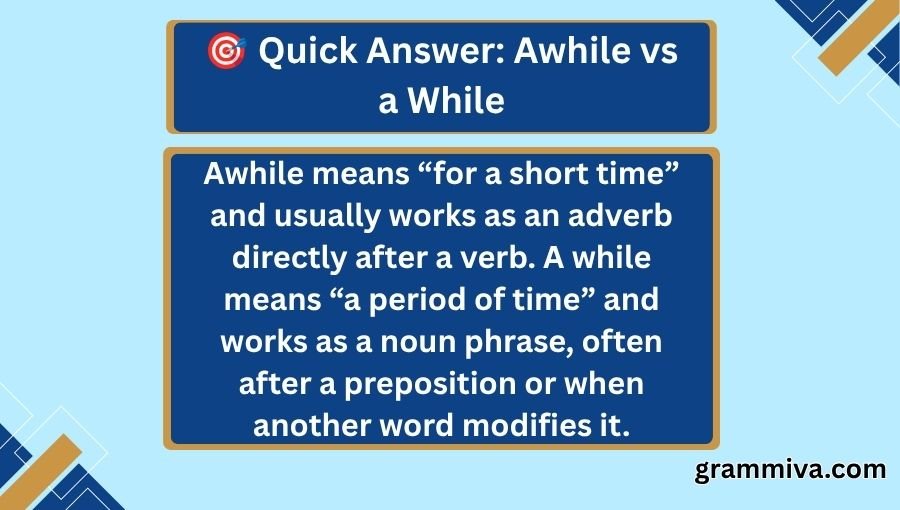
Awhile means “for a short time” and usually works as an adverb directly after a verb. A while means “a period of time” and works as a noun phrase, often after a preposition or when another word modifies it.
Compare:
- ✅ Please stay awhile.
- ❌ Please stay a while. — Not always wrong, but this version needs to be understood as a noun phrase. In this exact simple pattern, awhile is the cleaner choice.
- ✅ Please stay for a while.
- ❌ Please stay for awhile. — Standard edited English usually uses for a while.
A quick memory rule is: If you mean “for a short time” and no preposition comes before it, “awhile” may be the right choice. If “for” comes before it, use “a while.”
Awhile vs a While: Meaning and Correct Use
The core difference is grammatical rather than a difference in the length of time. Both forms can refer to a period of time, but they play different roles in a sentence.
| Form | Type | Meaning | Example | Correct/Incorrect |
|---|---|---|---|---|
| awhile | Adverb | For a short time | Please sit awhile. | ✅ Correct |
| a while | Noun phrase | A period of time | We waited for a while. | ✅ Correct |
| for awhile | Prepositional pattern | Intended to mean for a short time | We waited for awhile. | ❌ Usually avoid |
| for a while | Prepositional phrase | For a period of time | We waited for a while. | ✅ Correct |
| a while ago | Noun phrase | Some time in the past | I saw her a while ago. | ✅ Correct |
The key is not simply the meaning of “time.” Look at the grammar around the expression.
Is “awhile” one word?
Yes. Awhile is one word when it is used as an adverb meaning “for a short time.”
For example:
- ✅ Come in and rest awhile.
- ❌ Come in and rest a while. — This can occur in some writing, but the one-word adverb is the cleaner choice when no preposition is needed.
The word usually follows an action verb:
- stay awhile
- wait awhile
- rest awhile
- sit awhile
- talk awhile
- remain awhile
Is “a while” two words?
Yes. A while is two words when “while” is being used as a noun and “a” is its article.
Examples include:
- for a while
- in a while
- after a while
- a while ago
- quite a while
- a long while
Here, “while” behaves like a noun. Other words can describe or modify it.
| Pattern | Example | Why It Works |
|---|---|---|
| for a while | We talked for a while. | “While” is the noun after “for.” |
| in a while | I will call in a while. | “While” follows “in.” |
| after a while | After a while, she left. | “While” follows “after.” |
| a while ago | He called a while ago. | “While” names a period of time. |
| quite a while | It took quite a while. | “Quite” modifies the noun phrase. |
🎯 Understanding the Basics of Awhile vs a While
The easiest way to understand awhile vs a while is to ask what role the expression has in the sentence.
Awhile acts like an adverb. It tells us how long an action continues.
A while acts like a noun phrase. It names a period of time.
| Question | Awhile | A while |
|---|---|---|
| What is it? | Adverb | Noun phrase |
| Basic meaning | For a short time | A period of time |
| Usually follows a verb directly? | Yes | Sometimes |
| Common after “for”? | No | Yes |
| Can be modified by “long”? | No | Yes |
| Example | Stay awhile. | Stay for a while. |
A useful pair is:
- ✅ Stay awhile.
- ✅ Stay for a while.
Both are grammatical. The difference is the structure.
The first uses an adverb.
The second uses a preposition, followed by a noun phrase.
When should you use “awhile”?
Use awhile when it directly describes the length of an action.
Examples:
- Wait awhile.
- Sit awhile.
- Rest awhile.
- Stay awhile.
- Talk awhile.
You can often replace awhile with for a short time.
For example:
Please wait awhile.
becomes:
Please wait for a short time.
That substitution is a useful test.
When should you use “a while”?
Use a while when the phrase acts as a noun, especially after a preposition or when another word modifies it.
Examples:
- We waited for a while.
- I have not seen him in a while.
- After a while, everyone relaxed.
- She stayed for quite a while.
- It took a long while to finish.
Here, “while” is part of a noun phrase.
| Meaning | Word Type | Example Sentence |
|---|---|---|
| For a short time | Adverb | Please wait awhile. |
| A period of time | Noun phrase | We waited for a while. |
| A period modified by “long” | Noun phrase | It took a long while. |
| A past period | Noun phrase | I saw him a while ago. |
💡 Test Tip: Try the “For a Short Time” Test
When I am editing, I often use a very fast test: replace awhile with for a short time.
If the sentence still works naturally, awhile may be appropriate.
For example:
Stay awhile.
→ Stay for a short time.
That works.
Now try:
We stayed for awhile.
The sentence already contains for. Replacing the phrase gives:
We stayed for for a short time.
That shows why for a while is the standard choice.
Another useful test is to see whether another word can describe while.
For example:
- a long while
- quite a while
- a short while
- a little while
These patterns clearly treat “while” as a noun.
Is Awhile the Same as a While?
No. Awhile and a while can express a similar idea, but they are not always interchangeable because they have different grammatical roles.
Consider these examples:
- ✅ She stayed awhile.
- ❌ She stayed for awhile.
- ✅ She stayed for a while.
- ✅ She stayed a while.
The last sentence deserves a closer look. She stayed a while can be grammatical because “a while” can function as the object of an understood duration idea. However, when you want a clear, standard construction, She stayed for a while is often easier for readers.
The biggest trap is assuming that because awhile and a while sound alike, they can be swapped anywhere.
They cannot.
Why Do People Confuse Awhile and a While?
People confuse these forms because they sound almost identical in normal speech. They also share the same basic idea of time.
I once edited a short company guide where the writer used awhile after “for” several times. The writer knew the meaning perfectly. The problem was simply that the word had been treated as interchangeable with a while. Once we looked at the sentence structure, the pattern became easy to fix.
Other reasons include:
- Fast typing can make small word differences easy to miss.
- Autocorrect may not flag a grammatically possible word.
- Writers may remember the sound but not the grammar.
- Reading informal online writing can expose people to mixed usage.
- The two forms are close enough that the difference feels invisible.
This is why memorizing one spelling is not enough. You need to recognize the job each form performs.
📝 Awhile vs a While in a Real-Life Case Study
Imagine that you are writing an email to a coworker after a long meeting.
You want to say that the coworker should relax before starting the next task.
You could write:
- ✅ Take a break and rest awhile before you start the next task.
- ✅ Take a break and rest for a while before you start the next task.
Both versions are clear.
Now imagine writing:
- ❌ Take a break and rest for awhile before you start.
The problem is the combination for awhile. In standard edited American English, for a while is the better construction.
Here is another workplace example:
| Situation | Better Sentence | Reason |
|---|---|---|
| Directly after a verb | Please wait awhile. | “Awhile” acts as an adverb. |
| After “for” | Please wait for a while. | “While” is a noun after “for.” |
| With “long” | We waited a long while. | “Long” modifies the noun “while.” |
| With “quite” | We waited quite a while. | “Quite” modifies the noun phrase. |
| Past reference | That happened a while ago. | “A while” names a past period. |
Grammar Rules Explanation
Awhile is an adverb meaning “for a short time.” It can directly modify a verb.
A while is a noun phrase consisting of the article “a” and the noun “while.” It can appear after prepositions such as for, in, and after, and it can be modified by words such as long, short, quite, or little.
This explains the most common pattern:
- wait awhile
- wait for a while
The first sentence uses an adverb. The second uses a prepositional phrase containing the noun while.
Most standard English references treat this distinction in essentially the same practical way. The exact style preferred can vary by sentence, but the grammatical roles remain the useful guide.
Correct vs Incorrect at a Glance
| Sentence | Correct/Incorrect | Why |
|---|---|---|
| Please stay awhile. | ✅ Correct | “Awhile” directly modifies “stay.” |
| Please stay for a while. | ✅ Correct | “While” is the noun after “for.” |
| Please stay for awhile. | ❌ Incorrect in standard edited usage | Use the noun phrase “a while” after “for.” |
| It took quite a while. | ✅ Correct | “Quite” modifies the noun phrase. |
| It took quite awhile. | ❌ Incorrect | “Quite” does not normally modify the adverb “awhile” this way. |
How To Remember the Difference
I use a simple mental picture: awhile is an action helper; a while is a time thing.
If the expression sits close to an action and tells you how long the action happens, think awhile.
Sit awhile.
If the expression comes after a word such as for, in, or after, think a while.
Sit for a while.
This is not a perfect rule for every possible sentence, but it handles the most common cases.
Another memory trick is to look for a word that can go between a and while.
If you can naturally say:
- a long while
- quite a while
- a short while
- a little while
then you are clearly dealing with a while.
| Memory Clue | Likely Choice | Example |
|---|---|---|
| Directly describes an action | awhile | Wait awhile. |
| Follows “for” | a while | Wait for a while. |
| Follows “in” | a while | I will return in a while. |
| Modified by “long” | a while | We stayed a long while. |
| Part of “a while ago” | a while | She left a while ago. |
⚠️ Common Mistakes With Awhile and a While
The most common mistake is writing for awhile instead of for a while.
Another mistake is treating awhile as a general replacement for every expression containing “a while.”
For example:
- ❌ It happened awhile ago.
- ✅ It happened a while ago.
The phrase a while ago contains a noun phrase. “Ago” tells us that the period is in the past.
Common Grammar Confusions
This problem belongs to a larger family of small English mistakes.
| Confusion | Correct Difference | Example |
|---|---|---|
| its / it’s | Possession vs. “it is” | The dog wagged its tail. |
| your / you’re | Possession vs. “you are” | You’re holding your bag. |
| their / there / they’re | Possession, place, “they are” | They’re over there with their friends. |
| then / than | Time/order vs. comparison | We left then; this is better than that. |
| awhile / a while | Adverb vs. noun phrase | Stay awhile; stay for a while. |
Why These Mistakes Happen
Fast typing: When people type quickly, small spaces and short words are easy to overlook.
Autocorrect: A device may recognize both forms as real words. That means it may not warn you when the wrong form is used.
Lack of knowledge: Writers often learn the spoken expression first. They may not learn why the written forms differ.
Habit: Once someone has typed “for awhile” many times, the pattern can feel correct simply because it looks familiar.
Specific Wrong Forms To Watch
| Wrong Form or Use | What’s Wrong | Correct Form |
|---|---|---|
| for awhile | “While” should be the noun after “for.” | for a while |
| in awhile | Standard phrase uses the noun phrase. | in a while |
| after awhile | Standard noun phrase is preferred. | after a while |
| awhile ago | “A while” is the noun phrase in this expression. | a while ago |
| quite awhile | “Quite” normally modifies the noun phrase. | quite a while |
| a long awhile | “Long” modifies the noun “while,” not the adverb. | a long while |
I once caught myself typing in awhile during a quick message. I knew the rule, but I was typing fast and had focused on the sound rather than the sentence. That small slip reminded me why proofreading matters even when you know the grammar.
Awhile vs a While in Different Contexts
The same rule applies across casual speech, work writing, creative writing, and digital communication. The main difference is how formal or conversational the sentence feels.
| Context | Which Term to Use | Example |
|---|---|---|
| Everyday conversation | Either, depending on structure | Sit awhile. / Sit for a while. |
| Professional writing | Choose based on grammar | Please wait for a while. |
| Creative writing | Either, depending on structure and style | He sat awhile by the window. |
| Social media/texting | Either, but standard grammar still helps | I may be gone for a while. |
In professional writing, I usually prefer the clearest structure. For a while is especially easy for readers to understand.
In creative writing, awhile can sound smooth when it follows a verb:
She stayed awhile, watching the rain.
The choice is not about formal versus informal English alone. It is about sentence structure.
Common Phrases With A While
Some expressions are especially common and are worth learning as complete phrases.
| Phrase | Meaning |
|---|---|
| for a while | For a period of time |
| in a while | After some time from now |
| after a while | After some time has passed |
| a while ago | Some time in the past |
| quite a while | A fairly long period |
| a long while | A long period of time |
Examples:
- I will be away for a while.
- I will call you in a while.
- After a while, the noise stopped.
- We spoke a while ago.
- It has been quite a while.
- They waited a long while.
These phrases are worth remembering because they give you ready-made patterns.
Awhile vs a While: Useful Alternatives
Sometimes you can avoid the choice entirely by using another phrase. This can be helpful if you are unsure which form belongs in your sentence.
| Alternative | Works When | Does Not Work When |
|---|---|---|
| for a short time | You mean a brief period | You need a natural fixed phrase such as “a while ago” |
| briefly | You mean for a short time | You want to stress a period of time |
| temporarily | Something is not permanent | You only mean a very short wait |
| for some time | You mean an unspecified period | You specifically mean only a very brief period |
| for a bit | You want casual speech | Formal writing calls for a more neutral phrase |
For example:
Please wait awhile.
could become:
Please wait for a short time.
Or:
Please wait briefly.
The replacement may change the tone slightly, so choose the phrase that best fits your sentence.
Why Does Getting Awhile vs a While Right Matter?
This may seem like a tiny grammar issue. In most cases, it will not change the basic meaning of your sentence. Still, small grammar choices affect how polished and easy to read your writing feels.
Clear writing lets the reader focus on your idea instead of your wording.
That principle matters in school, work, publishing, and online communication.
| Situation | Why Getting It Right Matters |
|---|---|
| Resume | Small errors can make a document look less polished. |
| Client email | Clear grammar supports a professional tone. |
| Published content | Consistent grammar builds reader trust. |
| Social post | Correct wording makes short messages easier to understand. |
In a casual text, for awhile is unlikely to cause serious confusion. In a formal document, however, repeated errors can make the writer seem less careful.
Good grammar is not about trying to sound fancy. It is about making your meaning easy to follow.
Is There a Special Exception for Awhile?
There is no major special exception that changes the basic rule. The main issue is that some constructions can allow a while without the word for, while awhile is also possible after certain verbs.
For example:
- We stayed a while.
- We stayed awhile.
Both can be found in standard English.
However, the safest approach for learners is to remember the strong patterns:
- stay awhile
- stay for a while
- wait awhile
- wait for a while
- a while ago
- in a while
- after a while
This approach gives you a reliable choice without forcing you to memorize every possible sentence pattern.
Quick Recap Checklist ✅
Use this checklist when proofreading.
| Question | If Yes → Use |
|---|---|
| Does it directly describe an action and mean “for a short time”? | awhile |
| Does it come after “for”? | a while |
| Does it come after “in” in a time expression? | a while |
| Does another word describe “while,” such as “long” or “quite”? | a while |
| Is the phrase “a while ago”? | a while |
| Are you unsure? | Rewrite with “for a short time” and check the structure. |
Try these:
- Please wait awhile.
- Please wait for a while.
- I saw him a while ago.
If you can recognize why each one uses its particular form, you have the main rule down.
FAQs About Awhile vs a While
Is “awhile” grammatically correct?
Yes. Awhile is a correct English word when it is used as an adverb meaning “for a short time.” For example: Please sit awhile.
Is “a while” grammatically correct?
Yes. A while is correct when “while” acts as a noun in a phrase. For example: Please sit for a while.
Should I write “for awhile” or “for a while”?
In standard edited English, write for a while. The word while is functioning as a noun after the preposition for.
Is “wait awhile” correct?
Yes. Wait awhile is a standard construction. Here, awhile acts as an adverb that tells us how long to wait.
Is “wait a while” correct?
Yes, wait a while can be grammatical. However, wait awhile and wait for a while make the grammatical structure especially clear.
Is “in awhile” correct?
For standard edited writing, use in a while. For example: I will call you in a while.
Should it be “a while ago” or “awhile ago”?
The standard expression is a while ago. Here, a while is a noun phrase referring to a period of time in the past.
Should I write “after awhile” or “after a while”?
In standard edited English, after a while is the preferred form. The phrase follows the preposition after and uses while as a noun.
Can “awhile” and “a while” mean the same thing?
They can express a similar idea, but their grammatical roles differ. Awhile is an adverb. A while is a noun phrase. That difference determines which form fits a sentence.
What is the easiest way to remember the difference?
Think action = awhile and time period = a while. Also remember the strong pattern for a while, never for awhile, in standard edited English.
Conclusion
Awhile vs a while becomes much easier once you stop treating the two forms as simple spelling variations. Awhile is an adverb meaning “for a short time,” while a while is a noun phrase meaning a period of time. 😊
When the expression directly describes an action, awhile may be the right choice:
Stay awhile.
When the expression follows for, use a while:
Stay for a while.
The same pattern helps with familiar phrases such as in a while, after a while, a while ago, and quite a while.
If you are still unsure, use the replacement test. Try changing awhile to for a short time. If the sentence works naturally without creating another for, you may have found the right form.
The difference is small, but learning it gives your writing more control and polish. Once you recognize the grammar behind the words, the choice becomes almost automatic.
Remember: “awhile” describes an action; “a while” names a stretch of time. Get that one idea right, and you will rarely confuse them again.

I am Ryan Mitchell, a writer focused on English grammar, vocabulary, and everyday language. I work at Grammiva, creating easy-to-understand articles that help readers improve their English with confidence.
[…] understand what each form does and which spelling is the safest choice, the decision becomes easy. Awhile vs a While | Die vs Dye | Bougie vs […]