Have you ever typed a sentence and stopped because you were not sure whether to write patient vs patience? You are not alone. These two words look and sound closely related, but they do different jobs in a sentence. One can describe a person or refer to someone receiving medical care. The other describes the ability to stay calm while waiting or dealing with something difficult.
I teach grammar by looking at what a word does in a sentence, rather than asking students to memorize long rules. That method works especially well here. Once you know whether you need a person, a quality, or an action, the choice becomes much easier.
In this guide, I will explain the difference in plain US English. You will see clear examples, common mistakes, workplace examples, memory tricks, and practice questions. By the end, you should be able to choose the right word quickly and confidently. 😊 Tomatoes vs Tomatos | Inconsolable vs Unconsolable | Minuscule vs miniscule
🎯 Quick Answer: Patient vs Patience
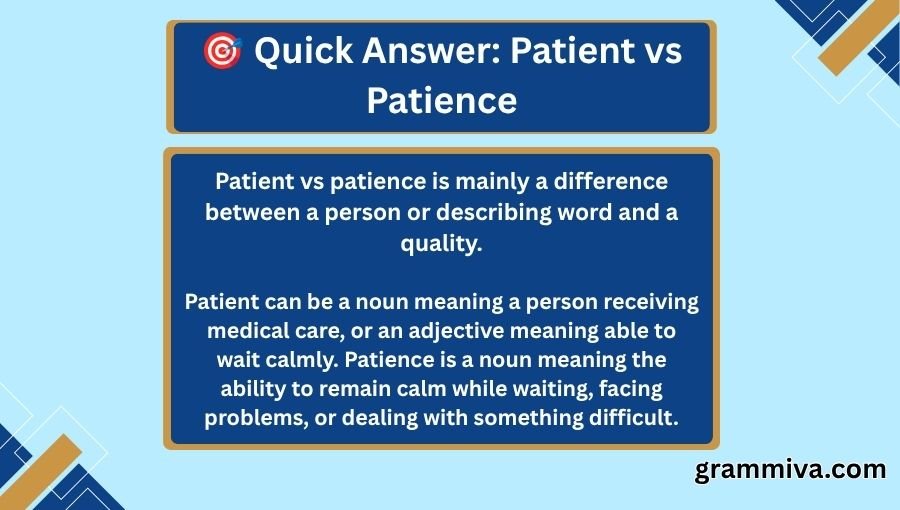
Patient vs patience is mainly a difference between a person or describing word and a quality.
Patient can be a noun meaning a person receiving medical care, or an adjective meaning able to wait calmly. Patience is a noun meaning the ability to remain calm while waiting, facing problems, or dealing with something difficult.
| Word | Main Use | Simple Meaning | Example |
|---|---|---|---|
| Patient | Noun | A person receiving medical care | The patient is resting. |
| Patient | Adjective | Able to wait calmly | She is patient with children. |
| Patience | Noun | The ability to stay calm | He has a lot of patience. |
A quick rule is this: a patient can be a person, while patience is a quality.
🔎 Is Patient the Same as Patience?
No. Patient and patience are related words, but they are not interchangeable. Patient can describe someone who waits calmly or identify someone receiving medical care. Patience names the calm quality itself.
Think about these two sentences:
- “Maria is patient.”
- “Maria has patience.”
The first sentence describes Maria. The second sentence names a quality that Maria has.
| Word | Part of Speech | What It Does | Example |
|---|---|---|---|
| Patient | Adjective | Describes a person | Tom is patient. |
| Patient | Noun | Names a person receiving care | The patient arrived early. |
| Patience | Noun | Names a quality | Tom has patience. |
| Patiently | Adverb | Describes how someone acts | Tom waited patiently. |
This difference is small in spelling but big in grammar.
🧠 Understanding the Basics of Patient vs Patience
The easiest way to understand patient vs patience is to focus on the ending of each word.
Patient is often used to describe a person. It can also be a noun for someone under medical care.
Patience is the name of a quality. It tells us about someone’s ability to wait, stay calm, or handle delays and problems.
| Form | Type | Meaning | Example | Correct/Incorrect |
|---|---|---|---|---|
| patient | Adjective | Calm while waiting | She is patient. | ✅ Correct |
| patient | Noun | Person receiving medical care | The patient needs help. | ✅ Correct |
| patience | Noun | Ability to stay calm | She has patience. | ✅ Correct |
| patience | Adjective | Describes a person | She is patience. | ❌ Incorrect |
| patient | Noun for calmness | The quality of staying calm | He has patient. | ❌ Incorrect |
Patient as an Adjective
When patient is an adjective, it describes someone who can wait without becoming upset.
For example:
“My brother is patient with young children.”
Here, patient describes the brother. It tells us how he behaves around children.
Other examples include:
- She was patient while the computer restarted.
- Our teacher is patient with new students.
- Please be patient while we check your order.
- He remained patient during the long meeting.
Notice that the word describes a person or, sometimes, their behavior.
Patient as a Noun
Patient can also be a noun. In this use, it means a person who is receiving medical care.
For example:
“The patient spoke with the doctor.”
Here, patient is not describing the person’s behavior. It names the person receiving medical attention.
That gives us two very different uses of the same spelling:
| Sentence | Role of “patient” | Meaning |
|---|---|---|
| The patient is waiting. | Noun | Person receiving medical care |
| The patient nurse listened carefully. | Adjective | Calm and willing to wait |
| Please be patient. | Adjective | Stay calm while waiting |
| The patient needs another test. | Noun | Person receiving medical care |
Patience as a Noun
Patience is a noun. It refers to the ability to stay calm when something takes time or becomes difficult.
For example:
“Learning a new language takes patience.”
The sentence does not describe a person as patient. Instead, it names the quality needed for learning.
You can often place words such as a lot of, great, little, or more before patience:
- She has a lot of patience.
- This job requires great patience.
- I need more patience.
- He has very little patience for rude behavior.
| Meaning | Word Type | Example Sentence |
|---|---|---|
| Calm behavior while waiting | Adjective | She is patient with customers. |
| A person receiving medical care | Noun | The patient saw the doctor. |
| The ability to stay calm | Noun | Patience is needed here. |
✏️ What Is the Difference Between Patient and Patience?
The core difference is simple: patient describes someone, while patience names the quality of staying calm.
Compare:
“The child is patient.”
This tells us what the child is like.
“The child has patience.”
This tells us what quality the child has.
A useful pattern is:
be + patient
- Be patient.
- She is patient.
- They were patient.
And:
have + patience
- Have patience.
- She has patience.
- They showed patience.
| Pattern | Correct Example | Why |
|---|---|---|
| be + patient | Please be patient. | Patient is an adjective. |
| seem + patient | He seems patient. | Patient describes him. |
| have + patience | She has patience. | Patience is a noun. |
| show + patience | They showed patience. | Patience is a quality. |
| need + patience | This takes patience. | Patience names the needed quality. |
💡 How Can You Remember Patient and Patience?
I use a simple memory trick with students: patient describes the person; patience describes the power to wait.
Try these pairs:
- “I am patient.”
- “I have patience.”
You can also remember the endings:
Patient → person or description
Patience → quality
Patiently → manner of action
For example:
“The patient teacher waited patiently because she had plenty of patience.”
That sentence contains all three forms:
- patient = describes the teacher
- patiently = tells how she waited
- patience = names the quality she had
💡 Test Tip
When you are unsure, put “is” or “has” into the sentence.
If the sentence works with is, patient may be correct:
“She is patient.”
If the sentence works with has, patience may be correct:
“She has patience.”
This is not a rule for every possible sentence, but it is a very useful quick test.
📝 Patient vs Patience in Real Life: A Case Study
Imagine that a customer has been waiting for a delayed order. A customer-service worker sends this message:
“Thank you for your patience while we resolve the delay.”
That sentence is correct because the worker is thanking the customer for the quality or ability to wait calmly.
Now imagine the worker writes:
“Thank you for your patient.”
That does not work. Patient is not the name of the quality in this sentence.
But the worker could say:
“We appreciate how patient you have been.”
Now patient is correct because it describes the customer.
I once edited a short customer-service email in which the writer had typed “Thank you for your patient.” The writer knew exactly what they wanted to say. They had simply chosen the adjective instead of the noun. Once we changed it to “patience,” the sentence was clear.
| Situation | Correct Sentence | Reason |
|---|---|---|
| Thanking someone for waiting | Thank you for your patience. | Patience is the quality. |
| Describing someone | You have been patient. | Patient describes the person. |
| Asking someone to wait calmly | Please be patient. | Patient is an adjective. |
| Describing medical care | The patient is ready. | Patient is a medical noun. |
Grammar Rules Explanation
Patient and patience belong to different grammatical categories in their main uses.
When patient describes a person who can wait calmly, it is an adjective. Adjectives describe nouns or pronouns.
Examples:
- She is patient.
- He remained patient.
- The patient teacher explained the rule again.
When patient refers to someone receiving medical care, it is a noun.
Examples:
- The patient spoke with the nurse.
- The doctor examined the patient.
- Each patient received an appointment card.
Patience is a noun. It names the quality or ability of remaining calm during waiting, difficulty, or delay.
Examples:
- Patience takes practice.
- She showed patience.
- We appreciate your patience.
The standard rule is therefore based on grammatical function. If you need an adjective to describe a person who waits calmly, use patient. If you need a noun naming the quality, use patience.
A helpful way to see the relationship is:
patient → adjective
patience → noun
patiently → adverb
The medical meaning of patient is also a noun, but it has a different meaning from the adjective.
Correct vs Incorrect at a Glance
| Sentence | Correct/Incorrect | Why |
|---|---|---|
| Please be patient while we investigate. | ✅ Correct | Patient describes the person. |
| Please have patience while we investigate. | ✅ Correct | Patience names the quality. |
| Thank you for your patience. | ✅ Correct | Patience is a noun. |
| Thank you for your patient. | ❌ Incorrect | Patient is not the noun needed here. |
| She is patience with her students. | ❌ Incorrect | Patient is the adjective needed here. |
⚠️ Why Do People Confuse Patient and Patience?
People confuse these words because they share most of their letters and are closely related in meaning. They also appear in similar sentences.
For example, you might know that someone who can wait calmly is “patient.” Then, when you need the noun, your brain may automatically produce the same word.
Typing makes the problem worse. Autocorrect can sometimes change a word, while fast typing can make similar endings easy to overlook.
I once caught myself typing “patients” when I meant “patience” in a note about a delayed project. I was moving quickly and had the medical word in my head because I had just edited a health-related paragraph. The sentence looked strange when I read it back, and that quick reread caught the error.
Here are three common reasons these mistakes happen:
- Fast typing — Your fingers may choose the familiar spelling before your brain checks the meaning.
- Autocorrect — Software may suggest a word that looks close but does not fit the sentence.
- Lack of knowledge — If you have never learned the noun/adjective difference, the two forms can seem interchangeable.
Similar Grammar Confusions
| Confusing Pair | Correct Difference | Example |
|---|---|---|
| its / it’s | Possession vs. “it is” | The dog hurt its paw. |
| your / you’re | Possession vs. “you are” | You’re holding your bag. |
| their / they’re | Possession vs. “they are” | They’re in their car. |
| affect / effect | Usually verb vs. noun | The noise affected the result. |
| then / than | Time/order vs. comparison | She arrived earlier than I did. |
| patient / patience | Description/person vs. quality | Be patient; show patience. |
Common Wrong Forms and Uses
| Wrong Form | What’s Wrong | Correct Form |
|---|---|---|
| Thank you for your patient. | A noun for the quality is needed. | Thank you for your patience. |
| Please have patient. | A noun is needed after “have.” | Please have patience. |
| She is patience. | An adjective is needed after “is.” | She is patient. |
| He was very patience. | “Very” modifies the adjective here. | He was very patient. |
| I need more patient. | The sentence needs the name of a quality. | I need more patience. |
| The patience is waiting for the doctor. | A person receiving care is meant. | The patient is waiting for the doctor. |
📚 Patient and Patience: Word Forms You Should Know
The words patient, patience, and patiently are connected, but each has its own grammatical job.
| Form | Type | Example |
|---|---|---|
| patient | Adjective | She is patient. |
| patient | Noun | The patient is resting. |
| patience | Noun | He has patience. |
| patiently | Adverb | She waited patiently. |
| patients | Plural noun | The clinic saw ten patients. |
The plural patients deserves special attention. It means more than one person receiving medical care.
For example:
“The hospital admitted several patients.”
It does not mean several examples of the quality called patience.
That distinction matters in medical, business, and everyday writing.
🏢 How Should You Use Patient and Patience at Work?
In professional writing, patience is especially common when someone has experienced a delay.
You may see phrases such as:
- Thank you for your patience.
- We appreciate your patience.
- Thank you for being patient.
- Please be patient while we complete the update.
All four can work, but their grammar differs.
| Professional Situation | Best Choice | Example |
|---|---|---|
| Formal thank-you | patience | Thank you for your patience. |
| Describing the reader | patient | Thank you for being patient. |
| Asking someone to wait | patient | Please be patient. |
| Mentioning the quality | patience | We appreciate your patience. |
In a workplace email, I usually prefer “Thank you for your patience” when the message is formal. It is short, polite, and clear.
💬 Patient and Patience in Different Contexts
The correct word can depend on what you are trying to say, but the basic grammar never changes.
| Context | Which Term to Use | Example |
|---|---|---|
| Everyday conversation | patient or patience | Please be patient. |
| Professional writing | Often patience | Thank you for your patience. |
| Creative writing | Either, depending on meaning | Her patience finally paid off. |
| Social media/texting | Either, depending on meaning | Please be patient with me! |
Everyday Conversation
People often use patient when asking someone to wait:
“Be patient. Dinner will be ready soon.”
They may also use patience when talking about the quality:
“I don’t have much patience today.”
Professional Writing
Patience appears often in customer-service messages:
“We appreciate your patience as we work to resolve this issue.”
Patient appears when describing the reader:
“Thank you for being patient.”
Creative Writing
Both forms can add detail to a story:
“She was patient enough to wait.”
or:
“Her patience was finally rewarded.”
Social Media and Texting
Casual messages may use either form:
“Please be patient with me 😅”
or:
“Thanks for your patience!”
The informal setting does not change the grammar.
🗣️ Common Phrases With Patient and Patience
Some phrases are worth learning as complete chunks. They can help you avoid mistakes because you begin to recognize the natural pattern.
| Phrase | Meaning |
|---|---|
| Be patient | Stay calm while waiting |
| Have patience | Stay calm and avoid giving up |
| Show patience | Demonstrate the ability to stay calm |
| Lose patience | Stop being willing to wait calmly |
| Test someone’s patience | Make someone wait or deal with difficulty |
| Thank you for your patience | Politely thank someone for waiting |
These phrases also show why the two words cannot simply replace each other.
You can be patient, but you do not normally say “be patience.”
You can have patience, but you do not say “have patient” when referring to the quality.
🎯 How Can You Tell Which Word You Need?
I recommend asking one simple question:
Am I describing someone, or am I naming the quality?
If you are describing someone, choose patient.
“The teacher is patient.”
If you are naming the quality, choose patience.
“The teacher has patience.”
If you are describing how an action happens, choose patiently.
“The teacher waited patiently.”
If you are talking about someone receiving medical treatment, choose patient as a noun.
“The patient spoke to the doctor.”
This three-way test is useful:
| What Are You Talking About? | Word |
|---|---|
| A person who can wait calmly | patient |
| A person receiving medical care | patient |
| The quality of staying calm | patience |
| The way someone waits | patiently |
🔄 Patient vs Patience in Sentences
Seeing the words in pairs makes the difference easier to remember.
| Patient | Patience |
|---|---|
| She is patient with her son. | She has patience with her son. |
| Please be patient. | Please have patience. |
| He remained patient during the delay. | He showed patience during the delay. |
| The patient waited for the doctor. | The patient’s patience was impressive. |
The last pair contains both meanings:
“The patient’s patience was impressive.”
Here, the first patient’s refers to a person receiving medical care. The second word, patience, refers to that person’s ability to wait calmly.
🧩 Synonyms and Alternatives
Sometimes you can replace patient or patience with another word. However, the replacement must fit the grammar and meaning.
| Alternative | Works When | Does Not Work When |
|---|---|---|
| Calm | You mean relaxed or not upset | You specifically mean willingness to wait |
| Tolerant | You mean accepting difficult behavior | You only mean waiting |
| Endurance | You mean ability to keep going | You need a simple everyday word |
| Self-control | You mean control over emotions | You mean general willingness to wait |
| Persistence | You mean continuing despite difficulty | You mean calm waiting alone |
For example, “She is calm” does not always mean “She is patient.” A calm person may still dislike waiting.
Likewise, persistence means continuing toward a goal. It is related to patience but does not have exactly the same meaning.
❤️ Why Does Getting Patient and Patience Right Matter?
Correct word choice helps readers understand your meaning without stopping to figure out what you intended.
This matters in several areas:
- Clarity: The right form makes the sentence easy to understand.
- Professionalism: Correct grammar creates a stronger impression in emails and reports.
- Digital communication: Short messages give readers less context, so word choice matters.
- Published writing: Repeated grammar errors can distract readers from your ideas.
A simple writing principle I use is:
“Clear words make clear ideas easier to trust.”
| Situation | Why Getting It Right Matters |
|---|---|
| Resume | Shows care with language and detail |
| Client email | Keeps the message polite and professional |
| Published content | Builds reader confidence |
| Social post | Prevents an avoidable grammar mistake |
You do not need complicated grammar to write well. You need the right word for the job.
📝 Quick Recap Checklist
Use this checklist whenever you are unsure.
| Question | If Yes → Use |
|---|---|
| Am I describing someone who can wait calmly? | patient |
| Am I talking about someone receiving medical care? | patient |
| Am I naming the ability to stay calm? | patience |
| Am I describing how someone waits? | patiently |
| Does “have” come before the word? | Usually patience |
| Does “be” describe someone’s calm behavior? | patient |
Practice Examples
- “Please be ___ while we finish the repair.”
Answer: patient
- “Thank you for your ___.”
Answer: patience
- “The doctor spoke with the ___.”
Answer: patient
The more you practice the sentence pattern, the faster the correct form will feel natural.
❓ FAQs About Patient vs Patience
Is patient an adjective or a noun?
Patient can be both. As an adjective, it describes someone who can wait calmly. As a noun, it means a person receiving medical care.
Is patience a noun?
Yes. Patience is a noun that names the ability to remain calm while waiting, dealing with problems, or facing delays.
Should I say “be patient” or “be patience”?
Say “be patient.” Patient is an adjective after “be” when you are describing someone’s behavior.
Correct: “Please be patient.”
Incorrect: “Please be patience.”
Should I say “have patient” or “have patience”?
Say “have patience” when you mean the ability to remain calm.
Correct: “You need to have patience.”
Incorrect: “You need to have patient.”
What is the difference between patient and patience?
Patient usually describes a person or names someone receiving medical care. Patience names the quality of staying calm while waiting or dealing with difficulty.
Is “thank you for your patience” correct?
Yes. “Thank you for your patience” is a standard and correct expression. It means you appreciate someone’s willingness to wait calmly.
Can patient mean a person in a hospital?
Yes. Patient is a noun for someone receiving medical care. A patient may be in a hospital, clinic, doctor’s office, or another medical setting.
What is the adverb form of patient?
The common adverb is patiently. It tells how someone does something.
Example:
“She waited patiently for her turn.”
Is “patients” the plural of patient?
Yes. Patients is the plural noun for people receiving medical care.
Example:
“The clinic treated several patients.”
It is not the plural form of patience.
How can I remember patient vs patience?
Remember this simple pattern:
Be patient. Have patience. Wait patiently.
These three phrases show the basic difference clearly.
🌟 Conclusion: Patient vs Patience Made Simple
Patient vs patience becomes much easier once you focus on the job each word performs. Patient can describe someone who waits calmly, and it can also be a noun for someone receiving medical care. Patience is the noun for the ability to stay calm while waiting or dealing with difficulty. Patiently is the adverb used to describe how someone acts.
When you are unsure, check the sentence pattern. If you are describing a person, patient is often the right choice. If you are naming the quality, use patience. If you are describing how an action happens, use patiently.
The fastest memory trick is simple: be patient, have patience, and wait patiently. Keep those three patterns in mind, and you will avoid most mistakes.
Good grammar does not have to feel hard. Sometimes, one small distinction is all you need to make your writing cleaner, clearer, and more confident. Keep the rule close, and the right word will come naturally. ✨

I am Ryan Mitchell, a writer focused on English grammar, vocabulary, and everyday language. I work at Grammiva, creating easy-to-understand articles that help readers improve their English with confidence.


[…] and British spelling handle the word label, the difference becomes easy to remember. ✍️ Patient vs Patience | Tomatoes vs Tomatos | Inconsolable vs […]
[…] to avoid, and how to answer the question quickly when you are unsure. Labeler vs Labeller | Patient vs Patience | Tomatoes vs […]