Have you ever typed a word, looked at it twice, and suddenly wondered whether it looks right? That happens with tomatoes vs tomatos more often than you might expect. 🍅 The two forms look almost identical, but only one is standard English spelling.
If you are writing a recipe, school assignment, grocery list, article, email, or social media post, knowing the correct form can save you from an easy spelling mistake. The good news is that the rule is simple once you understand why the extra e appears.
In this guide, I’ll explain the difference in plain US English. I’ll show you the correct plural form, explain why tomatos is incorrect in standard English, and give you simple ways to remember the spelling.
We’ll also look at common mistakes, real-life examples, writing contexts, and frequently asked questions. By the end, you should never have to pause over this spelling again. 🍅 Inconsolable vs Unconsolable | Minuscule vs miniscule | Bass vs Base
🎯 Quick Answer: Tomatoes vs Tomatos
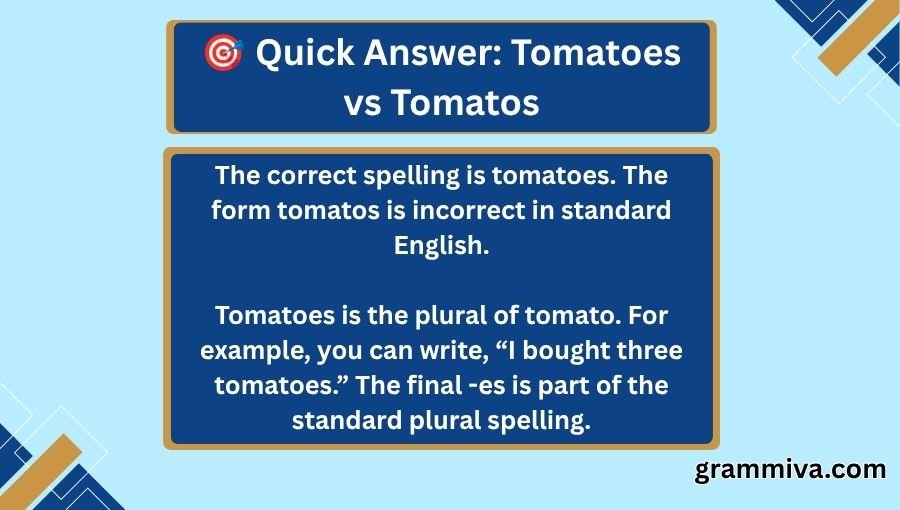
The correct spelling is tomatoes. The form tomatos is incorrect in standard English.
Tomatoes is the plural of tomato. For example, you can write, “I bought three tomatoes.” The final -es is part of the standard plural spelling.
Related Word Forms
The word tomato has several useful forms. The main spelling issue occurs when you change the singular noun into its plural form.
| Form | Type | Example |
|---|---|---|
| tomato | Singular noun | I sliced one tomato. |
| tomatoes | Plural noun | I sliced three tomatoes. |
| tomato’s | Singular possessive | The tomato’s skin was thin. |
| tomatoes’ | Plural possessive | The tomatoes’ flavor was strong. |
The apostrophe forms have different jobs. Tomato’s shows ownership by one tomato. Tomatoes’ shows ownership by more than one tomato.
For example:
- “The tomato’s color was bright.” = one tomato owns or has the quality.
- “The tomatoes’ colors were different.” = several tomatoes are being described.
The form tomatos does not serve as a standard plural form.
🍅 Tomatoes vs Tomatos: Understanding the Basics
The core difference is simple: tomatoes is the standard plural spelling, while tomatos is a misspelling.
The singular noun is tomato. When you mean more than one, the standard plural is tomatoes.
| Form | Type | Meaning | Example | Correct/Incorrect |
|---|---|---|---|---|
| tomato | Singular noun | One tomato | I ate one tomato. | ✅ Correct |
| tomatoes | Plural noun | More than one tomato | We bought five tomatoes. | ✅ Correct |
| tomatos | Intended plural | More than one tomato | We bought five tomatos. | ❌ Incorrect |
| tomato’s | Singular possessive | Belonging to one tomato | The tomato’s skin split. | ✅ Correct |
| tomatoes’ | Plural possessive | Belonging to several tomatoes | The tomatoes’ skins were thin. | ✅ Correct |
Why the extra “e” matters
English plurals are not always formed by simply adding s. Some nouns take -es instead.
That is what happens with tomato.
- Singular: tomato
- Plural: tomatoes
The spelling keeps the e before the plural s.
That gives us tomatoes, not tomatos.
A simple sentence breakdown
Consider this sentence:
We picked six tomatoes from the garden.
The word tomatoes is plural because it refers to six items. The base noun is tomato, and the plural ending is -es.
Now compare it with:
We picked six tomatos from the garden.
The meaning is clear, but the spelling is not standard. A reader will understand what you mean, yet the word should still be corrected to tomatoes in polished writing.
💡 Test Tip
When you are unsure, say the singular form first:
one tomato → two tomatoes
If you can see the full singular word tomato inside the plural, it becomes easier to remember that the plural ends in -es.
| Meaning | Word Type | Example Sentence |
|---|---|---|
| One fruit | Singular noun | The tomato is ripe. |
| More than one fruit | Plural noun | The tomatoes are ripe. |
| Possession by one | Singular possessive | The tomato’s stem is green. |
| Possession by several | Plural possessive | The tomatoes’ stems are green. |
Is Tomatoes the Correct Plural of Tomato?
Yes. Tomatoes is the correct standard plural of tomato.
The plural changes the ending from -o to -oes. This is why the spelling has an extra e before the final s.
Here are some examples:
- We need two tomatoes for the sauce. ✅
- She planted several tomatoes this spring. ✅
- The salad contains fresh tomatoes. ✅
Now compare the incorrect spelling:
- We need two tomatos for the sauce. ❌
- She planted several tomatos this spring. ❌
- The salad contains fresh tomatos. ❌
The error does not change the meaning. It changes the spelling.
That distinction matters because a spelling error can still make otherwise strong writing look careless.
Why Do People Confuse Tomatoes and Tomatos?
People often confuse these forms because tomatos looks like a logical plural. Someone may see tomato + s and assume the job is finished.
That assumption works for many English nouns:
- book → books
- chair → chairs
- apple → apples
But English has nouns that use -es in the plural. Tomato belongs to that group in standard usage.
I once caught myself typing “tomatos” in a quick grocery note. I knew the correct spelling, but my fingers followed the simple “add s” pattern. That tiny mistake reminded me how easily familiar words can fool us when we type quickly.
Several common factors can cause the mistake:
- Fast typing — You may type the word without checking it.
- Pattern matching — You may assume every plural takes only -s.
- Autocorrect — A device may not always catch the error.
- Limited exposure — If you mostly hear the word, you may not remember its written form.
- Visual similarity — The two spellings look almost the same.
The good news is that repeated exposure to tomatoes makes the correct pattern much easier to remember.
Tomatoes vs Tomatos at a Glance
The easiest way to compare the two forms is to focus on the ending.
| Feature | Tomatoes | Tomatos |
|---|---|---|
| Standard English spelling | Yes | No |
| Singular form | Tomato | Tomato |
| Plural form | Yes | No |
| Uses -es | Yes | No |
| Appropriate in formal writing | Yes | No |
| Appropriate in school writing | Yes | No |
If you remember only one thing, remember this:
One tomato. Two tomatoes.
How Is Tomatoes Used in Different Sentences?
Tomatoes is used whenever you need the plural form of tomato. It can appear as the subject, object, or part of a phrase.
As the subject
The tomatoes are ready to harvest.
Here, tomatoes is the subject. It refers to more than one tomato.
As the object
I washed the tomatoes before dinner.
Here, tomatoes receives the action of the verb washed.
After a number
We bought eight tomatoes.
A number greater than one normally signals that the plural form is needed.
In a general statement
Fresh tomatoes taste great in summer salads.
The plural form can also describe tomatoes generally.
These examples show that the spelling stays the same regardless of its role in the sentence.
🍅 Correct and Incorrect Examples
Seeing the forms side by side is one of the fastest ways to learn the difference.
| Sentence | Status | Explanation |
|---|---|---|
| I bought four tomatoes. | ✅ Correct | “Tomatoes” is the standard plural. |
| I bought four tomatos. | ❌ Incorrect | “Tomatos” is not the standard spelling. |
| The tomatoes are fresh. | ✅ Correct | The plural noun is spelled correctly. |
| The tomatos are fresh. | ❌ Incorrect | The plural needs -es. |
| She grows tomatoes in her garden. | ✅ Correct | “Tomatoes” correctly refers to several plants or fruits. |
📝 Case Study: A Small Workplace Spelling Mistake
Imagine a restaurant employee preparing a weekly supply list.
The original note says:
Please order 20 tomatos, six onions, and three bags of rice.
Everyone understands the request. The supplier probably knows exactly what is needed. But if the list is going into a professional ordering system, the spelling should be corrected:
Please order 20 tomatoes, six onions, and three bags of rice.
I once edited a short food article in which the writer used “tomatos” several times. The writer had excellent ideas and clear descriptions. The spelling issue was tiny, but it stood out because the rest of the article was polished. A five-second spelling check fixed the problem.
This is a useful lesson: a small error can attract attention even when the larger piece of writing is strong.
Grammar Rules Explanation
The standard plural form of tomato is tomatoes.
The important grammar point is that plural nouns do not all follow one spelling pattern. Many nouns form their plurals by adding -s, while other nouns use -es or change in another way.
For tomato, the standard plural is formed with -es:
tomato → tomatoes
The spelling tomatos does not follow the standard spelling used for the plural noun.
This is a spelling and word-form issue rather than a difference in meaning. Both forms may be understood by a reader, but only tomatoes is appropriate in standard edited English.
Most major English dictionaries and standard writing references recognize tomatoes as the normal plural form. When writing for school, work, publishing, or public communication, use the standard form.
Correct vs Incorrect at a Glance
| Sentence | Correct/Incorrect | Why |
|---|---|---|
| The tomatoes are on the counter. | ✅ Correct | The plural of “tomato” is “tomatoes.” |
| The tomatos are on the counter. | ❌ Incorrect | The plural is misspelled. |
| We need more tomatoes for the soup. | ✅ Correct | “Tomatoes” is the standard plural. |
| We need more tomatos for the soup. | ❌ Incorrect | The form should end in -oes. |
| She sells fresh tomatoes every Saturday. | ✅ Correct | The plural noun is correctly spelled. |
⚠️ Common Mistakes With Tomatoes and Tomatos
The most common mistake is simply adding s to the singular noun:
tomato + s = tomatos
That looks reasonable, but it is not the standard plural.
Another mistake is forgetting the final s:
tomatoe
That form is also incorrect when you mean more than one.
A third mistake involves apostrophes. Some writers add an apostrophe just because the word is plural:
tomato’s
That is not a regular plural. An apostrophe is used when showing possession in this case.
| Similar Confusion | Correct Form | Main Issue |
|---|---|---|
| it’s / its | it’s, its | Contraction vs possession |
| you’re / your | you’re, your | Contraction vs possessive adjective |
| they’re / their / there | they’re, their, there | Three different uses |
| who’s / whose | who’s, whose | Contraction vs possessive form |
| tomato / tomatoes | tomato, tomatoes | Singular vs plural spelling |
Why These Errors Happen
Fast typing: Your brain may know the correct form while your fingers produce the shorter version.
Autocorrect: Spell-check tools are helpful, but they should not replace proofreading.
Lack of knowledge: A learner who has not seen the plural written often may naturally add s.
Habit: If you repeatedly type the wrong form, the incorrect version can begin to look normal.
Specific Wrong Forms to Avoid
| Wrong Form | What’s Wrong | Correct Form |
|---|---|---|
| tomatos | Missing the e before s | tomatoes |
| tomatoe | Incorrect attempt at the plural | tomatoes |
| tomato’s | Incorrect if intended as a regular plural | tomatoes |
| tomatoes’s | Incorrect possessive construction | tomatoes’ |
| tomatos’ | Incorrect plural possessive | tomatoes’ |
The last two examples show why it helps to separate plural from possessive.
First make the plural:
tomato → tomatoes
Then, if needed, make the plural possessive:
tomatoes → tomatoes’
Does Tomato Always Take -es in the Plural?
In standard US English, the normal plural form is tomatoes.
This is the form you should choose in ordinary writing. It is especially important in formal contexts such as schoolwork, business documents, published articles, menus, recipes, and professional websites.
The key lesson is not that every noun ending in o must follow exactly the same rule. English spelling has several patterns and exceptions. Instead, learn tomatoes as the standard plural form of tomato.
That approach is both easier and safer.
Usage in Different Contexts
The correct spelling does not change just because the setting changes. Tomatoes remains the standard plural in conversation, professional writing, creative writing, and online communication.
| Context | Which Term to Use | Example |
|---|---|---|
| Everyday conversation | tomatoes | “I need tomatoes for dinner.” |
| Professional writing | tomatoes | “The shipment contains fresh tomatoes.” |
| Creative writing | tomatoes | “Red tomatoes covered the kitchen table.” |
| Social media/texting | tomatoes | “These tomatoes are huge!” |
In casual texting, people may make spelling mistakes. That does not make the incorrect spelling standard.
If you are writing something that other people will read, tomatoes is the safer choice.
What About Social Media and Text Messages?
Social media and texting often have relaxed spelling rules, but tomatoes is still the correct standard form.
For example:
Just picked some tomatoes from the garden! 🍅
That sentence is casual, but the spelling is still correct.
A typo such as tomatos may not matter much in a private message. However, if you are posting a recipe, creating a business page, or building content for an audience, correct spelling makes your writing look more polished.
How To Remember the Difference
The best memory trick is short:
One tomato → two tomatoes.
Say it out loud a few times:
- one tomato
- two tomatoes
- three tomatoes
- many tomatoes
Another useful trick is to picture the plural ending as -oes.
tomat + oes
You do not need to memorize a complicated grammar rule. Just remember the complete pair:
tomato → tomatoes
Memory Practice Table
| Singular | Plural | Correct? |
|---|---|---|
| tomato | tomatoes | ✅ Yes |
| tomato | tomatos | ❌ No |
| one tomato | two tomatoes | ✅ Yes |
| one tomato | two tomatos | ❌ No |
Common Phrases With Tomatoes
Unlike some words, tomatoes does not have many fixed idioms that require special grammar knowledge. However, it appears in many common food and gardening phrases.
| Phrase | Meaning |
|---|---|
| fresh tomatoes | Tomatoes that are recently picked or prepared |
| cherry tomatoes | Small varieties of tomatoes |
| sliced tomatoes | Tomatoes cut into slices |
| canned tomatoes | Tomatoes preserved in cans |
| tomato salad | A salad made partly or mainly with tomatoes |
| tomato sauce | A sauce made with tomatoes |
Notice that these phrases use the standard spelling tomato or tomatoes, depending on whether the noun is singular or plural.
Synonyms and Alternatives
There are times when you may want to avoid repeating a word. Depending on the context, you can use a broader term such as fruit, produce, or vegetables. However, these alternatives are not always exact replacements.
| Alternative | Works When | Does Not Work When |
|---|---|---|
| fruit | You are speaking about tomatoes as fruit | You need to identify tomatoes specifically |
| produce | You mean fresh farm or grocery items generally | You are naming the exact item |
| fresh produce | You mean recently harvested food | The tomatoes are processed or canned |
| tomato fruit | You need a more specific phrase | Simple everyday writing is preferred |
In most cases, simply using tomatoes is clearer.
Why Does Getting the Spelling Right Matter?
Correct spelling helps readers understand your message without distractions.
The difference between tomatoes and tomatos may seem small. Still, spelling is part of clear writing.
Clarity in communication
A correctly spelled word lets the reader focus on your message instead of noticing an error.
Professionalism
A client email, menu, website, report, or article looks more polished when common words are spelled correctly.
Accuracy in digital communication
Online content spreads quickly. A small spelling mistake can appear in a recipe, product page, social post, or image and then be copied elsewhere.
A useful writing principle is:
“Small details can protect the quality of a big message.”
That idea applies especially well to spelling.
| Situation | Why Getting It Right Matters |
|---|---|
| Resume | Shows care with written communication |
| Client email | Creates a polished professional impression |
| Published content | Protects readability and credibility |
| Social post | Makes the message easier to read and share |
Is Tomatos Ever Correct?
For standard English writing, tomatos should be treated as a misspelling of tomatoes.
You may occasionally encounter unusual names, usernames, product labels, fictional terms, or informal text that uses tomatos. A specific name can intentionally use a nonstandard spelling. That does not make tomatos the standard plural of tomato.
If you are writing an ordinary sentence about more than one tomato, choose tomatoes.
🍅 Tomatoes vs Tomatos in School Writing
Students sometimes make this mistake because they learn that many plurals are formed by adding s.
For example:
- cat → cats
- dog → dogs
- book → books
Then they apply the same pattern to tomato.
That is a reasonable guess, but English has many spelling patterns. The best approach is to learn common word forms as complete units.
For a school assignment, write:
The farmer grew hundreds of tomatoes.
Do not write:
The farmer grew hundreds of tomatos.
If you are proofreading a paper, search for tomatos. If your word processor finds it, replace it with tomatoes.
Can Spell-Check Catch Tomatos?
Sometimes a spell-check program can identify tomatos as a spelling error. However, you should not rely entirely on automatic correction.
Technology can miss errors, especially when a word resembles another valid word or when a custom dictionary contains unusual terms.
A quick human check is still useful.
My preferred method is simple: after finishing a document, search for words that I often mistype. For this word, searching for tomatos takes only a moment.
What Is the Plural Possessive Form?
The plural possessive form is tomatoes’.
Use it when several tomatoes are being described as possessing or having something.
For example:
The tomatoes’ skins were wrinkled.
Here, tomatoes’ refers to the skins of multiple tomatoes.
Compare:
The tomato’s skin was wrinkled.
That refers to one tomato.
| Form | Number | Function | Example |
|---|---|---|---|
| tomato | One | Singular | The tomato is red. |
| tomatoes | More than one | Plural | The tomatoes are red. |
| tomato’s | One | Singular possessive | The tomato’s skin is red. |
| tomatoes’ | More than one | Plural possessive | The tomatoes’ skins are red. |
How Can You Check Tomatoes Quickly?
Use a three-step check:
- Ask whether you mean one or more than one.
- If you mean one, use tomato.
- If you mean more than one, use tomatoes.
For possession, ask a second question: Who has or owns the thing being described?
One tomato:
The tomato’s stem.
Several tomatoes:
The tomatoes’ stems.
This method prevents both spelling and apostrophe mistakes.
🔎 How To Remember the Difference
A short phrase is enough:
Tomato has one “o” at the end. Tomatoes adds “es.”
Think:
tomato → tomatoes
Then practice with numbers:
1 tomato
2 tomatoes
10 tomatoes
100 tomatoes
The more often you see the correct form, the more natural it becomes.
🍅 Quick Recap Checklist
Use this checklist whenever you are unsure.
| Question | If Yes → Use |
|---|---|
| Do you mean one? | tomato |
| Do you mean more than one? | tomatoes |
| Do you mean something belongs to one tomato? | tomato’s |
| Do you mean something belongs to several tomatoes? | tomatoes’ |
| Are you writing the standard plural? | tomatoes |
| Are you tempted to write “tomatos”? | Stop and write tomatoes |
Practice Examples
- I bought three tomatoes at the market. ✅
- The tomato’s skin was very thin. ✅
- The tomatoes’ leaves were covered with water. ✅
FAQs About Tomatoes vs Tomatos
Is “tomatoes” the correct spelling?
Yes. Tomatoes is the standard plural spelling of tomato.
Is “tomatos” a word?
Tomatos may appear as a typo, informal spelling, or unusual name, but it is not the standard plural spelling of tomato. In normal English writing, use tomatoes.
Why is tomato pluralized as tomatoes?
The standard plural form uses -es, producing tomatoes. English has several plural spelling patterns, and not every noun simply takes -s.
Which is correct: tomato or tomatoes?
Both are correct, but they have different numbers. Tomato means one. Tomatoes means more than one.
What is the plural of tomato?
The plural of tomato is tomatoes.
Example:
I planted one tomato.
I planted six tomatoes.
Is “tomatos” grammatically wrong?
In standard English, tomatos is a spelling error. The standard plural form is tomatoes.
How do you spell tomatoes correctly?
Spell it T-O-M-A-T-O-E-S.
A useful memory pair is:
tomato → tomatoes
What is the possessive form of tomato?
For one tomato, use tomato’s.
Example:
The tomato’s color changed.
For several tomatoes, use tomatoes’.
Example:
The tomatoes’ colors changed.
Do you use tomatoes in formal writing?
Yes. Tomatoes is appropriate in formal, academic, professional, creative, and casual writing whenever you mean more than one tomato.
How can I stop spelling tomatoes incorrectly?
Memorize the pair tomato → tomatoes and practice it with numbers. You can also use a spelling check to search for tomatos before submitting important writing.
🍅 Final Takeaway: Tomatoes vs Tomatos
Tomatoes vs tomatos has a very simple answer: tomatoes is the correct standard plural, while tomatos is a misspelling.
Use tomato when you mean one. Use tomatoes when you mean more than one. If you need a possessive form, use tomato’s for one tomato and tomatoes’ for several.
The easiest rule to remember is:
One tomato, two tomatoes.
Do not let the short -s form trick you. Although tomatos may look logical, standard English uses -es here.
Correct spelling is a small part of good writing, but small details add up. Whether you are writing a grocery list, school assignment, recipe, business email, website, or social post, the extra e takes almost no effort.
So the next time you hesitate, skip the guesswork. Think of the pair, check the ending, and write tomatoes. 🍅
One tomato. More than one? Tomatoes. That’s the rule worth remembering.

I am Ethan Brooks, an English grammar and vocabulary writer. I work at Grammiva, where I create simple and helpful content to make English learning easier for students and everyday learners.



[…] questions. By the end, you should be able to choose the right word quickly and confidently. 😊 Tomatoes vs Tomatos | Inconsolable vs Unconsolable | Minuscule vs […]