Have you ever typed a word, looked at it twice, and suddenly wondered whether it looks right? That happens often with fascinating vs facinating. The two spellings look almost identical, so it is easy to leave out one letter without noticing. ✍️
The good news is simple: fascinating is the correct spelling in standard US English. Facinating is a misspelling. The extra s is easy to miss because we usually hear the word rather than see every letter when we say it. The confusion around fascinating vs facinating is easy to understand because the two forms look almost identical.
I teach and edit English writing, and this is exactly the kind of spelling question that can slow down otherwise strong writers. The word appears in school work, emails, reviews, articles, conversations, and social posts. Knowing the correct form helps your writing look polished and clear. 😊
In this guide, I’ll explain the difference, show you how to remember the spelling, look at common mistakes, and give you practical examples you can use right away. Exceed vs Excede | foreign vs foriegn | Extreme vs Extreem
🎯 Quick Answer: Fascinating vs Facinating
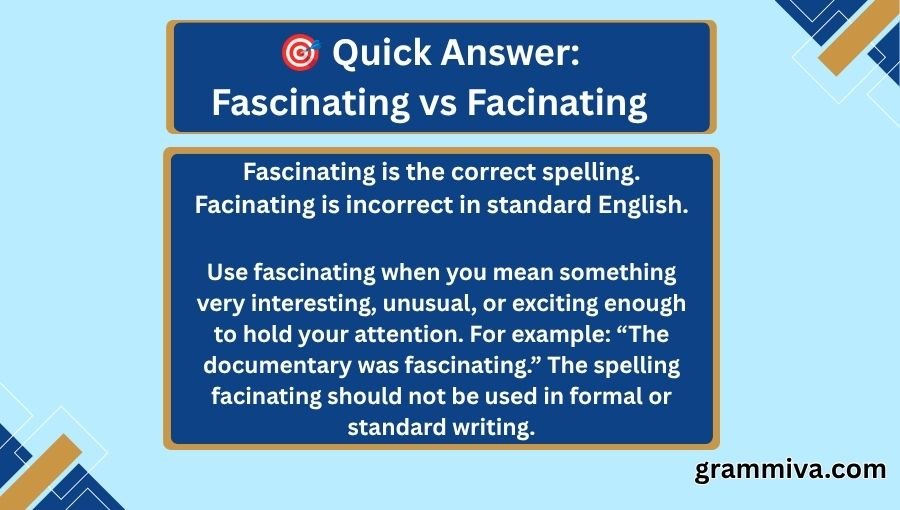
Fascinating is the correct spelling. Facinating is incorrect in standard English.
Use fascinating when you mean something very interesting, unusual, or exciting enough to hold your attention. For example: “The documentary was fascinating.” The spelling facinating should not be used in formal or standard writing.
| Spelling | Status | Meaning | Example |
|---|---|---|---|
| fascinating | ✅ Correct | Very interesting or absorbing | The book was fascinating. |
| facinating | ❌ Incorrect | No standard English meaning as a separate word | I read a facinating book. |
Is Fascinating the Correct Spelling?
Yes. Fascinating is the correct spelling in standard English. It comes from the verb fascinate, and the spelling keeps the s found in the base word.
The key is to connect the word to its base form:
fascinate → fascinating
That connection makes the spelling much easier to remember.
| Word | Part of Speech | Example |
|---|---|---|
| fascinate | Verb | Science stories fascinate me. |
| fascinates | Verb | Space science fascinates her. |
| fascinated | Adjective | He was fascinated by the machine. |
| fascinating | Adjective | The machine was fascinating. |
| fascination | Noun | Her fascination with space grew. |
Why the Extra “S” Matters
The s is not an optional letter. It is part of the spelling of the base word fascinate.
Compare these:
- fascinate
- fascinated
- fascinating
- fascination
They all keep the s.
If you remember the base word, the longer forms become much easier to spell.
What Does Fascinating Mean?
Fascinating describes something that strongly captures your interest or attention.
It can describe:
- a person
- a story
- a fact
- a place
- a subject
- an object
- an experience
- an idea
- a conversation
For example:
The scientist gave a fascinating talk about the ocean.
The word tells us that the talk was highly interesting and kept the audience engaged.
Fascinating vs Facinating at a Glance
The main difference is spelling, not meaning. Fascinating is the standard word, while facinating is a spelling error.
| Form | Type | Meaning | Example | Correct/Incorrect |
|---|---|---|---|---|
| fascinating | Adjective | Very interesting | It was a fascinating story. | ✅ Correct |
| facinating | Misspelling | Intended to mean “fascinating” | It was a facinating story. | ❌ Incorrect |
| fascinate | Verb | To strongly interest | History can fascinate children. | ✅ Correct |
| fascinated | Adjective | Very interested | I was fascinated by the painting. | ✅ Correct |
| fascination | Noun | Strong interest | Her fascination with birds began young. | ✅ Correct |
The easiest rule is this:
If you mean “very interesting,” spell it fascinating, with an s after the fa.
Why Do People Confuse Fascinating and Facinating?
People confuse these spellings because the word is pronounced in a way that does not make every letter obvious. When we speak quickly, the s can be easy to overlook.
Another reason is that English has many words in which letters are silent or less noticeable in speech. Writers may spell a word based on how it sounds.
I once reviewed a short school paragraph in which a student had written “facinating” three times. The student knew exactly what the word meant. The problem was not vocabulary. It was simply that the spelling had been built from sound instead of from the base word fascinate.
This is a useful lesson: when a spelling feels uncertain, look for a related word you already know.
| Possible Cause | What Happens | Helpful Fix |
|---|---|---|
| Fast typing | A letter gets skipped | Slow down for tricky words |
| Writing from sound | A letter is not heard clearly | Check the base word |
| Autocorrect | A typo may go unnoticed | Proofread important writing |
| Memory gap | The spelling is not stored well | Practice the correct form |
| Habit | The wrong spelling becomes familiar | Replace it with the correct form |
How Can You Remember the Spelling of Fascinating?
The simplest memory trick is to remember fascinate first. Then add -ing. This simple trick can help you avoid the fascinating vs facinating spelling mistake in future writing.
Think of it this way:
FASCINATE + ING = FASCINATING
Do not try to memorize every letter separately. Instead, break the word into a familiar base and an ending.
Memory Trick 1: Keep “Fascinate” Intact
Write these words together:
fascinate → fascinated → fascinating → fascination
Notice that the s stays in every form.
Memory Trick 2: Watch the “SC”
The beginning of the word is:
fas + cinating
The spelling contains sc after the first “fa.”
So avoid this:
fa + cinating
Use this:
fas + cinating
Memory Trick 3: Build a Word Family
When you learn one spelling, connect it to its related forms.
| Base or Related Word | Correct Form |
|---|---|
| Verb | fascinate |
| Present tense | fascinates |
| Past form | fascinated |
| -ing form | fascinating |
| Noun | fascination |
This method works because you are remembering a pattern rather than one isolated word.
What Are the Correct Meanings and Uses of Fascinating?
Fascinating is mainly used as an adjective. It describes something that creates strong interest.
Fascinating for People
You can describe a person as fascinating when that person is unusually interesting.
Example:
My history teacher is fascinating because she tells stories about the people behind major events.
Here, fascinating describes the teacher.
Be careful with context. Calling someone fascinating does not simply mean that the person is physically attractive. It usually suggests that the person is interesting because of their ideas, personality, experiences, knowledge, or behavior.
Fascinating for Things
You can use the word for objects, discoveries, places, and subjects.
The old map was fascinating.
The map captured the speaker’s attention.
Fascinating for Experiences
The word can also describe something you experience.
Visiting the science museum was fascinating.
The visit was interesting enough to hold the speaker’s attention.
Fascinating for Information
Facts can also be fascinating.
I learned a fascinating fact about how bees communicate.
Here, the adjective tells us that the fact is unusually interesting.
| Meaning | Word Type | Example Sentence |
|---|---|---|
| Very interesting | Adjective | The lecture was fascinating. |
| Strongly engaging | Adjective | She told a fascinating story. |
| Worthy of close attention | Adjective | The experiment produced fascinating results. |
| Unusually interesting | Adjective | He has a fascinating career. |
When Should You Use Fascinating?
Use fascinating when you want to say that something is extremely interesting or holds your attention.
It works well in both casual and formal writing.
For example:
- “That documentary was fascinating.”
- “She has a fascinating career.”
- “The research produced fascinating results.”
- “I had a fascinating conversation with my neighbor.”
- “The museum has a fascinating collection.”
The word is stronger than simply saying interesting, although the exact strength depends on context.
Test Tip 💡
If you are unsure about the spelling, replace the word with fascinate.
Ask yourself:
Does the base word contain an s?
Yes.
fascinate
Now form the -ing word:
fascinating
If you write facinating, the base word no longer matches. That is your warning sign.
A Real-Life Case Study: A Workplace Email
Imagine a coworker sends this message:
“I found a facinating report about customer behavior.”
The meaning is clear, but the spelling is wrong.
A polished version would be:
“I found a fascinating report about customer behavior.”
The change is tiny. Only one letter is missing. Yet that one letter makes the difference between standard spelling and a typo.
I once caught myself typing the wrong version of this word while editing a document. I stopped because I could not connect “facinating” to the base word I knew. Checking fascinate immediately solved the problem.
That is why I recommend checking the word family rather than relying only on visual memory.
| Situation | Less Accurate Version | Better Version |
|---|---|---|
| Work email | “a facinating report” | “a fascinating report” |
| School essay | “a facinating topic” | “a fascinating topic” |
| Review | “a facinating movie” | “a fascinating movie” |
| Conversation | “That is facinating!” | “That is fascinating!” |
Grammar Rules Explanation
Fascinating is the standard -ing form of the verb fascinate when it is used as a present participle or adjective. The spelling retains the letters of the base word and adds -ing.
The base form is:
fascinate
Adding -ing produces:
fascinating
The spelling does not remove the s.
The form facinating is not a standard alternative spelling. In ordinary English writing, it should be treated as an error.
Most standard English reference works agree on the spelling fascinating. A dictionary or spell-checker can also help confirm the form when you are unsure.
Correct vs Incorrect at a Glance
| Sentence | Correct/Incorrect | Why |
|---|---|---|
| The book was fascinating. | ✅ Correct | “Fascinating” is spelled correctly. |
| The book was facinating. | ❌ Incorrect | The spelling is missing the “s.” |
| She gave a fascinating presentation. | ✅ Correct | The adjective is correctly formed. |
| We had a facinating discussion. | ❌ Incorrect | “Facinating” is a misspelling. |
| The results were fascinating. | ✅ Correct | The standard spelling is used. |
Common Mistakes With Fascinating
Most errors happen for simple reasons. People type quickly, trust the sound of a word, or become familiar with a misspelling.
Here are some common causes.
Fast Typing
When you type quickly, your fingers may skip a letter. This is especially common with words that contain several consonants close together.
Autocorrect
Autocorrect can fix some errors, but it cannot replace careful proofreading. Some incorrect forms may remain unnoticed.
Lack of Familiarity
If you do not use a word often, its spelling may not feel automatic yet.
Sound-Based Spelling
People often write words according to how they sound. That can be risky because English spelling does not always match pronunciation perfectly.
| Confusion | Correct Form | Common Error |
|---|---|---|
| Possession vs contraction | its | it’s |
| You are vs possession | you’re | your |
| They are vs possession | they’re | their |
| It is vs possession | it’s | its |
| Very interesting adjective | fascinating | facinating |
The lesson is simple: do not assume that a word is spelled exactly the way it sounds.
Specific Wrong Spellings to Avoid
| Wrong Form | What’s Wrong | Correct Form |
|---|---|---|
| facinating | Missing “s” | fascinating |
| facinatingly | Built from the misspelled form | fascinatingly |
| facsinate | Letters are in the wrong pattern | fascinate |
| fascenating | Incorrect vowel pattern | fascinating |
| fasinating | Missing “c” after “s” | fascinating |
| fascinatting | Extra “t” | fascinating |
Not all of these errors are equally common, but they show how easily the spelling can change when someone tries to reconstruct the word from memory.
Is Fascinating Used in Everyday Conversation?
Yes. Fascinating is common in everyday conversation.
People use it to show strong interest in a subject, story, person, or experience.
Examples include:
- “That is fascinating.”
- “I find astronomy fascinating.”
- “She told me a fascinating story.”
- “That is a fascinating question.”
- “The history of this building is fascinating.”
In casual speech, you may also hear it as a short reaction:
“Fascinating!”
The word can express genuine interest. Depending on tone, however, it can sometimes sound dry or humorous. Context and voice matter.
How Does Fascinating Work in Professional Writing?
Fascinating is acceptable in professional writing, but it should be used with care.
In business writing, strong adjectives work best when they are supported by facts.
For example:
“The report contains fascinating data about customer behavior.”
This is reasonable if the data truly stands out.
However, if every report, chart, meeting, and email is described as fascinating, the word may lose its impact.
| Context | Which Term to Use | Example |
|---|---|---|
| Everyday conversation | fascinating | That story was fascinating. |
| Professional writing | fascinating | The study produced fascinating results. |
| Creative writing | fascinating | She entered a fascinating old house. |
| Social media/texting | fascinating | This is fascinating! |
The misspelling facinating should be avoided in all four contexts.
Can You Use Fascinating in Creative Writing?
Absolutely. Fascinating can add interest to descriptions, but strong writing does not need to rely on the word repeatedly.
For example:
The traveler found the village fascinating.
That sentence works, but a writer could make it more vivid:
The traveler could not stop watching the narrow streets fill with musicians, cooks, and storytellers.
The second version shows why the village was interesting.
| Approach | Example | Effect |
|---|---|---|
| Simple adjective | The town was fascinating. | Clear but general |
| Specific detail | The town came alive after sunset. | More vivid |
| Personal reaction | I could have stayed there for hours. | More personal |
| Descriptive detail | Music drifted through every narrow street. | More visual |
This does not mean you should avoid fascinating. It means you should choose it when it adds value.
Fascinating in Social Media and Texting
The correct spelling stays the same online.
You might write:
“That is fascinating!”
Or:
“This thread is fascinating.”
Texting is informal, so people sometimes make intentional spelling changes for humor or style. But facinating is normally just a typo, not a standard casual version of the word.
If you are posting professionally or publicly, use fascinating.
Common Phrases With Fascinating
There are many natural combinations that use fascinating.
| Phrase | Meaning |
|---|---|
| fascinating story | A story that strongly holds attention |
| fascinating fact | An unusually interesting fact |
| fascinating subject | A subject that creates strong interest |
| fascinating discovery | A discovery that is especially interesting |
| fascinating conversation | A conversation that keeps someone engaged |
| fascinating insight | An idea or observation that provides strong interest |
These are not fixed idioms in the strict sense. They are common combinations that sound natural in English.
Fascinating vs Interesting: Are They the Same?
Fascinating and interesting are close in meaning, but they are not always equally strong.
Interesting means something catches your attention or gives you useful information. Fascinating often suggests a stronger level of interest.
For example:
The lecture was interesting.
This tells us the lecture held the speaker’s attention.
The lecture was fascinating.
This suggests the lecture was especially absorbing or compelling.
| Word | General Strength | Example |
|---|---|---|
| interesting | Moderate interest | The article was interesting. |
| fascinating | Strong interest | The article was fascinating. |
| engaging | Holds attention | The speaker was engaging. |
| compelling | Strongly persuasive or absorbing | The argument was compelling. |
These words can overlap, but they are not perfect replacements in every sentence.
Synonyms and Alternatives for Fascinating
Several words can sometimes replace fascinating, depending on the situation.
| Alternative | Works When | Does Not Work When |
|---|---|---|
| interesting | Something catches your attention | You want to stress very strong interest |
| engaging | Something holds attention | The main idea is unusual rather than engaging |
| captivating | Something strongly holds attention | The tone needs to be very plain |
| compelling | Something is powerful or convincing | You only mean “interesting” |
| absorbing | Something takes up your attention | You need a very casual phrase |
No matter which synonym you choose, remember that fascinating vs facinating is a spelling question: only fascinating is correct. For example, “The novel was captivating” is natural. But “The spreadsheet was captivating” may sound unusual unless the spreadsheet itself is truly engaging.
Word choice should match the context.
Why Does Getting Fascinating Right Matter?
Correct spelling improves clarity, professionalism, and trust.
A single typo usually does not make communication impossible. But repeated spelling errors can distract readers. In school, work, publishing, and public writing, small details matter.
Clarity in Communication
Correct spelling helps readers move through your sentence without stopping to wonder whether a strange form is intentional.
Professionalism
A correctly spelled word makes your writing look carefully prepared.
Digital Communication
Online writing is often read quickly. A clean spelling pattern makes the message easier to scan.
I once edited a short professional bio where the writer had several small spelling errors. None changed the meaning, but together they made the bio look unfinished. Fixing those details made the entire piece feel more polished.
Good spelling removes distractions so your ideas can take center stage.
| Situation | Why Getting It Right Matters |
|---|---|
| Resume | Shows care and attention to detail |
| Client email | Creates a polished impression |
| Published content | Supports credibility and readability |
| Social post | Makes public writing look intentional |
How To Check Fascinating Before You Submit Your Writing
A quick check can prevent the error.
Step 1: Find the Base Word
Ask:
What is the base word?
Answer:
fascinate
Step 2: Add the Ending
Add -ing:
fascinate + ing
This gives:
fascinating
Step 3: Check the “S”
Look at the beginning:
fas-
If the s is missing, stop and correct the word.
Step 4: Read the Sentence
Make sure the word makes sense.
The topic was fascinating.
That sentence is natural.
Step 5: Use a Spell-Checker for Important Work
A spell-checker is helpful, but do not rely on it alone. Learning the word family gives you a stronger long-term solution. Before you finish your draft, take one last look at fascinating vs facinating and make sure you have used the correct spelling.
| Check | Question |
|---|---|
| Base word | Is it “fascinate”? |
| Spelling | Does the word contain “s”? |
| Ending | Does it end in “-ing”? |
| Meaning | Does it mean very interesting? |
| Final review | Does the sentence read naturally? |
Quick Recap Checklist ✅
Use this checklist whenever you are unsure.
| Question | If Yes → Use |
|---|---|
| Do I mean “very interesting”? | fascinating |
| Am I describing a person, thing, idea, or experience? | fascinating |
| Does my base word contain “s”? | fascinating |
| Did I write “facinating”? | Change it to fascinating |
| Am I writing a professional or school document? | Use fascinating |
Practice Examples
- The museum exhibit was fascinating.
- We watched a fascinating documentary about space.
- She gave a fascinating explanation of the problem.
Try covering the answers and spelling the word yourself.
FAQs About Fascinating vs Facinating
Is fascinating spelled with an s?
Yes. The correct spelling is fascinating, with an s after “fa.”
Is facinating a word?
Facinating is not the standard spelling of the English word. If you mean “very interesting,” use fascinating.
Why is fascinating spelled with an s?
The spelling comes from the base word fascinate. When -ing is added, the base spelling is retained: fascinate → fascinating.
What is the difference between fascinating and facinating?
There is no standard difference in meaning. Fascinating is the correct spelling. Facinating is a misspelling.
How do you spell fascinating correctly?
Spell it:
F-A-S-C-I-N-A-T-I-N-G
A useful memory aid is to remember the base word fascinate and then add -ing.
What does fascinating mean?
Fascinating means very interesting or able to strongly hold someone’s attention.
Is fascinating an adjective?
Yes. Fascinating commonly functions as an adjective.
For example:
The documentary was fascinating.
It can also function as an -ing form of the verb fascinate, depending on how it is used in a sentence.
What is the correct spelling: fascinating or facinating?
The correct spelling is fascinating. The form facinating should be corrected.
Is fascinating more positive than interesting?
Usually, yes. Fascinating often suggests a stronger level of interest than interesting, although the exact feeling depends on the sentence and context.
How can I remember fascinating vs facinating?
Remember the base word:
fascinate → fascinating
The s stays in the word. If you can remember fascinate, you can build the correct spelling of fascinating.
Fascinating vs Facinating: The Final Rule
Fascinating vs facinating has a very simple answer: fascinating is correct, while facinating is a misspelling. 😊
The best way to remember the correct form is to connect it to the base word fascinate. The s does not disappear when you add -ing. That gives you the correct form: fascinating.
Use the word when something is very interesting, absorbing, unusual, or able to hold your attention. It works naturally in conversations, school assignments, professional writing, reviews, creative work, and online posts.
If you see facinating in your draft, do not worry. It is an easy mistake to fix. Stop, think of fascinate, and rebuild the word.
One small letter can make your writing cleaner and more professional. Keep the s, remember fascinate, and you will have the correct spelling every time.
When in doubt, remember the word family: fascinate → fascinating.

I am Ethan Brooks, an English grammar and vocabulary writer. I work at Grammiva, where I create simple and helpful content to make English learning easier for students and everyday learners.

[…] version is simple: fiery is the standard spelling. Firey is generally considered a misspelling. Fascinating vs Facinating | Exceed vs Excede | foreign vs […]
[…] The good news is that you do not need to memorize a complicated rule. Once you understand the spelling pattern and learn a simple memory trick, you can avoid this mistake with confidence. 🎯 Fluorescent vs Flourescent | Fiery vs Firey | Fascinating vs Facinating […]