Have you ever typed a word, looked at it twice, and suddenly wondered whether you spelled it correctly? 😅 That happens often with words that have several vowels close together. Exhilarate vs exhilirate is a good example. The two spellings look almost identical, but only one is standard English.
If you are writing an email, school assignment, article, social post, or work document, this small spelling choice can make a big difference. A reader may understand what you mean either way, but an incorrect spelling can still distract from your message.
The correct word is exhilarate. It is a verb that means to make someone feel very happy, excited, or full of energy. Exhilirate is a common misspelling, not the standard form you should use in careful English.
I have seen this kind of mistake many times while checking written English. The problem is rarely a lack of intelligence. Usually, the writer knows the word and its meaning but remembers the vowel pattern incorrectly. The good news is that there is a simple way to remember the right spelling. 🎯Existence vs Existance | drunkenness vs drunkeness | disappoint vs disapoint
🎯 Quick Answer: Exhilarate vs Exhilirate
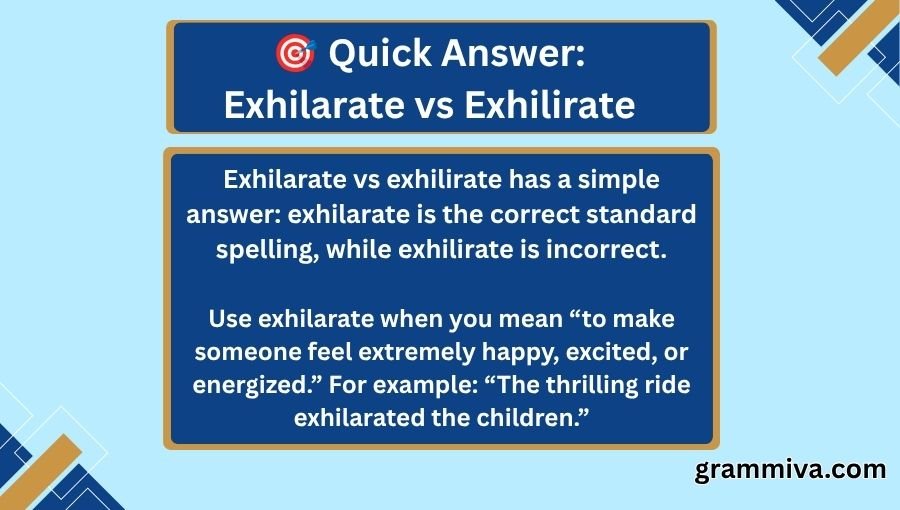
Exhilarate vs exhilirate has a simple answer: exhilarate is the correct standard spelling, while exhilirate is incorrect.
Use exhilarate when you mean “to make someone feel extremely happy, excited, or energized.” For example: “The thrilling ride exhilarated the children.”
| Spelling | Status | Example |
|---|---|---|
| exhilarate | ✅ Correct | The victory exhilarated the team. |
| exhilirate | ❌ Incorrect | The victory exhilirated the team. |
Related Word Forms of Exhilarate
The base word has several useful forms. These forms are standard words, but they have different jobs in a sentence. Understanding exhilarate vs exhilirate also means knowing the correct forms of the standard word.
| Form | Type | Example |
|---|---|---|
| exhilarate | Verb | The music can exhilarate the crowd. |
| exhilarates | Verb, third-person singular | The fresh air exhilarates her. |
| exhilarated | Past-tense verb / adjective | We felt exhilarated after the race. |
| exhilarating | Present participle / adjective | It was an exhilarating experience. |
| exhilaration | Noun | He felt a rush of exhilaration. |
| exhilaratingly | Adverb | The car moved exhilaratingly fast. |
A useful point is that exhilarated, exhilarating, and exhilaration keep the same central spelling pattern. Once you learn the base word, these related forms become easier to recognize.
🎯 Is Exhilarate the Same as Exhilirate?
No. Exhilarate and exhilirate are not two accepted spellings of the same standard English word. Exhilarate is the correct form, while exhilirate is a misspelling.
The main difference is the vowel after the h. The correct spelling contains -ila-, giving us:
exhilarate
The incorrect form changes that pattern to:
exhilirate
That small change is enough to make the second form wrong in standard English.
Exhilarate vs Exhilirate at a Glance
| Form | Type | Meaning | Example | Correct/Incorrect |
|---|---|---|---|---|
| exhilarate | Verb | Make someone very happy or excited | The news exhilarated us. | ✅ Correct |
| exhilirate | Intended verb | Intended to mean “make very happy or excited” | The news exhilirated us. | ❌ Incorrect |
Why the Spelling Causes Trouble
The word contains several letters that can be easy to mix up:
e x h i l a r a t e
Writers sometimes remember the sound more clearly than the letters. When they type the word from memory, they may insert an extra i and produce exhilirate.
The correct spelling has -hila-, not -hili-.
That is the key spelling point to remember.
🧠 How Do You Spell Exhilarate Correctly?
You spell the word exhilarate: E-X-H-I-L-A-R-A-T-E.
A useful memory trick is to focus on the middle:
ex-HILA-rate
Think of HILA as the small spelling chunk you need to protect. Do not replace the a with another i.
Here is a quick visual check:
| Question | Correct Answer |
|---|---|
| Does the word contain -hila-? | Yes |
| Does it contain -hili-? | No |
| Correct spelling | exhilarate |
| Common misspelling | exhilirate |
💡 Test Tip
When you are unsure, stop after exhil- and check the next letter. The correct sequence is:
exhil + arate
So the full word becomes:
exhilarate
If you see exhilirate on the page, the extra i is the warning sign.
Exhilarate: Meaning and Correct Use
Exhilarate is a verb meaning to make someone feel very happy, excited, lively, or energized. The exhilarate vs exhilirate question is mainly a spelling issue, because only one form is standard.
The person or thing causing the feeling is usually the subject of the sentence.
For example:
The concert exhilarated the audience.
Here is the sentence structure:
- The concert = the thing causing the feeling.
- exhilarated = the verb.
- the audience = the people who experienced the feeling.
Another example is:
The mountain view exhilarated the hikers.
The view creates a strong feeling of excitement or joy. The hikers receive that feeling.
Exhilarate as a Verb
The word is generally used when something produces a strong positive emotional response.
| Meaning | Word Type | Example Sentence |
|---|---|---|
| To make someone excited | Verb | The race exhilarated the fans. |
| To make someone feel very happy | Verb | The good news exhilarated her. |
| To fill someone with energy or excitement | Verb | The cold morning air exhilarated us. |
The word can describe emotional reactions caused by events, experiences, news, activities, places, or other things.
Exhilarated as a Past Form
Use exhilarated when describing a feeling that happened in the past.
For example:
I felt exhilarated after finishing the race.
Here, exhilarated describes the person’s emotional state.
Compare these two sentences:
- “The race exhilarated me.”
- “I felt exhilarated after the race.”
The first focuses on what caused the feeling. The second focuses on the person experiencing it.
Exhilarating as a Describing Word
Exhilarating is commonly used to describe something that creates excitement.
For example:
The helicopter ride was exhilarating.
This means the ride created a powerful feeling of excitement.
| Form | What It Describes | Example |
|---|---|---|
| exhilarate | An action | The ride can exhilarate passengers. |
| exhilarated | A person or feeling in the past | She was exhilarated. |
| exhilarating | Something that causes excitement | It was an exhilarating ride. |
| exhilaration | The feeling itself | He felt exhilaration. |
🎯 Exhilarate vs Exhilirate in Real Sentences
Seeing the two forms side by side makes the difference easier to remember.
| Correct Sentence | Incorrect Sentence |
|---|---|
| ✅ The final goal exhilarated the players. | ❌ The final goal exhilirated the players. |
| ✅ The trip exhilarated everyone. | ❌ The trip exhilirated everyone. |
| ✅ The exciting news exhilarated her. | ❌ The exciting news exhilirated her. |
| ✅ The fast ride exhilarated the children. | ❌ The fast ride exhilirated the children. |
| ✅ The fresh mountain air exhilarated us. | ❌ The fresh mountain air exhilirated us. |
The meaning is clear in the incorrect examples, but the spelling is not standard. In polished writing, always choose exhilarate or the correct form of that word.
📝 Case Study: A Workplace Email
Imagine that an employee has just helped complete a difficult project. They want to send this message: This exhilarate vs exhilirate mistake can easily appear in a workplace email when someone types too quickly.
“The team’s success really exhilarated me. I am proud of what we accomplished together.”
That sentence is correct. Exhilarated describes the writer’s strong feeling of happiness and excitement.
Now imagine the employee writes:
“The team’s success really exhilirated me.”
The reader will probably understand the intended meaning. However, the spelling is wrong. In a professional email, that small error may make the message look less polished.
I once edited a short work message in which a writer had typed a difficult word correctly three times but misspelled it the fourth time. The mistake was not a lack of knowledge. The writer had simply typed quickly and trusted the shape of the word instead of checking each letter.
That is a useful lesson. Knowing a word and spelling it correctly every time are related skills, but they are not exactly the same skill.
Grammar Rules Explanation
The standard spelling is exhilarate. The form exhilirate is not the standard spelling of the verb. The main rule behind exhilarate vs exhilirate is simple: use the spelling exhilarate in standard English.
The difference is spelling rather than grammar. Both forms are intended to represent the same verb, but only exhilarate belongs in standard edited English.
The word can take normal verb endings. For example:
- exhilarate
- exhilarates
- exhilarated
- exhilarating
The spelling of the base word remains important when adding these endings.
The basic pattern is:
exhilarate → exhilarated → exhilarating → exhilaration
A general check of standard English reference sources confirms that exhilarate is the established form.
Correct vs Incorrect at a Glance
| Sentence | Correct/Incorrect | Why |
|---|---|---|
| The victory exhilarated the players. | ✅ Correct | The verb is spelled correctly. |
| The victory exhilirated the players. | ❌ Incorrect | The middle vowel pattern is wrong. |
| The race was exhilarating. | ✅ Correct | Exhilarating is the correct related form. |
| She felt exhilarated afterward. | ✅ Correct | Exhilarated is the correct past form/adjective. |
| The experience was exhilirating. | ❌ Incorrect | The related form is spelled exhilarating. |
⚠️ Why Do People Confuse Exhilarate and Exhilirate?
People often confuse these forms because the word contains several vowels and because its spelling is not as easy to predict as the spelling of a short everyday word.
Three common causes are:
- Fast typing
When people type quickly, they often reproduce the sound or general shape of a word instead of checking every letter. - Autocorrect and spell-check habits
Digital tools can sometimes make writers less careful. If a word looks familiar, a writer may not stop to inspect it. - Lack of spelling knowledge
Someone may know exactly what the word means but have never learned its correct letter pattern.
I once caught myself typing a familiar word with the wrong vowel during a rushed editing session. I knew the word immediately, but my fingers followed the wrong pattern. That reminded me that even strong writers need a quick visual check when a word has a tricky spelling.
Similar Spelling Confusions
| Confusion | Correct Form | Common Error | Main Issue |
|---|---|---|---|
| its / it’s | its, it’s | mixing them | Possession vs contraction |
| your / you’re | your, you’re | mixing them | Possession vs contraction |
| their / they’re | their, they’re | mixing them | Possession vs contraction |
| affect / effect | affect, effect | swapping them | Different word functions and meanings |
| exhilarate / exhilirate | exhilarate | exhilirate | Incorrect vowel sequence |
Common Wrong Spellings of Exhilarate
| Wrong Form | What’s Wrong | Correct Form |
|---|---|---|
| exhilirate | Uses i where a belongs | exhilarate |
| exilerate | Drops part of the middle spelling | exhilarate |
| exhilerate | Changes the middle vowel pattern | exhilarate |
| exhilirated | Incorrect past form | exhilarated |
| exhilirating | Incorrect related form | exhilarating |
| exhiliration | Incorrect noun spelling | exhilaration |
Why Is Exhilarate Often Misspelled?
The spelling can feel awkward because the word is not one that most people type every day. Familiar words are usually easier to spell because we see them often.
Another problem is sound. English spelling does not always give us a simple one-letter-for-one-sound pattern. When a word is unfamiliar, people may guess its spelling from pronunciation.
That can produce forms such as exhilirate.
A better method is to learn the word visually:
EXHILARATE
Then learn its family:
EXHILARATED
EXHILARATING
EXHILARATION
Once you recognize the shared pattern, the incorrect exhilir- form looks more unusual.
How Does Exhilarate Work in Everyday Conversation?
In everyday conversation, people may choose simpler words such as excite, thrill, or energize. Still, exhilarate works well when you want to describe a strong rush of positive feeling.
For example:
“That roller coaster absolutely exhilarated me.”
This sounds more expressive than:
“That roller coaster made me happy.”
The word can fit conversations about travel, sports, entertainment, nature, achievements, and exciting experiences.
| Context | Which Term to Use | Example |
|---|---|---|
| Everyday conversation | exhilarate / exhilarated | The concert exhilarated me. |
| Professional writing | exhilarate / exhilarated | The successful launch exhilarated the team. |
| Creative writing | exhilarate / exhilarating | The exhilarating climb left us speechless. |
| Social media/texting | exhilarate or simpler words | That game was exhilarating! |
Exhilarate vs Exhilirate in Professional Writing
Professional writing rewards accuracy. A spelling error in a report may not change the meaning, but it can weaken the reader’s trust in the document. In professional writing, knowing exhilarate vs exhilirate helps you avoid a simple spelling mistake that can make polished content look less careful.
For example:
“The successful presentation exhilarated the sales team.”
This is polished and correct.
A stronger business document might instead use a more natural word if the emotional tone is too strong:
“The successful presentation energized the sales team.”
That choice depends on context. Exhilarate suggests strong excitement or joy. Energize can sound more neutral and professional.
The key is not simply knowing the spelling. You also need to choose a word that matches the tone.
Exhilarate in Creative Writing
Creative writing gives exhilarate more room to shine. The word can describe a powerful reaction to movement, danger, beauty, victory, discovery, or freedom.
For example:
The sudden rush of wind exhilarated the young sailor.
Or:
The runners felt exhilarated as they reached the summit.
The related adjective exhilarating is especially useful:
It was an exhilarating climb through the narrow canyon.
Notice the difference:
- The climb exhilarated them.
- The climb was exhilarating.
- They felt exhilarated.
Each sentence uses a different form of the same word family.
Exhilarate in Social Media and Texting
There is no spelling exception just because you are texting. If you choose to use the word, the standard spelling remains exhilarate.
That said, social media often favors shorter words.
You might write:
“That was exhilarating!”
Or simply:
“That was amazing!”
Both are fine. The best choice depends on your voice and audience.
If you use exhilirate, however, the casual setting does not turn the spelling into a standard form.
🎯 Key Differences Between Exhilarate and Exhilirate
The difference can be reduced to one clear rule: exhilarate is the standard spelling; exhilirate is a misspelling.
| Feature | Exhilarate | Exhilirate |
|---|---|---|
| Standard English word | Yes | No |
| Correct spelling | Yes | No |
| Verb meaning “to make very excited or happy” | Yes | Intended meaning only |
| Suitable for formal writing | Yes | No |
| Related form | exhilarated | exhilirated is incorrect |
| Related adjective | exhilarating | exhilirating is incorrect |
Common Phrases With Exhilarate
There are no major idioms built around exhilarate, but the word commonly appears with experiences that create excitement.
| Phrase | Meaning |
|---|---|
| exhilarate the crowd | Make a group of people very excited |
| exhilarate the senses | Create a strong, exciting sensory feeling |
| feel exhilarated | Feel very happy, excited, or energized |
| an exhilarating experience | An experience that creates strong excitement |
| an exhilarating ride | A ride that creates a strong rush of excitement |
| a sense of exhilaration | A strong feeling of excitement or joy |
These combinations can help you learn the word in natural chunks instead of memorizing it as isolated letters.
Synonyms and Alternatives to Exhilarate
Sometimes exhilarate is exactly right. Other times, a simpler word may fit better.
| Alternative | Works When | Does Not Work When |
|---|---|---|
| excite | You mean to create interest or excitement | You need the stronger sense of joyful energy |
| thrill | You mean to cause strong excitement | The feeling is mild or mainly about interest |
| energize | Something gives people fresh energy | You specifically mean intense emotional excitement |
| delight | Someone feels great pleasure | The main idea is excitement or a rush of energy |
| inspire | Something creates motivation or a strong idea | You simply mean an exciting experience |
For example, “The speech inspired the students” is not necessarily the same as “The speech exhilarated the students.” Inspiration can lead to action or new ideas. Exhilaration focuses more on a strong positive emotional lift.
Why Correct Spelling Matters
Correct spelling helps readers move through your message without stopping to decode an unusual word. Getting exhilarate vs exhilirate right helps keep your writing clear, accurate, and professional.
This matters in several ways:
- Clarity: The reader can recognize the word immediately.
- Professionalism: Careful spelling makes written work look polished.
- Digital communication: Short messages are often read quickly, so unusual errors can stand out.
- Trust: Clean writing can make your ideas feel more reliable.
A useful rule is:
“A small spelling check can protect a big idea.”
| Situation | Why Getting It Right Matters |
|---|---|
| Resume | Shows care and attention to detail |
| Client email | Supports a professional image |
| Published content | Keeps the writing polished |
| Social post | Makes the intended word easy to recognize |
🧩 How To Remember the Difference
The easiest memory trick is to remember the middle letters:
EX-HIL-A-RATE
The incorrect form changes that middle A into another I.
You can also connect the word with its related forms:
exhilarate → exhilarated → exhilarating → exhilaration
They all keep the exhilar- pattern.
Another useful trick is to say the spelling slowly in your head while typing:
ex-hil-a-rate
This is not a pronunciation rule. It is simply a spelling aid.
When Should You Use Exhilarate Instead of Excite?
Use exhilarate when you want to express a particularly strong feeling of happiness, excitement, or energy. Use excite when you need a broader and more common word.
Compare:
The announcement excited the students.
This could mean the students became interested or happy.
The announcement exhilarated the students.
This suggests a stronger emotional rush.
Neither word is automatically better. The right choice depends on the feeling you want to express.
❓ Why Do Writers Type Exhilirate Instead of Exhilarate?
Writers usually type exhilirate because they remember the word’s general sound but not its exact vowel pattern. Fast typing and visual memory can make the incorrect spelling feel natural.
The solution is simple: remember exhilarate as exhil + arate, not exhil + irate.
❓ Is Exhilirate a Word?
No. Exhilirate is not the standard spelling of the English verb you are looking for. If you mean “to make someone very happy, excited, or energized,” use exhilarate.
❓ Is Exhilarate a Verb or an Adjective?
Exhilarate is a verb. It describes the action of making someone feel very excited, happy, or energized.
For example:
The victory exhilarated the fans.
Exhilarating is the related adjective:
The victory was exhilarating.
❓ What Is the Past Tense of Exhilarate?
The past tense is exhilarated.
Example:
The unexpected win exhilarated the team.
Do not write exhilirated.
❓ What Is the Adjective Form of Exhilarate?
The common adjective form is exhilarating when you describe something that causes excitement.
Example:
It was an exhilarating experience.
Exhilarated can describe the person who experiences the feeling:
We were exhilarated by the result.
❓ How Do You Spell Exhilarating?
The correct spelling is exhilarating.
A useful pattern is:
exhilarate → exhilarating
The spelling keeps exhilar-. The incorrect form exhilirating should be avoided.
❓ What Does Exhilarate Mean in Simple English?
Exhilarate means to make someone feel very happy, excited, or full of energy.
For example:
The exciting game exhilarated the fans.
In simple terms, the game gave the fans a strong rush of positive excitement.
❓ What Is the Difference Between Exhilarated and Exhilarating?
Exhilarated usually describes the person or people who feel the emotion. Exhilarating usually describes the thing or experience that creates the emotion.
Compare:
I felt exhilarated.
and:
The ride was exhilarating.
The first describes my feeling. The second describes the ride.
❓ Is Exhilarate Formal English?
Yes. Exhilarate is a standard English verb and can be used in formal, professional, academic, and creative writing.
However, it may sound stronger or more expressive than everyday words such as excite, thrill, or energize.
Choose it when its meaning and tone fit the sentence.
❓ How Can I Remember Exhilarate vs Exhilirate?
Remember the middle spelling:
ex-HIL-A-rate
The key is the A after HIL.
Write:
exhilarate ✅
Not:
exhilirate ❌
❓ Can I Use Exhilarate in a Business Email?
Yes. You can use exhilarate in a business email when the strong feeling it describes fits the situation.
For example:
“The successful launch exhilarated the team.”
For a more neutral business tone, you could write:
“The successful launch energized the team.”
The choice depends on how strong you want the emotional language to sound.
✅ Quick Recap Checklist
| Question | If Yes → Use |
|---|---|
| Do you mean “make someone very excited or happy”? | exhilarate |
| Are you describing someone who felt that emotion in the past? | exhilarated |
| Are you describing an exciting experience? | exhilarating |
| Are you naming the feeling itself? | exhilaration |
| Are you considering exhilirate? | Do not use it |
Practice Examples
- The thrilling final match exhilarated the fans.
- The mountain climb was exhilarating.
- She felt a deep sense of exhilaration after completing the challenge.
FAQs About Exhilarate vs Exhilirate
Is exhilarate the correct spelling?
Yes. Exhilarate is the correct standard spelling. Exhilirate is a misspelling.
What does exhilarate mean?
Exhilarate means to make someone feel very happy, excited, or full of energy.
How do you spell exhilarate?
The spelling is E-X-H-I-L-A-R-A-T-E.
What is the most common spelling mistake for exhilarate?
A common mistake is writing exhilirate, with i instead of a in the middle.
What is the past tense of exhilarate?
The past tense is exhilarated.
What is the adjective form of exhilarate?
Exhilarating describes something that creates strong excitement. Exhilarated describes someone who feels that excitement.
Is exhilirate ever correct?
No. Exhilirate is not the standard spelling of the verb. Use exhilarate.
Can exhilarate describe a person?
Usually, exhilarate describes something that causes a person to feel excited. For example, “The victory exhilarated Maya.” To describe Maya’s feeling, say, “Maya felt exhilarated.”
Is exhilarate the same as excite?
They are similar, but exhilarate often suggests a stronger rush of happiness, excitement, or energy. Excite is more general and common.
How can I avoid spelling exhilarate incorrectly?
Remember the middle pattern HILA. Write exhilarate, not exhilirate. Learning its related forms—exhilarated, exhilarating, and exhilaration—also reinforces the correct spelling.
Conclusion
Exhilarate vs exhilirate becomes easy once you remember one small spelling rule: exhilarate is correct, while exhilirate is a misspelling. The correct word is a verb meaning to make someone feel very happy, excited, or energized.
When you need the past form, use exhilarated. When you describe something that creates strong excitement, use exhilarating. When you name the feeling itself, use exhilaration.
The biggest trap is the middle of the word. Do not let the extra i sneak into exhilarate. Remember the pattern ex-HIL-A-rate, and you will have a quick way to check yourself. ✨
Good spelling does not require memorizing every word in English. It often comes down to noticing the few letters that cause trouble and building a reliable memory for them.
So the next time you hesitate, choose exhilarate with confidence.
Remember: HILA belongs in exhilarate—one small letter can make your writing right.

I am Ethan Brooks, an English grammar and vocabulary writer. I work at Grammiva, where I create simple and helpful content to make English learning easier for students and everyday learners.

[…] By the end, you should be able to spot the correct form quickly and use it with confidence. 👍 Exhilarate vs Exhilirate | Existence vs Existance | drunkenness vs […]