Have you ever typed a word, looked at it twice, and still wondered whether the letters are in the right order? Deceive vs decieve is one of those spelling traps. The two forms look almost identical, but only one is correct in standard US English. The other is a common spelling mistake.
If you have ever paused over the spelling of deceive, you are not alone. The letters ei and ie can be confusing because English has many words that seem to follow different patterns. A quick search or spell-check can also make the issue feel more complicated than it really is. ✍️
I have taught and edited enough English to know that small spelling questions can matter. A single misplaced letter can make a polished email, school paper, or website article look careless. The good news is that this particular mistake has a simple answer. 😊
This guide explains the difference, shows the correct spelling in real sentences, gives you easy memory tricks, and answers the questions people often ask about deceive and decieve. Cemetery vs Cemetary | Coolly vs Cooly | Daiquiri vs Dacquiri
🎯 Quick Answer: Deceive vs Decieve
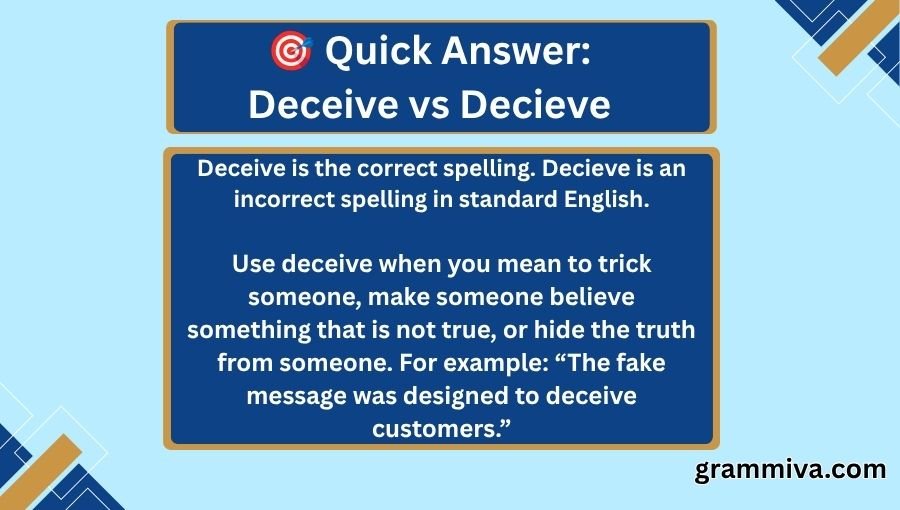
Deceive is the correct spelling. Decieve is an incorrect spelling in standard English.
Use deceive when you mean to trick someone, make someone believe something that is not true, or hide the truth from someone. For example: “The fake message was designed to deceive customers.”
| Spelling | Status | Meaning | Example |
|---|---|---|---|
| deceive | ✅ Correct | To trick or mislead someone | The scam was meant to deceive people. |
| decieve | ❌ Incorrect | Not a standard English spelling | The scam was meant to decieve people. |
🔤 Related Word Forms of Deceive
When learning deceive vs decieve, it also helps to know the related forms of deceive. These forms make the correct spelling easier to recognize. The word deceive has several useful related forms. Learning them can help you recognize the correct spelling in more situations.
| Form | Type | Example |
|---|---|---|
| deceive | Verb | Do not deceive your customers. |
| deceives | Verb, third-person singular | He deceives people with false claims. |
| deceived | Past tense/past participle | She was deceived by the message. |
| deceiving | Present participle/gerund | The advertisement is deceiving buyers. |
| deception | Noun | The deception was finally discovered. |
| deceptive | Adjective | The headline was deceptive. |
| deceiver | Noun | The deceiver admitted what he had done. |
Notice something useful here: the decei- spelling stays visible in several related forms. Seeing these words together can make the correct spelling easier to remember.
🎯 Is Deceive the Same as Decieve?
No. Deceive and decieve are not two accepted spellings of the same word. Deceive is the standard spelling, while decieve is a misspelling.
The main difference is the order of i and e. In deceive, the ending is spelled -eive, not -ieve.
| Form | Type | Meaning | Example | Correct/Incorrect |
|---|---|---|---|---|
| deceive | Verb | Trick or mislead | They tried to deceive the buyer. | ✅ Correct |
| decieve | Intended verb | Usually intended to mean “deceive” | They tried to decieve the buyer. | ❌ Incorrect |
| deceived | Past tense | Tricked or misled | The buyer was deceived. | ✅ Correct |
| decieved | Intended past tense | Usually intended to mean “deceived” | The buyer was decieved. | ❌ Incorrect |
The mistake is easy to make because decieve looks natural at first glance. However, changing the order of the letters changes a correct word into a spelling error.
🧩 Deceive vs Decieve at a Glance
The easiest rule is simple: write deceive with “ei” after the c.
Think of the spelling as:
de + cci + ve
Not:
de + cie + ve
| Feature | Deceive | Decieve |
|---|---|---|
| Standard spelling | Yes | No |
| Part of speech | Verb | Not a standard word |
| Main idea | To trick or mislead | — |
| Correct letter order | ei | ie |
| Example | They tried to deceive us. | They tried to decieve us. ❌ |
This distinction is especially useful when writing quickly. If you stop to check only one thing, check the order of e and i.
💡 Why Do People Confuse Deceive and Decieve?
People often confuse deceive vs decieve because English spelling does not always follow one simple rule. The familiar “i before e” saying can also cause trouble because it has many exceptions and limits.
The word deceive contains cci, so the expected pattern is ei. Writers who remember a general “ie” pattern may accidentally write decieve.
I once reviewed a short student essay in which the writer used decieve several times. The student knew exactly what the word meant. The problem was simply that the spelling looked right to them. Once we highlighted cci, they stopped making the mistake.
| Reason for Confusion | What Happens |
|---|---|
| Letter order | The writer swaps ei to ie. |
| Memory of “i before e” | The writer applies a broad spelling rule too quickly. |
| Fast typing | Fingers may place the letters in the wrong order. |
| Visual similarity | Both forms look almost identical. |
| Weak word memory | The writer knows the meaning but has not memorized the spelling. |
The key is not to rely on how the word “looks.” Learn the exact letter pattern instead.
📝 How Should You Spell Deceive Correctly?
When checking deceive vs decieve, the correct spelling is deceive. A useful way to break the word into parts is de + ceive.
A useful way to break it into parts is:
de + ceive
The important section is -ceive.
You can also compare it with related words:
- deceive
- deceives
- deceived
- deceiving
- deception
- deceptive
The same beginning gives you a visual pattern to remember.
| Word | Correct Spelling | Common Mistake |
|---|---|---|
| deceive | deceive | decieve |
| deceives | deceives | decieves |
| deceived | deceived | decieved |
| deceiving | deceiving | decieving |
| deception | deception | decption |
| deceptive | deceptive | decetive |
✏️ Correct Meanings and Uses of Deceive
Deceive is a verb. It generally means to cause someone to believe something that is false or to hide the truth from someone.
Deceive Someone
You can use deceive when one person deliberately misleads another person.
Example:
The seller tried to deceive the customer.
Here, the seller is the person doing the action. The customer is the person being misled.
Deceive Someone Into Doing Something
The verb can also appear in a structure where someone is tricked into taking an action.
Example:
The false advertisement deceived shoppers into buying the product.
The shoppers believed something that was not true, and that false belief led them to act.
Deceive Yourself
The word can also be used when someone refuses to accept the truth.
Example:
You are only deceiving yourself if you think the problem will disappear on its own.
Here, the person is not necessarily tricking someone else. The person is allowing themselves to believe something false.
| Meaning | Word Type | Example Sentence |
|---|---|---|
| Trick someone | Verb | The thief tried to deceive the guard. |
| Mislead someone | Verb | The report was designed to deceive readers. |
| Cause a false belief | Verb | The image could deceive viewers. |
| Mislead yourself | Verb | He was deceiving himself about the situation. |
💡 Test Tip: How Can You Remember the Correct Spelling?
My favorite test is to focus on the middle of the word.
Ask yourself:
Does it say “cci” or “cie”?
The correct answer is cci.
So:
de-CEI-ve ✅
Not:
de-CIE-ve ❌
You can also connect deceive with receive. Both contain -ceive.
| Memory Method | Correct Pattern |
|---|---|
| Focus on the middle | cei |
| Compare with receive | receive |
| Look at the ending | –eive |
| Watch the letter order | e comes before i |
| Avoid the common trap | Do not write decieve |
This is more reliable than trying to remember a broad spelling slogan.
📝 Case Study: A Workplace Email
The difference between deceive vs decieve can matter even in a simple workplace email. Using the correct spelling keeps the message professional and clear.
Imagine a manager writing this sentence in an email:
“We should never deceive customers about the features of our service.”
That sentence is correct. The manager is using deceive as a verb.
Now imagine this version:
“We should never decieve customers about the features of our service.”
The meaning is still easy to understand, but the spelling is wrong. In a professional email, that small error could make the message look less polished.
I once caught myself typing a similar -ie/-ei error while editing a document late in the afternoon. I knew the word, but my fingers followed the wrong letter order. That reminded me that even experienced writers benefit from a quick visual check.
| Workplace Example | Result |
|---|---|
| We must not deceive customers. | ✅ Correct |
| We must not decieve customers. | ❌ Incorrect |
| The customer was deceived. | ✅ Correct |
| The customer was decieved. | ❌ Incorrect |
The lesson is simple: knowing the meaning does not automatically guarantee correct spelling.
📚 Grammar Rules Explanation
Deceive is a verb, and its standard spelling uses ei in the sequence –cci–. Decieve is not the standard spelling of the verb.
The issue is therefore a spelling problem rather than a difference in meaning. There is no standard English rule that gives decieve a separate meaning from deceive. When a writer uses decieve, the intended word is almost always deceive.
Standard English reference works agree on the spelling deceive. The safest approach is to memorize the word as a complete spelling rather than trying to create a new rule for it.
Correct vs Incorrect at a Glance
| Sentence | Correct/Incorrect | Why |
|---|---|---|
| The website tried to deceive visitors. | ✅ Correct | Deceive is spelled with ei. |
| The website tried to decieve visitors. | ❌ Incorrect | Decieve is a misspelling. |
| She was deceived by the false claim. | ✅ Correct | Deceived keeps the correct spelling pattern. |
| She was decieved by the false claim. | ❌ Incorrect | The ei order has been reversed. |
| Do not deceive yourself. | ✅ Correct | The standard verb is deceive. |
⚠️ Common Mistakes With Deceive
The most common mistake in deceive vs decieve is reversing the e and i. Writers usually know the word’s meaning but type ie where ei belongs.
The most common mistake is simple letter reversal. Writers know the word but type ie where ei belongs.
Other mistakes can happen because people rely too heavily on memory rules, especially the familiar “i before e” idea.
Three causes are especially common:
- Fast typing: Your fingers may produce letters in the wrong order.
- Autocorrect: Software may not always catch a word that resembles a real spelling.
- Lack of knowledge: A writer may know the meaning but never have learned the spelling.
| Common Confusion | Correct Form | Example |
|---|---|---|
| it’s / its | it’s or its | It’s cold. / The dog wagged its tail. |
| your / you’re | your or you’re | Your coat is here. / You’re early. |
| their / there / they’re | depends on meaning | They’re over there with their bags. |
| affect / effect | depends on use | The noise affected me. |
| then / than | depends on meaning | First this, then that. / Taller than me. |
| deceive / decieve | deceive | Do not deceive people. |
Specific Wrong Spellings and Uses
| Wrong Form | What’s Wrong | Correct Form |
|---|---|---|
| decieve | The i and e are reversed. | deceive |
| decieved | The same letter-order error appears in the past form. | deceived |
| decieves | The same error appears in the third-person form. | deceives |
| decieving | The spelling incorrectly changes ei to ie. | deceiving |
| deceeve | The vowel sequence is incorrect. | deceive |
| deceve | A letter is missing. | deceive |
🧠 How to Remember Deceive vs Decieve
The easiest way to remember deceive vs decieve is to focus on the three letters cei. Write the correct pattern as de + cei + ve = deceive. The strongest memory trick is to remember “cci”.
Write this several times:
cci — cci — cci
Then place it inside the word:
de + cci + ve = deceive
Another helpful connection is receive:
re + cci + ve = receive
Both words contain -ceive.
| Word | Middle Pattern | Correct? |
|---|---|---|
| deceive | cei | ✅ |
| receive | cei | ✅ |
| perceive | cei | ✅ |
| conceive | cei | ✅ |
| decieve | cie | ❌ |
Do not assume that every English word follows the same vowel pattern. Learn the spelling of each word you use often.
🌎 How Is Deceive Used in Different Contexts?
Deceive works in many types of writing. The meaning stays similar, but the tone can change depending on the setting.
| Context | Which Term to Use | Example |
|---|---|---|
| Everyday conversation | deceive | I would never deceive you. |
| Professional writing | deceive | The company must not deceive customers. |
| Creative writing | deceive | The stranger tried to deceive the hero. |
| Social media/texting | deceive | That post could deceive readers. |
In casual speech, people may choose simpler words such as trick or mislead. In formal writing, deceive can be a clear and direct choice.
💬 Common Phrases With Deceive
Deceive appears in several useful sentence patterns. These are not special idioms, but they are common combinations that can help you use the word naturally.
| Phrase | Meaning |
|---|---|
| deceive someone | Trick or mislead a person |
| deceive the public | Cause the public to believe something false |
| deceive customers | Mislead buyers |
| deceive yourself | Refuse to accept the truth |
| deliberately deceive | Intentionally mislead |
| attempt to deceive | Try to trick someone |
For example, “The company deliberately deceived customers” clearly says that the misleading action was intentional.
🔄 Synonyms and Alternatives to Deceive
You do not always need to use deceive. The best alternative depends on the exact situation.
| Alternative | Works When | Does Not Work When |
|---|---|---|
| trick | Someone is fooled in a direct or simple way | You need a more formal tone |
| mislead | Someone receives a false or confusing impression | The situation is clearly a playful trick |
| fool | Someone is successfully made to believe something false | You need a neutral professional tone |
| lie to | Someone gives a false statement directly | The deception happens without a direct lie |
| misrepresent | Facts or information are presented inaccurately | The situation is casual or playful |
For example, “The advertisement misled customers” may sound more natural than “The advertisement deceived customers” in some business contexts. Both can be correct, but the exact meaning may differ.
🎯 Deceive vs Decieve in Professional Writing
Correct spelling matters more in professional writing because readers often judge a document by small details. A spelling error can distract from an otherwise strong message.
Use deceive in reports, emails, policies, articles, resumes, and other formal documents when the meaning calls for it.
| Professional Situation | Why Getting It Right Matters |
|---|---|
| Resume | Shows care with written language |
| Client email | Builds trust and professionalism |
| Published content | Protects readability and credibility |
| Business report | Keeps the message polished and clear |
A useful rule is simple: if you would proofread the document for names, numbers, and dates, proofread spelling too.
❓ Why Does Correct Spelling Matter in Digital Communication?
Correct spelling helps readers understand your message without distraction. Even when a typo does not change the meaning, it can reduce confidence in the writer.
Digital communication makes this especially relevant. Emails, social posts, messages, and online articles can be read by many people and saved for a long time.
Clear writing makes the reader’s job easier.
A single decieve typo will rarely cause serious confusion. Still, repeated spelling errors can make a writer seem less careful.
🧪 Practice: Can You Choose the Correct Form?
Try each sentence before checking the answers.
- The fake offer was designed to ______ customers.
- I would never try to ______ my friends.
- The story was intended to ______ the reader.
- The customer felt ______ by the advertisement.
- Do not ______ yourself about the risks.
Answers: deceive, deceive, deceive, deceived, deceive.
| Practice Sentence | Answer |
|---|---|
| The fake offer was designed to ___ customers. | deceive |
| I would never try to ___ my friends. | deceive |
| The story was intended to ___ the reader. | deceive |
| The customer felt ___ by the advertisement. | deceived |
| Do not ___ yourself about the risks. | deceive |
🧭 How Can You Check Deceive Quickly?
When you are unsure, use a three-step check:
- Ask what the word means. If you mean “trick” or “mislead,” you probably need deceive.
- Look at the middle. The correct sequence is cci.
- Check the related form. Deceived, deceiving, and deception can reinforce the spelling.
This takes only a few seconds.
| Step | Question | Answer |
|---|---|---|
| 1 | Do I mean “trick or mislead”? | If yes, use deceive. |
| 2 | Does the word contain cei? | Yes. |
| 3 | Am I tempted to write cie? | Stop and correct it. |
| 4 | Does the sentence need a verb? | Deceive may be the right choice. |
❓ Is Decieve Ever Correct?
No. Decieve is not the standard English spelling of the verb. If you mean to trick or mislead someone, write deceive.
This is different from words that have genuine spelling variations in different forms of English. In this case, decieve is simply a misspelling.
❓ Is Deceive a Verb?
Yes. Deceive is a verb.
It describes an action involving tricking, misleading, or causing someone to believe something false.
For example:
The false report deceived the public.
Here, deceived is the past-tense form of the verb.
❓ What Is the Past Tense of Deceive?
The past tense is deceived.
| Present | Past | -ing Form |
|---|---|---|
| deceive | deceived | deceiving |
| deceive | deceived | deceiving |
Do not write decieved. The correct form is deceived.
❓ What Is the Difference Between Deceive and Deceived?
Deceive is the base form of the verb. Deceived is its past-tense and past-participle form.
Compare:
- They deceive customers.
- They deceived customers yesterday.
The spelling stays connected to the same cci pattern.
❓ What Is the Difference Between Deceive and Mislead?
Both words can describe causing someone to believe something that is not true, but mislead often focuses on giving someone a false impression. Deceive can suggest intentional trickery or concealment.
For example:
The unclear wording misled readers.
The seller deliberately deceived buyers.
The best choice depends on the situation and tone.
❓ Why Is Decieve a Common Misspelling?
Decieve is common because writers may remember the ie sequence from other English words or type the letters in the wrong order. The two spellings also look almost identical.
The easiest solution is to memorize cci in deceive.
❓ How Do You Spell Deceive Correctly?
The correct spelling is:
D-E-C-E-I-V-E
The incorrect form is:
D-E-C-I-E-V-E
The difference is the order of e and i after the c.
❓ How Do You Remember Deceive vs Decieve?
Remember “cci”.
You can connect it with receive, perceive, and conceive. These words all help reinforce the spelling pattern -ceive.
A short memory line is:
“Deceive has cci.”
❓ Can You Use Deceive in a Sentence?
Yes. Here are a few examples:
- The scam was created to deceive customers.
- She did not want to deceive her family.
- The false image could deceive viewers.
- He was deceived by the message.
- The advertisement was deceptive.
❓ Is Deceive a Formal Word?
Deceive can be used in both everyday and formal English. It is especially useful when you want to clearly describe misleading behavior.
In casual speech, people may choose trick or fool. In formal writing, deceive often fits well.
❓ What Is the Easiest Rule for Deceive vs Decieve?
The easiest rule is:
Use deceive with “ei.” Never spell it decieve when you mean the standard English verb.
✅ Quick Recap Checklist
| Question | If Yes → Use |
|---|---|
| Do you mean “trick someone”? | deceive |
| Do you mean “mislead someone”? | deceive |
| Are you writing the base verb? | deceive |
| Are you writing the past form? | deceived |
| Are you tempted to write “cie”? | Stop and use cei |
| Are you writing “decieve”? | Change it to deceive |
Three More Practice Examples
- The fake website was built to deceive visitors. ✅
- The company was accused of trying to decieve buyers. ❌ → deceive
- Several customers said they had been deceived. ✅
🧠 A Simple Final Memory Trick
If you remember only one thing from this article, remember CEI.
Put it into the word:
DE + CEI + VE
That gives you:
DECEIVE ✅
Do not reverse the middle letters:
DECIEVE ❌
I find this method more useful than memorizing a long spelling rule. It gives you one small part of the word to check every time.
Conclusion
Deceive vs decieve has a very simple answer: deceive is correct, and decieve is a misspelling. The correct word is a verb that means to trick, mislead, or cause someone to believe something false. Its key spelling pattern is cci, as in de-cci-ve.
When you are writing quickly, remember that the familiar “i before e” idea is not enough to settle every spelling question. Instead, focus on the exact spelling of the word you need. With deceive, the letters e and i appear in that order after c.
The same pattern appears in useful related forms such as deceived, deceiving, deception, and deceptive. Learning these forms together makes the spelling easier to recognize.
So the next time you hesitate, do not guess. Look for cci. ✨ One small spelling check can turn decieve into the clear, correct deceive.

I am Adam Wilson, an English language content writer with an interest in grammar and vocabulary. I work at Grammiva and focus on creating clear explanations and practical examples for English learners.

[…] and how to use the word in real sentences. 🎯 By the end, the correct form should feel natural. Deceive vs Decieve | Cemetery vs Cemetary | Coolly vs […]