Have you ever typed a word, looked at it, and suddenly wondered, “Wait, is that really how it is spelled?” 😅 The spelling atheist vs athiest is a common example. The two forms look almost identical, but only one is correct in standard US English.
The correct spelling is atheist. The spelling athiest is a misspelling. The confusion usually happens because the letters e and i appear next to each other, and people may remember the sound of the word without remembering the exact order of those letters. The confusion around Atheist vs Athiest is common because the two spellings look almost identical.
I have seen this mistake in school assignments, online posts, and informal messages. It is easy to make, especially when typing quickly. The good news is that the rule is simple once you see the pattern. This guide explains the difference, shows how to use the correct word, and gives you easy ways to remember the spelling. By the end, you should be able to spot the mistake almost instantly. ✨ Acquire vs Aquire | achieve vs achive | Acceptable vs Aceptable
🎯 Quick Answer: Atheist vs Athiest
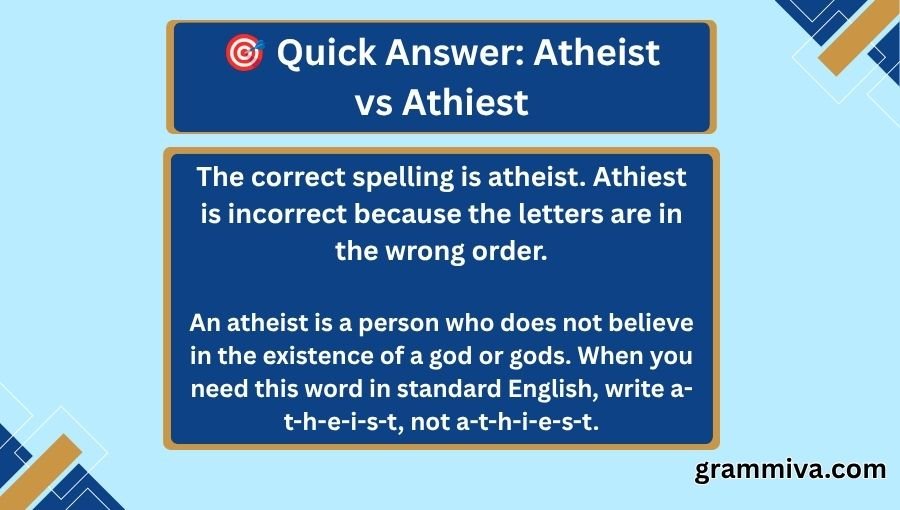
When it comes to Atheist vs Athiest, the correct spelling is atheist. The correct spelling is atheist. Athiest is incorrect because the letters are in the wrong order.
An atheist is a person who does not believe in the existence of a god or gods. When you need this word in standard English, write a-t-h-e-i-s-t, not a-t-h-i-e-s-t.
| Spelling | Status | Example |
|---|---|---|
| atheist | ✅ Correct | She describes herself as an atheist. |
| athiest | ❌ Incorrect | She describes herself as an athiest. |
🔎 Is Atheist the Same as Athiest?
No. Atheist and athiest are not two different words with different meanings. Atheist is the standard spelling, while athiest is a spelling error.
This distinction matters because switching two letters can turn a correct word into an incorrect one. The mistake does not create a separate accepted English term.
| Form | Type | Meaning | Example | Correct/Incorrect |
|---|---|---|---|---|
| atheist | Noun | A person who does not believe in a god or gods | The author was an atheist. | ✅ Correct |
| atheist | Adjective use | Describes something connected with atheism | The group discussed atheist writers. | ✅ Correct |
| athiest | Misspelling | No standard meaning as a separate English word | He called himself an athiest. | ❌ Incorrect |
🧠 Why Do People Confuse Atheist and Athiest?
The spelling Atheist vs Athiest can be confusing because the letters e and i are easy to reverse. People often confuse the two spellings because the letters e and i are easy to reverse. The correct sequence is -eis-, while the common mistake changes it to -ies-.
I once edited a short student essay in which the writer used “athiest” several times. The student knew exactly what the word meant. The problem was simply that the letter order had become a habit. After we focused on the spelling pattern, the mistake disappeared from the next draft.
Other reasons for the confusion include:
- typing too quickly;
- relying on sound instead of spelling;
- seeing the incorrect form repeatedly online;
- autocorrect failing to catch the mistake;
- remembering the word visually but not letter by letter;
- assuming that i should come before e.
The important point is that knowing the meaning does not always guarantee knowing the spelling.
A Simple Spelling Check
Break the word into two easy parts:
athe + ist
Then write:
a-t-h-e-i-s-t
Do not move the e and i.
| Version | Letter Pattern | Result |
|---|---|---|
| atheist | a-t-h-e-i-s-t | ✅ Correct |
| athiest | a-t-h-i-e-s-t | ❌ Incorrect |
| atheis | a-t-h-e-i-s | Incomplete |
| atheist’s | a-t-h-e-i-s-t + ‘s | ✅ Correct when showing possession |
📚 Atheist: Meaning and Correct Use
Atheist is a noun used for a person who does not believe in the existence of a god or gods. It can also appear before another noun to describe something related to atheism or to people who are atheist.
The basic noun use is straightforward:
She is an atheist.
Here, atheist identifies the person.
Another example is:
The speaker is an atheist.
Again, the word is a noun. It tells us what the person is.
The word can also modify another noun:
He read an atheist author.
Here, atheist describes the author.
The meaning should be understood from context, but the spelling stays the same.
| Meaning | Word Type | Example Sentence |
|---|---|---|
| A person who does not believe in a god or gods | Noun | The atheist explained his view calmly. |
| Related to an atheist or atheism | Descriptive use | She joined an atheist discussion group. |
| Used to identify a person’s stated position | Noun | My friend is an atheist. |
How to Use Atheist in a Sentence
Here are several natural examples:
- He is an atheist.
- She identifies as an atheist.
- The book includes an atheist character.
- An atheist speaker led the discussion.
- The article discusses atheist viewpoints.
The word should not be changed to athiest in any of these sentences.
💡 Test Tip
If you are unsure, slow down and look at the middle of the word.
Ask yourself:
Does the word contain “athei”?
If yes, you have the correct spelling:
atheist
If you see “athie,” you have probably reversed the e and i.
📝 Case Study: A Workplace Example
Imagine that you are writing a workplace newsletter about respectful discussion. You want to include this sentence:
The meeting included people with religious and atheist viewpoints.
That sentence uses atheist correctly.
Now imagine writing:
The meeting included people with religious and athiest viewpoints.
The second version contains a spelling error. The meaning may still be clear to readers, but the writing is less polished.
I once caught myself typing the wrong order of letters in a word that I had written hundreds of times. I stopped, checked the spelling, and corrected it before sending the document. That small pause is a useful habit: when a word suddenly looks strange, stop and check it instead of trusting muscle memory.
| Workplace Sentence | Correct/Incorrect | Reason |
|---|---|---|
| The report mentions atheist viewpoints. | ✅ Correct | The standard spelling is used. |
| The report mentions athiest viewpoints. | ❌ Incorrect | The e and i are reversed. |
| She identifies as an atheist. | ✅ Correct | The noun is spelled correctly. |
| She identifies as an athiest. | ❌ Incorrect | “Athiest” is a misspelling. |
| The article discusses atheism. | ✅ Correct | “Atheism” is a related standard word. |
Grammar Rules Explanation
The main rule for Atheist vs Athiest is simple: atheist is the standard English spelling, while athiest is incorrect. The main rule is simple: atheist is the standard English spelling, and athiest is a misspelling.
The correct form contains the sequence -thei-:
a-t-h-e-i-s-t
The incorrect form changes that sequence to -thie-:
a-t-h-i-e-s-t
There is no grammar rule that permits athiest as an alternative spelling of the noun. The issue is spelling rather than sentence structure.
Standard English reference sources agree on the spelling atheist. A general dictionary or spell-checking tool can therefore help confirm the form when you are unsure.
The related word atheism follows a different visible pattern:
a-t-h-e-i-s-m
This can be useful because it reminds you that the e comes before the i in the beginning of the word family.
Correct vs Incorrect at a Glance
| Sentence | Correct/Incorrect | Why |
|---|---|---|
| He is an atheist. | ✅ Correct | “Atheist” is correctly spelled. |
| He is an athiest. | ❌ Incorrect | The e and i are reversed. |
| She wrote about atheist ideas. | ✅ Correct | The standard spelling is used. |
| She wrote about athiest ideas. | ❌ Incorrect | “Athiest” is not the standard spelling. |
| The author describes himself as an atheist. | ✅ Correct | The noun is used correctly. |
⚠️ Common Mistakes With Atheist
The most common mistake in Atheist vs Athiest is reversing the e and i. The biggest mistake is simply reversing the e and i. But the error can appear in other forms when people type quickly.
I once reviewed a social post that had the wrong spelling in the first line. The writer fixed it immediately after I pointed it out. The post had been written on a phone, which made the mistake easy to understand: fast typing can cause even familiar words to go wrong.
Why These Errors Happen
Three causes are especially common:
- Fast typing: Your fingers may move faster than your attention.
- Autocorrect: A phone may not always recognize a misspelled word, especially if the incorrect form is not obviously impossible.
- Lack of knowledge: If you have only seen the word a few times, it is easy to remember the letters incorrectly.
Other factors include poor proofreading and learning the word mainly through speech.
Similar Spelling Confusions
| Confusion | Correct Form | Common Error | Main Problem |
|---|---|---|---|
| its / it’s | its / it’s | Mixing them | Possession vs contraction |
| your / you’re | your / you’re | Mixing them | Possession vs “you are” |
| their / there / they’re | their / there / they’re | Mixing them | Different meanings |
| definitely | definitely | definately | Missing letter order |
| separate | separate | seperate | Wrong vowel |
| atheist | atheist | athiest | Reversed e and i |
Specific Wrong Forms to Avoid
| Wrong Form | What’s Wrong | Correct Form |
|---|---|---|
| athiest | e and i are reversed | atheist |
| athiest’s | Based on the incorrect spelling | atheist’s |
| athiests | Incorrect spelling plus plural ending | atheists |
| athiest’s | Incorrect base word and possessive ending | atheist’s |
| atheis | Missing the final t | atheist |
| athest | Missing the i | atheist |
✍️ How to Remember the Correct Spelling
A simple memory trick is to focus on the middle: A simple way to remember Atheist vs Athiest is to focus on the middle letters: athei.
ATHEI
You can think of the word as:
ATHE + IST
The key is not to let the i jump ahead of the e.
Another useful trick is to connect it with atheism. Both words begin with athe-.
- atheist
- atheism
That shared beginning gives you a reliable visual cue.
| Memory Method | What to Remember | Example |
|---|---|---|
| Letter order | e comes before i | atheist |
| Word family | atheist → atheism | Both begin with athe- |
| Slow spelling | Say the letters in order | a-t-h-e-i-s-t |
| Visual check | Look for athei | Correct: atheist |
🌎 Usage in Different Contexts
The spelling does not change based on where you use the word. Whether you are chatting with a friend, writing an article, or posting online, the standard spelling remains atheist.
Everyday Conversation
In casual conversation, you might say:
My neighbor is an atheist.
The word is still spelled atheist, even though the conversation itself is informal.
Professional Writing
Professional writing benefits from correct spelling because readers may judge the care taken with the entire document based on small errors.
For example:
The survey included questions about religious and atheist perspectives.
Creative Writing
Authors can use the word in dialogue, narration, or character descriptions:
“I am an atheist,” the character said.
A fictional character can misspell a word only if the writer intentionally wants to show that character’s spelling mistake. In normal narration, use the standard form.
Social Media and Texting
Informal writing may contain many shortcuts, but athiest is still a misspelling. A short post does not require perfect style, but standard spelling makes the message easier to read.
| Context | Which Term to Use | Example |
|---|---|---|
| Everyday conversation | atheist | He is an atheist. |
| Professional writing | atheist | The report discusses atheist viewpoints. |
| Creative writing | atheist | The character calls himself an atheist. |
| Social media/texting | atheist | I have an atheist friend. |
💬 Common Phrases With Atheist
There are no special idioms that require the unusual spelling athiest. When common phrases use the word, they use atheist.
| Phrase | Meaning |
|---|---|
| an atheist | A person who does not believe in a god or gods |
| identify as an atheist | State that you consider yourself an atheist |
| atheist viewpoint | A viewpoint associated with atheism |
| atheist writer | A writer who is atheist |
| atheist community | A community centered around people who identify as atheist |
| atheist beliefs | Beliefs or views associated with atheism |
These phrases are useful because they show that the same spelling works in different sentence patterns.
🔄 Synonyms and Alternatives
There is no perfect synonym for atheist in every sentence. Some related terms can describe a person’s position, but they may not mean exactly the same thing.
For example, nonbeliever is broader and may be used in different contexts. Agnostic is not simply another word for atheist because the two terms can describe different positions about knowledge and belief.
For that reason, choose an alternative only when its meaning fits your sentence.
| Alternative | Works When | Does Not Work When |
|---|---|---|
| nonbeliever | You want a broader term | You need the precise term atheist |
| secular person | You mean someone not strongly tied to religion in public or social life | You specifically mean lack of belief in gods |
| agnostic | You mean uncertainty or a position about what can be known | You are using it as a direct replacement for atheist |
| person who does not believe in gods | You want a clear plain-English description | You need a short single-word term |
🎯 Atheist vs Athiest at a Glance
The central difference can be summarized in one sentence: atheist is correct, while athiest is a misspelling.
Once you remember the order e-i, the problem becomes much easier.
| Feature | Atheist | Athiest |
|---|---|---|
| Standard English spelling | ✅ Yes | ❌ No |
| Meaning | Person who does not believe in a god or gods | No separate standard meaning |
| Suitable for formal writing | ✅ Yes | ❌ No |
| Suitable for casual writing | ✅ Yes | ❌ No |
| Correct word family connection | atheism | Incorrect form |
❓ Why Does the Spelling Atheist Feel Unusual?
The spelling can feel unusual because English contains many words where letter order is hard to predict. Writers may also hear the word more often than they see it in print.
The solution is not to guess from pronunciation. Instead, learn the visual pattern.
When you see atheist, notice:
athe + ist
When you see athiest, notice that the i has moved too early.
That one visual check can prevent the mistake.
🧩 Does Atheist Have Related Word Forms?
Yes. Several related forms appear in normal English, including atheism, atheists, and atheist’s.
The spelling of the base word remains important because the other forms are built from it.
| Form | Type | Example |
|---|---|---|
| atheist | Singular noun | He is an atheist. |
| atheists | Plural noun | Several atheists attended. |
| atheist’s | Singular possessive | The atheist’s essay was published. |
| atheism | Related noun | The article discusses atheism. |
| atheistic | Related adjective | The book presents an atheistic argument. |
💼 Why Does Correct Spelling Matter?
Correct spelling helps readers understand your meaning without distraction. A single typo rarely destroys a sentence, but repeated spelling errors can make writing look rushed or poorly checked.
This matters most when the word appears in work that represents you.
| Situation | Why Getting It Right Matters |
|---|---|
| Resume | Shows care with written details |
| Client email | Supports a professional impression |
| Published content | Makes the writing easier to trust and read |
| Social post | Prevents an avoidable public spelling error |
A useful writing principle is:
Clear writing makes the reader’s job easier.
That applies even to one seven-letter word.
❓ Is Athiest Ever Correct?
No, not as the standard spelling of the word atheist. If you mean a person who does not believe in a god or gods, use atheist.
You may encounter athiest online because people make spelling mistakes. Seeing the form repeatedly does not make it a standard alternative.
❓ How Can You Check Whether Atheist Is Spelled Correctly?
Look at the middle letters. The correct form contains e before i:
atheist
If the spelling has i before e after the h, it is wrong:
athiest
A spell-check tool can also help, but learning the correct form yourself is better because you will not need to depend on software every time.
❓ What Is the Plural of Atheist?
The plural is atheists.
Simply add s to the correctly spelled singular form:
atheist → atheists
Do not begin with the misspelled form.
| Singular | Plural | Example |
|---|---|---|
| atheist | atheists | The atheists joined the discussion. |
| athiest | athiests | ❌ Both forms are misspelled. |
❓ What Is the Possessive Form of Atheist?
The singular possessive form is atheist’s.
For example:
The atheist’s essay was published online.
For a plural possessive, use atheists’:
The atheists’ discussion continued for an hour.
The apostrophe changes based on whether the noun is singular or plural.
| Form | Use | Example |
|---|---|---|
| atheist | Singular | The atheist spoke. |
| atheist’s | Singular possessive | The atheist’s book was nearby. |
| atheists | Plural | The atheists spoke. |
| atheists’ | Plural possessive | The atheists’ meeting ended. |
❓ Is Atheist a Noun or an Adjective?
Atheist is primarily a noun when it names a person. It can also be used before a noun as a descriptive word, as in atheist writer or atheist group.
For example:
She is an atheist.
Here, it is a noun.
In:
She is an atheist writer.
the word appears before another noun and describes the writer.
The exact grammatical role depends on the sentence.
❓ What Is the Difference Between Atheist and Agnostic?
An atheist is generally a person who does not believe in a god or gods. An agnostic generally describes a person who believes that knowledge about whether a god or gods exist is uncertain or cannot be known.
The terms can overlap in some people’s self-descriptions, so context matters. They should not automatically be treated as identical words.
❓ Is Atheist the Correct Spelling in American English?
Yes. Atheist is the standard spelling in US English. The spelling athiest is a misspelling.
The same basic spelling is also standard in other major forms of English.
❓ Why Do People Write Athiest Instead of Atheist?
People usually write athiest because they reverse the e and i. Fast typing, weak visual memory, autocorrect, and limited exposure to the written word can all contribute.
The easiest solution is to memorize the sequence:
athei
Then add:
st
That produces:
atheist
❓ How Do You Remember Atheist vs Athiest?
Remember that e comes before i in atheist. Another useful memory cue is the related word atheism, which also begins with athe-.
Try writing the word three times:
atheist — atheist — atheist
Then cover it and write it again from memory. Short practice like this can make the correct form easier to recall.
❓ What Is the Most Common Mistake With Atheist?
The most common mistake is writing athiest instead of atheist. The writer usually knows the word but places the i before the e.
A quick proofreading check of the middle letters can catch the error.
❓ Is Atheist a Negative or Offensive Word?
The word atheist is a descriptive term for a person’s position about belief in gods. Whether a particular sentence sounds respectful depends on the context, tone, and way the word is used.
The spelling question is separate from questions about tone or personal beliefs. In neutral writing, use the standard spelling and describe people accurately.
❓ What Should I Write: Atheist or Athiest?
Write atheist.
If your intended meaning is a person who does not believe in the existence of a god or gods, atheist is the correct standard form. Athiest should be corrected.
✅ Quick Recap Checklist
Use this quick check whenever you are unsure.
| Question | If Yes → Use |
|---|---|
| Am I naming a person who does not believe in a god or gods? | atheist |
| Am I writing the standard spelling? | atheist |
| Do I see athei in the middle? | Correct |
| Did I write athie instead? | Correct it to atheist |
| Am I making the plural? | atheists |
| Am I making the singular possessive? | atheist’s |
Practice Examples
- She is an atheist. ✅
- The article discusses atheist writers. ✅
- He called himself an athiest. ❌ → Correct: He called himself an atheist.
Conclusion
Atheist vs athiest has a very simple answer: atheist is the correct spelling, and athiest is a misspelling. Atheist vs Athiest has a simple answer: atheist is the correct spelling, while athiest is a misspelling.
The easiest way to remember it is to watch the middle letters. Write atheist with e before i: a-t-h-e-i-s-t. The incorrect form moves those two letters and produces a-t-h-i-e-s-t.
This small spelling difference can matter in schoolwork, professional writing, published content, and online communication. You do not need a complicated grammar rule to remember it. Learn the correct visual pattern, connect it with the related word atheism, and pause for a quick check when the word does not look right.
Good spelling is often about small habits. One careful second can prevent a typo that would otherwise remain in a sentence for everyone to see. 😊
So when you mean the word for a person who does not believe in a god or gods, remember one simple rule: e before i in atheist. Get that pattern right, and athiest becomes an easy mistake to spot. ✨

I am Adam Wilson, an English language content writer with an interest in grammar and vocabulary. I work at Grammiva and focus on creating clear explanations and practical examples for English learners.
[…] situations, and FAQs. By the end, you should be able to spot the correct form quickly. 🎯 Atheist vs Athiest | Acquire vs Aquire | achieve vs […]