Have you ever typed a resume, college application, or email and paused over bachelors degree vs bachelors degree? You are not alone.
The two phrases may look almost identical, but the real question is whether the word bachelor needs an apostrophe.
The standard form in US English is bachelor’s degree when you mean one degree earned by one bachelor-level graduate.
The apostrophe shows possession. The degree is associated with a bachelor.
That tiny punctuation mark can make a big difference in polished writing. ✍️
It can also matter when you are writing a resume, cover letter, school application, professional profile, or published article.
I have edited plenty of academic and workplace writing over the years, and this is one of those small grammar points that often gets missed.
The good news is that the rule is simple once you understand what the apostrophe is doing.
In this guide, I’ll explain the difference, show correct and incorrect examples, cover common variations, and give you quick tests you can use whenever you are unsure. 😊 Bad Rap vs Bad Rep | Doughnut vs Donut | Smoky vs Smokey
🎯 Quick Answer: Bachelors Degree vs Bachelors Degree
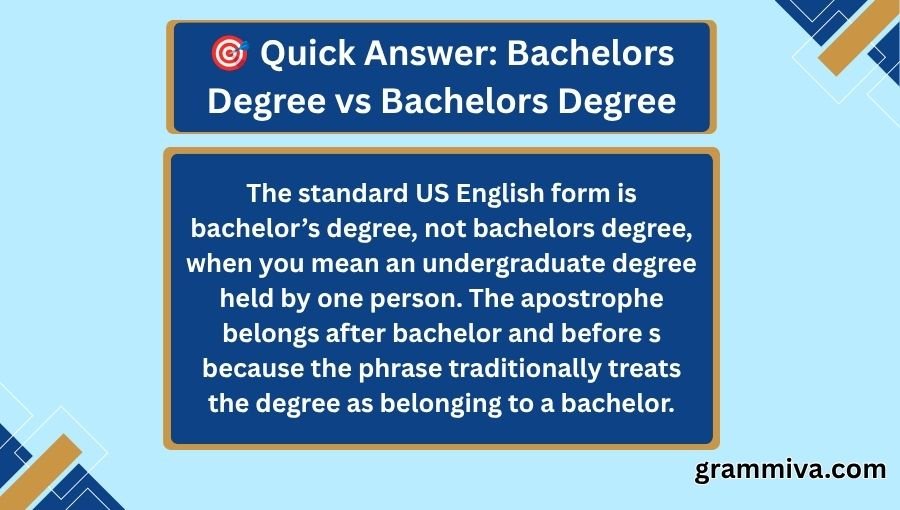
The standard US English form is bachelor’s degree, not bachelors degree, when you mean an undergraduate degree held by one person. The apostrophe belongs after bachelor and before s because the phrase traditionally treats the degree as belonging to a bachelor.
For example:
- ✅ She earned a bachelor’s degree in biology.
- ❌ She earned a bachelors degree in biology.
If you are writing formally, use bachelor’s degree.
Related Word Forms and Common Variations
The word bachelor can appear in several forms, but the apostrophe changes depending on whether you mean one person, more than one person, or a degree title.
| Form | Type | Example |
|---|---|---|
| bachelor | Singular noun | He is a bachelor. |
| bachelor’s | Singular possessive | She earned a bachelor’s degree. |
| bachelors | Plural noun | The two bachelors attended the event. |
| bachelors’ | Plural possessive | The bachelors’ apartments were nearby. |
| bachelor’s degree | Standard degree phrase | I have a bachelor’s degree in English. |
| Bachelor of Arts | Formal degree title | She earned a Bachelor of Arts in history. |
The most important point is this: bachelors without an apostrophe is normally a plural noun. It means more than one bachelor. It is not the standard spelling of the degree phrase.
🔎 Is Bachelor’s Degree the Correct Form?
Yes. Bachelor’s degree is the standard form when referring generally to an undergraduate degree earned by one person.
The phrase contains a possessive form. Think of it as a degree associated with a bachelor. The possessive ’s gives the phrase its standard written form.
Consider these examples:
- ✅ Maria has a bachelor’s degree in nursing.
- ❌ Maria has a bachelors degree in nursing.
- ✅ He is working toward a bachelor’s degree.
- ❌ He is working toward a bachelors degree.
The word degree is the noun being described. Bachelor’s tells us what kind of degree it is.
Bachelor’s Degree in a Sentence
Here is the basic pattern:
subject + verb + a bachelor’s degree + field
For example:
James earned a bachelor’s degree in computer science.
The subject is James.
The verb is earned.
The phrase a bachelor’s degree identifies the type of degree.
The phrase in computer science identifies the field.
The apostrophe does not change the meaning of the degree. It simply makes the phrase grammatically standard.
When Bachelor Is Used Without an Apostrophe
You do not need an apostrophe every time the word bachelor appears.
For example:
- He became a bachelor after the divorce.
- The novel features several bachelors.
Here, bachelor is a regular noun. There is no degree phrase.
| Meaning | Word Type | Example Sentence |
|---|---|---|
| One unmarried man | Singular noun | He lived as a bachelor. |
| More than one unmarried man | Plural noun | Several bachelors attended. |
| Degree associated with one bachelor | Singular possessive | She earned a bachelor’s degree. |
| Degree associated with more than one bachelor | Plural possessive, rare in this context | The bachelors’ experiences differed. |
💡 Test Tip: Try the “Whose?” Test
When you see bachelor’s, ask yourself:
“Whose degree?”
If your intended meaning is a degree associated with a bachelor, the possessive form makes sense.
Try it:
She earned a bachelor’s degree.
Ask: “Whose degree?”
Answer: “A bachelor’s.”
This is not a perfect test for every historical grammar question, but it is a useful way to remember the standard spelling.
Bachelors Degree vs Bachelors Degree at a Glance
The phrase bachelors degree vs bachelors degree presents a special problem because the two sides are written exactly the same way. The meaningful comparison is actually between bachelor’s degree and bachelors degree.
| Form | Type | Meaning | Example | Correct/Incorrect |
|---|---|---|---|---|
| bachelor’s degree | Singular possessive phrase | An undergraduate degree | She earned a bachelor’s degree. | ✅ Correct |
| bachelors degree | Plural noun used incorrectly | Intended as an undergraduate degree | She earned a bachelors degree. | ❌ Incorrect |
| Bachelor of Arts | Formal degree name | A specific degree title | He earned a Bachelor of Arts. | ✅ Correct |
| Bachelor of Science | Formal degree name | A specific degree title | She earned a Bachelor of Science. | ✅ Correct |
| bachelors | Plural noun | More than one bachelor | Three bachelors lived there. | ✅ Correct |
📝 Correct Meanings and Uses
The most common use is bachelor’s degree. However, related degree terms can appear in several settings.
1. General Academic Writing
Use bachelor’s degree when talking about the degree in general.
- ✅ A bachelor’s degree can prepare students for many careers.
- ❌ A bachelors degree can prepare students for many careers.
This form works in essays, articles, reports, school materials, and general explanations.
2. Resumes and Professional Profiles
A resume may use either a full phrase or a formal degree name.
For example:
- Bachelor’s degree in Marketing
- Bachelor of Arts in English
- Bachelor of Science in Biology
A resume often uses fragments rather than full sentences. Even so, the spelling should remain correct.
- ✅ Bachelor’s Degree in Finance
- ❌ Bachelors Degree in Finance
3. Formal Degree Names
When you use the official name of a degree, you may see Bachelor of Arts, Bachelor of Science, or another formal title.
These titles do not normally use the possessive apostrophe.
- ✅ She earned a Bachelor of Science in Chemistry.
- ❌ She earned a Bachelor’s of Science in Chemistry.
Notice the difference. Bachelor’s degree is a general phrase. Bachelor of Science is a formal degree name.
| Use | Preferred Form | Example |
|---|---|---|
| General reference | bachelor’s degree | He has a bachelor’s degree. |
| Field reference | bachelor’s degree in + field | She has a bachelor’s degree in art. |
| Formal degree title | Bachelor of Arts | He earned a Bachelor of Arts. |
| Formal science degree | Bachelor of Science | She earned a Bachelor of Science. |
| Plural people | bachelors | The bachelors met for dinner. |
How Do You Write Bachelor’s Degree on a Resume?
On a resume, write bachelor’s degree when you are using the general degree phrase. If you are giving the formal degree name, use the appropriate title, such as Bachelor of Arts or Bachelor of Science.
For example:
Education
Bachelor’s Degree in Business Administration
University Name
Or:
Education
Bachelor of Science in Computer Science
University Name
I once edited a job application where the applicant had written “Bachelors Degree” three times. Nothing was wrong with the person’s qualifications. The only problem was the missing apostrophe. We corrected the wording before the application was sent.
That small edit made the document look much more polished.
Why Do People Confuse Bachelor’s and Bachelors?
People confuse these forms because the apostrophe is easy to miss, and bachelors is a real English word. The problem is that it has a different job.
Bachelors is the plural of bachelor.
Bachelor’s is the singular possessive form.
Fast typing is one major reason. People often leave out apostrophes when they type quickly. Autocorrect can also play a role. Some writing tools do not catch every grammar error, especially when the incorrect form is itself a valid word.
Another reason is simple lack of knowledge. Many writers learn the phrase by hearing it. When they later type it, they may not know whether an apostrophe belongs there.
I once caught myself typing “bachelors degree” in a quick note. I knew the rule, but I was typing quickly and skipped the apostrophe. That reminded me why a final proofreading pass matters even for simple phrases.
Common Confusions With Similar Grammar Forms
| Confusion | Correct Form | Common Incorrect Form | Reason |
|---|---|---|---|
| Singular possessive | bachelor’s | bachelors | Apostrophe shows possession |
| Plural | bachelors | bachelor’s | Plural does not need an apostrophe |
| Possessive pronoun | its | it’s | It’s means “it is” or “it has” |
| Possessive adjective | your | you’re | You’re means “you are” |
| Possessive adjective | their | they’re | They’re means “they are” |
| Singular possessive | student’s | students | Apostrophe marks possession |
Specific Wrong Forms to Avoid
| Wrong Form | What’s Wrong | Correct Form |
|---|---|---|
| bachelors degree | Missing possessive apostrophe | bachelor’s degree |
| Bachelor’s of Science | Apostrophe is unnecessary before “of” | Bachelor of Science |
| bachelors’ degree | Uses plural possessive for a normal singular degree | bachelor’s degree |
| bachelor degree | Drops the possessive form | bachelor’s degree |
| Bachelors Degree | Missing apostrophe and unnecessary capitalization in a general phrase | bachelor’s degree |
| bachelors degree’s | Adds both an incorrect plural form and an incorrect ending | bachelor’s degree |
⚠️ Common Mistakes With Bachelor’s Degree
The most common mistake is simply leaving out the apostrophe.
Mistake 1: Treating “Bachelors” as the Degree Name
Writers sometimes see the word bachelor and assume that adding s creates the degree term.
It does not.
Bachelors means more than one bachelor. It does not normally mean a degree.
Mistake 2: Adding an Apostrophe to Bachelor of Science
The opposite error is also common.
- ❌ Bachelor’s of Science
- ✅ Bachelor of Science
When degree follows bachelor, use bachelor’s degree. When you use the formal construction Bachelor of Science, do not add the apostrophe.
Mistake 3: Capitalizing Every Word
A general phrase usually does not need title-style capitalization.
- ✅ She earned a bachelor’s degree in history.
- ❌ She earned a Bachelor’s Degree in History.
Formal degree names can be capitalized according to the style used by the institution or document.
Mistake 4: Assuming the Plural Needs an Apostrophe
The plural noun bachelors does not need an apostrophe.
For example:
- Three bachelors attended the party.
The apostrophe is not a general “plural mark.” It has a specific grammatical job.
Grammar Rules Explanation
The standard form bachelor’s degree uses a singular possessive noun followed by the noun degree. The apostrophe and s mark the singular possessive form of bachelor.
The form bachelors degree is not the standard construction for the general degree phrase. In that spelling, bachelors is a plural noun. It does not correctly serve as the usual possessive modifier in this phrase.
The distinction is similar to other singular possessives:
- student’s book
- teacher’s desk
- doctor’s office
- bachelor’s degree
In each case, the apostrophe helps show the relationship between the first noun and the following noun.
Standard English reference works and major dictionaries consistently recognize the conventional phrase bachelor’s degree. The key lesson is not to memorize a difficult exception. It is to recognize the possessive pattern.
Correct vs Incorrect at a Glance
| Sentence | Correct/Incorrect | Why |
|---|---|---|
| She earned a bachelor’s degree in English. | ✅ Correct | Uses the standard singular possessive form. |
| She earned a bachelors degree in English. | ❌ Incorrect | The possessive apostrophe is missing. |
| He has a Bachelor of Science in physics. | ✅ Correct | Uses a formal degree name. |
| He has a Bachelor’s of Science in physics. | ❌ Incorrect | The apostrophe does not belong in this “of” construction. |
| They both earned bachelor’s degrees. | ✅ Correct | The possessive form modifies the plural noun degrees. |
How Does the Apostrophe Change the Meaning?
The apostrophe changes the grammatical form of bachelor. Without it, bachelors is plural. With it, bachelor’s is singular possessive.
Compare:
bachelors = more than one bachelor
bachelor’s = belonging to or associated with one bachelor
This is why the distinction matters even though the spoken forms may sound very similar.
| Form | What It Signals | Example |
|---|---|---|
| bachelor | One bachelor | He is a bachelor. |
| bachelors | More than one bachelor | Two bachelors arrived. |
| bachelor’s | Singular possessive | She earned a bachelor’s degree. |
| bachelors’ | Plural possessive | The bachelors’ homes were nearby. |
Case Study: A College Application
Imagine a student named Jordan applying for a graduate program.
Jordan writes:
Education: Bachelors Degree in Psychology
The information is understandable, but the form is not polished.
A cleaner version is:
Education: Bachelor’s Degree in Psychology
If the school uses the formal degree name, an even more specific version could be:
Education: Bachelor of Arts in Psychology
The important lesson is that the writer has choices. The writer can use the general phrase bachelor’s degree or a formal degree title such as Bachelor of Arts. What should be avoided is the nonstandard bachelors degree.
This same rule applies to resumes, cover letters, scholarship forms, professional biographies, and academic essays.
Bachelor’s Degree in Different Writing Contexts
The same basic grammar rule applies across most forms of writing. What changes is the level of formality and whether you are using a general phrase or an official degree title.
| Context | Which Term to Use | Example |
|---|---|---|
| Everyday conversation | bachelor’s degree | I have a bachelor’s degree. |
| Professional writing | bachelor’s degree | Applicants should have a bachelor’s degree. |
| Creative writing | bachelor’s degree | She was proud of her bachelor’s degree. |
| Social media/texting | bachelor’s degree | Finally finished my bachelor’s degree! |
| Formal degree listing | Bachelor of Arts/Science | Bachelor of Science in Biology |
Everyday Conversation
In casual speech, people often shorten or simplify academic terms. Still, if you write the phrase, bachelor’s degree is the safe standard.
Professional Writing
Professional writing calls for extra care. A resume or business profile may be read quickly. Small errors can affect how polished the document appears.
Creative Writing
Creative writing gives you more freedom in style, but standard spelling still helps readers understand your meaning without distraction.
Social Media and Texting
People often drop punctuation in casual messages. That does not make the full form wrong. If you want polished writing, keep the apostrophe.
Common Phrases With Bachelor’s Degree
There are several common phrases built around bachelor’s degree.
| Phrase | Meaning |
|---|---|
| bachelor’s degree in English | An undergraduate degree focused on English |
| bachelor’s degree program | A program leading to a bachelor’s degree |
| bachelor’s degree holder | A person who has earned a bachelor’s degree |
| bachelor’s degree requirements | Conditions needed to earn the degree |
| bachelor’s degree program | A course of study leading to the degree |
| earn a bachelor’s degree | Complete the requirements for the degree |
These phrases are useful in academic, career, and professional writing.
What Are Good Alternatives to Bachelor’s Degree?
Sometimes you can replace the phrase with another expression. The best choice depends on context.
| Alternative | Works When | Does Not Work When |
|---|---|---|
| undergraduate degree | You want a broad academic term | You need to identify a bachelor-level degree specifically |
| four-year degree | The program normally takes about four years | The program length is unusual or different |
| Bachelor of Arts | The specific degree is a BA | The degree is not a Bachelor of Arts |
| Bachelor of Science | The specific degree is a BS | The degree is not a Bachelor of Science |
| undergraduate qualification | You need a broad academic phrase | You are writing in simple everyday US English |
For most general writing, bachelor’s degree is clear and natural.
Why Does Correct Spelling Matter?
Correct spelling and punctuation help readers trust your writing. One missing apostrophe may not change the basic meaning, but repeated small errors can make a document look rushed.
Clarity in Communication
Good punctuation helps readers understand how words relate to one another. In this case, the apostrophe shows that bachelor’s is being used as a possessive modifier.
Professionalism
A resume, job application, or professional profile should look clean. Correct grammar shows attention to detail.
Digital Communication
Online writing is often scanned quickly. A familiar, standard phrase is easier to recognize.
A useful rule I give writers is:
Small marks can make a big difference in clear writing.
Why It Matters in Different Situations
| Situation | Why Getting It Right Matters |
|---|---|
| Resume | Creates a polished professional impression |
| Client email | Shows care and attention to detail |
| Published content | Supports clean, standard language |
| Social post | Makes the message easier to read |
Is There a Special Exception?
There is no major exception that turns bachelors degree into the standard general spelling. The main variation comes from using an official degree title.
For example:
- bachelor’s degree = general phrase
- Bachelor of Arts = formal degree title
- Bachelor of Science = formal degree title
You may also see school-specific capitalization styles. When you are listing the exact official name of a degree, follow the institution’s stated style when appropriate.
The key point remains the same: do not add an apostrophe to Bachelor of Arts simply because the phrase refers to a bachelor’s degree.
How To Remember the Difference
I recommend using three quick checks.
Check 1: Are You Talking About the Degree?
If yes, the general phrase is usually:
bachelor’s degree
Check 2: Are You Talking About More Than One Bachelor?
If yes, use:
bachelors
For example:
The two bachelors arrived early.
Check 3: Is It a Formal Degree Title?
If yes, you may have:
Bachelor of Arts
Bachelor of Science
This three-step check solves most cases.
| Question | Answer | Form |
|---|---|---|
| Am I naming the general degree? | Yes | bachelor’s degree |
| Am I talking about several bachelors? | Yes | bachelors |
| Am I naming a formal degree? | Yes | Bachelor of Arts/Science |
| Am I writing “bachelors degree”? | Yes | Change it to bachelor’s degree |
| Am I writing “Bachelor’s of Science”? | Yes | Change it to Bachelor of Science |
FAQs About Bachelor’s vs Bachelors
Is “bachelors degree” grammatically correct?
No. In standard US English, the usual form is bachelor’s degree. The apostrophe marks the singular possessive form.
Is it bachelor’s degree or bachelors degree?
Use bachelor’s degree when referring to the undergraduate degree. Bachelors without an apostrophe is the plural form of bachelor, not the standard form of the degree phrase.
Why does bachelor’s degree have an apostrophe?
The apostrophe marks the singular possessive form of bachelor. In the phrase bachelor’s degree, bachelor’s modifies degree.
Should bachelor’s degree be capitalized?
Usually, no, when it is used as a general phrase in a sentence. For example: She earned a bachelor’s degree in history. Formal degree names such as Bachelor of Science may use capitalization.
Should I write bachelor’s degree on my resume?
Yes. Bachelor’s degree is a standard way to describe the qualification on a resume. You can also list the formal degree name, such as Bachelor of Science in Marketing.
Is “Bachelor of Science” correct without an apostrophe?
Yes. Bachelor of Science is a formal degree-name construction. Do not write Bachelor’s of Science when using that construction.
What is the plural of bachelor?
The plural is bachelors. For example: Three bachelors attended the event. This is different from the possessive bachelor’s.
Is “bachelors’ degree” correct?
No, not for the normal meaning of one person’s degree. Bachelors’ is a plural possessive form and does not fit the standard general phrase. Use bachelor’s degree.
Can I write “four-year degree” instead?
Sometimes. Four-year degree is a broader, more informal term. It may work when the exact degree type is not important, but it does not always mean exactly the same thing as bachelor’s degree.
What is the easiest way to remember the spelling?
Remember this pair:
bachelors = more than one bachelor
bachelor’s = degree associated with one bachelor
If you mean the academic qualification, bachelor’s degree is the safe choice.
Quick Recap Checklist ✅
Use this checklist whenever you are unsure.
| Question | If Yes → Use |
|---|---|
| Are you referring to one person’s undergraduate degree? | bachelor’s degree |
| Are you talking about several unmarried men? | bachelors |
| Are you naming a formal BA degree? | Bachelor of Arts |
| Are you naming a formal BS degree? | Bachelor of Science |
| Did you type “bachelors degree”? | Change it to bachelor’s degree |
| Did you type “Bachelor’s of Science”? | Change it to Bachelor of Science |
Practice Examples
Try these before checking the answers:
- She earned a ______ degree in chemistry.
- Three ______ attended the dinner.
- He earned a ______ of Science in engineering.
Answers:
- bachelor’s
- bachelors
- Bachelor
The pattern becomes much easier when you focus on the job the word is doing.
Key Differences Between Bachelor’s Degree and Bachelors Degree
The core difference is the apostrophe. Bachelor’s degree uses a singular possessive form, while bachelors degree incorrectly uses a plural noun as though it were the standard degree modifier.
| Feature | Bachelor’s Degree | Bachelors Degree |
|---|---|---|
| Apostrophe | Yes | No |
| Standard degree phrase | Yes | No |
| Bachelor’s is singular possessive | Yes | No |
| Bachelors is plural | No | Yes |
| Suitable for formal writing | Yes | No |
| Example | She earned a bachelor’s degree. | She earned a bachelors degree. |
What Should You Use in Formal US English?
For formal US English, choose bachelor’s degree when you are referring to the general academic qualification. Use Bachelor of Arts, Bachelor of Science, or another official title when you are naming the specific degree.
The easiest rule is:
Use “bachelor’s degree” for the general phrase and “Bachelor of Arts/Science” for the formal title.
Do not use bachelors degree as the standard spelling.
Conclusion: Bachelors Degree vs Bachelors Degree Made Simple
Bachelors degree vs bachelors degree becomes much easier once you focus on the apostrophe: the standard form for the academic qualification is bachelor’s degree. The apostrophe marks the singular possessive form of bachelor, while bachelors without an apostrophe is the plural noun.
Use bachelor’s degree in phrases such as “She earned a bachelor’s degree in history.” When you use a formal title, write Bachelor of Arts or Bachelor of Science without an apostrophe before of.
The good news is that you do not need to memorize a long grammar rule. Just remember three forms: bachelor’s degree, bachelors, and Bachelor of Science/Bachelor of Arts. 🎓
A tiny apostrophe can separate polished writing from a common error. So the next time you write a resume, application, email, or article, take one second to check it.
When you mean the degree, give “bachelor’s” its apostrophe. ✨

I am Alex Morgan, an English grammar and vocabulary writer passionate about making language learning simple and useful. I work at Grammiva, where I create clear educational content and practical English examples for learners.

[…] you can use when writing emails, school assignments, reports, posts, and everyday messages. 😊 Bachelors Degree vs Bachelors Degree | Bad Rap vs Bad Rep | Doughnut vs […]