Have you ever typed a sentence like “There are two flys in the kitchen” and then stopped to wonder if something looked wrong? 😅 You are not alone. flies vs flys is a common spelling question because English changes the spelling of some words when they become plural or change form.
The good news is that the rule is simple once you see the pattern.
In standard US English, flies is the correct spelling in the situations most writers mean.
Flyspeck is not the standard plural of fly, and it is not the standard third-person singular form of the verb fly.
I teach writers to look at the word’s job in the sentence first.
Is it talking about more than one insect? Is it describing something that a person, bird, or plane does? In both cases, the standard form is usually flies.
This guide explains the difference in plain English.
You will see examples, tables, common mistakes, memory tricks, and answers to the questions people ask most often. By the end, the spelling should feel automatic. ✍️ Hygiene vs Hygene | Organizing vs Organising | Per Se vs Per Say
🎯 Quick Answer: Flies vs flys
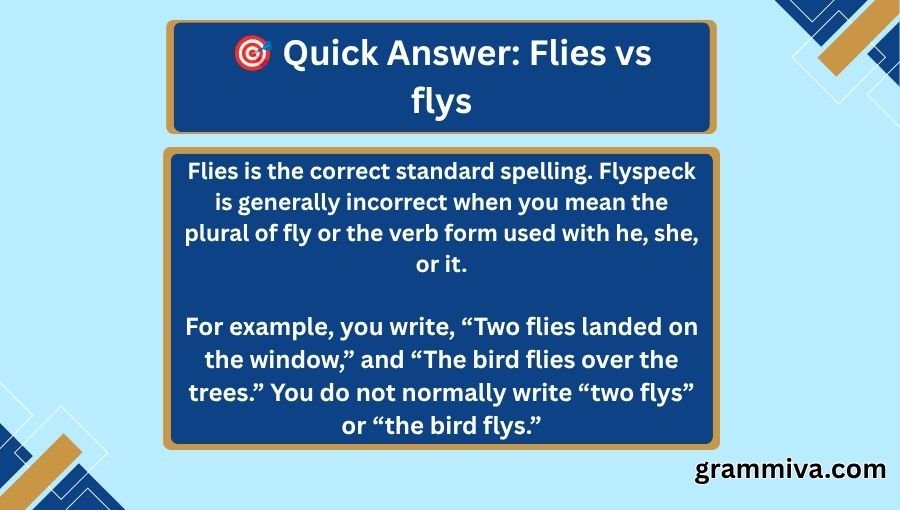
Flies is the correct standard spelling. Flyspeck is generally incorrect when you mean the plural of fly or the verb form used with he, she, or it.
For example, you write, “Two flies landed on the window,” and “The bird flies over the trees.” You do not normally write “two flys” or “the bird flys.”
Related Word Forms
The word fly has several related forms. Knowing them helps prevent mistakes with both spelling and punctuation.
| Form | Type | Example |
|---|---|---|
| fly | Singular noun or base verb | A fly is on the wall. |
| flies | Plural noun | Three flies are on the wall. |
| fly | Base verb | Birds fly south. |
| flies | Third-person singular verb | A bird flies south. |
| flew | Past-tense verb | The bird flew away. |
| flown | Past participle | The bird has flown away. |
| flying | Present participle | The bird is flying. |
| fly’s | Singular possessive | The fly’s wings are small. |
| flies’ | Plural possessive | The flies’ wings are delicate. |
The key point is that flies can be both a plural noun and a verb. Its meaning depends on the sentence.
🔎 Understanding Flies vs flys
The core difference is spelling. In standard English, fly changes to flies when it needs a plural noun form or a third-person singular verb form.
| Form | Type | Meaning | Example | Correct/Incorrect |
|---|---|---|---|---|
| fly | Singular noun | One insect or other meaning of fly | I saw a fly. | ✅ Correct |
| flies | Plural noun | More than one fly | I saw three flies. | ✅ Correct |
| fly | Base verb | To move through the air | Birds fly. | ✅ Correct |
| flies | Third-person singular verb | He, she, or it moves through the air | The eagle flies high. | ✅ Correct |
| flys | Intended plural noun | Usually meant to mean more than one fly | I saw two flys. | ❌ Incorrect |
| flys | Intended third-person verb | Usually meant as the verb flies | The eagle flys high. | ❌ Incorrect |
Why does fly become flies?
When fly is used as a noun, the plural form follows a common English spelling rule.
Words ending in a consonant followed by y often change the y to ies when they become plural.
For example:
- fly → flies
- baby → babies
- city → cities
- party → parties
- story → stories
The same basic pattern applies when fly is used as a verb with he, she, or it.
So:
- I fly.
- You fly.
- We fly.
- They fly.
- He flies.
- She flies.
- It flies.
The spelling changes because the word has changed form.
Is flys ever the standard spelling?
In ordinary standard English, flys is not the correct spelling for the plural of fly or for the third-person singular verb.
If you are writing an essay, email, report, school assignment, article, or other standard English text, use flies.
A rare proper name, brand name, username, title, or specialized label could use Flyspeck as a name. That does not make it the standard English spelling of the word.
🦋 When Should You Use Flies?
You should use flies when fly is plural or when it is the third-person singular form of the verb fly.
These two uses are easy to separate once you look at what the word is doing.
Flies as a plural noun
When you mean more than one fly, use flies.
Examples:
- One fly is near the door.
- Two flies are near the door.
- Several flies entered the room.
- The flies disappeared after the window was opened.
Here, flies is a noun. It names more than one thing.
The singular and plural forms work like this:
one fly → two flies
You would not write:
one fly → two flys
That spelling does not follow the standard plural pattern.
Flies as a verb
Flies is also the correct form of the verb fly when the subject is he, she, or it, or another singular third-person subject.
Examples:
- The bird flies over the lake.
- The plane flies across the country.
- A butterfly flies from flower to flower.
- My brother flies home every December.
Compare those sentences with sentences using I, you, we, or they:
- I fly to Chicago.
- You fly to Chicago.
- We fly to Chicago.
- They fly to Chicago.
- She flies to Chicago.
The verb changes because the subject changes.
A simple meaning table
| Meaning | Word Type | Example Sentence |
|---|---|---|
| More than one insect | Plural noun | The flies are near the window. |
| More than one flying object or insect in another context | Plural noun | Several flies appeared in the room. |
| He, she, or it moves through the air | Verb | The bird flies over the field. |
| A singular thing travels by air | Verb | The plane flies every morning. |
💡 Test Tip: Use the subject test
When you are unsure about flies vs flys, ask two questions:
Question 1: Am I talking about more than one fly?
If yes, write flies.
Question 2: Is fly the verb, and is the subject he, she, or it?
If yes, write flies.
If you can replace the subject with they, you will usually need fly, not flies.
For example:
They fly every summer.
But:
She flies every summer.
That quick subject test catches many spelling errors.
📝 Case Study: A Real Workplace Example
I once edited a short workplace notice that said, “Please close the window because several flys have entered the office.” The writer had typed the message quickly and did not notice the spelling.
The fix was simple:
“Please close the window because several flies have entered the office.”
The meaning was already clear. The problem was the spelling. In a casual message, someone might understand flys without trouble. In a workplace notice, however, the standard spelling makes the message look polished and reliable.
This is a good example of why spelling rules matter. The goal is not to make writing fancy. The goal is to make it clean and easy to trust.
📚 Grammar Rules Explanation
The standard rule is based on how English forms certain plurals and third-person singular verbs.
For a noun such as fly, the plural is formed by changing the final y to ies:
fly → flies
The same spelling appears with the verb when the subject is third-person singular:
fly → flies
This means that flies is not simply a special word that must be memorized. It fits a wider spelling pattern found in English.
The important detail is the letter before the y. When a word ends in a consonant plus y, the y often changes to ies when the word takes this type of ending.
Examples include:
- baby → babies
- city → cities
- country → countries
- story → stories
- fly → flies
However, words ending in a vowel plus y usually keep the y and add s.
For example:
- boy → boys
- day → days
- toy → toys
- key → keys
That distinction helps explain why fly becomes flies, while boy becomes boys.
Most standard English dictionaries and grammar references agree on the ordinary spelling: flies is the standard form.
Correct vs Incorrect at a Glance
| Sentence | Correct/Incorrect | Why |
|---|---|---|
| Two flies are on the wall. | ✅ Correct | Flies is the plural noun. |
| Two flys are on the wall. | ❌ Incorrect | The standard plural is flies. |
| The bird flies over the house. | ✅ Correct | Flies is the third-person singular verb. |
| The bird flys over the house. | ❌ Incorrect | The standard verb form is flies. |
| The birds fly over the house. | ✅ Correct | Birds is plural, so the base verb fly is used. |
⚠️ Why Do People Confuse Flies and flys?
People confuse these forms because English has many different plural and verb patterns. It is easy to remember “add S” and forget that some words require a spelling change.
There are also several everyday reasons for the mistake:
- Fast typing: You may type the word before thinking about the spelling.
- Autocorrect: A phone or browser may not always catch a nonstandard form.
- Lack of knowledge: You may never have learned the consonant-plus-y rule.
- Sound: Flies and flys may seem similar when spoken.
- Visual habit: If you have seen an incorrect form online, it can start to look familiar.
I once caught myself typing flys in a quick message while editing a travel article. I knew the rule, but I was typing fast and had focused on the sentence rather than the word. A quick reread caught it.
That experience is a useful reminder: knowing a rule does not always prevent a typo. Proofreading still matters.
Similar Grammar Confusions
The problem is not unique to this word. English has many pairs that look or sound similar.
| Confusion | Correct Forms | Main Difference |
|---|---|---|
| it’s / its | it’s, its | It’s means it is or it has; its shows possession. |
| your / you’re | your, you’re | Your shows possession; you’re means you are. |
| their / there / they’re | their, there, they’re | Possession, place, and they are. |
| who’s / whose | who’s, whose | Who’s means who is or who has; whose asks about possession. |
| then / than | then, than | Time/order versus comparison. |
Common Wrong Spellings and Uses
| Wrong Form | What’s Wrong | Correct Form |
|---|---|---|
| flys | Incorrect standard plural | flies |
| flys | Incorrect third-person singular verb | flies |
| two flys | Incorrect plural spelling | two flies |
| the bird flys | Incorrect verb spelling | the bird flies |
| the flies’s wings | Incorrect possessive form | the flies’ wings |
| one flies | Incorrect if referring to one insect | one fly |
🧠 How To Remember the Difference
A simple memory trick is:
Consonant + Y → change Y to IES.
The word fly ends in ly. The letter before y is l, a consonant.
So:
fly → flies
You can also remember the sentence:
One fly, two flies.
That short phrase is enough for the noun form.
For the verb, remember:
I fly, but she flies.
This gives you both major uses.
Here is another useful pattern:
| Singular/Base Form | Changed Form |
|---|---|
| fly | flies |
| try | tries |
| cry | cries |
| carry | carries |
| study | studies |
Seeing several examples together makes the pattern easier to remember.
🌎 Flies vs flys in Different Contexts
The standard spelling does not change just because the setting changes. In formal and informal writing, flies remains the normal spelling.
| Context | Which Term to Use | Example |
|---|---|---|
| Everyday conversation | flies | There are flies in the kitchen. |
| Professional writing | flies | The report notes that flies were found near the storage area. |
| Creative writing | flies | A swarm of flies rose from the field. |
| Social media/texting | flies | Ugh, there are flies everywhere! |
Texting and social media may contain intentional misspellings, slang, or playful spellings. That does not change the standard spelling rule.
If you are writing something that needs to be correct, use flies.
✍️ Professional Writing With Flies
Correct spelling becomes more valuable when your words represent you at work.
Imagine these sentences in a report:
“The inspector found several flys near the loading area.”
The intended meaning is easy to understand, but the spelling looks careless.
A better version is:
“The inspector found several flies near the loading area.”
The corrected sentence is not more complicated. It simply follows standard English.
This matters in:
- business reports
- customer emails
- school assignments
- websites
- newsletters
- resumes and cover letters
- published articles
- instructions and signs
Good spelling helps readers focus on your message instead of noticing avoidable errors.
💬 Everyday Conversation and Informal Writing
In speech, you will not hear the spelling difference. Both forms can sound similar. That is one reason people may learn the wrong written form.
For example, someone might say:
“There are flies in the kitchen.”
When you write the sentence, however, you need the standard spelling.
The same is true for the verb:
“That bird flies very fast.”
Speech gives you the meaning. Writing gives you a second job: choosing the correct letters.
📱 Social Media and Texting
Online writing is often less formal. People may leave out punctuation or use slang. Still, flies is the standard spelling.
You might see someone write:
“There are so many flys here.”
Readers will probably understand it. But if you want correct US English, write:
“There are so many flies here.”
The goal is not to judge informal writing. It is simply to know the standard form when accuracy matters.
🦟 Common Phrases With Flies
The word flies appears in many normal expressions and sentences. Some are literal, while others use flies as a verb.
| Phrase | Meaning |
|---|---|
| Time flies | Time seems to pass quickly. |
| Flies around the room | Moves around the room in flight. |
| Flies over the city | Travels through the air above the city. |
| Flies into the air | Moves upward through the air. |
| Flies in the face of | Goes against an idea, rule, or expectation. |
| Flies under the radar | Goes unnoticed or receives little attention. |
Not every phrase means the same thing. In time flies, flies is a verb. In flies around the room, it may be a plural noun if the sentence says something such as “The flies are around the room.”
Always look at the surrounding words.
🔄 Alternatives and Related Words
Sometimes you can avoid the spelling issue by changing the sentence. This can be useful if you are rewriting a sentence for clarity.
| Alternative | Works When | Does Not Work When |
|---|---|---|
| insects | You mean flies as insects in general | You specifically need to name flies. |
| flying insects | You want to describe the group | You need a short, direct noun. |
| travels by air | You mean movement through the air | You specifically need the verb flies. |
| takes a flight | You are describing air travel | You mean an animal flying. |
| moves through the air | You want a broad description | You need the exact verb flies. |
These alternatives do not replace flies in every sentence. They simply give you other ways to express the same general idea.
💼 Why Does Correct Spelling Matter?
Correct spelling improves clarity and shows care.
A single spelling mistake rarely destroys communication. But repeated errors can make a reader question the quality of the rest of a document.
Consider this simple principle:
Clear writing makes the reader’s job easier.
Clarity in communication
When the spelling is correct, readers do not have to pause and wonder whether a word is intentional or accidental.
Professionalism
A correctly spelled word gives your writing a more polished appearance. This matters when your writing represents a company, school, or professional role.
Digital communication
Online writing moves quickly. Emails, messages, comments, and posts are often written without much editing. That makes simple spelling checks even more useful.
| Situation | Why Getting It Right Matters |
|---|---|
| Resume | Shows attention to detail. |
| Client email | Builds a professional impression. |
| Published content | Protects the quality of the writing. |
| Social post | Makes the message easier to read and share. |
🎯 Flies vs flys: The Most Important Rule
If you remember only one rule from this article, remember this:
Use flies, not flys, in standard English when you mean the plural of fly or the third-person singular form of the verb fly.
Examples:
- One fly → two flies.
- I fly → she flies.
- Birds fly → a bird flies.
The spelling flys is not the normal standard form for these uses.
❓ Is Flies the Plural of Fly?
Yes. Flies is the standard plural of the noun fly.
For example:
One fly landed on the table.
becomes:
Three flies landed on the table.
The spelling changes from y to ies.
❓ Why Is Flyspeck Wrong?
Flyspeck is wrong in standard English when it is intended as the plural noun or third-person singular verb. The standard spelling is flies.
The change follows a common spelling pattern for words ending in a consonant plus y.
❓ Is It “Two Flies” or “Two Flyspeck”?
The correct phrase is “two flies.”
Use flies because fly changes its final y to ies when forming this plural.
Correct:
We saw two flies.
Incorrect:
We saw two flys.
❓ Is It “The Bird Flyspeck” or “The Bird Flies”?
The correct sentence is “The bird flies.”
The subject bird is singular, so the verb fly takes its third-person singular form: flies.
Compare:
The bird flies.
with:
The birds fly.
The singular subject uses flies, while the plural subject uses fly.
❓ What Is the Difference Between Fly and Flies?
Fly can be a singular noun or a base-form verb. Flies can be a plural noun or the third-person singular form of the verb.
| Sentence | Role of the Word |
|---|---|
| I saw a fly. | Singular noun |
| I saw two flies. | Plural noun |
| Birds fly. | Base verb |
| A bird flies. | Third-person singular verb |
❓ Is Flyspeck Ever Correct?
Flyspeck is not the standard English spelling for the plural of fly or the normal third-person singular form of the verb fly. A proper name, brand, username, or special label could contain Flyspeck, but that is a name-specific use rather than the standard grammar rule.
❓ What Is the Possessive Form of Fly?
For one fly, use fly’s:
The fly’s wings were damaged.
For more than one fly, use flies’:
The flies’ wings were difficult to see.
Notice the apostrophe placement.
| Meaning | Correct Form | Example |
|---|---|---|
| One fly owns something | fly’s | The fly’s wing is damaged. |
| Several flies own something | flies’ | The flies’ wings are damaged. |
❓ Does Fly Become Flies in Every Sentence?
No. Fly does not become flies every time it appears.
The base verb remains fly with I, you, we, and they:
I fly.
They fly.
The verb becomes flies with a singular third-person subject:
She flies.
The plane flies.
The noun becomes flies when you mean more than one fly.
❓ What Is the Easiest Way To Remember Flies vs flys?
Use two memory sentences:
One fly, two flies.
and:
I fly, she flies.
If you remember those two patterns, you can handle most everyday uses correctly.
❓ How Do I Avoid This Spelling Mistake When Typing?
Slow down for words that end in y. When you need a plural or third-person singular form, check the letter before the y.
You can also proofread by asking:
- Is the word a noun?
- Do I mean more than one?
- Is it a verb?
- Is the subject he, she, or it?
If the answer points to the changed form of fly, write flies.
❓ Is Flies a Verb or a Noun?
It can be either.
As a noun:
The flies are outside.
As a verb:
The bird flies outside.
The surrounding words tell you which role it has.
❓ Can I Use Flies in Formal Writing?
Yes. Flies is the standard spelling and is completely appropriate in formal writing.
For example:
The study area contained several flies.
or:
The aircraft flies between the two cities each day.
The spelling is standard in academic, professional, and everyday English.
❓ What Should I Write: Flyspeck or Flies?
Write flies when you need the plural noun or the third-person singular verb.
Use:
- fly for one fly
- flies for more than one fly
- fly with I, you, we, and they
- flies with he, she, it, or another singular third-person subject
✅ Quick Recap Checklist
Use this checklist whenever you are unsure.
| Question | If Yes → Use |
|---|---|
| Do you mean more than one fly? | flies |
| Is the subject he, she, or it and the verb is fly? | flies |
| Is the subject I, you, we, or they? | fly |
| Do you mean one insect? | fly |
| Are you writing the plural possessive? | flies’ |
| Are you writing the singular possessive? | fly’s |
Practice Examples
Try these before looking at the answers:
- The butterfly ___ over the garden.
- Three ___ landed near the window.
- They ___ south every winter.
Answers:
- flies — “The butterfly flies over the garden.”
- flies — “Three flies landed near the window.”
- fly — “They fly south every winter.”
🧾 Final Comparison Table
Here is the entire rule in one place.
| Word | Correct? | Use |
|---|---|---|
| fly | ✅ | Singular noun or base verb |
| flies | ✅ | Plural noun or third-person singular verb |
| fly’s | ✅ | Singular possessive |
| flies’ | ✅ | Plural possessive |
| flys | ❌ | Not the standard form for these uses |
Conclusion
Flies vs flys becomes easy once you remember that the standard form is flies for the plural of fly and for the third-person singular verb. 🧠
Use fly for one insect or for the base verb with I, you, we, and they. Use flies for more than one insect and with a singular third-person subject such as he, she, it, or the bird. When possession is involved, use fly’s for one fly and flies’ for more than one.
The most useful memory trick is short: one fly, two flies; I fly, she flies.
If you see flys in ordinary English writing, check whether the writer really means flies. In almost every standard sentence involving the plural noun or the verb form, flies is the spelling you want.
Once this pattern becomes familiar, you will spot the mistake quickly. ✨
Remember: one fly, many flies — and when she takes off, she flies.

I am Alex Morgan, an English grammar and vocabulary writer passionate about making language learning simple and useful. I work at Grammiva, where I create clear educational content and practical English examples for learners.



[…] guide explains why, when the other spelling may appear, and how to remember the difference. Flies vs flys | Hygiene vs Hygene | Organizing vs […]