Have you ever typed a word that sounds right, looked at it on the screen, and suddenly wondered, “Wait, is that actually how it is spelled?” 😅 The endure vs indure question is a good example.
The two forms look almost identical, and when you hear the word spoken quickly, the first vowel can be easy to miss.
The good news is that you do not need a complicated grammar rule to solve this problem.
In modern standard US English, endure is the normal spelling. It is the verb used when you mean to suffer through something, tolerate something difficult, withstand pressure, or continue to exist over time.
Indure is different. You may encounter it in older texts or as a historical spelling, but it is not the form you should normally choose in modern writing.
Historical references record indure as an obsolete spelling or older variant of endure.
I have seen this kind of spelling confusion many times in editing.
A word can sound perfectly natural while its written form feels uncertain. Once you know the modern rule, however, the choice becomes easy. 🎯 Whoa vs Woah | Coozie vs Koozie | Paid vs Payed
🎯 Quick Answer: Endure vs Indure
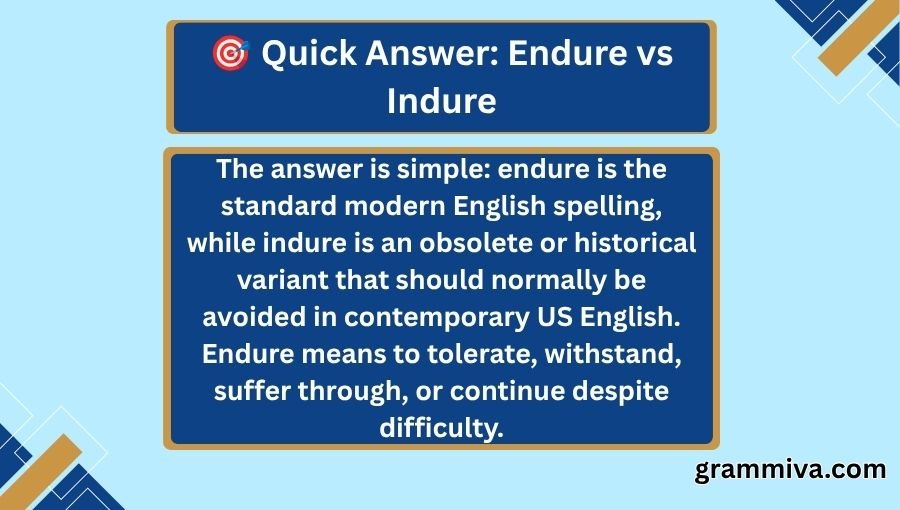
The answer is simple: endure is the standard modern English spelling, while indure is an obsolete or historical variant that should normally be avoided in contemporary US English. Endure means to tolerate, withstand, suffer through, or continue despite difficulty.
For example:
- ✅ She had to endure several difficult months.
- ❌ She had to indure several difficult months.
If you are writing an email, essay, report, résumé, article, or social media post today, choose endure.
🧩 Related Word Forms of Endure
The word endure has several common forms. Knowing them can make the spelling easier to remember because the same end- beginning appears across the modern forms.
| Form | Type | Example |
|---|---|---|
| endure | Base verb | We must endure the delay. |
| endures | Third-person singular verb | She endures difficult conditions well. |
| endured | Past tense/past participle | They endured many setbacks. |
| enduring | Present participle/adjective | Their friendship is enduring. |
| endurance | Noun | His endurance impressed the team. |
You may occasionally see historical forms related to indure in older writing. Those forms do not change the modern spelling rule. For normal contemporary writing, use the endure family.
🎯 Understanding Endure vs Indure
The main difference is spelling and modern usage. Endure is the standard word used today. Indure may appear in historical material, but it is not the normal choice for modern American writing.
Here is the difference at a glance:
| Form | Type | Meaning | Example | Correct/Incorrect |
|---|---|---|---|---|
| endure | Verb | To suffer, tolerate, withstand, or last | She endured the pain. | ✅ Correct |
| indure | Historical/obsolete variant | Older form related to endure | The old text used “indure.” | ⚠️ Historical |
| endured | Past-tense verb | Suffered or lasted | He endured the hardship. | ✅ Correct |
| enduring | Present participle/adjective | Continuing or lasting | They built an enduring friendship. | ✅ Correct |
The safest modern rule is very short:
If you mean “suffer through,” “withstand,” or “last,” spell it endure.
That rule works in school writing, workplace writing, everyday conversation, and most online content.
Is Endure the Correct Modern Spelling?
Yes. Endure is the standard modern spelling in US English.
You can use it when someone continues through pain, difficulty, stress, discomfort, or hardship. You can also use it when something continues to exist for a long time.
Examples:
- ✅ The hikers endured the freezing weather.
- ❌ The hikers indured the freezing weather.
- ✅ Their friendship endured for many years.
- ❌ Their friendship indured for many years.
- ✅ She could not endure the constant noise.
- ❌ She could not indure the constant noise.
The word can describe both people and things. A person can endure hardship. A relationship can endure change. A building can endure harsh weather. A tradition can endure for generations.
What Does Endure Mean?
Endure is a verb meaning to continue through something difficult or unpleasant without giving up. It can also mean to last or remain for a long period.
The word commonly appears in three situations:
- Suffering or hardship
- She endured years of difficulty.
- Tolerance
- I cannot endure that loud music.
- Lasting over time
- Their friendship endured despite the distance.
Here is a simple breakdown:
She endured the long journey.
- She = subject
- endured = verb
- the long journey = what she experienced
The verb tells us that she went through the difficult journey rather than avoiding it.
| Meaning | Word Type | Example Sentence |
|---|---|---|
| Suffer through difficulty | Verb | He endured the pain. |
| Tolerate something unpleasant | Verb | I cannot endure the noise. |
| Last over time | Verb | Their bond endured for decades. |
| Continue despite problems | Verb | The business endured the crisis. |
💡 When Should You Use Endure?
Use endure when the idea is “keep going despite something difficult” or “continue to exist.”
1. Endure for Physical Difficulty
This is one of the most common uses.
- ✅ The runner endured the pain and finished the race.
- ❌ The runner indured the pain and finished the race.
Here, endured means the runner tolerated the pain rather than stopping.
Other examples include:
- She endured a long recovery.
- The workers endured extreme heat.
- He endured several sleepless nights.
- They endured a difficult winter.
2. Endure for Emotional or Mental Difficulty
The word also works with emotional stress and hard experiences.
- ✅ She endured years of uncertainty.
- ❌ She indured years of uncertainty.
You might also say:
- He endured the loss with courage.
- They endured a painful period of separation.
- I do not know how she endured the stress.
- The family endured a very difficult time.
3. Endure for Something That Lasts
This meaning is slightly different. Instead of focusing on suffering, it focuses on continued existence.
- ✅ The old bridge has endured for more than a century.
- ❌ The old bridge has indured for more than a century.
You can use endure for:
- traditions
- friendships
- buildings
- ideas
- stories
- customs
- relationships
- reputations
For example:
The tradition endured despite major social changes.
This means the tradition continued to exist even though circumstances changed.
🧠 How Can You Test Whether Endure Is Correct?
A simple test is to replace the word with “withstand,” “tolerate,” or “last.”
If one of those words fits, endure is probably the word you need.
For example:
She had to ___ the pressure.
Try “withstand.”
She had to withstand the pressure.
That works, so:
She had to endure the pressure.
Another example:
Their friendship will ___.
Try “last.”
Their friendship will last.
So:
Their friendship will endure.
💡 Test Tip
When you are unsure, ask:
“Do I mean suffer through, tolerate, withstand, or last?”
If the answer is yes, write endure.
Do not choose indure simply because the spoken sound makes an i seem possible.
📝 Case Study: A Workplace Email
Imagine that a manager is writing an email after a difficult project. She wants to encourage her team.
An employee drafts this sentence:
❌ We have indured several unexpected problems during this project.
The manager changes it to:
✅ We have endured several unexpected problems during this project.
Why is the second sentence better?
Because endured is the standard modern spelling. The sentence means that the team experienced difficult problems and continued working despite them.
The manager could continue:
We have endured several unexpected problems during this project, but we have kept moving forward.
That sounds natural and professional.
I once edited a short workplace message where a writer had used a similar spelling error. The writer knew exactly what the word meant. The problem was not vocabulary. It was simply that the word had been heard more often than it had been seen in writing. That is one reason spelling mistakes like this can survive even in otherwise strong writing.
📚 Grammar Rules Explanation
The modern grammar rule is straightforward: endure is the standard verb for expressing the idea of suffering through something, tolerating something difficult, withstanding a challenge, or lasting over time. When learning endure vs indure, the key point is that endure is the standard spelling used in modern English.
Indure does not function as a normal modern spelling choice in US English. Historical English records contain indure as an older form or variant connected with endure, which explains why the spelling may appear in older material.
This distinction matters because an older form can still be found in historical sources without being appropriate for ordinary modern writing. A reader who sees indure in a contemporary email or essay will usually interpret it as a spelling error rather than as a deliberate historical form.
Most modern reference works and standard writing practice support using endure in contemporary English.
Correct vs Incorrect at a Glance
| Sentence | Correct/Incorrect | Why |
|---|---|---|
| She had to endure the pain. | ✅ Correct | Endure is the standard modern spelling. |
| She had to indure the pain. | ❌ Incorrect | Indure is not the normal modern form. |
| They endured years of hardship. | ✅ Correct | Endured is the correct past form. |
| They indured years of hardship. | ❌ Incorrect | The past form should be endured. |
| Their friendship endured the distance. | ✅ Correct | Endured expresses continued existence. |
The important point is that this is mainly a spelling and modern usage issue, not a case where two common modern words have different meanings.
❓ Is Indure Ever Correct?
In ordinary modern US English, you should not use indure as your normal spelling. However, it can appear in historical texts as an obsolete spelling or older variant of endure.
That distinction matters.
If you are writing a modern sentence, use:
- ✅ The family endured many hardships.
If you are reproducing an old source exactly, you may preserve its original spelling:
- ⚠️ The original document says “indure.”
In that second situation, you are not choosing indure as your preferred modern spelling. You are preserving historical wording.
This is similar to how editors handle old spellings in historical documents. The goal is to represent the original text accurately.
❓ Why Do People Confuse Endure and Indure?
People confuse these forms mainly because they sound similar and because English spelling does not always match speech perfectly.
There are several common reasons:
- The first vowel can be unclear when the word is spoken quickly.
- People often write words based on how they sound.
- The spelling in- is common at the beginning of many English words.
- A person may have heard endure many times but rarely seen it in print.
- Fast typing can produce accidental substitutions.
- Autocorrect does not catch every mistake.
- A writer may have learned the meaning without learning the spelling.
A student once wrote, “I don’t know how anyone could indure that situation,” in an essay I was reviewing. The student clearly understood the word and used it correctly in context. Only the first vowel was wrong. That is a useful reminder: knowing a word’s meaning and knowing its spelling are two separate skills.
⚠️ Common Mistakes With Endure and Indure
The most common mistake is replacing the e in endure with i. If you are still unsure about endure vs indure, remember that endure is the standard form for modern English.
Another problem occurs when writers change the spelling in other forms.
For example:
- ❌ indured
- ❌ induring
- ❌ indures
The modern forms are:
- ✅ endured
- ✅ enduring
- ✅ endures
Common Similar Grammar Confusions
The same kind of mistake happens with many pairs of English words.
| Confusion | Correct Forms | Common Problem |
|---|---|---|
| it’s / its | it’s, its | Apostrophe confusion |
| your / you’re | your, you’re | Sound alike |
| their / they’re / there | three different forms | Similar pronunciation |
| affect / effect | affect, effect | Similar meaning and sound |
| then / than | then, than | Fast writing |
| endure / indure | endure | Spelling based on sound |
These errors do not all follow the same grammar rule. However, they share one thing: the writer knows what they want to say but chooses the wrong written form.
Why These Mistakes Happen
Fast typing: When people type quickly, their fingers may choose a familiar letter pattern.
Autocorrect: Spell-check tools are useful, but they are not perfect. A word can also slip through if the software does not understand the sentence.
Lack of knowledge: A person may know the word from speech but never have learned its standard spelling.
Sound-based spelling: English contains many words whose spelling cannot be predicted perfectly from pronunciation.
Specific Wrong Spellings and Uses
| Wrong Form | What’s Wrong | Correct Form |
|---|---|---|
| indure | Historical-looking spelling used as modern English | endure |
| indured | Incorrect modern past-tense spelling | endured |
| induring | Incorrect modern participle spelling | enduring |
| indures | Incorrect modern third-person form | endures |
| to indure hardship | Uses the obsolete spelling in normal writing | to endure hardship |
| has indured | Incorrect spelling of the past participle | has endured |
📖 Word Origin and History
The history of the two spellings helps explain why indure can sometimes be found in older material.
Older English records show forms related to both indure and endure. Historical sources record indure as an older spelling, while endure became the standard modern form.
This is useful because it explains one mystery: if indure is wrong for modern writing, why does it sometimes appear in old books?
The answer is that English spelling has changed over time. A form can be legitimate in an older stage of the language without being the normal spelling today.
| Period | Form | Note |
|---|---|---|
| Older English | indure and related forms | Historical spellings occurred. |
| Later English | endure becomes common | The modern-looking spelling gains standard use. |
| Modern English | endure | Standard spelling for ordinary writing. |
| Historical quotations today | indure may appear | Preserve it when accurately quoting an old source. |
You do not need to memorize the history to spell the word correctly. The practical rule remains: modern writing uses endure.
🌎 Endure vs Indure in Different Contexts
The correct choice does not change simply because the setting changes. Modern writers should generally use endure in all four contexts below.
| Context | Which Term to Use | Example |
|---|---|---|
| Everyday conversation | endure | I can’t endure this heat. |
| Professional writing | endure | The company endured several difficult years. |
| Creative writing | endure | Her hope endured through the darkest days. |
| Social media/texting | endure | We can endure this together. |
Creative writing deserves one small note. A novelist writing historical fiction might intentionally use an older spelling to create a period feel. Even then, the choice should be deliberate.
For normal modern creative writing, endure remains the natural choice.
❓ Does Endure Mean the Same Thing as Tolerate?
Often, yes, but the two words are not always interchangeable.
Tolerate usually focuses on accepting something unpleasant or annoying.
Endure often suggests continuing through something difficult, painful, or demanding.
Compare:
- I tolerate the noise.
- I endure the pain.
Both can suggest difficulty, but endure often has a stronger sense of persistence.
You can also say:
Their friendship endured for decades.
You would not normally replace that with:
Their friendship tolerated for decades.
That sentence does not work because tolerate does not have the same meaning of lasting over time.
❓ Can Endure Mean “Last”?
Yes. Endure can mean to continue to exist or remain strong over time.
Examples:
- The old building endured for generations.
- Their friendship endured despite the distance.
- The tradition endured through major changes.
- His influence endured long after his retirement.
This is an important meaning because it is not about suffering in a direct sense.
Consider:
The memory endured.
Here, endured means the memory continued to exist.
So when you see endure vs indure, remember that the correct word can describe both hardship and long-lasting things.
🔎 Common Phrases With Endure
The word endure appears naturally with several common nouns and phrases.
| Phrase | Meaning |
|---|---|
| endure pain | Continue through physical discomfort |
| endure hardship | Continue through difficult conditions |
| endure suffering | Continue despite suffering |
| endure criticism | Deal with criticism without giving up |
| endure pressure | Withstand strong demands or stress |
| endure for years | Continue or remain for a long time |
Examples:
- She endured tremendous pressure at work.
- The team endured harsh conditions.
- Their friendship endured for years.
- He learned to endure criticism without losing focus.
These phrases are useful because they show how naturally the standard spelling fits everyday English.
🔄 Synonyms and Alternatives to Endure
You can sometimes replace endure with another word, but the best choice depends on the exact meaning.
| Alternative | Works When | Does Not Work When |
|---|---|---|
| tolerate | You mean accept something unpleasant | You mean something lasted for years |
| withstand | You mean resist pressure, force, or difficulty | You want a softer meaning of simple acceptance |
| bear | You mean cope with something difficult | You need a formal word for lasting over time |
| survive | You mean get through a dangerous or difficult situation | You simply mean tolerate mild annoyance |
| last | You mean continue to exist | You mean actively suffer through something |
For example:
She endured the pain.
Possible alternatives:
- She bore the pain.
- She withstood the pain.
- She survived the ordeal.
But:
Their friendship endured for decades.
The most natural alternatives are:
- Their friendship lasted for decades.
- Their friendship continued for decades.
The best synonym depends on what you want the reader to notice.
💼 Why Getting the Spelling Right Matters
A single letter can change how polished your writing appears. Even when the reader understands your meaning, a spelling mistake can make the sentence look rushed or careless.
This matters especially in:
- school assignments
- résumés
- job applications
- client emails
- reports
- published articles
- websites
- professional social posts
A useful writing principle is:
Clear writing makes the reader’s job easier.
Why Accuracy Matters in Real Situations
| Situation | Why Getting It Right Matters |
|---|---|
| Résumé | Shows care with written details |
| Client email | Builds a professional impression |
| Published content | Protects readability and credibility |
| Social post | Helps your message look polished |
An isolated spelling error does not define a writer’s skill. Still, repeated errors can distract readers from the message.
If you are unsure, checking the word before publishing takes only a few seconds.
🧠 How to Remember the Difference
The easiest memory trick is visual: This simple memory trick makes endure vs indure much easier to remember.
Endure starts with E.
Then connect the word with its common meanings:
Endure = experience something difficult and keep going.
You can also remember:
- endure pain
- endure hardship
- endure pressure
- endure change
- endure for years
All of these begin with end-, not ind-.
Another useful trick is to remember the related forms:
- endure
- endured
- enduring
- endures
- endurance
Seeing the repeated end- pattern makes the spelling easier to recognize.
❓ Is Endure Used in Both American and British English?
Yes. Endure is used in both American and British English.
This is not like spelling pairs such as color/colour or center/centre. The difference between endure and indure is not a normal US-versus-UK spelling difference.
For modern writing in either variety, endure is the safe standard choice.
| English Variety | Standard Modern Form |
|---|---|
| US English | endure |
| British English | endure |
| Canadian English | endure |
| Australian English | endure |
| Historical English | indure may appear in older texts |
So if you are writing for an American audience, there is no reason to switch to indure.
❓ How Do You Spell the Past Tense of Endure?
The past tense is endured.
The spelling is:
endure → endured
Examples:
- ✅ She endured the difficult conditions.
- ❌ She indured the difficult conditions.
Notice that the e remains part of the word.
Other forms include:
- endure
- endures
- endured
- enduring
- endurance
These are all connected to the modern standard form.
❓ Can Endure Be Used for Positive Things?
Yes. Although endure often describes hardship, it can also describe something that continues successfully over time.
For example:
Their friendship endured for decades.
The friendship is not suffering. It is lasting.
You can also say:
The author’s work has endured.
This means the work has remained important or remembered over time.
So the word can carry a positive idea when it describes strength, stability, or lasting value.
📝 Practice: Choose the Correct Form
Try these before looking at the answers.
- The team had to ______ several difficult setbacks.
- Their friendship has ______ despite the distance.
- She could not ______ the constant noise.
- The old tradition ______ for many generations.
- He learned to ______ pressure calmly.
Answers:
- endure
- endured
- endure
- endured
- endure
Notice that none of the sentences needs indure.
❓ What Is the Difference Between Endure and Indure?
The difference in endure vs indure is mainly modern spelling and historical usage. Endure is the standard modern English word, while indure is an obsolete or historical spelling that may appear in older material.
The simplest comparison is:
| Question | Endure | Indure |
|---|---|---|
| Standard modern English? | Yes | No |
| Common today? | Yes | No |
| Means tolerate or withstand? | Yes | Historically related |
| Means last over time? | Yes | Historical variant |
| Recommended for US English? | Yes | No |
| May appear in old texts? | Yes | Yes |
That is the central answer to endure vs indure.
❓ Should You Use Indure in a School Essay?
No. In a normal modern school essay, use endure.
For example:
- ✅ The characters had to endure many hardships.
- ❌ The characters had to indure many hardships.
Using the historical spelling in a modern essay could make your teacher think it is simply a spelling error.
The only reason to preserve indure would be if you were directly discussing or quoting an older text where that spelling actually appears.
❓ Should You Use Indure in a Business Email?
No. Use endure in a business email.
For example:
Our team has endured several challenges, but we are still on schedule.
That sentence is clear and professional.
Writing indure instead could distract the reader and make the message appear less polished.
❓ Why Does Indure Look Like It Could Be Correct?
The spelling feels possible because English contains many common words beginning with in-.
Examples include:
- include
- inform
- inspire
- involve
- improve
A writer may therefore assume that indure follows a similar pattern.
Sound can also cause the mistake. When people hear a word rather than read it, they may create a spelling that seems logical from pronunciation.
This is especially common with words that have unfamiliar written forms.
The important lesson is that spelling is learned from repeated exposure. The more often you see endure, the more natural the correct form becomes.
⚡ Quick Recap Checklist
Use this checklist whenever you are unsure.
| Question | If Yes → Use |
|---|---|
| Do you mean suffer through something? | endure |
| Do you mean tolerate something difficult? | endure |
| Do you mean withstand pressure? | endure |
| Do you mean continue to exist? | endure |
| Are you quoting an old text that says “indure”? | Preserve the original spelling |
| Are you writing normal modern US English? | endure |
Three Quick Practice Examples
1. We had to ______ the long delay.
Answer: endure
2. Their relationship ______ many difficult years.
Answer: endured
3. The tradition has ______ for generations.
Answer: endured
If you can remember those three patterns, you have the main rule down.
FAQs About Endure vs Indure
Is “indure” a correct English word?
Indure is recorded as an obsolete or historical spelling related to endure, but it is not the standard choice in modern US English. In contemporary writing, use endure.
What does endure mean?
Endure means to suffer through, tolerate, withstand, or continue despite difficulty. It can also mean to last or remain in existence over time.
Is endure or indure correct?
Endure is correct for standard modern English. Indure should normally be avoided unless you are dealing with historical wording or preserving an original quotation.
Why do people spell endure as indure?
The mistake usually comes from pronunciation, fast typing, unfamiliarity with the written word, or the influence of other common words that begin with in-.
How do you spell the past tense of endure?
The past tense is endured.
Example:
They endured the difficult journey.
Not:
❌ They indured the difficult journey.
Can endure mean last?
Yes. Endure can mean to continue or remain for a long time.
Example:
Their friendship endured for decades.
In that sentence, endured means lasted.
Is indure an old spelling of endure?
Yes. Historical sources record indure as an older or obsolete spelling associated with endure.
That historical fact explains why you may occasionally encounter the spelling in older material.
Is endure a formal word?
Endure works in both everyday and formal English. You can use it in conversation, school writing, business communication, journalism, fiction, and academic writing.
For example:
The company endured a difficult year.
That sentence works naturally in professional writing.
Can I use indure in creative writing?
Only if you have a specific reason, such as creating an intentionally historical voice or reproducing an older text. For ordinary modern creative writing, endure is the better choice.
Is there a difference between American and British spelling?
No meaningful modern spelling difference exists here. Both American and British English use endure as the standard modern form.
🎯 Conclusion
Endure vs indure has a simple modern answer: use endure. It is the standard spelling when you mean to suffer through something, tolerate difficulty, withstand pressure, or continue to exist over time.
The form indure may appear in historical texts because older English used spelling variants that are no longer standard. That does not make it the right choice for a modern email, essay, résumé, article, or social post.
When you are unsure, use the quick test: if the word means suffer, tolerate, withstand, or last, choose endure.
Remember the modern word family:
endure → endures → endured → enduring → endurance
And remember the simplest rule:
- ✅ Endure = standard modern English
- ⚠️ Indure = historical or obsolete form
Once you train your eye to recognize the end- spelling, this tiny spelling problem becomes much easier. ✨ When in doubt, endure is the word to use.

I am Alex Morgan, an English grammar and vocabulary writer passionate about making language learning simple and useful. I work at Grammiva, where I create clear educational content and practical English examples for learners.



[…] the end, choosing between the two should feel much easier. ✍️ Endure vs Indure | Whoa vs Woah | Coozie vs […]
[…] patterns, and gives you simple tests you can use whenever you are unsure. Farther vs Further | Endure vs Indure | Whoa vs […]