Have you ever typed a sentence like “I already payed the bill” and then stopped to wonder if something looked wrong? You are not alone. paid vs payed is one of those spelling questions that can make even careful writers pause.
The two words look almost identical, but they do not have the same job in standard English.
The good news is that the main rule is simple. When you mean that money was given or a debt was settled, paid is the correct word.
Payed has a much narrower use and usually appears in special nautical or technical writing. 💡
I teach writers to look at the meaning of the sentence first, not just the spelling.
Once you know what the verb means in context, the right form becomes much easier to choose.
In this guide, I will explain the difference, show clear examples, cover common mistakes, and give you quick tests you can use whenever you are unsure. ✍️ etc vs ect | Foodie vs Foody | Awhile vs a While
🎯 Quick Answer: Paid vs Payed
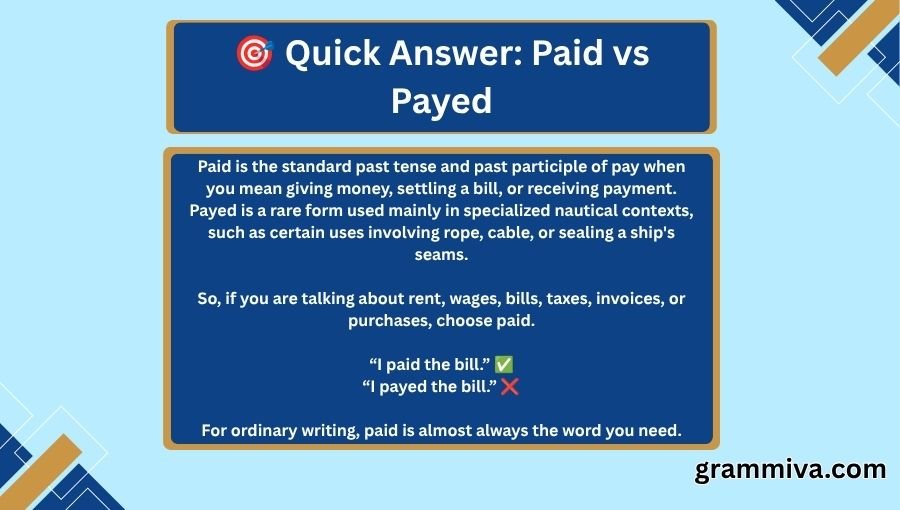
Paid is the standard past tense and past participle of pay when you mean giving money, settling a bill, or receiving payment. Payed is a rare form used mainly in specialized nautical contexts, such as certain uses involving rope, cable, or sealing a ship’s seams.
So, if you are talking about rent, wages, bills, taxes, invoices, or purchases, choose paid.
- “I paid the bill.” ✅
- “I payed the bill.” ❌
For ordinary writing, paid is almost always the word you need.
Related Forms of Pay
The word pay has several related forms. Knowing them makes the main rule easier to remember.
| Form | Type | Example |
|---|---|---|
| pay | Base verb | I need to pay the bill. |
| pays | Third-person singular present | She pays the rent on Friday. |
| paying | Present participle | He is paying for lunch. |
| paid | Past tense / past participle | We paid the invoice yesterday. |
| payed | Rare specialized past form | The crew payed out the cable. |
The important point is that paid is the normal past form for the everyday meaning of pay. Payed does not replace it.
🎯 Understanding the Basics of Paid vs Payed
The core difference is based on meaning. Paid is the normal past form of pay when money or a financial obligation is involved. Payed is a specialized form found in limited technical and nautical uses.
English has many irregular verbs. Their past forms do not always end in -ed. Pay is one of them.
For the common meaning, the pattern is:
pay → paid → paid
Examples:
- “I pay my credit card every month.”
- “I paid my credit card yesterday.”
- “I have paid my credit card already.”
The spelling payed may look logical because many regular verbs simply add -ed. However, standard English does not use payed for ordinary financial payments.
| Form | Type | Meaning | Example | Correct/Incorrect |
|---|---|---|---|---|
| pay | Base verb | Give money or settle a debt | I will pay the fee. | ✅ Correct |
| paid | Past tense | Gave money or settled a debt | I paid the fee. | ✅ Correct |
| paid | Past participle | Used with helping verbs | She has paid the fee. | ✅ Correct |
| payed | Rare past form | Specialized nautical use | The crew payed out the line. | ✅ Correct in special context |
| payed | Ordinary financial past tense | Gave money | I payed the fee. | ❌ Incorrect |
When Should You Use Paid?
Use paid when pay means giving money or settling a financial obligation.
This covers a huge range of everyday situations:
- paying a bill
- paying rent
- paying taxes
- paying a worker
- paying a fee
- paying for food
- paying a loan
- paying an invoice
- paying a fine
- paying a debt
For example:
“Maria paid the restaurant bill before leaving.”
Here, paid tells us that Maria gave money to settle the bill.
Another example is:
“The company paid its employees on Friday.”
The verb describes money given to workers. Therefore, paid is correct.
When Can Payed Be Correct?
Payed can be correct in narrow nautical or technical uses. It is not the normal past form of pay when money is involved.
One specialized use concerns handling rope, cable, or similar material. For example, a technical text might say that a crew payed out a cable. In that setting, payed belongs to a specialized use of the verb.
This is why you should not treat payed as simply a “less common spelling” of paid. The two forms can belong to different meanings.
| Meaning | Word Type | Example Sentence |
|---|---|---|
| Gave money | Verb, past tense | I paid the cashier. |
| Settled a debt | Verb, past tense | We paid the loan. |
| Gave wages | Verb, past tense | The business paid its workers. |
| Handled cable or rope in a specialized nautical use | Verb, past tense | The crew payed out the cable. |
💡 Test Tip: Ask What Was Being Paid
Here is the fastest test I teach.
Ask yourself: “Am I talking about money?”
If the answer is yes, use paid.
- Money → paid ✅
- Bill → paid ✅
- Rent → paid ✅
- Salary → paid ✅
- Invoice → paid ✅
- Ordinary purchase → paid ✅
If the sentence is about a specialized nautical action involving rope, cable, or ship work, payed may be appropriate.
This simple test will solve nearly every everyday spelling question involving these two words.
Is Paid the Correct Word for Money?
Yes. Paid is the correct standard word when you are talking about money, wages, bills, purchases, debts, or other financial obligations.
Consider these examples:
- “She paid for the tickets.” ✅
- “She payed for the tickets.” ❌
- “We paid our rent yesterday.” ✅
- “We payed our rent yesterday.” ❌
- “The client paid the invoice.” ✅
- “The client payed the invoice.” ❌
The reason is grammatical as well as conventional. Pay is irregular in its common past form, so its past tense is paid, not payed.
Paid in Questions
The same rule applies when the sentence is a question.
- “Did you pay the bill?” ✅
- “Did you paid the bill?” ❌
Notice something important here: after did, use the base form pay, not paid.
The same pattern appears with other verbs:
- Did you go?
- Did she call?
- Did they pay?
Not:
- Did you went?
- Did she called?
- Did they paid?
This is a separate grammar rule, but it often appears when people are already unsure about the word.
Paid With and Paid For
Paid for usually describes the thing someone purchased.
“I paid for the coffee.”
Paid with usually describes the method or thing used to make the payment.
“I paid with a credit card.”
Both use paid.
| Pattern | Meaning | Example |
|---|---|---|
| paid for | Purchased or covered the cost of something | I paid for dinner. |
| paid with | Used a payment method | I paid with cash. |
| paid by | Identifies the person or method responsible for payment | The invoice was paid by the client. |
| paid in | Describes the form or denomination of payment | She was paid in cash. |
Why Do People Confuse Paid and Payed?
People confuse these forms because payed looks like the regular past tense of pay. The ending makes it seem as if the word should follow the same pattern as verbs such as walked, called, and worked.
There is another problem: spell-check tools do not always explain meaning. A specialized word can exist in a dictionary even when it is wrong for the sentence you are writing.
I once reviewed a student’s short essay about saving money. The student had written payed several times. When I asked why, the answer was simple: “I thought every past verb just needed -ed.” That small misunderstanding explained the whole problem.
The best way to avoid this mistake is to learn the word as a pair:
pay → paid
Do not try to build the past tense from the spelling of the present tense.
Common Sources of Confusion
| Cause | What Happens | Helpful Fix |
|---|---|---|
| Fast typing | You type the regular-looking form without thinking | Pause and check the meaning |
| Autocorrect | A device may accept or suggest a word without explaining context | Read the full sentence |
| Lack of knowledge | You may not know that pay is irregular | Memorize “pay → paid” |
| Similar spelling | Paid and payed differ by only one letter | Focus on meaning |
| Specialized vocabulary | You may see payed in technical writing | Check the context |
Paid vs Payed: Correct and Incorrect Examples
The easiest way to see the difference is to compare complete sentences.
| Sentence | Correct/Incorrect | Why |
|---|---|---|
| I paid my rent yesterday. | ✅ Correct | Money was given to cover rent. |
| I payed my rent yesterday. | ❌ Incorrect | Ordinary financial use requires paid. |
| She paid for the new laptop. | ✅ Correct | Paid is the normal past form for purchases. |
| She payed for the new laptop. | ❌ Incorrect | Payed is not the standard financial form. |
| The crew payed out the cable. | ✅ Correct | This is a specialized nautical use. |
The fifth example shows why simply saying “payed is always wrong” would be too broad. In ordinary writing, avoid it. In specialized technical writing, it can have a legitimate role.
📝 Case Study: A Workplace Email
Imagine that you work in an office and need to tell a supplier that an invoice has been settled.
You might write:
“The invoice was paid this morning.” ✅
That sentence is clear and professional.
Now imagine this version:
“The invoice was payed this morning.” ❌
The reader will probably understand the meaning, but the spelling is wrong for standard financial use.
I once caught myself typing payed in a quick work note because I had just been editing a document full of regular past-tense verbs. I stopped, changed it to paid, and moved on. That small pause is often all it takes.
The lesson is useful beyond this one word: do not let a familiar spelling pattern override the meaning of the verb.
Grammar Rules Explanation
The standard rule is simple: paid is the past tense and past participle used for the ordinary financial meaning of pay. Payed belongs to limited specialized uses, especially nautical language.
English contains many irregular verbs. Their past forms must be learned rather than created by simply adding -ed. For example:
- go → went
- buy → bought
- take → took
- pay → paid
The form paid works in both simple past and perfect constructions.
“I paid yesterday.”
“I have paid already.”
It can also appear in passive constructions.
“The bill was paid.”
Payed should not be substituted for paid just because pay ends in a consonant sound that seems to invite -ed.
Most standard dictionaries list both forms in their appropriate contexts, but the ordinary financial meaning clearly calls for paid.
Correct vs Incorrect at a Glance
| Sentence | Correct/Incorrect | Why |
|---|---|---|
| We paid the bill before leaving. | ✅ Correct | Financial payment |
| We payed the bill before leaving. | ❌ Incorrect | Payed is not the normal financial form |
| The company has paid the workers. | ✅ Correct | Past participle of ordinary pay |
| The company has payed the workers. | ❌ Incorrect | Wrong form for wages |
| The crew payed out the line. | ✅ Correct | Specialized nautical meaning |
How to Remember the Difference
The simplest memory trick is:
Money gets PAID.
You can connect the spelling to familiar phrases:
- paid bill
- paid rent
- paid wages
- paid invoice
- paid tax
- paid fee
- paid debt
If money changes hands, paid is your safe choice.
Another useful trick is to remember the short verb pair:
Pay today → paid yesterday.
You do not need to memorize a long grammar rule every time you write.
⚠️ Common Mistakes With Paid and Payed
Most mistakes come from trying to make pay behave like a regular verb. Writers may think that because pay is short, its past tense should be payed. That logic feels natural, but English does not always follow that pattern.
Digital writing adds more problems. Fast typing can lead to careless spelling. Autocorrect can make writers trust a suggestion without checking the sentence. A lack of grammar knowledge can also make the wrong form seem reasonable.
Similar Grammar Confusions
The problem is not unique to paid vs payed. English has many pairs that sound or look similar.
| Confusion | Correct Forms | Example |
|---|---|---|
| it’s / its | it’s = it is; its = belonging to it | It’s cold. / The dog wagged its tail. |
| your / you’re | your = belonging to you; you’re = you are | Your phone is here. / You’re early. |
| they’re / their / there | different meanings | They’re ready. / Their car is there. |
| affect / effect | usually verb / noun | The change may affect sales. / The effect was clear. |
| then / than | time/order / comparison | We ate, then left. / She is taller than me. |
| paid / payed | ordinary past / specialized form | I paid the bill. |
Specific Wrong Forms to Avoid
| Wrong Form | What’s Wrong | Correct Form |
|---|---|---|
| payed the bill | Wrong past form for financial payment | paid the bill |
| payed rent | Wrong past form for ordinary rent payment | paid rent |
| has payed | Wrong past participle in ordinary use | has paid |
| had payed | Wrong past participle in ordinary financial use | had paid |
| payed for dinner | Wrong form for a purchase | paid for dinner |
| payed the employee | Wrong form for wages | paid the employee |
What Does Paid Mean in Different Contexts?
Paid works across nearly all ordinary settings where money or payment is involved. The context may change, but the past form stays the same.
| Context | Which Term to Use | Example |
|---|---|---|
| Everyday conversation | paid | I paid for lunch. |
| Professional writing | paid | The client paid the invoice. |
| Creative writing | paid | She paid the driver before leaving. |
| Social media/texting | paid | Just paid my rent! |
The style can change from formal to casual. The spelling does not.
Everyday Conversation
People use paid constantly in daily speech.
“I already paid.”
“Who paid for dinner?”
“Did you pay the parking fee?”
These sentences are natural and standard.
Professional Writing
In business writing, accuracy matters even more because financial words appear often.
“The balance was paid in full.”
“The customer paid the outstanding amount.”
“The invoice has been paid.”
Using payed in these sentences can make a document look careless.
Creative Writing
Fiction writers also use paid when characters exchange money.
“He paid the driver and walked away.”
There is no special spelling rule for fiction.
Social Media and Texting
Informal writing may contain abbreviations or sentence fragments, but paid is still the standard spelling.
“Paid the bill. Finally! 😅”
The casual style does not turn payed into the normal form.
Common Phrases With Paid
There are many everyday phrases built around paid. Learning them can make the correct form automatic.
| Phrase | Meaning |
|---|---|
| paid in full | A debt or bill has been completely settled |
| paid off | A debt has been fully cleared |
| paid up | All required payments have been made |
| paid leave | Time away from work for which the employee receives normal pay |
| paid vacation | Vacation time that is paid |
| paid in cash | Payment was made using cash |
Examples include:
- “The loan is paid off.”
- “Your account is paid in full.”
- “Employees receive paid vacation.”
- “The membership is fully paid up.”
These phrases all reinforce the same everyday spelling: paid.
Can Paid Be Replaced With Another Word?
Sometimes. The best alternative depends on exactly what you mean.
| Alternative | Works When | Does Not Work When |
|---|---|---|
| settled | You mean a bill or debt was resolved | You need to describe every type of payment |
| purchased | You mean someone bought something | You are talking about wages or debts |
| funded | Money was provided for a project or activity | You simply bought an item |
| compensated | Someone received payment for work or loss | You mean a normal store purchase |
| covered | Someone took responsibility for a cost | The sentence needs a precise financial meaning |
For example:
“I paid the bill.”
can sometimes become:
“I settled the bill.”
But settled changes the tone slightly. It often focuses on resolving an amount owed.
Likewise:
“The company paid the workers.”
could become:
“The company compensated the workers.”
That is more formal and does not always sound natural in everyday speech.
Why Does Getting Paid vs Payed Right Matter?
Correct spelling improves clarity. It also helps your writing look careful and trustworthy.
A single misspelled word will rarely stop someone from understanding you. However, repeated errors in a resume, client email, school paper, or business document can affect how readers judge the overall quality of the writing.
A useful writing principle is:
Clear words make clear ideas easier to trust.
The goal is not to make every sentence sound fancy. The goal is to make every sentence easy to understand.
| Situation | Why Getting It Right Matters |
|---|---|
| Resume | Shows care with basic written English |
| Client email | Builds a professional impression |
| Published content | Protects the quality of the finished work |
| Social post | Makes the message cleaner and easier to read |
Is There a Special Exception for Payed?
Yes. Payed can be valid in specialized nautical or technical language. This is the main exception worth remembering.
For example, a technical text may use payed out when describing the controlled release or handling of a line or cable. Specialized writing may also use the form in connection with certain ship-related work.
This does not mean that payed is a normal alternative to paid.
Think of it this way:
Money → paid
Specialized nautical use → payed may be correct
If you are writing an email about rent, a store purchase, an invoice, a salary, or a bill, there is no reason to choose payed.
How Can You Check Your Sentence Quickly?
You can use a three-step check.
Step 1: Find the Verb
Look for the word describing the payment or action.
“I ___ the bill yesterday.”
Step 2: Ask What the Verb Means
Is the person giving money or settling a financial obligation?
If yes, choose paid.
Step 3: Look for a Specialized Meaning
Is the sentence about a nautical or technical use involving a line, cable, or related ship work?
If yes, payed may be possible.
This method works because it checks meaning rather than spelling alone.
Paid vs Payed in Questions
Many learners know that paid is correct but then accidentally use it after did.
Remember this rule:
Did + base verb
Therefore:
“Did you pay the invoice?” ✅
Not:
“Did you paid the invoice?” ❌
And not:
“Did you payed the invoice?” ❌
After did, the past meaning is already carried by did, so the main verb returns to its base form.
| Sentence | Correct/Incorrect | Reason |
|---|---|---|
| Did you pay the bill? | ✅ Correct | Did takes the base verb |
| Did you paid the bill? | ❌ Incorrect | Do not use the past form after did |
| Did you payed the bill? | ❌ Incorrect | Payed is not the ordinary past form anyway |
| Have you paid the bill? | ✅ Correct | Paid is the past participle after have |
Paid vs Payed in Passive Sentences
The passive voice also uses paid for ordinary financial meanings.
Examples:
“The invoice was paid yesterday.” ✅
“The employee was paid on Friday.” ✅
“The fee has been paid.” ✅
The pattern is:
was/were + paid
or
has/have/had + paid
The form does not change simply because the sentence is passive.
This is useful in business writing because passive sentences often appear in invoices, receipts, payment notices, and account records.
How Does Paid Work With Different Verb Tenses?
Although the main question is about the past form, seeing the complete pattern can help.
| Tense | Example |
|---|---|
| Present | I pay the bill. |
| Present, third person | She pays the bill. |
| Past | She paid the bill. |
| Present perfect | She has paid the bill. |
| Past perfect | She had paid the bill before dinner. |
| Future | She will pay the bill tomorrow. |
| Present continuous | She is paying the bill now. |
Notice that paid appears in past and perfect forms. Payed does not take its place in ordinary financial writing.
Does Paid Always Refer to Money?
Not always in a narrow sense. The verb pay can be used in several expressions where the idea is broader than simply handing someone cash.
For example:
“He paid attention.”
Here, no money is involved. The phrase means that he gave careful attention.
The past form is still paid:
“He paid attention during the meeting.” ✅
Another example is:
“She paid the price for her mistake.”
This can be literal or figurative. Again, the correct past form is paid.
So the best memory rule is slightly broader than “money gets paid.”
A better rule is:
For ordinary uses of the verb pay, the past form is paid.
The specialized form payed is the exception.
How Is Paid Used in Figurative Expressions?
Paid also appears in many expressions where no direct financial transaction is happening.
Examples include:
- paid attention
- paid a visit
- paid a compliment
- paid the price
- paid tribute
- paid respect
Consider:
“She paid attention to the warning.”
The verb does not mean that she handed over money. Yet paid is still the correct past form.
This is another reason not to make the rule too narrow. The key is the ordinary verb pay, not only physical money.
How To Remember Paid vs Payed
If you remember only three things, remember these:
- Pay → paid for normal past-tense use.
- Money, bills, rent, wages, and purchases → paid.
- Payed is limited to specialized uses, especially nautical language.
A short memory line can help:
Yesterday I paid; I did not payed.
And when asking a question:
Did I pay?
That gives you the correct forms for most situations.
Paid vs Payed Practice Examples
Try choosing the correct word before looking at the answers.
Practice 1
“I ___ my electric bill yesterday.”
Answer: paid ✅
Practice 2
“Have you ___ the registration fee?”
Answer: paid ✅
Practice 3
“Did she ___ for the meal?”
Answer: pay ✅
Practice 4
“The crew ___ out the cable.”
Answer: payed may be correct in the specialized nautical sense. ✅
Practice 5
“He ___ attention to the warning.”
Answer: paid ✅
These examples show why context matters.
What Is the Fastest Rule for Paid vs Payed?
The fastest everyday rule is this:
If you mean a normal payment, use paid.
That rule handles bills, rent, wages, invoices, purchases, taxes, fees, debts, and most figurative expressions.
Only stop and consider payed if you are reading or writing specialized nautical or technical material.
For ordinary US English, choosing paid is almost always the right answer.
How Does Paid vs Payed Affect Professional Writing?
Professional writing benefits from simple, standard word choices. If a payment notice says “Your invoice has payed,” readers may notice the error immediately.
A better version is:
“Your invoice has been paid.”
This is short, clear, and standard.
The same applies to:
- business emails
- resumes
- invoices
- reports
- contracts
- customer messages
- website copy
- school assignments
You do not need a complicated vocabulary to sound professional. Correct basic grammar and spelling often do more for clarity than fancy words.
Quick Recap Checklist
Use this checklist whenever you hesitate.
| Question | If Yes → Use |
|---|---|
| Did someone give money? | paid |
| Was a bill settled? | paid |
| Was rent given to a landlord? | paid |
| Did a company give wages? | paid |
| Did someone buy something? | paid |
| Is the phrase figurative, such as “paid attention”? | paid |
| Is the sentence a question with “did”? | pay |
| Is the writing about specialized nautical handling of a line or cable? | payed may be correct |
Final Practice
- “I ___ my credit card bill.” → paid ✅
- “Did you ___ the parking fee?” → pay ✅
- “The sailor ___ out the line.” → payed may be correct in the specialized sense. ✅
FAQs About Paid vs Payed
Is paid or payed correct when talking about money?
Paid is correct. Use paid for bills, rent, wages, purchases, fees, taxes, loans, and other ordinary financial payments.
“I paid the bill.” ✅
Is payed ever a correct word?
Yes. Payed can be correct in specialized nautical or technical uses. It should not be used as the normal past tense of pay when you mean giving or receiving money.
Why is the past tense of pay paid?
Pay is an irregular verb in its ordinary use. Its standard past tense and past participle are paid.
The basic pattern is:
pay → paid → paid
Is “I payed the bill” grammatically correct?
No. In standard English, the correct sentence is:
“I paid the bill.” ✅
Payed is not the normal past form for financial payment.
Should I write “I have paid” or “I have payed”?
Write “I have paid.”
After have, use the past participle paid.
“I have paid the invoice.” ✅
Is “Did you paid?” correct?
No. After did, use the base verb pay.
“Did you pay?” ✅
The word did already marks the past tense.
What is the difference between paid and payed?
Paid is the ordinary past tense and past participle of pay. Payed is a rare specialized form, mainly associated with nautical or technical uses.
Is “paid attention” correct?
Yes. Paid attention is the standard expression.
“The students paid attention during the lesson.” ✅
No money is involved, but paid is still the correct past form of pay.
Is “paid for” correct?
Yes. Use paid for when someone covers the cost of something.
“We paid for the tickets.” ✅
How can I remember paid vs payed?
Remember: For ordinary uses of pay, the past form is paid. If you are talking about money, bills, wages, purchases, or common expressions such as paid attention, choose paid.
Conclusion
Paid vs payed becomes much easier once you focus on meaning instead of spelling. For normal uses of the verb pay, paid is the correct past tense and past participle. Use it for bills, rent, wages, purchases, fees, debts, and common expressions such as paid attention.
Payed has a much smaller role. You may encounter it in specialized nautical or technical writing, especially when the verb describes handling a line or cable. That special use does not make it an alternative spelling for ordinary financial payments.
When you are unsure, ask yourself what the sentence means. If you are describing an ordinary act of paying, choose paid. If the sentence contains did, remember to use the base form pay instead.
Once you learn the simple pattern pay → paid, the confusion largely disappears. Keep that pair in mind, and you will avoid one of English’s most common little spelling traps. 🌟
Pay today, paid yesterday, and write it right every time. ✨

I am Ethan Brooks, an English grammar and vocabulary writer. I work at Grammiva, where I create simple and helpful content to make English learning easier for students and everyday learners.
[…] you mean the brand or the product in general. Let’s make the rule easy to remember. ✍️ Paid vs Payed | etc vs ect | Foodie vs […]