Have you ever stared at two words that look almost the same and wondered which one belongs in your sentence? 😅 Inconsolable vs unconsolable is one of those small English word choices that can cause a surprising amount of doubt.
Both words describe someone who cannot be comforted. That makes the choice seem simple. Yet there is a key difference in standard usage: inconsolable is the more common and preferred choice, especially in US English, while unconsolable is a valid but less frequent alternative.
I work with English learners and writers, and I often see people assume that one of these forms must be completely wrong. That is not quite true. The real issue is frequency and natural usage.
If you need the safest word for an essay, article, email, report, or everyday sentence, choose inconsolable. It clearly tells the reader that someone is so sad, upset, or distressed that comfort does not seem to help.
Let’s break down the difference in plain English so you can choose the right word with confidence. 🌟 Minuscule vs miniscule | Bass vs Base | Sightseeing vs Siteseeing
🎯 Quick Answer: Inconsolable vs Unconsolable
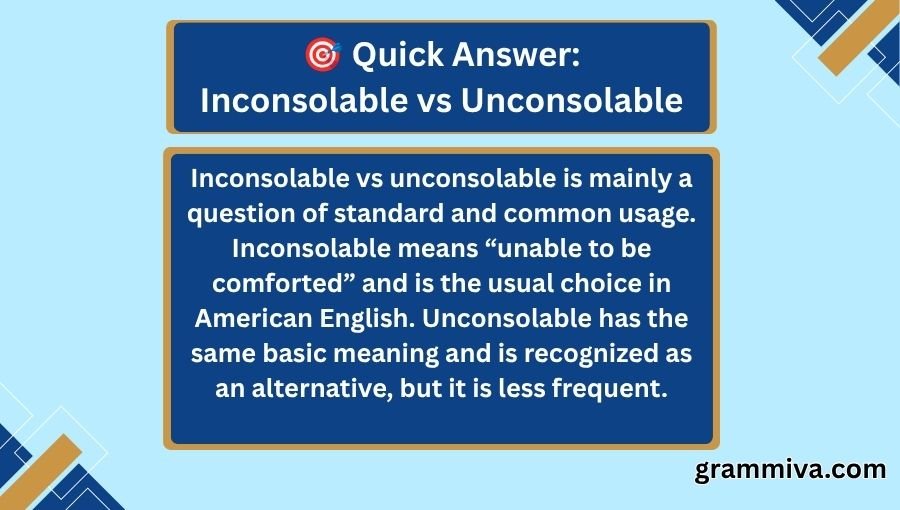
Inconsolable vs unconsolable is mainly a question of standard and common usage. Inconsolable means “unable to be comforted” and is the usual choice in American English. Unconsolable has the same basic meaning and is recognized as an alternative, but it is less frequent.
| Word | Meaning | Best General Choice? | Example |
|---|---|---|---|
| Inconsolable | Unable to be comforted | Yes | She was inconsolable after the loss. |
| Unconsolable | Unable to be comforted | Valid, but less common | The child seemed unconsolable. |
So, if you are unsure, use inconsolable.
Is Inconsolable the Same as Unconsolable?
Yes, the two words have essentially the same meaning: they describe someone who cannot be comforted. The important difference is that inconsolable is much more common, while unconsolable is a less frequent alternative.
Oxford lists unconsolable as an alternative to inconsolable and notes that inconsolable is more frequent. Merriam-Webster also gives unconsolable as meaning inconsolable.
This means you should not automatically label unconsolable as a spelling mistake. It is a real English word. However, frequency matters when you want your writing to sound natural.
| Feature | Inconsolable | Unconsolable |
|---|---|---|
| Basic meaning | Cannot be comforted | Cannot be comforted |
| Part of speech | Adjective | Adjective |
| Standard word | Yes | Yes |
| Frequency | More common | Less common |
| Best choice for most US writing | Yes | Usually no |
| Example | He was inconsolable. | He was unconsolable. |
A simple rule
If you want one rule that works almost every time, remember this:
Use “inconsolable” when you mean extremely sad or upset and unable to be comforted.
That choice will sound natural to most American readers.
Inconsolable: Meaning and Correct Use
Inconsolable is an adjective that describes a person, animal, or sometimes an emotional state that cannot be comforted or soothed.
The word often appears when the emotion is very strong. It can describe grief, sadness, disappointment, crying, or deep distress.
For example:
- She was inconsolable after hearing the news.
- The child became inconsolable after losing his favorite toy.
- His family was inconsolable with grief.
Merriam-Webster defines inconsolable as being incapable of being consoled. Cambridge gives the same basic idea and explains that the person is so sad or disappointed that it is impossible to make them feel better.
How the sentence works
Consider this sentence:
Maria was inconsolable after her dog died.
- Maria = subject
- was = linking verb
- inconsolable = adjective
- after her dog died = explains the reason for her emotional state
The adjective does not mean that Maria will never feel better. It describes her condition at that moment.
That point matters. Saying someone is inconsolable is usually about the intensity of their present grief or distress.
Common uses of inconsolable
| Use | Meaning | Example Sentence |
|---|---|---|
| Grief | Too sad to be comforted | He was inconsolable after his father’s death. |
| Disappointment | Extremely upset by an outcome | She was inconsolable after losing the final match. |
| Crying | Crying that does not stop with comfort | The baby was inconsolable for an hour. |
| Emotional pain | Deep distress that comfort does not ease | He seemed inconsolable after the breakup. |
Why Do People Confuse Inconsolable and Unconsolable?
People confuse the two words because both forms follow a pattern that English speakers already know. English often uses un- to create the opposite of an adjective. Words such as unable, unhappy, and uncomfortable are common.
That can make unconsolable feel like the obvious form.
At the same time, English also uses in- in words such as invisible, incomplete, and inaccurate. So both patterns look possible.
I once reviewed a student’s short essay about a family losing a pet. The student had written unconsolable several times. At first, the student thought the word was simply wrong because a teacher had marked it. The better explanation was more useful: the word exists, but inconsolable is the normal choice in most standard writing.
| Reason for Confusion | What Happens |
|---|---|
| Similar spelling | Both words look natural |
| Prefix habits | Writers know both “in-” and “un-” |
| Autocorrect | Software may not flag the less common form |
| Limited vocabulary exposure | A writer may have seen only one version |
| Dictionary differences | Some dictionaries list both forms |
The safest lesson is not “one word exists and one does not.” The safer lesson is “both exist, but one is much more common.”
Inconsolable vs Unconsolable at a Glance
The central difference is usage frequency, not basic meaning. Inconsolable is the normal choice for most readers, while unconsolable is a recognized but less common alternative.
| Form | Type | Meaning | Example | Correct/Incorrect |
|---|---|---|---|---|
| inconsolable | Adjective | Unable to be comforted | She was inconsolable. | ✅ Correct |
| unconsolable | Adjective | Unable to be comforted | She was unconsolable. | ✅ Correct, but less common |
| inconsolably | Adverb | In a way that cannot be comforted | He cried inconsolably. | ✅ Correct |
| unconsolably | Adverb | In a way that cannot be comforted | He cried unconsolably. | ✅ Correct, but less common |
| inconsolability | Noun | The state of being inconsolable | Her inconsolability worried him. | ✅ Correct |
The important point is that unconsolable is not simply a typo. Oxford’s learner dictionaries list it as an alternative and describe inconsolable as the more frequent form.
What Does Inconsolable Mean in Everyday English?
In everyday English, inconsolable means “so upset that comfort does not seem to work.”
It is a strong word. You would not normally use it for a person who is mildly annoyed.
For example:
- “I was a little disappointed” is mild.
- “I was very upset” is stronger.
- “I was inconsolable” suggests extreme emotional distress.
Example comparisons
| Sentence | Emotional Strength | Natural? |
|---|---|---|
| I was slightly sad. | Low | ✅ |
| I was upset about the news. | Medium | ✅ |
| I was devastated by the news. | High | ✅ |
| I was inconsolable after the loss. | Very high | ✅ |
This is why inconsolable often appears with words such as grief, tears, crying, loss, and devastated.
Can You Use Unconsolable in a Sentence?
Yes. Unconsolable is a real adjective and can be used in a sentence. However, it is less frequent than inconsolable, so it may sound unusual to some readers.
For example:
The child was unconsolable after his mother left the room.
The meaning is clear. There is no major grammar problem with the sentence.
Still, if I were editing the sentence for a general US audience, I would normally write:
The child was inconsolable after his mother left the room.
The second version is more familiar and more likely to sound natural without distracting the reader.
| Version | Meaning | Editorial Advice |
|---|---|---|
| She was inconsolable. | Cannot be comforted | Best choice |
| She was unconsolable. | Cannot be comforted | Valid, but less common |
| She cried inconsolably. | She cried without being comforted | Best choice |
| She cried unconsolably. | Same basic meaning | Valid, but less common |
💡 Test Tip: How Can You Check Which Word Sounds Better?
Try replacing the word with “unable to be comforted.”
If the sentence still makes sense, both forms may work. Then ask yourself which form sounds more natural.
For example:
He was unable to be comforted after the loss.
Now compare:
He was inconsolable after the loss.
That sounds natural and direct.
You can also use a frequency test:
- Is the sentence formal or professional?
- Is the audience broad?
- Do you want the most familiar word?
- Are you writing for US English?
If you answer yes to these questions, choose inconsolable.
📝 Case Study: Choosing the Right Word at Work
Imagine that you are writing an email to your manager after a difficult event.
A first draft might say:
“The employee was unconsolable after receiving the news.”
The sentence is understandable. But I would edit it to:
“The employee was inconsolable after receiving the news.”
Why?
The goal of workplace writing is usually clarity. The more familiar word is the better choice when both words carry the same meaning.
I once edited a short workplace report where the writer had chosen an unusual synonym simply because it sounded more formal. The result was technically understandable, but it slowed the reader down. We replaced it with a common word, and the sentence became much easier to read.
| Draft | Edited Version | Why |
|---|---|---|
| She was unconsolable after the news. | She was inconsolable after the news. | More familiar |
| He remained unconsolable for hours. | He remained inconsolable for hours. | More natural |
| The child was inconsolable. | The child was inconsolable. | Clear and direct |
Grammar Rules Explanation
Both inconsolable and unconsolable function as adjectives. They can appear after a linking verb such as be, seem, become, or remain, or before a noun.
Examples include:
- She was inconsolable.
- The child seemed inconsolable.
- His inconsolable grief lasted for weeks.
The key grammar issue is not that unconsolable breaks a basic adjective rule. It does not. The key issue is standard usage and frequency.
Major reference sources recognize inconsolable as the established common form. Oxford also recognizes unconsolable as an alternative and marks it as less frequent. Merriam-Webster lists unconsolable with the definition “inconsolable.”
So the practical grammar rule is simple:
When you need the standard, familiar adjective for someone who cannot be comforted, use “inconsolable.”
There is no grammar rule requiring every negative adjective to use in- or every opposite adjective to use un-. English has developed both patterns, and individual words have to be learned as established forms.
Correct vs Incorrect at a Glance
| Sentence | Correct/Incorrect | Why |
|---|---|---|
| She was inconsolable after the loss. | ✅ Correct | Standard and common usage |
| She was unconsolable after the loss. | ✅ Correct | Recognized alternative, but less common |
| She was inconsolably after the loss. | ❌ Incorrect | The adverb does not fit after “was” here |
| She cried inconsolably. | ✅ Correct | Adverb correctly modifies “cried” |
| He felt inconsolable about the result. | ✅ Correct | Adjective follows “felt” |
The fourth example shows an important point. Inconsolable and inconsolably are not interchangeable.
⚠️ Common Mistakes With Inconsolable and Unconsolable
Most mistakes happen because writers focus on spelling rather than sentence structure.
Another problem is speed. When people type quickly, they often trust the first form that looks familiar.
I once caught myself typing unconsolable in a draft because I was thinking about the familiar prefix un-. I stopped and checked the sentence. The more natural choice for the audience was inconsolable. That small pause saved an unnecessary edit later.
Similar grammar confusions
| Confusion | Correct Forms | Main Difference |
|---|---|---|
| it’s / its | it’s / its | “It’s” = it is; “its” shows possession |
| your / you’re | your / you’re | “Your” shows possession; “you’re” = you are |
| their / they’re | their / they’re | “Their” shows possession; “they’re” = they are |
| affect / effect | affect / effect | Usually verb vs. noun, with exceptions |
| then / than | then / than | Time/order vs. comparison |
These mistakes share one lesson: English spelling does not always work by a simple logical formula.
Specific wrong forms and better choices
| Wrong Form | What’s Wrong | Correct Form |
|---|---|---|
| inconsolabley | Incorrect spelling of the adverb | inconsolably |
| inconsolible | Wrong vowel pattern | inconsolable |
| inconsolabale | Extra letters | inconsolable |
| unconsolible | Incorrect spelling | unconsolable or, preferably, inconsolable |
| inconsolably sad person | Awkward word form | inconsolable person |
| she was inconsolably | Wrong part of speech in this structure | she was inconsolable |
Three common causes are especially easy to spot:
- Fast typing: Your fingers may choose the form your brain expects.
- Autocorrect: A writing app may not understand your intended word.
- Lack of knowledge: You may know the meaning but not the standard form.
The best fix is to slow down and check the word in context.
Where Did Inconsolable Come From?
The history of inconsolable is well established. It comes from a Latin form related to the idea of being unable to be comforted, and the English word has been used since the late 16th century.
You do not need to memorize this history to use the word correctly. Still, it helps explain why inconsolable is a long-established form.
The related word unconsolable developed as an alternative form. Modern reference works recognize it, but it remains less frequent.
| Period | Form | Note |
|---|---|---|
| Late 1500s | inconsolable | Established in English |
| Later English use | inconsolable | Continued as the common form |
| Modern English | unconsolable | Recognized alternative |
| Modern US English | inconsolable | Usually the safer choice |
The history supports the same practical lesson: inconsolable is the established form you are most likely to want.
How Should You Use These Words in Different Contexts?
The meaning stays almost the same across contexts, but the best choice can change slightly based on your audience. In everyday and professional US English, inconsolable is usually the smoother option.
| Context | Which Term to Use | Example |
|---|---|---|
| Everyday conversation | Inconsolable | She was inconsolable after the breakup. |
| Professional writing | Inconsolable | The client appeared inconsolable after the announcement. |
| Creative writing | Either, depending on style | He stood alone, inconsolable in the rain. |
| Social media/texting | Usually inconsolable | I was inconsolable after that ending! |
Everyday conversation
Use inconsolable when describing extreme sadness.
“She was inconsolable after hearing the news.”
It sounds natural and clear.
Professional writing
Professional writing should favor familiar language.
“The patient appeared inconsolable after receiving the news.”
Depending on the setting, you may want a more neutral phrase such as extremely distressed. Still, inconsolable is grammatically fine.
Creative writing
Creative writers have more freedom.
An author might choose unconsolable because it fits the rhythm, voice, or style of a particular passage. Since unconsolable is recognized, it can work when the writer has a reason to choose it.
Social media and texting
Informal writing has fewer restrictions.
You might write:
“I was inconsolable after that movie.”
The word can also be used humorously for small disappointments:
“They ran out of pizza, and I was inconsolable. 😂”
That is an exaggerated, playful use. The context makes the joke clear.
Common Phrases With Inconsolable
There are no special idioms that you must memorize, but inconsolable appears naturally in several common word combinations.
| Phrase | Meaning |
|---|---|
| inconsolable grief | Grief that seems impossible to ease |
| inconsolable sadness | Extreme sadness that comfort does not relieve |
| inconsolable crying | Crying that does not respond to comfort |
| inconsolable child | A child who cannot be soothed |
| inconsolable after the loss | Unable to be comforted after something is lost |
| completely inconsolable | Extremely difficult or impossible to comfort |
These phrases are especially useful because they show how the adjective behaves in real sentences.
For example:
The family was inconsolable after the loss.
Here, inconsolable describes the family’s emotional condition.
Synonyms and Alternatives for Inconsolable
Sometimes inconsolable is stronger than you need. In those cases, another word may communicate your idea more precisely.
| Alternative | Works When | Does Not Work When |
|---|---|---|
| Heartbroken | Someone is deeply hurt by loss | The person is only mildly disappointed |
| Devastated | The emotional impact is severe | You need a neutral description |
| Distraught | Someone is extremely upset or troubled | You specifically mean that comfort cannot help |
| Miserable | Someone feels very unhappy | You need to stress extreme grief |
| Unable to be comforted | You want maximum clarity | You want a short, vivid adjective |
Notice that these words are not perfect replacements in every sentence.
For example, miserable can describe someone who is unhappy, but it does not necessarily mean that the person cannot be comforted.
That is why inconsolable remains useful. It carries a specific idea.
Why Does Getting Inconsolable Right Matter?
Getting the word right matters because good writing should be easy to understand. A familiar word helps your reader move through the sentence without stopping to wonder about your word choice.
“Clear writing lets the reader focus on the message, not the wording.”
Clarity in communication
When you use inconsolable, most readers immediately understand that the person is extremely upset and cannot easily be comforted.
Professionalism
In a resume, report, business email, or formal article, the more common form is usually the safer choice.
Digital writing accuracy
Search engines, readers, editors, and writing tools all benefit from clear, standard wording. A less common form is not automatically wrong, but a common form reduces friction.
| Situation | Why Getting It Right Matters |
|---|---|
| Resume or cover letter | Shows careful word choice |
| Client email | Keeps the message clear |
| Published article | Gives readers familiar language |
| Social post | Makes the meaning instantly clear |
How Can You Remember the Difference?
The easiest memory trick is to connect inconsolable with the phrase “cannot be consoled.”
Think:
inconsolable → cannot be consoled
Then remember that unconsolable also exists, but it is less common.
Another useful trick is to memorize the full phrase rather than only the word:
- inconsolable grief
- inconsolable child
- inconsolable after a loss
- cried inconsolably
When you learn words inside phrases, you are less likely to rebuild their spelling from scratch.
| Memory Method | Example |
|---|---|
| Meaning link | inconsolable = cannot be comforted |
| Phrase link | inconsolable grief |
| Contrast | inconsolable = common; unconsolable = less common |
| Grammar link | inconsolable = adjective; inconsolably = adverb |
Quick Recap Checklist
Use this checklist whenever you hesitate between the two forms.
| Question | If Yes → Use |
|---|---|
| Do I mean someone cannot be comforted? | inconsolable |
| Am I writing for a general US audience? | inconsolable |
| Do I want the more common form? | inconsolable |
| Am I intentionally using a less common alternative? | unconsolable can work |
| Am I describing how someone cries? | inconsolably |
Practice examples
1. After hearing the final decision, she was ______.
Answer: inconsolable.
2. The baby cried ______ for several minutes.
Answer: inconsolably.
3. The writer used the less common adjective “______” in the novel.
Answer: unconsolable.
The first two answers are the forms I would normally recommend for general US English.
Are Inconsolable and Unconsolable Interchangeable?
For basic meaning, yes. Both describe someone who cannot be comforted. However, they are not equally common.
Inconsolable is the better default choice. Unconsolable is acceptable as an alternative, but many readers will encounter it less often.
Is Unconsolable Grammatically Correct?
Yes. Unconsolable is a recognized adjective. It has the same basic meaning as inconsolable.
The issue is not basic grammatical correctness. The issue is that unconsolable is less frequent. If you want the most familiar form, choose inconsolable.
Which Is More Common: Inconsolable or Unconsolable?
Inconsolable is more common. Oxford specifically identifies unconsolable as less frequent than inconsolable.
That makes inconsolable the better choice for most everyday, academic, professional, and web writing.
Should I Use Inconsolable in American English?
Yes. Inconsolable is the safest and most natural choice in American English.
American English reference sources list inconsolable as the standard adjective for someone who cannot be comforted.
Can Inconsolable Describe a Baby?
Yes. Inconsolable can describe a baby who is crying and cannot be soothed.
For example:
“The baby became inconsolable after waking.”
This is a common use because the word focuses on the baby’s response to attempts at comfort.
What Is the Adverb Form of Inconsolable?
The adverb is inconsolably.
Use inconsolably when you need to describe how someone does something.
- She was inconsolable.
- She cried inconsolably.
The first sentence needs an adjective after was. The second needs an adverb because inconsolably describes the verb cried.
Is “Inconsolably Sad” Correct?
Yes, but it is often unnecessary. Inconsolable already expresses an intense state of sadness or distress.
For example:
“She was inconsolable.”
is usually cleaner than:
“She was inconsolably sad.”
Both can make sense, but the first is more direct.
Is “Inconsolable Grief” Correct?
Yes. Inconsolable grief is a natural phrase for grief that cannot be eased or comforted.
For example:
“The family struggled with inconsolable grief after the loss.”
The phrase is especially useful in serious or emotional writing.
Is Unconsolably a Word?
Yes. Unconsolably is the adverb form related to unconsolable. It is recognized, but it is less common than inconsolably.
For most US English writing, I recommend inconsolably.
Can I Use Unconsolable in Formal Writing?
You can, but I would normally choose inconsolable in formal writing unless you have a specific stylistic reason to use unconsolable.
Formal writing benefits from familiar wording. Since the two words carry the same basic meaning, there is little advantage in choosing the less common form.
What Is the Difference Between Inconsolable and Inconsolably?
Inconsolable is an adjective, while inconsolably is an adverb.
Compare:
- The child was inconsolable.
- The child cried inconsolably.
The adjective describes the person or state. The adverb describes the way an action happens.
What Is the Easiest Way to Remember Inconsolable vs Unconsolable?
Remember one sentence:
When in doubt, choose inconsolable.
Both forms can be correct, but inconsolable is more common and is the form most readers will expect.
Inconsolable vs Unconsolable: The Bottom Line
If you are choosing between the two words for ordinary US English, inconsolable is the best default. It means someone is so sad, upset, or distressed that they cannot be comforted. Unconsolable carries the same basic meaning and is a recognized alternative, but it is less common.
The distinction is therefore not a simple “right versus wrong” spelling rule. Instead, it is a matter of standard usage, frequency, and audience.
| Point | Best Answer |
|---|---|
| More common word | Inconsolable |
| Less common alternative | Unconsolable |
| Meaning of both | Unable to be comforted |
| Standard adjective | Inconsolable |
| Adverb | Inconsolably |
| Best choice for US English | Inconsolable |
| Is unconsolable valid? | Yes |
When I edit a sentence and both forms are possible, I ask one simple question: Which word will help the reader understand the sentence without stopping? In this case, the answer is usually inconsolable.
Use inconsolable for the clearest, most familiar choice. Keep unconsolable in your vocabulary, but reach for it only when you have a reason to prefer the less common form.
Final takeaway
Inconsolable vs unconsolable does not require a complicated grammar rule. Both words can describe someone who cannot be comforted, but inconsolable is the more common and natural choice for most US English writing. 🌟
If you remember only one thing, remember this: when someone cannot be comforted, “inconsolable” is usually the word you want. Clear word choice makes good writing feel effortless—and that is exactly what you want your readers to experience.

I am Alex Morgan, an English grammar and vocabulary writer passionate about making language learning simple and useful. I work at Grammiva, where I create clear educational content and practical English examples for learners.
[…] asked questions. By the end, you should never have to pause over this spelling again. 🍅 Inconsolable vs Unconsolable | Minuscule vs miniscule | Bass vs […]
[…] you should be able to choose the right word quickly and confidently. 😊 Tomatoes vs Tomatos | Inconsolable vs Unconsolable | Minuscule vs […]