Have you ever typed a word that looked right, only to stop and wonder if one letter was out of place? That happens often with minuscule vs miniscule. The two spellings look almost identical, sound very similar in ordinary speech, and are sometimes mixed up in emails, schoolwork, articles, and online posts.
The good news is that the rule is simple. Minuscule is the standard spelling in modern US English. Miniscule is widely treated as a misspelling when it is intended to mean something very small.
I have seen this mistake in everything from student essays to polished business documents. It is easy to make because the word seems as if it should be built from mini, a familiar word meaning small. But English spelling does not always follow the pattern our eyes expect. 🧠
In this guide, I will explain the difference, show you how to use the correct form, and give you practical ways to remember it. By the end, you should be able to spot the error quickly and write with confidence. ✍️ Bass vs Base | Sightseeing vs Siteseeing | Breach vs Breech
🎯 Quick Answer: Minuscule vs miniscule
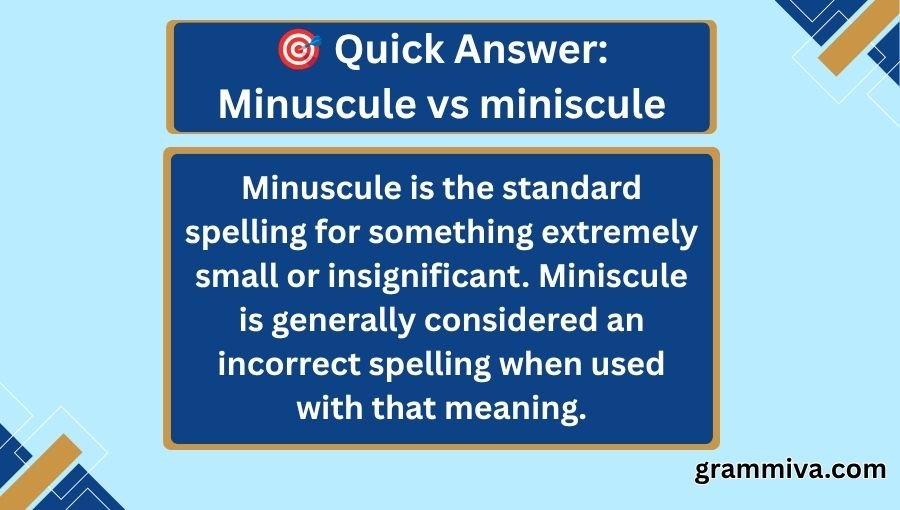
Minuscule is the standard spelling for something extremely small or insignificant. Miniscule is generally considered an incorrect spelling when used with that meaning.
For example, you can write, “The difference was minuscule.” You should not write, “The difference was miniscule” in standard edited US English.
The easiest rule is:
Use minuscule, not miniscule, when you mean “very small.”
Is minuscule the same as miniscule?
No. Minuscule is the standard form, while miniscule is usually a spelling error in standard English. The confusion comes from the fact that miniscule looks logical because of the familiar word mini.
Consider these examples:
- ✅ The font was minuscule and difficult to read.
- ❌ The font was miniscule and difficult to read.
The meaning is clear in both sentences, but only the first uses the standard spelling.
Another pair:
- ✅ She made a minuscule change to the design.
- ❌ She made a miniscule change to the design.
The difference is just a few letters, but spelling matters when you are writing for school, work, publishing, or other formal settings.
Minuscule vs miniscule at a glance
The central difference is spelling and standard usage. Minuscule is the form you should choose when you mean extremely small.
| Form | Type | Meaning | Example | Correct/Incorrect |
|---|---|---|---|---|
| minuscule | Adjective | Extremely small | The error was minuscule. | ✅ Correct |
| miniscule | Nonstandard spelling | Usually intended to mean extremely small | The error was miniscule. | ❌ Incorrect |
| minuscule | Adjective | Very slight or insignificant | They found a minuscule difference. | ✅ Correct |
| miniscule | Spelling variant caused by confusion | Usually intended as “very small” | We found a miniscule amount. | ❌ Incorrect |
The safest choice is simple: spell the word with “usc,” not “isc.”
💡 Why do people confuse minuscule and miniscule?
People confuse these spellings because miniscule looks as if it connects naturally to “mini,” which commonly suggests something small. The standard spelling, however, is minuscule.
I once caught myself typing miniscule in a draft email. I had written the sentence quickly and was mentally connecting the word to mini. When I reread the message, the spelling looked suspicious. That small pause saved me from sending the error to a client.
Several factors make this mistake common:
- The two forms look nearly identical.
- Both are pronounced similarly in normal speech.
- The word is not used in every everyday conversation.
- The spelling miniscule feels logical because of mini.
- Autocorrect may not always catch the error.
- Writers may have seen the incorrect form repeatedly online.
The visual trap
Look closely:
minuscule
miniscule
Only one vowel and one consonant pattern separate the two spellings. When you read quickly, your brain may focus on the beginning and end of the word rather than every letter in the middle.
That is why memorizing the correct pattern is more useful than trying to decide based on appearance.
What does minuscule mean?
Minuscule means extremely small. It can describe physical size, a small amount, a slight difference, or something that seems unimportant.
Here are the main uses:
Minuscule for physical size
Use minuscule when an object is extremely small.
- The insect was minuscule.
- She noticed a minuscule crack in the glass.
- The print on the label was minuscule.
In each sentence, the word tells us that the thing being described is very small.
Minuscule for a small amount
The word can also describe a quantity that is extremely small.
- We found only a minuscule amount of dust.
- The recipe requires a minuscule quantity of salt.
- The company saw a minuscule increase in costs.
Here, the thing itself may not be physically tiny. The amount is tiny.
Minuscule for a small difference
You can also use the word for a change or difference that is very slight.
- There was a minuscule difference between the two results.
- The updated version showed a minuscule improvement.
- The temperature change was minuscule.
This use is common in professional and academic writing.
Minuscule for something of little importance
The word can sometimes describe something so small that it seems unimportant.
- The delay was minuscule compared with the total project time.
- That mistake had a minuscule effect on the final result.
The basic idea remains the same: something is extremely small, slight, or limited.
| Meaning | Word Type | Example Sentence |
|---|---|---|
| Extremely small in size | Adjective | The mark was minuscule. |
| Extremely small in amount | Adjective | Only a minuscule amount remained. |
| Very slight in degree | Adjective | The change was minuscule. |
| Very small in effect | Adjective | The error had a minuscule impact. |
How should you use minuscule in a sentence?
Use minuscule before a noun or after a linking verb when you want to describe something as extremely small or slight.
Common patterns include:
minuscule + noun
- a minuscule amount
- a minuscule change
- a minuscule detail
- a minuscule error
- a minuscule insect
linking verb + minuscule
- The difference was minuscule.
- The chance is minuscule.
- The amount seems minuscule.
The word is an adjective, so it describes a noun or tells us what something is like.
Sentence breakdown
Consider:
The report showed a minuscule increase in sales.
- The report = subject
- showed = verb
- a minuscule increase = object phrase
- minuscule = adjective describing increase
The word does not need a special grammatical structure. The main challenge is simply spelling it correctly.
🎯 How can you remember the correct spelling of minuscule?
A useful memory trick is to focus on the middle of the word rather than the familiar mini beginning.
Think:
MINU + SCULE
Not:
MINI + SCULE
The standard spelling is minuscule.
💡 Test Tip
If you are unsure, ask yourself:
“Am I using this word to mean extremely small?”
If the answer is yes, choose minuscule.
You can also replace the word temporarily with tiny, very small, or slight. If the sentence still makes sense, you probably have the meaning right. Then check the spelling: minuscule.
📝 Case Study: A small spelling mistake in a workplace email
Imagine that a project manager sends this email:
“There is only a miniscule difference between the two versions.”
The reader will probably understand the intended meaning. The problem is not communication at the basic level. The problem is that the spelling looks incorrect in standard edited English.
A polished version would say:
“There is only a minuscule difference between the two versions.”
I once edited a short project summary where this exact kind of mistake appeared in a sentence about a very small budget change. The writer had excellent grammar everywhere else. The error stood out because the document was otherwise carefully edited.
This is a useful lesson: a tiny spelling error can stand out more when the rest of a document is highly polished.
For a casual message, the mistake may go unnoticed. For a report, proposal, résumé, or published article, it is worth correcting.
What are the grammar rules for minuscule vs miniscule?
The main grammar rule is straightforward: minuscule is the standard adjective when the intended meaning is “extremely small.” The spelling miniscule is generally not the standard form for that meaning.
The issue is therefore primarily one of spelling and standard usage rather than a complicated difference in grammar.
You can use minuscule in several grammatical positions:
- Before a noun: “a minuscule error”
- After a linking verb: “The error was minuscule.”
- After other linking structures: “The difference seemed minuscule.”
Most standard English reference works agree on minuscule as the normal spelling for this adjective.
There is no need to change the spelling based on whether the word appears in formal or informal writing. The standard form remains the same.
Correct vs incorrect at a glance
| Sentence | Correct/Incorrect | Why |
|---|---|---|
| The difference was minuscule. | ✅ Correct | The standard spelling means extremely small. |
| The difference was miniscule. | ❌ Incorrect | Miniscule is generally treated as a misspelling. |
| We noticed a minuscule change. | ✅ Correct | The adjective correctly describes a slight change. |
| We noticed a miniscule change. | ❌ Incorrect | The standard spelling is minuscule. |
| The amount was minuscule. | ✅ Correct | The word correctly describes a very small amount. |
Why is minuscule the preferred spelling?
The spelling minuscule is preferred because it is the established standard form of the adjective meaning extremely small. Writers should not change it to miniscule simply because mini is a familiar word associated with small things.
This is a good example of a larger lesson in English spelling. A word may look as if it should follow a familiar pattern without actually doing so.
For example, English contains many words whose spelling cannot be predicted perfectly from their sound or from another word that looks related. That is why experienced writers still use spell-checkers, dictionaries, and careful proofreading.
The important point here is not to invent a new rule based on the word mini. Simply remember the established spelling:
minuscule
⚠️ Common mistakes with minuscule
The most common mistake is replacing the u in minuscule with an i.
Other errors happen because people type quickly or rely heavily on visual memory.
| Common Confusion | Example | Correct Form |
|---|---|---|
| its / it’s | The company changed it’s policy. | its |
| your / you’re | Your going to like it. | you’re |
| their / there / they’re | Their going over there. | they’re |
| affect / effect | It had a strong affect. | effect |
| minuscule / miniscule | The change was miniscule. | minuscule |
These mistakes have different causes, but the pattern is similar. A writer knows what they want to say but selects a familiar-looking form.
Why these mistakes happen
Fast typing: When people type quickly, they often write by sound or visual pattern.
Autocorrect: Spell-check tools are useful, but they are not perfect. A word can sometimes pass a basic spelling check even when it is not the form you intended.
Lack of knowledge: If you have never learned the standard spelling, you may naturally choose the form that looks most familiar.
Repeated exposure: Seeing an incorrect spelling online can make it look normal.
I once caught a similar spelling error in my own notes after reading the same incorrect form several times on a website. Repetition can make almost any spelling feel familiar. That is why checking the word itself is better than trusting what “looks right.”
Specific wrong spellings and uses
| Wrong Form | What’s Wrong | Correct Form |
|---|---|---|
| miniscule | The middle spelling is incorrect for the standard adjective. | minuscule |
| miniscule amount | The noun phrase uses the nonstandard spelling. | minuscule amount |
| miniscule change | The adjective is misspelled. | minuscule change |
| miniscule difference | The adjective should use the standard form. | minuscule difference |
| miniscule error | The intended adjective is spelled incorrectly. | minuscule error |
Is miniscule ever acceptable?
In ordinary standard US English, you should use minuscule when you mean extremely small. Miniscule is best avoided in edited writing.
You may encounter miniscule in websites, informal posts, user-generated text, old documents, or other places where spelling has not been carefully edited. Seeing it does not make it the preferred spelling.
This distinction matters because real-world usage and standard edited usage are not always identical. People make spelling mistakes, and those mistakes can spread through repeated copying.
If you are writing something that needs to look polished, choose minuscule.
Minuscule in everyday conversation
In everyday conversation, minuscule can describe something extremely small, although speakers may choose simpler words such as tiny or very small.
For example:
“The chance of finding it is minuscule.”
That sentence sounds natural and clear.
You could also say:
“The chance is tiny.”
Both sentences communicate a similar idea. The choice depends on tone.
| Context | Which Term to Use | Example |
|---|---|---|
| Everyday conversation | minuscule | The difference is minuscule. |
| Professional writing | minuscule | The cost increase was minuscule. |
| Creative writing | minuscule | A minuscule light flickered in the distance. |
| Social media/texting | minuscule | The change was minuscule. |
Even in casual writing, there is no reason to choose miniscule if you mean extremely small.
How does minuscule work in professional writing?
Minuscule works well in professional writing when you need to describe a very small amount, change, error, or difference.
For example:
- The revised estimate shows a minuscule increase.
- The two proposals have a minuscule difference in cost.
- The test revealed a minuscule error.
- The update produced a minuscule improvement.
However, choose the word carefully. In some business writing, small or slight may be clearer.
Compare:
The project experienced a minuscule delay.
with:
The project experienced a slight delay.
Both can work. The second may sound more neutral and natural in a formal report.
How does minuscule work in creative writing?
Creative writers can use minuscule when they want to emphasize extreme smallness.
For example:
A minuscule silver thread caught the light.
Or:
He noticed a minuscule footprint in the wet sand.
The word can create a sharper image than the general word small. It tells the reader that the object is not merely small but extremely small.
Still, writers should avoid using it in every sentence. Variety usually makes prose stronger.
How is minuscule used in texting and social media?
You can use minuscule in texts and social posts just as you would anywhere else. The spelling does not change because the setting is informal.
For example:
“The difference is minuscule 😂”
or:
“That was a minuscule update.”
Informal writing often ignores some standard spelling rules, but minuscule remains the best spelling when you want to write the word correctly.
Common phrases with minuscule
There are no major idioms built around minuscule, but several natural word combinations appear often.
| Phrase | Meaning |
|---|---|
| minuscule amount | An extremely small quantity |
| minuscule difference | A very slight difference |
| minuscule change | A very small change |
| minuscule detail | A very small detail |
| minuscule error | A very small error |
| minuscule increase | A very small rise |
These combinations are useful because they show how the adjective behaves in real sentences.
What words can replace minuscule?
Several alternatives can replace minuscule, depending on the exact meaning and tone. The best choice depends on whether you are describing physical size, amount, degree, or importance.
| Alternative | Works When | Does Not Work When |
|---|---|---|
| tiny | You mean very small physical size. | You need a more formal tone. |
| very small | You want maximum clarity. | You want a more precise or polished adjective. |
| slight | You mean a small difference or degree. | You mean an object’s physical size is extremely small. |
| insignificant | You mean something has little importance. | You simply mean something is physically tiny. |
| negligible | You mean an amount or effect is so small that it can almost be ignored. | You are only describing physical size. |
For example, tiny works well for an insect. Slight works well for a difference. Negligible works well for an effect that has almost no practical impact.
Choosing the right synonym can make your writing more precise.
Why does correct spelling of minuscule matter?
Correct spelling improves clarity, professionalism, and trust. A single misspelled word rarely destroys communication, but repeated errors can affect how readers judge a piece of writing.
I often tell writers that proofreading is not about making a sentence look fancy. It is about removing distractions. When a reader notices a spelling error, their attention can shift away from the idea you are trying to communicate.
A useful rule is:
Good writing makes the message easy to notice, not the mistakes.
| Situation | Why Getting It Right Matters |
|---|---|
| Résumé | Spelling errors can make a document look less polished. |
| Client email | Correct spelling supports a professional tone. |
| Published content | Readers expect careful editing. |
| Social post | Correct spelling makes the message easier to trust and share. |
This is especially useful when writing online. Digital content moves quickly, but fast publishing is not a reason to ignore basic spelling.
How can you remember minuscule vs miniscule?
The simplest memory trick is to memorize the middle letters.
Remember this:
minuSCule
The word contains usc after minu.
You do not need to build a complicated memory story around it. Just remember:
Very small = minuscule.
Another useful technique is to write the correct form three times:
minuscule — minuscule — minuscule
Then place it into a sentence:
The difference was minuscule.
Repeated correct use helps make the spelling familiar.
Minuscule vs miniscule in edited writing
In edited US English, minuscule is the form you should use. Editors, teachers, employers, and readers who care about standard spelling are more likely to expect this form.
That does not mean everyone who writes miniscule is careless. The error is understandable. The two spellings are extremely close, and the incorrect version has a logical-looking connection to mini.
Still, when you have a choice, there is no reason to take the risk. Use the standard form.
Is minuscule formal or informal?
Minuscule can be used in both formal and informal English. It is not limited to one type of writing.
In formal writing:
The study found a minuscule difference between the groups.
In everyday speech:
The difference was minuscule.
In creative writing:
A minuscule drop of water rested on the leaf.
The word fits all three settings. The main issue is choosing the correct spelling.
What is the easiest way to check minuscule?
If you are proofreading and hesitate, stop and look at the middle of the word. If you have written miniscule, change it to minuscule when the intended meaning is “extremely small.”
A simple editing routine is:
- Read the whole sentence.
- Identify what the adjective describes.
- Confirm that you mean “extremely small” or “very slight.”
- Check the spelling.
- Replace miniscule with minuscule if necessary.
This takes only a few seconds.
⚠️ Minuscule vs miniscule: Common questions about usage
The confusion is mostly about spelling, but writers often have related questions. Here are direct answers to the most common ones.
FAQs About Minuscule vs Miniscule
Is “miniscule” a word?
Miniscule is commonly encountered as a spelling of the intended word minuscule, but it is generally not the standard spelling for the adjective meaning extremely small. In standard edited US English, use minuscule.
Which is correct, minuscule or miniscule?
Minuscule is correct for the standard adjective meaning extremely small. Miniscule is generally treated as a misspelling.
How do you spell minuscule correctly?
The standard spelling is m-i-n-u-s-c-u-l-e: minuscule.
What does minuscule mean?
Minuscule means extremely small. It can describe physical size, an amount, a difference, a change, or an effect.
Why do people spell minuscule as miniscule?
The spelling miniscule is easy to produce because people often connect the word with mini, which is strongly associated with small size. Fast typing and repeated exposure to the incorrect form can also reinforce the mistake.
Is minuscule formal English?
Yes. Minuscule is appropriate in formal, professional, academic, creative, and casual writing. The choice of a simpler synonym may depend on the tone of the sentence.
Can I use minuscule to describe an amount?
Yes. For example: “Only a minuscule amount of water remained.” Here, the word describes the amount as extremely small.
Can minuscule describe a difference?
Yes. You can write, “There was a minuscule difference between the two measurements.” It means the difference was very small.
What is an easy trick for remembering minuscule?
Remember that the standard spelling is minuscule, with u after min. Think minu + scule, not mini + scule.
Is minuscule better than tiny?
Not always. Minuscule is useful when you want to stress extreme smallness or use a somewhat more polished word. Tiny is often simpler and more natural in everyday writing.
✅ Quick Recap Checklist
Use this checklist whenever you are unsure about the spelling.
| Question | If Yes → Use |
|---|---|
| Do you mean extremely small? | minuscule |
| Are you describing a tiny amount? | minuscule |
| Are you describing a very small difference? | minuscule |
| Are you describing a slight change? | minuscule |
| Are you tempted to write “miniscule”? | Stop and write minuscule instead |
Practice examples
- The difference between the two measurements was minuscule.
- We found only a minuscule amount of dust.
- The insect was so minuscule that I could barely see it.
Try covering the word and spelling it from memory. Then check your answer.
Final thoughts on minuscule vs miniscule
Minuscule vs miniscule becomes much easier once you remember that minuscule is the standard spelling for something extremely small. The form miniscule is usually a spelling mistake caused by the natural temptation to connect the word with mini.
When you describe a tiny amount, a slight difference, a small change, or something extremely small, write minuscule. The word works in casual conversation, professional writing, creative work, and online content.
The best way to remember it is simple: do not let the familiar word mini change the spelling in your head. Look at the middle and remember minu-scule.
A small spelling detail can make a big difference in polished writing. 🌟
When you mean extremely small, choose minuscule—and make that tiny spelling choice with confidence.

I am Adam Wilson, an English language content writer with an interest in grammar and vocabulary. I work at Grammiva and focus on creating clear explanations and practical examples for English learners.
[…] break down the difference in plain English so you can choose the right word with confidence. 🌟 Minuscule vs miniscule | Bass vs Base | Sightseeing vs […]
[…] end, you should never have to pause over this spelling again. 🍅 Inconsolable vs Unconsolable | Minuscule vs miniscule | Bass vs […]