Have you ever typed a travel sentence and suddenly wondered whether sightseeing vs siteseeing is the correct spelling? ✈️ You are not alone. These two forms look almost identical, but only one is the standard English word for visiting places of interest and enjoying what you see.
The confusion is easy to understand. English has many words that change when a word is added to another word. We have seeing, site, sight, and seeing a site. So, when someone wants to describe a day spent visiting famous places, it can feel natural to write siteseeing.
I have taught and edited enough English to know that small spelling questions can cause big doubts. The good news is that this one has a very simple answer.
In this guide, I will explain sightseeing vs siteseeing in plain English. You will learn which spelling is correct, why the other form causes trouble, how to use the word in everyday and professional writing, and how to remember the difference without checking a dictionary every time. 😊 Breach vs Breech | Spicy vs Spicey | Habit vs Habbit
🎯 Quick Answer: Sightseeing vs Siteseeing
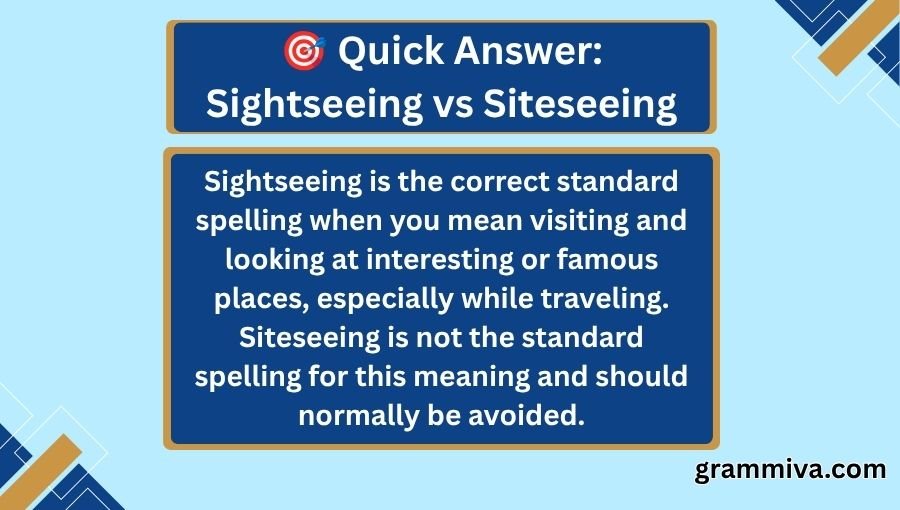
Sightseeing is the correct standard spelling when you mean visiting and looking at interesting or famous places, especially while traveling. Siteseeing is not the standard spelling for this meaning and should normally be avoided.
For example:
- ✅ We spent Saturday sightseeing in Chicago.
- ❌ We spent Saturday siteseeing in Chicago.
A simple memory trick is this: sightseeing is about seeing sights.
Is Sightseeing the Same as Siteseeing?
No. Sightseeing is the standard word, while siteseeing is generally a misspelling when the intended meaning is visiting interesting places.
The key is the word sight. A sight can be something worth seeing, such as a landmark, building, monument, natural feature, or famous attraction.
When you combine sight with seeing, you get sightseeing.
| Form | Type | Meaning | Example | Correct/Incorrect |
|---|---|---|---|---|
| sightseeing | Noun/gerund | Visiting places of interest | We went sightseeing downtown. | ✅ Correct |
| siteseeing | Nonstandard spelling | Usually intended to mean sightseeing | We went siteseeing downtown. | ❌ Incorrect |
| sightsee | Verb | To visit and look at interesting places | We plan to sightsee tomorrow. | ✅ Correct |
| sightseer | Noun | A person who goes sightseeing | The sightseers took photos. | ✅ Correct |
| sightseeing trip | Noun phrase | A trip focused on visiting attractions | It was a fun sightseeing trip. | ✅ Correct |
The important point is that site and sight have different meanings. A site is a place or location. A sight is something you see or an interesting thing to look at.
🔍 Why Do People Confuse Sightseeing and Siteseeing?
People confuse these words because sight and site sound the same in standard American English. They are homophones, which means they have the same pronunciation but different spellings and meanings.
I once edited a travel handout for a student group. The writer had used siteseeing several times. The intended meaning was clear, but every occurrence needed to be changed to sightseeing. The writer told me afterward that the mistake happened because they were thinking about visiting different sites. That explanation makes perfect sense, but English uses sightseeing for the activity.
Here is the easiest way to separate the words:
- sight → something you see
- site → a place or location
- seeing → looking at or noticing something
- sightseeing → visiting places and attractions to see them
Sight means something you see
A sight can be a person, place, object, event, or view that attracts attention.
Examples:
- The Grand Canyon is an amazing sight.
- We saw a beautiful sight from the mountain.
- The parade was an exciting sight.
Site means a place
A site usually refers to a physical location.
Examples:
- The company chose a new building site.
- The construction site is closed.
- Archaeologists studied the ancient site.
Sightseeing combines sight + seeing
Sightseeing describes the activity of visiting places that are interesting to look at.
Examples:
- We went sightseeing after breakfast.
- They spent the afternoon sightseeing.
- I love sightseeing when I visit a new city.
| Word | Basic Idea | Example |
|---|---|---|
| sight | Something seen | The waterfall was an incredible sight. |
| site | A place or location | The hotel site is near the beach. |
| seeing | Looking at or noticing | I enjoy seeing new places. |
| sightseeing | Visiting attractions | We went sightseeing in Boston. |
What Does Sightseeing Mean?
Sightseeing means visiting and looking at places or things that are interesting, famous, beautiful, or historically important.
It is most often connected with travel. However, you can go sightseeing in your own city, too.
For example:
We went sightseeing in San Francisco during our vacation.
This means the people visited attractions and interesting places in San Francisco.
Common sightseeing activities
Sightseeing may include:
- visiting museums
- looking at famous buildings
- touring historic areas
- visiting monuments
- viewing natural landmarks
- exploring a city
- taking photographs of attractions
- joining a guided tour
The activity does not require a specific type of transportation. You can go sightseeing by walking, driving, taking a bus, riding a boat, or joining a tour.
Sightseeing as a noun
In many sentences, sightseeing works as a noun.
- Sightseeing is popular in Rome.
- We spent the morning sightseeing.
- The hotel offers sightseeing tours.
Sightseeing as part of a phrase
It also appears in common phrases such as:
- sightseeing tour
- sightseeing bus
- sightseeing cruise
- sightseeing trip
- sightseeing guide
- sightseeing attraction
| Meaning | Word Type | Example Sentence |
|---|---|---|
| Visiting interesting places | Noun/gerund | Sightseeing was the best part of our trip. |
| Looking at attractions | Noun/gerund | We spent three hours sightseeing. |
| Related to tourist attractions | Modifier | We booked a sightseeing tour. |
🧠 How Can You Remember Sightseeing vs Siteseeing?
The easiest memory trick is to connect sightseeing with sights.
Think:
Sight + seeing = seeing sights.
If you are looking at famous places, you are seeing sights. Therefore, the activity is sightseeing.
Try this mental test:
“Am I talking about a place itself, or am I talking about looking at interesting things?”
If you mean the activity of visiting attractions, choose sightseeing.
If you mean a physical location, choose site.
| Question | Word to Think About | Example |
|---|---|---|
| What is something interesting to see? | sight | The castle is a famous sight. |
| What is a physical location? | site | The site is near the river. |
| What activity involves seeing attractions? | sightseeing | We went sightseeing. |
| What person visits attractions? | sightseer | The sightseers boarded the bus. |
💡 Test Tip
Remove -seeing mentally.
If your intended word is sight, then sightseeing is probably what you need.
For example:
We spent the day ___.
You mean you spent the day seeing attractions. The correct answer is:
We spent the day sightseeing.
📝 Sightseeing vs Siteseeing in a Real-Life Case Study
Imagine that a manager sends this email to a group of employees before a conference:
“After the conference, we will have three hours for siteseeing.”
The meaning is understandable. Most readers will know what the manager means. However, the spelling is still incorrect for standard English.
A polished version would be:
“After the conference, we will have three hours for sightseeing.”
Now consider a different sentence:
“The company selected the site for its new office.”
Here, site is correct because the sentence refers to a physical location.
I once caught myself typing siteseeing in a quick message after a long day of editing travel content. I noticed it before sending the message because I remembered the simple rule: sightseeing means seeing sights. That small check has saved me more than once.
| Situation | Correct Sentence | Reason |
|---|---|---|
| Vacation activity | We went sightseeing. | The activity involves seeing attractions. |
| Physical location | The construction site is large. | Site means a location. |
| Tourist activity | They booked a sightseeing tour. | The tour is for seeing attractions. |
| Building location | The site was chosen last month. | The sentence refers to a location. |
📚 Grammar Rules Explanation
The standard spelling for the travel activity is sightseeing. It is formed with the word sight, not site. The meaning is closely connected to seeing notable or interesting things.
The spelling siteseeing creates a different word combination. While site can correctly describe a location, siteseeing is not the standard form used for the travel activity.
This distinction is based on meaning, not simply sound.
In English, words that sound alike can have completely different spellings and meanings. Sight and site are a good example. The same pattern appears with pairs such as right/write and their/there.
Most major English dictionaries and standard writing references use sightseeing for the activity of visiting interesting places.
Correct vs Incorrect at a Glance
| Sentence | Correct/Incorrect | Why |
|---|---|---|
| We went sightseeing in New York. | ✅ Correct | Sightseeing is the standard spelling. |
| We went siteseeing in New York. | ❌ Incorrect | Siteseeing is not the standard spelling for this activity. |
| The tour includes sightseeing. | ✅ Correct | The sentence describes visiting attractions. |
| The tour includes siteseeing. | ❌ Incorrect | The intended activity should be spelled sightseeing. |
| The construction site is downtown. | ✅ Correct | Site means a physical location. |
The rule is simple: use sight when you mean something worth seeing, and use site when you mean a location.
⚠️ Common Mistakes With Sightseeing
The most common mistake is writing siteseeing because travelers often visit different sites. Another cause is the fact that sight and site sound alike.
Three everyday problems make this mistake more likely:
- Fast typing — You type what sounds right without stopping to check the spelling.
- Autocorrect — Your device may not catch the error because the wrong form can look like a possible word.
- Lack of knowledge — If you have never learned the sight/site difference, the spelling can seem completely logical.
Similar grammar and spelling confusions
| Confusing Pair | Correct Choice Depends On | Example |
|---|---|---|
| its / it’s | Possession vs. “it is” | The dog hurt its paw. |
| your / you’re | Possession vs. “you are” | You’re bringing your camera. |
| their / there / they’re | Possession, place, or “they are” | They’re over there with their bags. |
| to / too / two | Direction, also, or number | We went to see two sights, too. |
| sight / site | Something seen vs. location | The sight was beautiful; the site was remote. |
Specific wrong spellings and uses
| Wrong Form | What’s Wrong | Correct Form |
|---|---|---|
| siteseeing | Uses site instead of sight | sightseeing |
| site seeing | Incorrectly separates the standard compound | sightseeing |
| sight seeing | Usually written as one word for the activity | sightseeing |
| sight-seeing | Hyphenated form is not the usual modern spelling | sightseeing |
| siteseer | Uses the wrong base word | sightseer |
A student once wrote site seeing in every answer on a travel worksheet. When I asked what the word meant, the student said, “Seeing all the sites.” That answer showed exactly why the mistake happened. The meaning was close, but the standard spelling is tied to sight, not site.
🕰️ Sightseeing Word History and Spelling
The useful history here is simple. The modern word sightseeing combines sight with seeing. Its spelling reflects the meaning of looking at notable things.
You do not need to memorize a complicated history to spell it correctly. The meaning gives you the clue.
| Stage | Form | Note |
|---|---|---|
| Earlier English | sight | A thing seen or something worth seeing |
| Modern English | sight | Retains the meaning related to seeing |
| Modern English | see/seeing | Describes the act of looking or observing |
| Modern compound | sightseeing | Describes visiting places and attractions |
| Modern related noun | sightseer | A person who goes sightseeing |
The key lesson is that the first part is sight, not site.
🌎 Sightseeing vs Siteseeing in Different Contexts
The correct spelling stays the same across most types of writing. What changes is the style of the sentence. Knowing the difference between sightseeing vs siteseeing helps you choose the right spelling in casual, professional, and online writing.
Everyday conversation
In casual speech, people commonly say:
“What are you doing today?”
“We’re going sightseeing.”
Professional writing
In business writing, use the same standard spelling:
“The conference schedule includes an optional sightseeing tour.”
Creative writing
A story might use the word to create a sense of travel:
“By noon, they had finished sightseeing and were ready for lunch.”
Social media and texting
Casual writing may contain many shortened forms, but sightseeing is still the correct spelling:
“First day in DC! So much sightseeing! 🏛️”
| Context | Which Term to Use | Example |
|---|---|---|
| Everyday conversation | sightseeing | We’re going sightseeing today. |
| Professional writing | sightseeing | The program includes a sightseeing tour. |
| Creative writing | sightseeing | They spent the afternoon sightseeing. |
| Social media/texting | sightseeing | Lots of sightseeing today! 📸 |
🗺️ Common Phrases With Sightseeing
Sightseeing appears in several common travel phrases. These combinations are useful because they help you recognize the correct spelling quickly.
| Phrase | Meaning |
|---|---|
| sightseeing tour | An organized tour of attractions |
| sightseeing trip | A trip focused partly or mainly on visiting attractions |
| sightseeing bus | A bus used to take visitors around attractions |
| sightseeing cruise | A boat trip focused on views and attractions |
| sightseeing guide | A person or guide that helps visitors explore attractions |
| sightseeing destination | A place known for attractions and things to see |
For example:
- We booked a sightseeing tour of the city.
- The sightseeing bus stopped near the museum.
- Our sightseeing cruise lasted two hours.
- She worked as a sightseeing guide during the summer.
Notice that every phrase uses sightseeing.
🔄 What Alternatives Can Replace Sightseeing?
Sometimes you can replace sightseeing with another phrase, but the exact meaning may change.
For example, touring can work when you mean traveling around an area. Exploring can work when you mean discovering a place. Visiting attractions is a clear but longer alternative.
| Alternative | Works When | Does Not Work When |
|---|---|---|
| touring | You are traveling around a place | You mean only looking at one attraction |
| exploring | You want to stress discovery | You need a specific tourism term |
| visiting attractions | You want maximum clarity | You want a short, natural phrase |
| taking a tour | You are participating in an organized tour | You are exploring alone |
| traveling around | You mean moving between places | You specifically mean viewing attractions |
For most travel writing, sightseeing is the simplest and most natural choice.
💼 Why Does Correct Spelling Matter?
Correct spelling matters because small errors can distract readers from your message. The mistake may not stop someone from understanding you, but it can make your writing look less polished. Getting sightseeing vs siteseeing right can make travel writing clearer and more professional.
This is especially true when you are writing for work, school, customers, or a public audience.
“Clear writing lets your reader focus on your message instead of your mistakes.”
Clarity in communication
A reader should not have to stop and wonder whether a word is intentional or accidental.
Professionalism
A travel company, hotel, tour operator, or writer should use standard spelling in public material.
Digital communication
Search engines, websites, emails, and social posts all benefit from clear and standard language.
| Situation | Why Getting It Right Matters |
|---|---|
| Resume | Shows attention to detail |
| Client email | Builds trust and professionalism |
| Published content | Makes the writing look polished |
| Social post | Helps readers understand the message quickly |
One spelling mistake will not ruin an email. But repeated errors can affect how readers judge the care behind the writing.
🎯 Key Differences Between Sightseeing and Siteseeing
The main difference is that sightseeing is the correct word for visiting and viewing attractions, while siteseeing is a nonstandard spelling for that intended meaning.
| Feature | Sightseeing | Siteseeing |
|---|---|---|
| Standard spelling | Yes | No |
| Refers to tourist activity | Yes | Intended meaning, but incorrect spelling |
| Contains “sight” | Yes | No |
| Connected with attractions | Yes | Intended meaning |
| Appropriate in formal writing | Yes | No |
| Common source of error | No | Yes |
If you remember only one line from this article, remember:
You go sightseeing to see sights.
❓ Why Is “Siteseeing” Wrong?
“Siteseeing” is wrong when it is used as the spelling for the normal travel activity because that activity is spelled sightseeing.
The word site means a location. For example:
The construction site is closed.
The word sight relates to something seen:
The waterfall was a beautiful sight.
Therefore:
We went sightseeing.
Not:
We went siteseeing.
The mistake is understandable because travelers may visit many sites. But the standard word for the activity is still sightseeing.
❓ Is “Sightseeing” One Word?
Yes. Sightseeing is normally written as one word when it refers to the activity of visiting and viewing attractions.
Correct:
We spent the afternoon sightseeing.
Incorrect for standard usage:
We spent the afternoon sight seeing.
The same applies to common compounds such as sightseeing tour and sightseeing bus.
❓ Is Sightseeing a Noun or a Verb?
Sightseeing is commonly used as a noun or as a gerund form related to the verb sightsee.
Examples include:
- Sightseeing is fun.
- We went sightseeing.
- She enjoys sightseeing.
- They spent the morning sightseeing.
The base verb is sightsee.
Examples:
- We plan to sightsee tomorrow.
- They sightsee whenever they travel.
The person who does it is a sightseer.
❓ What Is the Difference Between Sight and Site?
Sight refers to something seen or something worth seeing. Site refers to a place or location.
Examples:
- The mountain was a beautiful sight.
- The building site is near the highway.
This distinction explains why the travel activity is sightseeing.
❓ Should I Write “Sight Seeing” With a Space?
No. When you mean the travel activity, write sightseeing as one word.
Use:
We spent the day sightseeing.
Do not normally write:
We spent the day sight seeing.
The one-word form is the standard spelling.
❓ Can I Use “Siteseeing” in a Text Message?
You may see people use siteseeing in informal messages, but it is still not the standard spelling. If you want correct English, use sightseeing, even in a casual text.
For example:
“We’re going sightseeing tomorrow! 📸”
That is correct and natural.
❓ How Do I Remember the Correct Spelling?
Connect sightseeing with sights.
Think of this sentence:
“I am sightseeing because I want to see the sights.”
The word sight gives you the first part of sightseeing.
Do not let the word site distract you just because sightseeing often involves visiting sites.
❓ Is “Sightseeing Tour” Correct?
Yes. Sightseeing tour is a standard phrase for an organized trip around attractions or places of interest.
Examples include:
- We booked a sightseeing tour.
- The sightseeing tour starts at 9 a.m.
- Our hotel offers a sightseeing tour of the city.
❓ What Is a Person Who Goes Sightseeing Called?
A person who goes sightseeing can be called a sightseer.
For example:
The city was crowded with sightseers.
The word follows the same basic idea:
sight + seer = sightseer
The person is someone who looks at sights.
❓ Can “Site” Ever Be Correct in a Travel Sentence?
Yes. Site is completely correct when you mean a physical location.
For example:
We visited the archaeological site.
Here, site refers to the location itself.
But if you mean the general activity of visiting attractions, use:
We went sightseeing.
The two words can appear in the same paragraph without being interchangeable.
❓ What Is the Best Rule for Sightseeing vs Siteseeing?
Use sightseeing when you mean visiting and looking at interesting places or attractions. Use site when you mean a physical location.
A short rule is:
Sightseeing = seeing sights.
That rule works in most everyday writing situations.
🧩 How To Remember the Difference
Use the SIGHT test:
S — See
I — Interesting
G — Great
H — Highlights
T — To explore
The point is not the letters themselves. The point is to connect sightseeing with things you can see.
You can also use a simple pair:
A site is a place. A sight is something you see.
Then:
Sight + seeing = sightseeing. The main sightseeing vs siteseeing rule is easy: use sightseeing when you mean visiting and viewing attractions.
| If You Mean… | Choose… |
|---|---|
| A location | site |
| Something worth seeing | sight |
| Visiting attractions | sightseeing |
| A person visiting attractions | sightseer |
| The action of visiting attractions | sightsee/sightseeing |
✅ Quick Recap Checklist
Use this checklist before you submit an email, article, school assignment, or social post.
| Question | If Yes → Use |
|---|---|
| Am I talking about visiting attractions? | sightseeing |
| Am I talking about something interesting to see? | sight |
| Am I talking about a physical location? | site |
| Am I describing a person who visits attractions? | sightseer |
| Am I using the standard spelling for the travel activity? | sightseeing |
Practice examples
- We spent the afternoon sightseeing in Seattle. ✅
- The museum site is easy to reach by train. ✅
- The old castle was an impressive sight. ✅
Try filling in the blank before looking at the answer:
We went ______ after checking into the hotel.
Answer: sightseeing.
📌 Sightseeing vs Siteseeing at a Glance
Here is the entire lesson in one table.
| Question | Answer |
|---|---|
| What is the correct travel word? | sightseeing |
| Is siteseeing standard? | No |
| Why do people make the mistake? | Sight and site sound alike |
| What does sight mean? | Something seen or worth seeing |
| What does site mean? | A place or location |
| Is sightseeing one word? | Yes |
| What is the verb? | sightsee |
| What is the person called? | sightseer |
| What is the best memory trick? | Sightseeing means seeing sights |
FAQs About Sightseeing vs Siteseeing
Is sightseeing correct or is siteseeing correct?
Sightseeing is correct when you mean visiting and looking at interesting or famous places. Siteseeing is not the standard spelling for this activity.
What is the correct spelling of sightseeing?
The correct spelling is sightseeing. It is normally written as one word.
Why do people spell sightseeing as siteseeing?
People often confuse the two because sight and site sound alike. They may also think about visiting different sites, which makes siteseeing seem logical.
What does sightseeing mean?
Sightseeing means visiting and viewing places or attractions that are interesting, famous, beautiful, or important.
What is the difference between sight and site?
Sight refers to something seen or something worth seeing. Site refers to a place or physical location.
Is sightseeing a noun?
Yes. Sightseeing commonly functions as a noun or gerund. For example, “We spent the day sightseeing.”
Is sightseeing one word or two?
It is normally one word: sightseeing.
Is “sightseeing tour” grammatically correct?
Yes. Sightseeing tour is a standard noun phrase for an organized tour of attractions.
What do you call someone who goes sightseeing?
A person who goes sightseeing can be called a sightseer.
What is an easy way to remember sightseeing?
Remember the phrase “seeing the sights.” If you are talking about that activity, spell it sightseeing, with sight, not site.
🌟 Conclusion
Sightseeing vs siteseeing has a simple answer: sightseeing is the correct standard spelling for the activity of visiting and viewing interesting places. The word siteseeing is generally a spelling mistake caused by confusion between sight and site.
Remember the central difference. A sight is something you see or something worth seeing. A site is a place or location. When you visit attractions, you are seeing sights, so the activity is sightseeing.
The rule is especially useful because sight and site sound the same. You cannot always rely on what you hear. Instead, think about what the word means. If the sentence is about tourism, attractions, landmarks, or exploring a city, sightseeing is almost certainly the word you need.
I use one final memory line with students and writers:
You visit a site, but you go sightseeing to see the sights. ✈️
Once that connection sticks, this spelling problem becomes one less thing to worry about. 🌎

I am Ethan Brooks, an English grammar and vocabulary writer. I work at Grammiva, where I create simple and helpful content to make English learning easier for students and everyday learners.
[…] common mistakes. By the end, you should be able to choose the right word without stopping to guess. Sightseeing vs Siteseeing | Breach vs Breech | Spicy vs […]
[…] Let’s break down the difference in plain English so you can choose the right word with confidence. 🌟 Minuscule vs miniscule | Bass vs Base | Sightseeing vs Siteseeing […]