Have you ever typed a word, looked at it twice, and suddenly wondered if it looks right? 😅 spicy vs spicey is one of those small spelling questions that can stop a sentence in its tracks.
The confusion is easy to understand. The word spicy comes from spice, so some writers expect the ending to be -ey. That can make spicey look reasonable at first glance. But standard US English uses spicy, not spicey, when describing food, flavor, personality, or other things with a strong or exciting quality.
I have seen this mistake in casual messages, school writing, menus, and online posts. The good news is that the rule is simple once you see the pattern.
This guide explains the difference between the two spellings, shows you correct examples, covers common mistakes, and gives you quick ways to remember the right form. By the end, you should be able to choose the correct spelling without stopping to think. 🌶️ Habit vs Habbit | Summary vs Summery | Partier vs Partyer
🎯 Quick Answer: Spicy vs Spicey
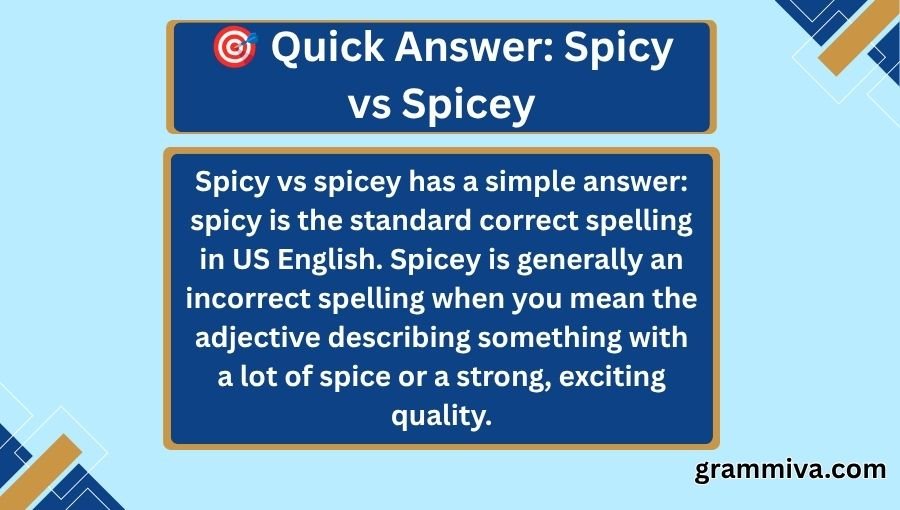
Spicy vs spicey has a simple answer: spicy is the standard correct spelling in US English. Spicey is generally an incorrect spelling when you mean the adjective describing something with a lot of spice or a strong, exciting quality.
For example, write “This salsa is spicy,” not “This salsa is spicey.”
| Spelling | Standard US English? | Meaning | Example |
|---|---|---|---|
| spicy | ✅ Yes | Having a strong or hot flavor; exciting or lively | The soup is spicy. |
| spicey | ❌ No | Not the standard spelling of the adjective | The soup is spicey. |
The key point is worth remembering: spice + y becomes spicy, with the final e dropped before -y.
Related Word Forms for Spicy
The word spicy has several useful related forms. These forms are not alternate spellings of spicy. They are different words that serve different grammar roles.
| Form | Type | Example |
|---|---|---|
| spice | Noun/verb | I added a little spice to the dish. |
| spicy | Adjective | The curry is spicy. |
| spicier | Comparative adjective | This sauce is spicier than that one. |
| spiciest | Superlative adjective | This is the spiciest dish here. |
| spiciness | Noun | I like the spiciness of the peppers. |
| spiced | Adjective/past participle | We served spiced rice. |
| spice up | Phrasal verb | Let’s spice up the meal. |
Notice that none of these standard forms requires spicey.
🔎 Is Spicy the Correct Spelling?
Yes. Spicy is the standard spelling when you need an adjective related to spice.
The word ends in -y, not -ey. This gives us forms such as spicy, spicier, and spiciest.
Correct spelling
Use spicy when you describe food or something that has a strong, hot, or lively quality.
- The chicken is spicy.
- She ordered a spicy curry.
- That sauce is too spicy for me.
- He likes spicy food.
Incorrect spelling
Avoid spicey when you are trying to spell the ordinary adjective.
- The chicken is spicey. ❌
- She ordered a spicey curry. ❌
- That sauce is too spicey for me. ❌
- He likes spicey food. ❌
The correct form in each case is spicy. ✅
📌 Spicy vs Spicey at a Glance
The central difference is spelling, not meaning. In standard US English, spicy is the word you want.
| Form | Type | Meaning | Example | Correct/Incorrect |
|---|---|---|---|---|
| spicy | Adjective | Having a strong or hot flavor | The noodles are spicy. | ✅ Correct |
| spicey | Intended adjective | Usually a misspelling of spicy | The noodles are spicey. | ❌ Incorrect |
| spicier | Comparative adjective | More spicy | This sauce is spicier. | ✅ Correct |
| spiceyer | Intended comparative | Incorrect spelling | This sauce is spiceyer. | ❌ Incorrect |
| spiciest | Superlative adjective | Most spicy | This is the spiciest dish. | ✅ Correct |
Why does the extra E cause trouble?
The base noun is spice, which ends in e. When people want to turn it into an adjective, they may naturally think:
spice + y = spicey
That looks logical, but English spelling does not always keep every letter from the base word when a suffix is added.
Here, the standard form is:
spice → spicy
The final e is removed before -y.
🌶️ What Does Spicy Mean?
Spicy is an adjective. It commonly describes food or drinks that have a strong, hot, or sharp flavor caused by spices or spicy ingredients.
For example:
The chili is spicy.
Here, spicy tells us what kind of chili it is.
The word can also describe something that feels exciting, bold, lively, or provocative, depending on the context.
| Meaning | Word Type | Example Sentence |
|---|---|---|
| Strong or hot flavor | Adjective | This curry is spicy. |
| Strongly flavored | Adjective | I prefer spicy noodles. |
| Exciting or lively | Adjective | The story took a spicy turn. |
| Bold or provocative | Adjective | The comedian made a spicy joke. |
Spicy for food
This is by far the most common use.
Examples include:
- spicy chicken
- spicy noodles
- spicy salsa
- spicy soup
- spicy tacos
- spicy curry
- spicy peppers
If you are describing the flavor, spicy is the normal choice.
Spicy for personality or content
The word can also be used informally to describe something bold or exciting.
For example:
That was a spicy comment.
The sentence does not necessarily mean the comment contained food. It can suggest that the comment was bold, surprising, or provocative.
Context determines the exact meaning.
💡 Test Tip
When you are unsure about spicy vs spicey, remove the word from your sentence and ask:
“Am I trying to describe something as having a strong or hot flavor?”
If the answer is yes, use spicy.
A second memory test is even shorter:
spice → spicy
Do not add the original e before -y.
How Do You Use Spicy in a Sentence?
Use spicy as an adjective before a noun or after a linking verb.
Here are the two most useful patterns:
Before a noun:
We ordered a spicy pizza.
After a linking verb:
The pizza is spicy.
| Sentence Pattern | Example | Purpose |
|---|---|---|
| spicy + noun | spicy sauce | Describes a noun |
| be + spicy | The sauce is spicy. | Describes a subject |
| seem + spicy | The sauce seems spicy. | Gives an impression |
| become + spicy | The dish became spicy. | Describes a change |
| taste + spicy | The soup tastes spicy. | Describes flavor |
Correct and incorrect examples
| Correct Example | Incorrect Example |
|---|---|
| The soup is spicy. ✅ | The soup is spicey. ❌ |
| I love spicy food. ✅ | I love spicey food. ❌ |
| We bought spicy salsa. ✅ | We bought spicey salsa. ❌ |
| This curry is spicier. ✅ | This curry is spiceyer. ❌ |
| That was the spiciest dish. ✅ | That was the spiceyest dish. ❌ |
📝 A Real-Life Case Study: A Restaurant Menu
I once edited a short food description that included several dishes from the same menu. The writer had spelled the word spicey each time. The meaning was clear, but the repeated spelling error made the menu look less polished.
The fix was simple. Every instance became spicy.
For example:
- “Spicey chicken wings” ❌
- “Spicy chicken wings” ✅
The lesson was not that the writer did not understand English. The writer clearly knew what the word meant. The problem was simply that the spelling felt logical because the base word is spice.
This is why checking one small spelling rule can improve an entire piece of writing.
Grammar Rules Explanation
The standard adjective is formed as spicy, not spicey.
The basic spelling pattern is:
spice + y → spicy
The final e in spice is dropped before the adjective ending -y. This follows a common English spelling pattern in which a word ending in silent e may lose that e when a suffix is added.
The same general idea appears in words such as:
- noise → noisy
- ice → icy
- juice → juicy
- grease → greasy
The resulting adjectives do not normally keep the final e.
This makes spicey an incorrect spelling when the intended word is the ordinary adjective spicy. Standard reference works and common US English usage support spicy as the normal form.
Correct vs Incorrect at a Glance
| Sentence | Correct/Incorrect | Why |
|---|---|---|
| The wings are spicy. | ✅ Correct | Spicy is the standard adjective. |
| The wings are spicey. | ❌ Incorrect | Spicey is not the standard spelling. |
| I ordered a spicy sandwich. | ✅ Correct | The adjective correctly describes the sandwich. |
| I ordered a spicey sandwich. | ❌ Incorrect | The final e should be removed. |
| This sauce is spicier than mine. | ✅ Correct | The comparative form is spicier. |
The most useful rule is simple:
spice → spicy
Do not write spicey when you mean the standard adjective.
⚠️ Why Do People Confuse Spicy and Spicey?
People often confuse these spellings because spice visibly ends in e. When adding -y, it feels natural to keep every letter.
The eye sees:
spice + y
and may produce:
spicey
But standard spelling gives us:
spicy
There are several reasons this mistake appears.
Fast typing
When people type quickly, they often spell a word based on how it feels rather than checking each letter.
Autocorrect
Phones and writing apps can sometimes fail to correct an uncommon typo. If the mistake survives once, a writer may repeat it.
Lack of spelling knowledge
Someone may know the word perfectly well when speaking but may never have learned its standard written form.
Pattern confusion
English contains many words that keep their spelling when endings are added. This can make the rule less obvious.
A student once showed me a short paragraph about favorite foods. She had written spicey several times. When I asked why, she pointed to the word spice and said, “Because it already has an e.” Her reasoning made sense. The problem was simply that English spelling uses a different pattern here.
That is a good reminder: spelling errors are not always caused by careless thinking.
Common Spelling Confusions Like Spicy vs Spicey
The confusion is part of a larger group of English mistakes where two forms look or sound similar.
| Confusion | Correct Form | Incorrect Form | Main Problem |
|---|---|---|---|
| it’s / its | it’s / its | Mixing them | Apostrophe changes meaning |
| your / you’re | your / you’re | Mixing them | Possession vs contraction |
| they’re / their / there | they’re / their / there | Mixing them | Similar sound, different roles |
| definitely | definitely | definately | Extra vowel pattern |
| separate | separate | seperate | Vowel order |
| spicy | spicy | spicey | Keeping the final e |
These mistakes show why spelling checks matter. A word can look almost right while still being wrong.
Specific Wrong Forms to Avoid
Here are some common forms people may type when they are unsure about the correct spelling.
| Wrong Form | What’s Wrong | Correct Form |
|---|---|---|
| spicey | Keeps the final e | spicy |
| spiceyer | Adds -yer to the wrong base | spicier |
| spiceyest | Builds the superlative from the wrong spelling | spiciest |
| spiceyness | Keeps the incorrect base form | spiciness |
| spicyness | Uses the wrong vowel pattern before -ness | spiciness |
| spice-y | Unnecessary hyphen | spicy |
The safest approach is to learn the full word family:
spice → spicy → spicier → spiciest → spiciness
That pattern makes the correct spelling much easier to recall.
🧠 How to Remember the Correct Spelling
The fastest memory trick is:
Think “spice loses e”
Start with:
SPICE
Then remove the final E and add Y:
SPIC + Y
The result is:
SPICY
Another useful trick is to connect it with similar words.
| Base Word | Correct Adjective |
|---|---|
| ice | icy |
| juice | juicy |
| noise | noisy |
| grease | greasy |
| spice | spicy |
This gives you a pattern rather than a single spelling rule to memorize.
A one-second test
Ask yourself:
Does the word describe food with a strong or hot flavor?
If yes:
spicy ✅
If you see:
spicey ❌
remove the e.
Spicy vs Spicey in Different Contexts
The correct spelling does not change just because the setting changes. Whether you are writing a work email, a text, a menu, or a creative story, spicy remains the standard form.
| Context | Which Term to Use | Example |
|---|---|---|
| Everyday conversation | spicy | This sauce is really spicy. |
| Professional writing | spicy | The restaurant offers several spicy dishes. |
| Creative writing | spicy | A spicy scent filled the kitchen. |
| Social media/texting | spicy | This taco is seriously spicy! |
Casual writing may contain slang, shortcuts, or playful spellings. But if you are intentionally writing standard English, spicy is the correct choice.
Can Spicy Describe More Than Food?
Yes. Spicy can have broader informal uses.
For food, it can describe heat or strong flavor:
The curry is spicy.
For conversation, entertainment, or ideas, it can suggest something bold, lively, surprising, or provocative:
That interview got spicy.
The exact meaning depends on context. The spelling does not change.
| Use | Example | Meaning |
|---|---|---|
| Food | spicy noodles | Strong or hot flavor |
| Conversation | a spicy debate | Lively or heated |
| Humor | a spicy joke | Bold or provocative |
| Story | a spicy plot twist | Exciting or surprising |
| Social media | things got spicy | The situation became lively or tense |
Common Phrases With Spicy
There are many ordinary phrases built around spicy. These can help you become familiar with the correct spelling.
| Phrase | Meaning |
|---|---|
| spicy food | Food with a strong or hot flavor |
| spicy sauce | Sauce with a strong or hot flavor |
| spicy chicken | Chicken prepared with spicy ingredients |
| spicy salsa | Salsa with a strong, hot flavor |
| spicy curry | Curry with noticeable heat or strong spices |
| spicy take | An informal term for a bold or controversial opinion |
Seeing the correct form in common phrases can make it easier to remember.
Spicy, Hot, Fiery, and Zesty: Useful Alternatives
Sometimes you can replace spicy with another word. But these alternatives do not always mean exactly the same thing.
| Alternative | Works When | Does Not Work When |
|---|---|---|
| hot | You mean strong chili heat | You mean a general flavor from spices |
| fiery | You want a vivid, dramatic description | You need a plain, neutral description |
| peppery | Pepper flavor is the main point | The dish is spicy for another reason |
| zesty | You mean bright, sharp flavor | You specifically mean chili heat |
| seasoned | You mean food has been flavored | You mean the food is hot or spicy |
For ordinary writing, spicy is often the clearest word when you mean food with noticeable heat or strong spice flavor.
🎯 Why Getting the Spelling Right Matters
A spelling mistake such as spicey may seem tiny. In many casual situations, readers will understand it. Still, correct spelling helps your writing look careful and professional.
Clarity in communication
Correct spelling makes reading easier. The reader does not need to pause and wonder whether a strange form is intentional.
Professionalism
Menus, websites, product descriptions, reports, and business messages benefit from standard spelling.
Digital communication
Online writing spreads quickly. A misspelled word can be copied into captions, product pages, menus, or posts.
A useful rule is:
Small spelling choices can create a big difference in how polished your writing feels.
| Situation | Why Getting It Right Matters |
|---|---|
| Resume | Shows care with written communication |
| Client email | Creates a polished impression |
| Published content | Protects readability and credibility |
| Social post | Makes the message easier to read |
Even when nobody complains about a typo, correct spelling is still a good habit.
Is Spicey Ever Correct?
In ordinary US English, spicey should not be used as the standard spelling of the adjective spicy.
There can be unusual cases where a spelling appears as part of a proper name, username, title, brand, character name, or other intentionally chosen label. In such a case, the unusual spelling belongs to that name rather than representing the standard adjective.
For normal writing, however, use:
spicy ✅
not:
spicey ❌
Do not change the spelling of a proper name if you are reproducing that name exactly. But when you are describing food or another thing in ordinary English, spicy is the form to choose.
💡 How To Check Spicy in Seconds
When proofreading, use this three-step check.
Step 1: Find the word
Look for spicey.
Step 2: Ask what you mean
If you mean “having a strong or hot flavor” or the related informal sense of “bold” or “exciting,” you probably need the adjective spicy.
Step 3: Remove the E
Change:
spicey
to:
spicy
Then check related forms:
- spicy
- spicier
- spiciest
- spiciness
This quick check catches most mistakes.
Does the Rule Change for Spicier and Spiciest?
No. The same spelling pattern continues into the comparative and superlative forms.
The standard forms are:
- spicy
- spicier
- spiciest
Not:
- spicey
- spiceyer
- spiceyest
| Degree | Correct | Incorrect |
|---|---|---|
| Basic | spicy ✅ | spicey ❌ |
| Comparative | spicier ✅ | spiceyer ❌ |
| Superlative | spiciest ✅ | spiceyest ❌ |
For example:
This curry is spicy. ✅
This curry is spicier than the soup. ✅
That curry is the spiciest item on the menu. ✅
The spelling changes in a predictable way. The original final e does not return.
Is Spicy a Noun or an Adjective?
Spicy is an adjective. It describes a noun.
For example:
spicy noodles
Here, spicy describes noodles.
It can also come after a linking verb:
The noodles are spicy.
In that sentence, spicy describes the subject noodles.
| Word | Part of Speech | Example |
|---|---|---|
| spice | Noun | The recipe needs more spice. |
| spice | Verb | Let’s spice the dish up. |
| spicy | Adjective | The dish is spicy. |
| spiciness | Noun | I enjoy the spiciness. |
| spicier | Adjective | This one is spicier. |
| spiciest | Adjective | This is the spiciest one. |
Knowing the word’s grammar role can also help you choose the right form.
FAQs About Spicy vs Spicey
Is spicy or spicey correct?
Spicy is the correct standard spelling in US English. Spicey is generally a misspelling when you mean the adjective related to spice.
Why is spicy spelled without an e?
The standard spelling drops the final e from spice before adding -y. The result is spicy, not spicey.
Is spicey ever acceptable?
Only in an unusual special case, such as an intentionally spelled name, title, username, or other proper label. For ordinary English, use spicy.
What is the difference between spicy and spicey?
There is normally no difference in intended meaning. Spicy is the standard spelling, while spicey is generally an incorrect spelling of the same intended word.
How do you spell spicy correctly?
Spell it S-P-I-C-Y: spicy.
Is “spicier” spelled with an e?
No. The standard comparative form is spicier, not spiceyer. The final e from spice does not stay in the adjective family.
Is “spiciest” the correct spelling?
Yes. Spiciest is the standard superlative form. For example: “That was the spiciest chili I have ever tasted.”
Is spicy only used for food?
No. It is most commonly used for food and flavor, but it can also describe something bold, lively, exciting, or provocative in informal contexts.
What is the noun form of spicy?
The noun form is spiciness. For example: “The spiciness of the sauce surprised me.”
How can I remember spicy vs spicey?
Use the simple pattern spice → spicy. Think of the word spice losing its final e before -y. If you see spicey in ordinary English, change it to spicy.
✅ Quick Recap Checklist
The easiest way to remember the rule is to focus on the spelling pattern rather than the sound.
| Question | If Yes → Use |
|---|---|
| Am I describing food with strong or hot flavor? | spicy |
| Am I using the adjective related to spice? | spicy |
| Am I comparing two things? | spicier |
| Am I describing the highest degree? | spiciest |
| Am I naming the quality as a noun? | spiciness |
| Did I write “spicey”? | Change it to spicy |
Practice examples
- This salsa is spicy. ✅
- My brother likes spicier food than I do. ✅
- That was the spiciest curry on the menu. ✅
Now compare them with the incorrect versions:
- This salsa is spicey. ❌
- My brother likes spiceyer food. ❌
- That was the spiceyest curry. ❌
The correction is straightforward every time.
Key Differences Between Spicy and Spicey
The biggest difference is that only one of these is the standard adjective in ordinary US English.
Spicy is a real, standard English word. It can describe flavor and can also have broader informal meanings.
Spicey is generally a spelling error when used in place of spicy.
| Feature | Spicy | Spicey |
|---|---|---|
| Standard adjective | ✅ Yes | ❌ No |
| Used for food | ✅ Yes | ❌ Not as standard spelling |
| Used in formal writing | ✅ Yes | ❌ Avoid |
| Used in casual writing | ✅ Yes | ❌ Avoid |
| Comparative form | spicier | spiceyer ❌ |
| Superlative form | spiciest | spiceyest ❌ |
| Noun form | spiciness | spiceyness/spicyness ❌ |
Why Do People Confuse Spicy and Spicey?
The main reason is the spelling of the base word spice. Writers see the final e and may assume it should remain when they add -y.
That is a reasonable guess, but standard English uses spicy.
I once caught myself typing spicey in a quick message while writing about a hot sauce. I stopped because the word looked slightly wrong on the screen. The quick test—“spice becomes spicy”—fixed it immediately.
That experience is useful because even experienced writers can make small spelling slips when typing quickly.
The solution is not to memorize hundreds of rules. It is to remember a few high-value patterns.
For this word, the pattern is:
spice → spicy
Spicy vs Spicey for Writers and Editors
If you write for school, work, websites, food businesses, or social media, spicy should be your default spelling.
An editor seeing spicey will normally treat it as a typo unless there is clear evidence that the unusual form is part of a name.
Before publishing, search your document for:
- spicey
- spiceyer
- spiceyest
- spiceyness
- spicyness
Then replace the ordinary misspellings with the standard forms:
- spicy
- spicier
- spiciest
- spiciness
This is especially useful when working with long documents. A single typo can appear several times without being noticed.
A Simple Editing Rule for Spicy
When I edit writing, I prefer rules that can be applied quickly. For this word, I use one:
If you mean the adjective related to spice, write “spicy.”
Then check the rest of the word family.
| Meaning | Correct Form |
|---|---|
| Basic adjective | spicy |
| More intense | spicier |
| Most intense | spiciest |
| Quality or state | spiciness |
| Ingredient/flavor source | spice |
| Verb | spice |
This approach is easier than trying to remember every possible typo separately.
Conclusion
Spicy vs spicey is an easy spelling choice once you remember one rule: the standard adjective is spicy, with no e between the c and y. 🌶️
Use spicy to describe food with strong or hot flavor, and use it in broader informal expressions when something is bold, lively, or provocative. Use spicier for comparisons, spiciest for the highest degree, and spiciness for the noun.
The form spicey is generally not correct in standard US English. It usually appears because writers carry the final e from spice into the adjective.
When in doubt, remember this tiny pattern:
spice → spicy
That one change solves the entire problem. Once the pattern becomes familiar, you will spot spicey as quickly as you spot any other common typo.
So the next time you write about salsa, curry, wings, noodles, or a bold opinion, choose spicy with confidence. ✅
Spice loses its e, and spicy gets it right.

I am Adam Wilson, an English language content writer with an interest in grammar and vocabulary. I work at Grammiva and focus on creating clear explanations and practical examples for English learners.



[…] sentences. By the end, you should be able to choose the right word quickly and confidently. ✨ | Spicy vs Spicey | Habit vs Habbit | Summary vs […]
[…] how to remember the difference without checking a dictionary every time. 😊 Breach vs Breech | Spicy vs Spicey | Habit vs […]