Have you ever typed a party invitation and stopped at hors doeuvres vs hors derves because neither spelling looked quite right? You are not alone. This French loanword is often misspelled because its spelling does not match the way many English speakers hear it. 🥂
The correct standard spelling is hors d’oeuvres. The singular form is hors d’oeuvre. The two forms in the title are common mistakes, not two different English words with different meanings.
I have seen this error in party menus, event emails, restaurant posts, and even polished business invitations.
The good news is that the rule is simple once you see the pattern. In this guide, I will explain the correct spelling, show why the common errors happen, and give you easy ways to remember the word. Height vs Heighth | Guarantee vs Guarentee | Equipment vs Equiptment
🎯 Quick Answer: Hors Doeuvres vs Hors Derves
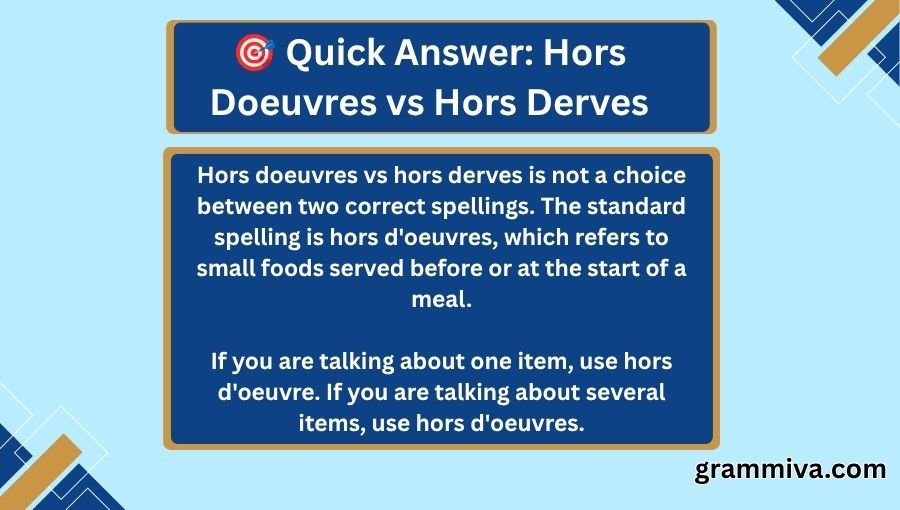
Hors doeuvres vs hors derves is not a choice between two correct spellings. The standard spelling is hors d’oeuvres, which refers to small foods served before or at the start of a meal.
If you are talking about one item, use hors d’oeuvre. If you are talking about several items, use hors d’oeuvres.
| Spelling | Status | Meaning | Example |
|---|---|---|---|
| hors d’oeuvre | ✅ Correct | One small food served before a meal | The chef prepared one hors d’oeuvre. |
| hors d’oeuvres | ✅ Correct | More than one small food served before a meal | We served hors d’oeuvres before dinner. |
| hors doeuvres | ❌ Incorrect | Common misspelling | We served hors doeuvres. |
| hors derves | ❌ Incorrect | Common misspelling | Guests enjoyed hors derves. |
The key point is this: use the apostrophe and keep the full spelling of “oeuvres.”
Is Hors Doeuvres the Correct Spelling?
No. Hors doeuvres is a common misspelling of hors d’oeuvres. The missing apostrophe is the first clue, but the spelling of the second part also matters.
The correct plural form contains three important pieces:
hors + d’ + oeuvres
The apostrophe in d’oeuvres should not be dropped in standard writing.
For example:
- Correct: The hotel offered hors d’oeuvres before the ceremony. ✅
- Incorrect: The hotel offered hors doeuvres before the ceremony. ❌
This is especially important in formal writing. A menu, invitation, event program, or client email should use the standard spelling.
Why does the spelling look unusual?
English contains many words borrowed from other languages. Some keep spelling patterns that look unusual to English readers. Hors d’oeuvre is one of those expressions.
You do not need to know French grammar to spell it correctly in English. You simply need to remember the standard written form.
| Part | Correct Form | Common Problem |
|---|---|---|
| First word | hors | Sometimes changed or dropped |
| Apostrophe | d’ | Often removed |
| Second word | oeuvres | Often shortened to “oeuvres” incorrectly or heard as “derves” |
| Plural ending | -s | Sometimes forgotten |
Hors D’oeuvre vs Hors D’oeuvres: What Is the Difference?
The difference is number. Hors d’oeuvre is singular, while hors d’oeuvres is plural.
This distinction works much like other singular and plural nouns.
| Form | Number | Example |
|---|---|---|
| hors d’oeuvre | Singular | I chose one hors d’oeuvre. |
| hors d’oeuvres | Plural | We sampled several hors d’oeuvres. |
Consider these examples:
Singular:
“The waiter brought one hors d’oeuvre.”
Here, the writer is talking about one small food item.
Plural:
“The waiter brought several hors d’oeuvres.”
Here, the writer is talking about multiple items.
A useful comparison
Think of the difference like this:
- one cookie → several cookies
- one sandwich → several sandwiches
- one hors d’oeuvre → several hors d’oeuvres
The word may look difficult, but the basic singular-versus-plural idea is easy.
📝 Hors Doeuvres vs Hors Derves at a Glance
The fastest way to understand the issue is to compare the common spellings side by side.
| Form | Correct? | Why |
|---|---|---|
| hors d’oeuvre | ✅ Yes | Correct singular form |
| hors d’oeuvres | ✅ Yes | Correct plural form |
| hors doeuvre | ❌ No | Missing apostrophe |
| hors doeuvres | ❌ No | Missing apostrophe |
| hors derves | ❌ No | Incorrect spelling |
| hors deuvres | ❌ No | Missing the “o” in oeuvres |
Here are some practical examples:
- Correct: The restaurant served elegant hors d’oeuvres. ✅
Incorrect: The restaurant served elegant hors doeuvres. ❌ - Correct: We ordered several hors d’oeuvres for the reception. ✅
Incorrect: We ordered several hors derves for the reception. ❌ - Correct: An hors d’oeuvre was placed beside each glass. ✅
Incorrect: An hors d’oeuvre was placed beside each glass. ❌ - Correct: The menu included hot and cold hors d’oeuvres. ✅
Incorrect: The menu included hot and cold hors deuvres. ❌
Notice that the correct spelling stays consistent even when the word appears in different sentences.
💡 How Can You Remember the Correct Spelling?
The easiest memory trick is to focus on d’oeuvres. Do not try to spell the word only from its sound.
I teach students to break it into a visual pattern:
hors d’oeuvres
Then remember:
HORS — D’ — OEUVRES
The apostrophe is easy to forget when typing quickly. The “oeu” combination is also unfamiliar to many English speakers. That is why spelling the word from memory can be difficult.
My simple memory method
When I need to type the word, I think:
“Do not lose the D-apostrophe.”
Then I check the ending:
“O-E-U-V-R-E-S.”
You do not need to say all those letters aloud. The goal is simply to create a visual checkpoint.
| Memory Check | What to Ask |
|---|---|
| First part | Did I write hors? |
| Middle | Did I include d’? |
| Ending | Did I write oeuvres? |
| Number | Is it singular or plural? |
Why Do People Confuse Hors Doeuvres and Hors Derves?
People confuse these forms mainly because the spelling is not easy to predict from the way the word sounds.
When people hear an unfamiliar word, they often write the sounds they think they hear. That works for many simple English words. It does not work as well for unusual borrowed expressions.
I once reviewed a company event invitation where the writer had typed “hors derves” several times. The rest of the invitation was excellent. The writer knew exactly what the food was but had never needed to spell the term before. A quick correction fixed the entire issue.
Other factors also play a role:
- People type the word from memory.
- They may rarely see it written.
- Autocorrect may not suggest the expected spelling.
- Speech can make the middle of the word hard to identify.
- People may assume two similar spellings are acceptable.
- They may have learned the term by hearing it rather than reading it.
The important thing is not to feel embarrassed by the mistake. It is an unusual-looking word. Once you learn the standard form, it becomes much easier.
Hors D’oeuvres: Meaning and Correct Use
Hors d’oeuvres refers to small portions of food that are served before a meal or during an event where guests may eat small items rather than sit down for a full meal.
The term is commonly used for foods such as:
- small sandwiches
- stuffed vegetables
- bite-sized pastries
- cheese portions
- small seafood dishes
- vegetables with dips
- tiny savory pastries
The exact food does not determine whether something is called an hors d’oeuvre. The setting and serving style matter too.
Singular use
Use hors d’oeuvre when referring to one item.
Example:
The chef created a special hors d’oeuvre for the tasting.
Plural use
Use hors d’oeuvres when referring to multiple items.
Example:
The caterer prepared six types of hors d’oeuvres.
| Meaning | Word Type | Example Sentence |
|---|---|---|
| One small food item | Singular noun | She selected an hors d’oeuvre. |
| Several small food items | Plural noun | Guests enjoyed several hors d’oeuvres. |
| Food served before or during an event | Noun phrase | The reception included light hors d’oeuvres. |
When Should You Use Hors D’oeuvres?
Use hors d’oeuvres when you are writing about small foods served at a gathering, reception, party, cocktail event, wedding, or similar occasion.
You might see the term in:
- restaurant menus
- catering proposals
- wedding invitations
- corporate event notices
- hotel descriptions
- party announcements
- cookbooks
- food reviews
For example:
“Light hors d’oeuvres will be served at 6 p.m.”
This sentence is natural and clear.
You can also use it in everyday conversation:
“We had some hors d’oeuvres while we waited for dinner.”
The word is not limited to formal writing. It is simply more common in food and event contexts.
💡 Test Tip: Is Your Spelling Correct?
Here is a quick test I use when proofreading.
Ask yourself:
“Does the word contain d’ and oeuvres?”
If yes, you are probably on the right track.
If you see:
- hors d’oeuvres → correct
- hors doeuvres → missing apostrophe
- hors derves → incorrect spelling
- hors deuvres → missing “o”
This test is especially useful when proofreading menus and invitations.
A Real-Life Case Study: An Event Invitation
Imagine that a company is sending this invitation to clients:
“Join us for drinks, networking, and hors d’oeuvres at 6:30 p.m.”
The wording is professional and clear.
Now imagine this version:
“Join us for drinks, networking, and hors derves at 6:30 p.m.”
The meaning is still understandable, but the spelling error can make the invitation look less polished.
I once caught a similar mistake while checking a short event announcement. The writer had spent a lot of time making the announcement sound warm and professional. One unusual food term had simply been spelled from memory. It took only a few seconds to fix, but it showed why proofreading unfamiliar words matters.
| Situation | Better Choice | Reason |
|---|---|---|
| Wedding invitation | hors d’oeuvres | Standard spelling |
| Restaurant menu | hors d’oeuvres | Clear and professional |
| Casual text | hors d’oeuvres | Still the standard form |
| Business invitation | hors d’oeuvres | Avoids a visible spelling error |
Grammar Rules Explanation
The standard English forms are hors d’oeuvre for the singular and hors d’oeuvres for the plural.
The expression functions as a noun. When referring to one item, use the singular form. When referring to more than one, use the plural form with the final s.
The apostrophe in d’oeuvre is part of the standard spelling used in English. Removing it produces a nonstandard spelling. Changing oeuvres to derves also produces a misspelling.
The main rule is therefore simple:
Use “hors d’oeuvre” for one and “hors d’oeuvres” for more than one.
Standard reference works, including major English dictionaries, recognize the standard spelling with the apostrophe. When writing for school, work, publishing, or public audiences, follow that standard form.
Correct vs Incorrect at a Glance
| Sentence | Correct/Incorrect | Why |
|---|---|---|
| We served hors d’oeuvres before dinner. | Correct | Standard plural spelling |
| The chef prepared one hors d’oeuvre. | Correct | Standard singular spelling |
| We served hors doeuvres before dinner. | Incorrect | Apostrophe is missing |
| The guests enjoyed hors derves. | Incorrect | The word is misspelled |
| The menu listed several hors d’oeuvres. | Correct | Correct plural form |
⚠️ Common Mistakes With Hors D’oeuvres
The most common errors are spelling errors, not meaning errors.
People usually know what they want to say. The problem is getting the unusual spelling onto the page.
Three common causes are especially easy to spot:
1. Fast typing
When people type quickly, they often remove punctuation they think is not essential. The apostrophe in d’oeuvres can disappear.
2. Autocorrect
Autocorrect can sometimes leave an unfamiliar word alone. A writer may assume that a word not flagged by a device must be correct.
3. Lack of familiarity
If you mostly hear the word at parties or restaurants, you may know its meaning without knowing how it is written.
This is not unusual. Spelling and pronunciation do not always give us a perfect map of each other.
Similar Grammar Confusions
The same general problem appears with other commonly confused forms.
| Confused Forms | Correct Choice | Main Issue |
|---|---|---|
| its / it’s | Depends on meaning | Possessive vs contraction |
| your / you’re | Depends on meaning | Possessive vs contraction |
| their / they’re | Depends on meaning | Possessive vs contraction |
| there / their | Depends on meaning | Place vs possession |
| affect / effect | Depends on context | Different grammatical uses |
| hors doeuvres / hors d’oeuvres | hors d’oeuvres | Spelling and punctuation |
Specific Misspellings to Avoid
| Wrong Form | What’s Wrong | Correct Form |
|---|---|---|
| hors doeuvres | Apostrophe is missing | hors d’oeuvres |
| hors derves | Letters are incorrect | hors d’oeuvres |
| hors deuvres | “o” is missing | hors d’oeuvres |
| hors doeuvre | Apostrophe is missing | hors d’oeuvre |
| hors d’oeuvre’s | Unneeded possessive ending in ordinary plural use | hors d’oeuvres |
| hors derves | Misspelled second part | hors d’oeuvres |
What Is the Singular Form of Hors D’oeuvres?
The singular form is hors d’oeuvre.
Use it when you mean one item.
For example:
The chef placed one hors d’oeuvre on each plate.
The plural form is:
The chef placed several hors d’oeuvres on the table.
This is one of the most useful details to remember because writers sometimes use the plural form even when talking about a single item.
| Number | Correct Form | Example |
|---|---|---|
| One | hors d’oeuvre | One hors d’oeuvre was served. |
| Two or more | hors d’oeuvres | Two hors d’oeuvres were served. |
How Is Hors D’oeuvres Used in Different Contexts?
The spelling stays the same across formal and casual contexts. What changes is the style of the sentence around it.
Everyday conversation
You might say:
“They had great hors d’oeuvres at the party.”
Professional writing
A business event notice might say:
“Light hors d’oeuvres will be available during the networking session.”
Creative writing
A story might describe a character moving around a crowded room while picking up small foods from a serving table.
Social media and texting
Someone might write:
“The wedding had amazing hors d’oeuvres!”
Even in informal writing, the standard spelling is still the best choice.
| Context | Which Term to Use | Example |
|---|---|---|
| Everyday conversation | hors d’oeuvres | We enjoyed hors d’oeuvres before dinner. |
| Professional writing | hors d’oeuvres | Light hors d’oeuvres will be provided. |
| Creative writing | hors d’oeuvres | Servers carried trays of hors d’oeuvres. |
| Social media/texting | hors d’oeuvres | Those hors d’oeuvres were amazing! |
Common Phrases With Hors D’oeuvres
There are several natural combinations that appear often in menus, invitations, and event descriptions.
These are not special idioms. They are simply common phrases that pair naturally with the word.
| Phrase | Meaning |
|---|---|
| light hors d’oeuvres | Small, not very filling foods |
| passed hors d’oeuvres | Foods carried around and offered to guests |
| hot hors d’oeuvres | Small foods served warm |
| cold hors d’oeuvres | Small foods served chilled or at room temperature |
| assorted hors d’oeuvres | A selection of different small foods |
| hors d’oeuvres reception | An event centered around small foods and drinks |
For example:
The invitation promised light hors d’oeuvres and drinks.
Or:
Servers passed hot hors d’oeuvres throughout the evening.
What Are Good Alternatives to Hors D’oeuvres?
You can replace hors d’oeuvres with simpler phrases when the context allows it.
Good alternatives include appetizers, small bites, finger foods, and snacks. However, these words are not always exact replacements.
For example, “appetizers” often suggests food served before a main meal at a restaurant. “Small bites” is more casual. “Finger foods” focuses on the way food is eaten.
| Alternative | Works When | Does Not Work When |
|---|---|---|
| appetizers | Talking about food served before a meal | The event specifically uses a formal hors d’oeuvres service |
| small bites | Casual menus and event descriptions | A very formal document needs traditional wording |
| finger foods | Foods designed to be eaten by hand | The foods require utensils |
| snacks | Casual food between meals | Describing an elegant reception |
| refreshments | General food and drinks | You specifically mean small savory dishes |
Choosing an alternative can sometimes make your writing easier to understand.
Is Hors D’oeuvres Too Formal for Everyday Writing?
No. The word can appear in both formal and casual writing.
However, it does have a polished or event-focused feel. In casual conversation, appetizers or snacks may sound more natural depending on what you mean.
For example:
“We had some appetizers before the movie.”
This is casual and simple.
But:
“The reception featured an elegant selection of hors d’oeuvres.”
This sounds more formal and event-focused.
The choice depends on your audience and the kind of food you are describing.
Does Hors Derves Mean Something Different?
No. Hors derves is not a separate food term with a different meaning. It is simply a misspelling of hors d’oeuvres.
The same is true of hors doeuvres. These forms may be understood by readers because the intended word is obvious, but they are not the standard spellings.
| Spelling | Different Meaning? | Recommendation |
|---|---|---|
| hors d’oeuvres | No special alternate meaning | Use this |
| hors doeuvres | No | Correct it |
| hors derves | No | Correct it |
| hors deuvres | No | Correct it |
🧠 A Simple Three-Step Spelling Trick
When you need to type the word without checking a reference, use three steps.
Step 1: Write “hors.”
Do not change the first word.
Step 2: Add “d’.”
Remember the apostrophe.
Step 3: Write “oeuvres.”
Keep the full sequence of letters.
That gives you:
hors + d’ + oeuvres = hors d’oeuvres
For the singular:
hors + d’ + oeuvre = hors d’oeuvre
| Step | Singular | Plural |
|---|---|---|
| First part | hors | hors |
| Middle | d’ | d’ |
| Final part | oeuvre | oeuvres |
| Full form | hors d’oeuvre | hors d’oeuvres |
This visual method is much more reliable than trying to spell the term only from its sound.
Why Does Getting the Spelling Right Matter?
Correct spelling matters because small errors can change how polished your writing appears.
A spelling mistake on a casual text may not matter much. A spelling mistake on a wedding invitation, business proposal, restaurant menu, or published article can stand out.
I once reviewed a printed event menu where nearly every line was carefully designed. One misspelled food term stood out immediately because it was surrounded by otherwise professional copy. That experience reminded me that small words can have a big effect when they appear in visible places.
| Situation | Why Getting It Right Matters |
|---|---|
| Resume or professional profile | Shows care with written details |
| Client email | Supports a polished professional image |
| Published content | Protects writing quality and credibility |
| Social post | Makes the post look cleaner and more intentional |
A useful rule is:
Clear writing earns trust one small detail at a time.
That applies to spelling just as much as grammar.
Is There a Special Exception to the Standard Spelling?
There is no ordinary English usage in which hors derves becomes the correct spelling of the food term.
You may see creative spellings in restaurant names, product names, jokes, usernames, or other brand-specific material. A business could intentionally alter a word as part of its name. That does not change the standard spelling used in ordinary English.
For normal writing, menus, invitations, schoolwork, and professional communication, use:
hors d’oeuvre — singular
hors d’oeuvres — plural
Hors Doeuvres vs Hors Derves: The Key Differences
At this point, the distinction can be reduced to a few clear rules.
| Feature | Correct Form | Common Incorrect Form |
|---|---|---|
| Singular | hors d’oeuvre | hors doeuvre |
| Plural | hors d’oeuvres | hors doeuvres |
| Apostrophe | Required in standard spelling | Often omitted |
| Meaning | Small food served before or around a meal | Intended to have the same meaning |
| “Derves” spelling | Not standard | Common phonetic error |
The important thing is that the two forms in the title are not competing vocabulary choices. They are attempts to spell the same word.
How Should You Write It on a Menu?
For a menu, use hors d’oeuvres when listing multiple small foods.
For example:
Hors D’oeuvres
Mini vegetable pastries
Stuffed mushrooms
Small cheese bites
If the menu lists one particular item, the singular form may be appropriate:
Hors d’oeuvre
Crispy vegetable pastry
In most menu situations, however, you will be referring to several foods, so the plural form is more common.
| Menu Situation | Recommended Form |
|---|---|
| Category containing several foods | Hors d’oeuvres |
| One individual item | Hors d’oeuvre |
| Several varieties | Assorted hors d’oeuvres |
| Informal menu | Small bites or appetizers may also work |
Can You Use Appetizers Instead?
Yes, often. Appetizers is a natural English alternative, especially in US English.
But the words can have slightly different practical uses. An appetizer may be a larger dish served before a meal at a restaurant. Hors d’oeuvres often suggests smaller portions that are served at a reception, party, or social event.
For example:
“The restaurant serves appetizers before the main course.”
This sounds completely natural.
Meanwhile:
“The wedding reception featured passed hors d’oeuvres.”
This gives a more specific event image.
The best word depends on the setting.
Quick Recap Checklist
Use this checklist whenever you are unsure about the spelling.
| Question | If Yes → Use |
|---|---|
| Am I talking about one item? | hors d’oeuvre |
| Am I talking about several items? | hors d’oeuvres |
| Did I include the apostrophe? | d’ |
| Did I spell the ending “oeuvres”? | oeuvres |
| Am I writing a formal invitation or menu? | Use the standard spelling |
Practice Examples
- The hotel served elegant hors d’oeuvres during the reception.
- The chef created one special hors d’oeuvre for the tasting.
- The invitation said that hors d’oeuvres would be served at 7 p.m.
If you can write those forms correctly, you have the main rule down.
Frequently Asked Questions About Hors Doeuvres vs Hors Derves
What is the correct spelling: hors doeuvres or hors derves?
Neither is the standard spelling. The correct plural form is hors d’oeuvres. The singular form is hors d’oeuvre.
Is “hors d’oeuvres” singular or plural?
Hors d’oeuvres is plural. Use it when referring to two or more small food items. For one item, use hors d’oeuvre.
Why is there an apostrophe in hors d’oeuvres?
The apostrophe is part of the standard spelling of the expression in English. It should normally be retained in formal and standard written English.
Is hors derves a word?
No. Hors derves is a misspelling of hors d’oeuvres. It does not have a separate standard meaning.
Is hors doeuvres acceptable in formal writing?
No. Although readers will probably understand it, hors doeuvres is not the standard spelling. Use hors d’oeuvres in formal writing.
What does hors d’oeuvres mean?
Hors d’oeuvres are small portions of food served before a meal or at a social event. They may include many different types of savory foods.
Can I use appetizers instead of hors d’oeuvres?
Yes. Appetizers is often a good alternative, especially when talking about food served before a meal. The exact choice depends on the setting and type of food.
How do you remember how to spell hors d’oeuvres?
Remember the visual pattern hors + d’ + oeuvres. Pay special attention to the apostrophe after d and the letters oeuvres.
What is the difference between hors d’oeuvre and hors d’oeuvres?
The difference is number. Hors d’oeuvre refers to one item, while hors d’oeuvres refers to multiple items.
Should “hors d’oeuvres” be capitalized?
Usually, no. In a normal sentence, write hors d’oeuvres in lowercase. It may be capitalized as part of a heading or title according to the style used for that heading.
Final Conclusion: Hors Doeuvres vs Hors Derves Made Simple
Hors doeuvres vs hors derves becomes easy once you know that neither spelling is the standard form. The correct expression is hors d’oeuvres for multiple small foods and hors d’oeuvre for one.
The biggest things to remember are the apostrophe in d’ and the full spelling oeuvres. Do not spell the word only by sound. Instead, remember its visual shape.
If you are writing an invitation, menu, email, article, or social post, take a second to check the word. A tiny spelling check can make polished writing look even better. ✨
My favorite shortcut is simple: hors, d-apostrophe, oeuvres. Once that pattern sticks, you will not need to hesitate every time you write it.
When in doubt, choose the standard form: hors d’oeuvres. 🥂

I am Adam Wilson, an English language content writer with an interest in grammar and vocabulary. I work at Grammiva and focus on creating clear explanations and practical examples for English learners.

[…] By the end, you should be able to spot the correct form quickly and use it with confidence. 😊 Hors Doeuvres vs Hors Derves | Height vs Heighth | Guarantee vs […]
[…] By the end, you should be able to spot the correct form in seconds. 😊 Hierarchy vs Heirarchy | Hors Doeuvres vs Hors Derves | Height vs […]