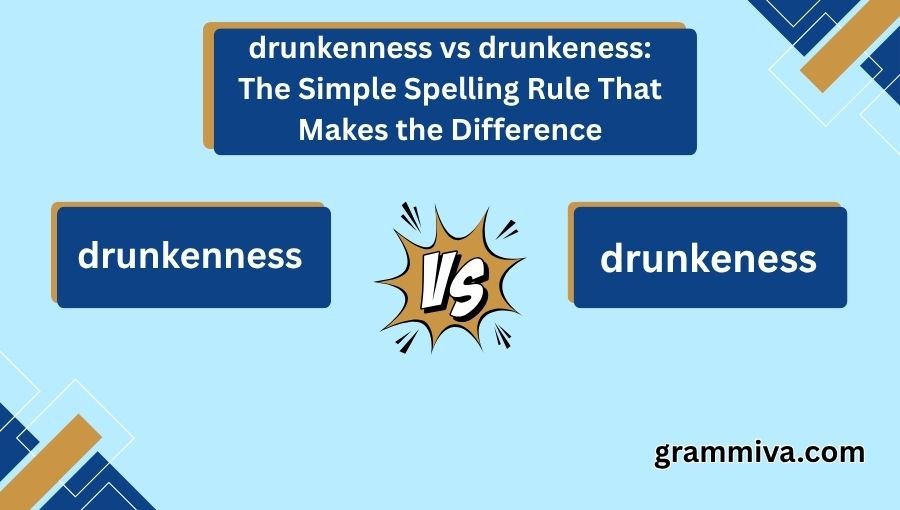
Have you ever typed a word, looked at it twice, and wondered whether one letter is missing? This guide explains drunkenness vs drunkeness, a common spelling question because the two forms look almost identical. The difference is just one letter, but only one spelling is standard in US English.
I work with English learners and everyday writing, and this is the kind of spelling question that can cause a quick pause. The correct form is drunkenness, with two n’s before the final -ess. Drunkeness is a misspelling.
The word refers to the state or condition of being drunk. It can appear in formal writing, news reports, legal or workplace discussions, and ordinary conversation. The tricky part is that English spelling does not always make word endings easy to predict. A writer may see drunken and simply add -ess, producing drunkeness. That seems logical at first glance, but it leaves out a letter.
In this guide, I will explain the spelling, meaning, grammar, common mistakes, related forms, and practical uses. I will also give you simple tests you can use whenever you are unsure. ✍️🙂 disappoint vs disapoint | Coming vs Comming | Dilemma vs Dilema
🎯 Quick Answer: drunkenness vs drunken
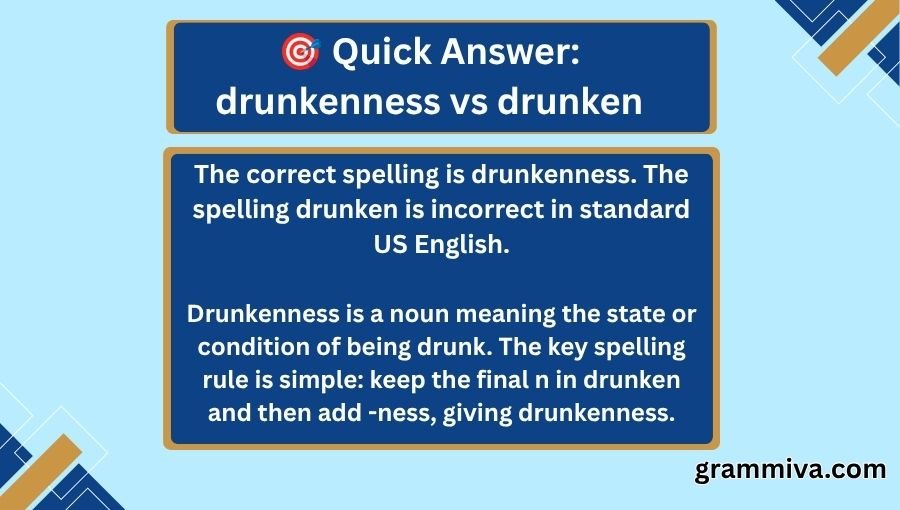
The correct spelling is drunkenness. The spelling drunken is incorrect in standard US English.
Drunkenness is a noun meaning the state or condition of being drunk. The key spelling rule is simple: keep the final n in drunken and then add -ness, giving drunkenness.
| Spelling | Status | Meaning | Example |
|---|---|---|---|
| drunkenness | ✅ Correct | The state of being drunk | The law addresses public drunkenness. |
| drunkeness | ❌ Incorrect | Standard spelling does not use this form | The report contained a spelling error. |
Related Word Forms and Their Uses
The main word family helps explain why the spelling can be confusing. Drunk and drunken are related words, but they do not work in exactly the same way. Drunkenness is the noun form.
Here are the most useful forms:
| Form | Type | Example |
|---|---|---|
| drunk | Adjective / noun | He was drunk after the party. |
| drunken | Adjective | The police dealt with a drunken driver. |
| drunkenness | Noun | Public drunkenness can create safety concerns. |
| drunkenly | Adverb | He walked drunkenly toward the door. |
| drunkeness | Misspelling | ❌ This spelling should be avoided. |
The important point is that adding -ness to drunken does not remove the final n.
🎯 Is Drunkenness the Same as Drunkeness?
Yes, they are intended to represent the same word, but only drunkenness is the standard spelling. Drunkeness is simply a misspelling created by leaving out one of the n’s.
The difference is visual:
drunken + ness = drunkenness
Not:
drunken + ess = drunken
The word drunkenness contains the sequence -nness- near the end. That may look unusual, but unusual-looking spelling is not the same as incorrect spelling.
A useful way to see it
Start with:
drunken
Now add:
-ness
You get:
drunkenness
The final n belongs to the base word drunken. The n at the beginning of -ness is part of the suffix. Both remain.
| Word | Base | Ending | Result |
|---|---|---|---|
| kindness | kind | -ness | kindness |
| darkness | dark | -ness | darkness |
| sadness | sad | -ness | sadness |
| drunkenness | drunken | -ness | drunkenness |
This pattern gives you a reliable spelling clue.
🔎 Drunkenness vs Drunkeness at a Glance
The core difference is spelling, not meaning. If someone writes drunken, they normally intend the noun drunkenness.
| Form | Type | Meaning | Example | Correct/Incorrect |
|---|---|---|---|---|
| drunkenness | Noun | State of being drunk | His drunkenness caused concern. | ✅ Correct |
| drunkeness | Misspelled noun | Intended to mean drunkenness | His drunkeness caused concern. | ❌ Incorrect |
| drunken | Adjective | Related to being drunk | It was a drunken argument. | ✅ Correct |
| drunk | Adjective | Affected by alcohol | He appeared drunk. | ✅ Correct |
| drunkenly | Adverb | In a drunken manner | He spoke drunkenly. | ✅ Correct |
The fastest answer
If you have to choose between the two spellings, choose:
drunkenness
That is the form you should use in standard US English.
🧠 Why Do People Confuse Drunkenness and Drunkeness?
People often confuse these spellings because drunken looks natural when the word is built quickly from drunken and -ness. The eye can also treat the repeated letters as something that should be simplified. People often search for drunkenness vs drunkeness because the two spellings look almost identical.
There is another reason. English has many words that gain -ness without a visible double consonant. A writer may therefore expect drunken + ness to look simpler than it actually does.
I once reviewed a short workplace report in which a writer used drunken several times. The writer knew exactly what the word meant. The problem was not vocabulary. It was the visual discomfort caused by the repeated n. Once we broke the word into drunken + ness, the spelling became easy to remember.
| Reason for Confusion | What Happens | Better Approach |
|---|---|---|
| Repeated letters look strange | The writer removes an n | Keep both n’s |
| Fast typing | One letter is skipped | Proofread unusual word endings |
| Word formation is unclear | The suffix is added incorrectly | Think of drunken + ness |
| Memory of the spelling is weak | The shorter form feels familiar | Memorize the correct form |
| Autocorrect is unreliable | A misspelling may not be caught | Check a trusted reference |
📚 Drunkenness: Meaning and Correct Use
Understanding drunkenness vs drunkeness starts with knowing that drunkenness is the correct noun form. Drunkenness is a noun. It describes the condition or state of being drunk.
The word is often used when the writer is discussing drunken behavior as a general condition rather than simply saying that one person is drunk.
For example:
The officer reported signs of drunkenness.
Here, drunkenness is the thing being reported. It acts as a noun.
Another example is:
His drunkenness affected the people around him.
Again, the word names a condition.
When the noun form fits
Use drunkenness when you need to name the state itself.
| Meaning | Word Type | Example Sentence |
|---|---|---|
| The state of being drunk | Noun | The man’s drunkenness was obvious. |
| Drunk behavior or condition | Noun | The policy addresses public drunkenness and drunkenness-related conduct. |
| A condition affecting behavior | Noun | Her drunkenness made the situation harder to manage. |
The word can sound more formal than simply using drunk. That is one reason you may see it in formal reports or discussions.
✏️ How Do You Spell Drunkenness Correctly?
When checking drunkenness vs drunkeness, remember that the correct spelling keeps both n’s. You spell it d-r-u-n-k-e-n-n-e-s-s.
The easiest method is to divide it into two parts:
drunken + ness
The first word ends in n. The suffix -ness begins with n. Both letters stay.
| Step | Form |
|---|---|
| Start with the adjective | drunken |
| Add the noun suffix | + ness |
| Keep the original ending | drunken + ness |
| Final spelling | drunkenness |
Do not try to make the word look smoother by removing one n. English spelling often preserves letter patterns that may look unusual.
💡 Test Tip: Use the “Keep the Base” Test
When I teach spelling, I like simple tests that can be used in seconds.
For this word, ask:
What is the base word before I add -ness?
The answer is:
drunken
Now add:
ness
That produces:
drunkenness
If your version does not preserve the final n from drunken, check it again.
A second test is the double-n check. Look at the middle of the final part:
drunkenness
You should see nn before the final ess.
Test Tip
If you are writing an important document and the word looks strange, do not change it just because the repeated letters feel awkward. Check the word instead.
📝 Case Study: A Workplace Report
This example shows why drunkenness vs drunkeness can cause problems in workplace writing. Imagine a manager writing a report after an employee arrives at work showing signs of being drunk.
A sentence might read:
The manager documented concerns related to the employee’s apparent drunkenness.
That sentence uses drunkenness correctly as a noun.
Now imagine the same sentence written as:
The manager documented concerns related to the employee’s apparent drunken.
The meaning is still understandable, but the spelling is wrong.
I once caught myself typing a similar double-letter mistake while editing quickly. I had written the word from memory and almost moved on. The odd-looking ending made me stop. Breaking the word into drunken + ness immediately exposed the missing n.
| Version | Sentence | Result |
|---|---|---|
| Correct | The manager documented the employee’s drunkenness. | ✅ Correct |
| Incorrect | The manager documented the employee’s drunkeness. | ❌ Incorrect |
| Correct | The policy addresses workplace conduct related to drunkenness. | ✅ Correct |
| Incorrect | The policy addresses workplace conduct related to drunkeness. | ❌ Incorrect |
The lesson is useful beyond this one word: when a spelling error involves a suffix, look at the base word before changing anything.
Grammar Rules Explanation
The spelling rule behind drunkenness vs drunkeness is simple: drunken keeps its final n when -ness is added. The correct noun is formed from the adjective drunken plus the noun-forming suffix -ness. The spelling therefore retains the final n of drunken and adds the n that begins -ness.
The result is drunkenness.
The incorrect form drunken leaves out one of those n’s. It is not the standard spelling in US English.
This is primarily a spelling issue rather than a difference in grammatical meaning. A writer who uses drunken generally intends the same noun, but standard edited writing should use drunkenness.
Most major English dictionaries and standard spelling references use drunkenness as the accepted form.
Correct vs Incorrect at a Glance
| Sentence | Correct/Incorrect | Why |
|---|---|---|
| The officer noted signs of drunkenness. | ✅ Correct | The standard noun spelling is used. |
| The officer noted signs of drunkeness. | ❌ Incorrect | One n is missing. |
| Public drunkenness can cause safety problems. | ✅ Correct | Drunkenness is used as a noun. |
| Public drunkeness can cause safety problems. | ❌ Incorrect | The spelling is not standard. |
| The report described repeated incidents of drunkenness. | ✅ Correct | The noun is spelled correctly. |
⚠️ Common Mistakes With This Word
The confusion between drunkenness vs drunkeness often happens because the double n looks unusual. The most common mistake is simple: writers remove one n because drunkenness looks unusual.
Other errors can happen because of fast typing, autocorrect, or limited familiarity with the word.
A student once wrote drunken in an essay and told me the double n looked like a typo. That reaction is understandable. Some correct English spellings look strange at first. The best habit is to trust the word’s actual spelling rather than how comfortable it looks.
Common spelling confusions
| Confusion | Correct Form | Common Wrong Form | Main Problem |
|---|---|---|---|
| its / it’s | its / it’s | mixing them | Possession vs contraction |
| your / you’re | your / you’re | mixing them | Possession vs “you are” |
| their / there / they’re | all three | mixing them | Different meanings |
| affect / effect | affect / effect | switching them | Different grammatical roles |
| drunkenness | drunkenness | drunkeness | Missing n |
Specific mistakes to avoid
| Wrong Form | What’s Wrong | Correct Form |
|---|---|---|
| drunkeness | One n is missing | drunkenness |
| drunkenesss | Extra s letters | drunkenness |
| drunkenness | Extra n in the wrong place | drunkenness |
| drunkennes | Final s is missing | drunkenness |
| drunkennesS | Incorrect capitalization in normal text | drunkenness |
| drunken-ness | Unnecessary hyphen | drunkenness |
The standard form is simply drunkenness, with no hyphen and no unusual capitalization.
⌨️ Why Fast Typing Causes Spelling Errors
Fast typing is one of the easiest ways to lose a repeated letter. When two identical letters appear close together, the fingers may record only one.
Autocorrect can make the problem harder. A writing program may catch the mistake, but not every tool catches every misspelling. Some systems also learn frequently typed forms, so a repeated error can become familiar.
Lack of knowledge is another cause. If you have rarely seen drunkenness in print, drunken may look perfectly normal.
The solution is not to slow down every sentence. Instead, slow down for words that look unusual.
| Cause | Example | Helpful Fix |
|---|---|---|
| Fast typing | Dropping one n | Proofread repeated letters |
| Autocorrect | Trusting the software completely | Check unfamiliar words |
| Lack of knowledge | Never learning the standard form | Save the correct spelling |
| Visual confusion | Double n looks wrong | Break the word into parts |
| Memory error | Choosing the shorter spelling | Use a spelling test |
📖 Word Origin and Spelling History
The spelling history of this word does not need a complicated historical explanation to understand the modern form. The useful point for present-day writers is that drunkenness belongs to the familiar English pattern in which -ness forms a noun describing a state or quality.
The spelling preserves the final n of drunken when the suffix is added.
| Stage | Form | Note |
|---|---|---|
| Base adjective | drunken | Describes someone or something affected by drinking |
| Noun suffix | -ness | Forms a noun naming a state or condition |
| Combined form | drunken + ness | Both n’s remain |
| Modern standard form | drunkenness | Correct noun spelling |
You do not need to memorize a long history to spell the word correctly. The word-building pattern is enough.
🌎 How Is Drunkenness Used in Different Contexts?
The correct form remains drunkenness across everyday, professional, creative, and digital writing. What changes is the tone of the sentence.
Everyday conversation
In casual speech, people often choose drunk instead because it is shorter and more natural.
He was drunk last night.
Drunkenness is still correct, but it can sound more formal.
Professional writing
The noun works well in reports, policies, workplace documents, and formal discussions.
The policy addresses behavior associated with drunkenness.
Creative writing
Writers may use the word when describing a character’s state or behavior.
His drunkenness turned a quiet evening into a loud argument.
Social media and texting
The word is grammatically fine, but casual users may choose simpler words.
| Context | Which Term to Use | Example |
|---|---|---|
| Everyday conversation | drunk / drunkenness | He was drunk at the party. |
| Professional writing | drunkenness | The report discussed workplace drunkenness. |
| Creative writing | drunkenness / drunken | The character’s drunkenness changed his behavior. |
| Social media/texting | drunk | He was way too drunk last night. |
The key distinction is not whether the word is “formal enough.” It is whether you need a noun that names the condition.
💬 What Are Common Phrases With Drunkenness?
There are several natural combinations involving drunkenness, especially in formal or descriptive writing. The word often appears with terms such as public, excessive, or signs of.
| Phrase | Meaning |
|---|---|
| public drunkenness | Being drunk in a public setting |
| signs of drunkenness | Evidence suggesting that someone is drunk |
| excessive drunkenness | A high or extreme level of drunken behavior |
| drunkenness and disorder | Drunken behavior linked with disorderly conduct |
| apparent drunkenness | A condition that appears to be drunkenness |
These phrases should not be confused with fixed idioms. They are common word combinations that can appear naturally in different contexts.
🔄 What Words Can Replace Drunkenness?
Sometimes drunkenness is not the best word. The right alternative depends on your sentence and tone.
For casual writing, being drunk may sound more natural. For formal writing, intoxication may sometimes fit better. However, these words are not always exact replacements.
| Alternative | Works When | Does Not Work When |
|---|---|---|
| being drunk | You want simple, everyday language | A formal noun is required |
| intoxication | You need a formal term for an affected state | You specifically want the tone of drunkenness |
| drunken behavior | You mean actions linked to being drunk | You are naming the condition itself |
| being intoxicated | You want a clear phrase | A compact noun is needed |
| drunk state | You need plain explanatory language | The phrase sounds unnatural in a polished sentence |
For example, these sentences are close in meaning:
His drunkenness was obvious.
His intoxication was obvious.
It was obvious that he was drunk.
The best choice depends on your audience and the tone of your writing.
🎯 Why Does the Correct Spelling Matter?
Spelling matters because readers notice errors even when they understand the intended meaning. A single missing letter usually does not block communication, but it can make writing look rushed or unpolished.
This is especially important in professional documents. A spelling error in a casual text may not matter much. The same error in a report, article, application, or published page can weaken the reader’s trust.
A useful rule I give writers is:
Clear writing starts with words the reader does not have to stop and question.
| Situation | Why Getting It Right Matters |
|---|---|
| Resume or application | Shows care and attention to detail |
| Client email | Supports a professional tone |
| Published content | Protects writing quality and credibility |
| Social post | Makes the message easier to read |
Correct spelling also helps search engines and readers find the intended term. If you are writing online, using the standard form is the safest choice.
🧩 How To Remember the Difference
The easiest way to remember drunkenness vs drunkeness is to think of drunken + ness. The easiest memory trick is to think of drunkenness as two pieces:
DRUNKEN + NESS
Do not spell it from the way it sounds. Build it from the parts.
You can also remember this short sentence:
Drunken keeps its N before ness.
If you remember that sentence, you can recreate the spelling instead of trying to memorize every letter.
A second memory trick
Picture the ending:
-nness
The word has two n’s right next to each other.
That may look strange, but that strange-looking part is exactly what helps you recognize the correct form.
| Memory Method | Reminder |
|---|---|
| Word parts | drunken + ness |
| Letter test | Look for nn |
| Base-word test | Keep the n in drunken |
| Visual test | drunkenness has two n’s |
| Quick choice | Choose drunkenness, not drunkeness |
📝 Practice Examples
Practice makes this spelling much easier. Look at each pair and identify the standard form.
Example 1
The report mentioned public drunkenness. ✅
The report mentioned public drunken. ❌
The first sentence uses the standard noun spelling.
Example 2
The manager was concerned about repeated drunkenness at company events. ✅
The manager was concerned about repeated drunken at company events. ❌
Again, the second version drops one n.
Example 3
The article discussed the effects of drunkenness. ✅
The article discussed the effects of drunken. ❌
The correct word has nn before the final ess.
| Question | Answer |
|---|---|
| Which spelling is standard? | drunkenness |
| Does it contain two n’s together? | Yes |
| Is drunkeness standard? | No |
| Is drunkenness a noun? | Yes |
| Can drunk replace it in every sentence? | No |
🛠️ How To Proofread Drunkenness in Your Writing
If you are editing an article, report, or school paper, use a quick three-step check.
Step 1: Find the word.
Search your document for both:
drunkenness
and
drunken
Step 2: Replace the misspelling.
Every ordinary use of drunken should normally become drunkenness.
Step 3: Check the sentence role.
Make sure you actually need the noun. If you are describing a person, drunk or drunken may be a better choice.
For example:
The driver was drunk.
This is different from:
The report described the driver’s drunkenness.
The first describes the person. The second names the condition.
🔍 When Should You Use Drunk Instead?
Use drunk when you are directly describing a person or person’s condition. Use drunkenness when you need a noun that names the condition.
Compare these examples:
The man was drunk. ✅
The man’s drunkenness was obvious. ✅
The words are related, but they have different jobs in the sentence.
| Sentence | Word | Role |
|---|---|---|
| She was drunk. | drunk | Describes a person |
| His drunkenness was obvious. | drunkenness | Names a condition |
| It was a drunken argument. | drunken | Describes an argument |
| He spoke drunkenly. | drunkenly | Describes how he spoke |
This distinction can help you avoid forcing drunkenness into a sentence where a simpler word would work better.
❓ Is Drunkeness Ever the Correct Spelling?
No. In standard US English, drunkenness is the correct spelling for the noun. Drunkeness should be treated as a spelling error.
If you see drunken in an online post, old document, user-generated comment, or informal message, the intended word is almost certainly drunkenness.
That does not mean the writer’s meaning is impossible to understand. It simply means the spelling should be corrected in polished writing.
| Form | Standard US English? | Recommendation |
|---|---|---|
| drunkenness | Yes | Use it |
| drunkeness | No | Correct it |
| drunken | Yes | Use when it fits |
| drunk | Yes | Use when it fits |
| drunkenly | Yes | Use when an adverb is needed |
🚦 Drunkenness vs Drunkeness in SEO and Online Writing
If you are creating web content, spelling the primary term correctly is especially useful. Search engines are good at understanding misspellings and related terms, but writers should still use the standard spelling in headings, body copy, metadata, and examples.
If your audience searches for drunkenness vs drunken, you can address that exact comparison while making it clear that one form is misspelled.
A good article should not repeat the misspelled form more than necessary. Explain it once, show why it is wrong, and then use the correct form naturally.
| Online Element | Recommended Form |
|---|---|
| Main heading | drunkenness |
| Body text | drunkenness |
| Example sentence | drunkenness |
| Spelling comparison | drunkenness vs drunkeness |
| FAQ answer | State that drunkenness is correct |
This gives readers the answer they need without turning the page into a collection of repeated keywords.
⚡ Quick Recap Checklist
The rule is simple: use drunkenness with two n’s.
| Question | If Yes → Use |
|---|---|
| Are you naming the state of being drunk? | drunkenness |
| Are you adding -ness to drunken? | drunkenness |
| Does your spelling have only one n before ess? | ❌ Check it |
| Are you describing a person directly? | Consider drunk |
| Are you describing a noun related to being drunk? | Consider drunken |
Practice
- The report mentioned signs of ________.
Answer: drunkenness - His ________ caused problems at the event.
Answer: drunkenness - The writer typed “drunken.” Is that correct?
Answer: No. The standard spelling is drunkenness.
❓ FAQs About Drunkenness vs Drunkeness
Is drunkenness the correct spelling?
Yes. Drunkenness is the standard spelling in US English. It is spelled with two n’s before the final -ess.
Is drunken a word?
Drunkeness is not the standard spelling of the noun. It is normally a misspelling of drunkenness.
How do you spell drunkenness?
Spell it d-r-u-n-k-e-n-n-e-s-s. A useful way to remember it is drunken + ness.
Why does drunkenness have two n’s?
The word can be understood as drunken + -ness. The base word ends in n, and the suffix begins with n, so both letters remain.
Is drunkenness a noun?
Yes. Drunkenness is a noun that names the state or condition of being drunk.
What is the difference between drunk and drunkenness?
Drunk commonly describes a person who has consumed enough alcohol to be affected by it. Drunkenness names the condition itself.
Is “drunken” a common spelling mistake?
Yes, it is an easy spelling mistake because the double n in drunkenness can look unusual. Fast typing and uncertainty about the suffix can lead writers to drop one n.
Should I use drunkenness in formal writing?
Yes, when the noun fits your sentence. Drunkenness is suitable for formal, professional, academic, and general writing.
Can I use “being drunk” instead of drunkenness?
Often, yes. Being drunk is a simpler phrase and may sound more natural in casual writing. However, it does not always fit the same grammatical structure as the noun drunkenness.
How can I remember drunkenness vs drunken?
Remember the word as drunken + ness. The final n in drunken stays, so the finished word has nn: drunkenness.
Conclusion
Drunkenness vs drunken has one clear answer: drunkenness is the correct spelling, while drunken is a misspelling. The best way to remember the difference is to build the word from drunken + ness. When you do that, the two n’s make sense.
I recommend using a simple three-part check whenever you see this word. First, ask whether you need the noun that names the state of being drunk. Second, start with drunken. Third, add -ness without removing the final n.
Remember that drunk, drunken, drunkenly, and drunkenness can all be correct, but they serve different grammatical roles. The misspelled form drunken should not appear in polished standard US English.
The spelling may look unusual at first, but that is exactly why the word is worth remembering. Keep the two n’s, and you will get it right every time. ✅📚
When in doubt, remember: drunken + ness = drunkenness. Two n’s, one correct spelling.

I am Adam Wilson, an English language content writer with an interest in grammar and vocabulary. I work at Grammiva and focus on creating clear explanations and practical examples for English learners.
[…] conversations, and online posts. By the end, you should be able to spot the error quickly. ✨ drunkenness vs drunkeness | disappoint vs disapoint | Coming vs […]