Have you ever typed a word that looks almost right, then stopped because one letter seemed to be missing? That is exactly what happens with pretty vs prety. The two forms look so close that a quick typo can easily slip into a text, email, school paper, or social media post. ✍️
The good news is simple: pretty is the correct standard English spelling, while prety is normally a misspelling. If you are checking pretty vs prety, you do not need to learn two different words. You need to remember one correct spelling.
I work with English grammar and editing, and I see this kind of mistake often. It is especially common when someone types quickly or relies on memory instead of looking closely at each letter. Once you know the rule, however, the choice becomes easy. 😊
This guide explains the difference, shows correct and incorrect examples, covers common mistakes, and gives you simple ways to remember the spelling. Absorption vs Absorbsion
🎯 Quick Answer: pretty vs prety
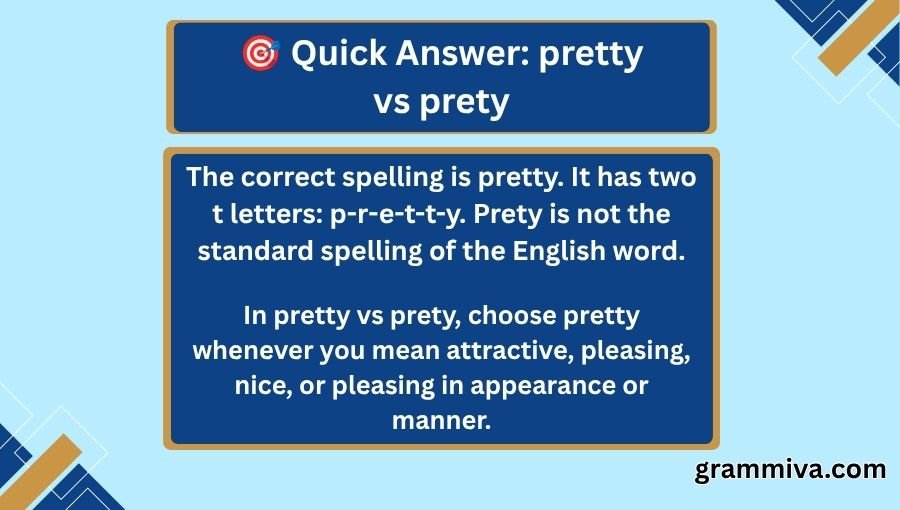
The correct spelling is pretty. It has two t letters: p-r-e-t-t-y. Prety is not the standard spelling of the English word.
In pretty vs prety, choose pretty whenever you mean attractive, pleasing, nice, or pleasing in appearance or manner.
Related Word Forms of Pretty
The word pretty has several related forms and uses. Some are created by adding endings, while others use the same spelling in different grammatical roles.
| Form | Type | Example |
|---|---|---|
| pretty | Adjective | She wore a pretty dress. |
| pretty | Adverb | The room is pretty quiet. |
| prettily | Adverb | The flowers were arranged prettily. |
| prettiness | Noun | The prettiness of the garden stood out. |
| prettier | Comparative adjective | This picture is prettier than the first one. |
| prettiest | Superlative adjective | That was the prettiest flower in the garden. |
The key point in pretty vs prety is that the base word remains pretty, with two t letters. Its related forms are built from that correct spelling.
🔎 Is Pretty the Same as Prety?
No. Pretty and prety are not two standard spellings with different meanings. Pretty is the accepted spelling, while prety is generally an error.
The confusion is easy to understand. When people say the word aloud, they do not hear both t sounds as separate, strong sounds. That can make it tempting to type only one t.
Here is the basic difference:
| Form | Type | Meaning | Example | Correct/Incorrect |
|---|---|---|---|---|
| pretty | Adjective/adverb | Attractive, pleasing, or fairly/quite | She has a pretty smile. | ✅ Correct |
| prety | — | Not the standard spelling | She has a prety smile. | ❌ Incorrect |
If you are deciding between pretty vs prety, the visual clue is simple: pretty has double t.
Why Pretty Has Two Ts
The standard spelling is pretty, not prety. The two t letters belong to the normal spelling of the word.
Think of the word as three parts:
pre + tt + y
That middle pair is easy to forget. When I teach spelling, I often tell students to look for the “double letter” rather than trying to remember the entire word at once.
A useful memory sentence is:
A pretty word has two t’s in the middle.
That is not a grammar rule for every English word. It is simply a practical spelling trick.
What Does Pretty Mean?
Pretty most often describes something that looks attractive or pleasing. It can describe people, clothing, places, objects, colors, designs, sounds, and many other things.
For example:
- She bought a pretty necklace.
- The house has a pretty garden.
- That is a pretty shade of blue.
The word can also be used as an adverb to mean fairly or quite.
- The test was pretty easy.
- I am pretty sure.
- The room is pretty large.
| Meaning | Word Type | Example Sentence |
|---|---|---|
| Attractive or pleasing | Adjective | The child picked a pretty flower. |
| Fairly or quite | Adverb | The movie was pretty good. |
| Attractive in a delicate or pleasing way | Adjective | They stayed in a pretty little town. |
💡 Test Tip: If you can replace the word with attractive, pleasing, fairly, or quite, you may be looking for pretty. If you are spelling it, always check for the two t letters.
📚 Understanding Pretty vs Prety at a Glance
The simplest rule for pretty vs prety is that only pretty should normally appear in standard English writing.
| Feature | Pretty | Prety |
|---|---|---|
| Standard English spelling | Yes | No |
| Has two t’s | Yes | No |
| Can be an adjective | Yes | No |
| Can be an adverb | Yes | No |
| Used in formal writing | Yes | No |
| Normal dictionary word | Yes | No |
Pretty as an Adjective
As an adjective, pretty describes a person or thing.
Consider this sentence:
The garden is pretty.
- The garden = subject
- is = linking verb
- pretty = adjective describing the garden
Now compare:
She bought a pretty dress.
Here, pretty describes the noun dress.
The same pattern works with many nouns:
- a pretty picture
- a pretty house
- a pretty flower
- a pretty card
- a pretty room
Pretty as an Adverb
Pretty can also work as an adverb when it means fairly or quite.
For example:
The book is pretty interesting.
Here, pretty does not describe a person or object directly. It changes the strength of interesting.
Another example is:
I am pretty tired.
The word means something like quite or fairly.
This meaning is different from the appearance-related meaning, but the spelling does not change.
✨ How Do You Spell Pretty Correctly?
You spell the word p-r-e-t-t-y.
The most common mistake is leaving out one of the two t letters. That produces prety, which is generally considered a spelling error.
| Spelling | Letters | Status |
|---|---|---|
| pretty | P-R-E-T-T-Y | ✅ Correct |
| prety | P-R-E-T-Y | ❌ Incorrect |
| prettty | P-R-E-T-T-T-Y | ❌ Incorrect |
| pretti | P-R-E-T-T-I | ❌ Incorrect |
| prettyy | P-R-E-T-T-Y-Y | ❌ Incorrect |
The safest habit is to pause for one second before submitting your writing. Look directly at the middle of the word.
pret-ty
There are two t letters.
💬 Why Do People Confuse Pretty and Prety?
People confuse pretty vs prety mainly because the incorrect form is visually close to the correct one. One missing letter can be hard to notice, especially when reading quickly.
Three common causes are:
- Fast typing — Your fingers may skip a repeated letter.
- Autocorrect or typing habits — A keyboard may not always catch a simple spelling error.
- Lack of spelling knowledge — If you have never focused on the double t, the word can be easy to misspell.
I once caught myself typing prety in a quick message. I had written the sentence so fast that I did not notice the missing t until I reread it. That small mistake reminded me how easily repeated letters disappear during fast typing.
| Cause | Why It Leads to the Error | Helpful Fix |
|---|---|---|
| Fast typing | Fingers may skip a repeated letter | Slow down when proofreading |
| Autocorrect | A typo may not always be corrected | Review important messages |
| Lack of knowledge | The correct spelling may not be familiar | Memorize the double-t pattern |
| Visual habit | The wrong form can look almost normal | Compare both forms carefully |
| Voice typing | Spoken words do not show repeated letters | Proofread the typed result |
Similar Grammar and Spelling Confusions
The pretty vs prety problem is a spelling issue, but it belongs to a larger group of common English mistakes.
| Confusion | Correct Form | Main Difference |
|---|---|---|
| its / it’s | its, it’s | Possession vs. contraction |
| your / you’re | your, you’re | Possession vs. “you are” |
| their / they’re | their, they’re | Possession vs. “they are” |
| then / than | then, than | Time/order vs. comparison |
| there / their / they’re | all three | Place, possession, or “they are” |
| affect / effect | affect, effect | Different grammatical roles and meanings |
These examples show why a single missing or changed letter can affect the quality of a sentence.
📝 Case Study: A Simple Workplace Example
Imagine that an employee sends this message to a customer:
“We have created a prety design for your new brochure.”
The customer will probably understand the meaning. Still, the spelling error can make the message look rushed or unprofessional.
A corrected version is:
“We have created a pretty design for your new brochure.”
The meaning has not changed. The spelling has.
I once edited a short business document where a repeated-letter typo appeared several times. The writer knew the correct word and its meaning. The problem came from typing quickly. We fixed the errors by searching for the word and checking every occurrence.
| Situation | Incorrect | Correct |
|---|---|---|
| Customer email | We made a prety layout. | We made a pretty layout. |
| School paper | It was a prety scene. | It was a pretty scene. |
| Text message | That dress is prety. | That dress is pretty. |
| Product description | A prety blue cover | A pretty blue cover |
The lesson is simple: knowing a word’s meaning is not enough. The letters still need to be correct.
Grammar Rules Explanation
Pretty is the standard English spelling. Prety is normally an incorrect spelling caused by leaving out one of the two t letters.
The difference is not a grammar choice in which each form has its own function. Instead, it is mainly a spelling choice. When the intended word is pretty, standard English writing uses the form with two t letters.
The word pretty can serve different grammatical roles depending on the sentence. As an adjective, it can describe a noun, as in “a pretty dress.” As an adverb, it can modify an adjective or other expression, as in “pretty difficult.”
Most standard English reference works agree on the spelling pretty. The important point for learners is to remember that the double t is part of the standard form.
Correct vs Incorrect at a Glance
| Sentence | Correct/Incorrect | Why |
|---|---|---|
| She bought a pretty dress. | ✅ Correct | The standard spelling is used. |
| She bought a prety dress. | ❌ Incorrect | One t is missing. |
| The weather is pretty warm. | ✅ Correct | Pretty is used as an adverb. |
| The weather is prety warm. | ❌ Incorrect | The spelling is wrong. |
| That is a pretty good idea. | ✅ Correct | Pretty is correctly spelled. |
The important rule is not complicated: use pretty with two t’s.
⚠️ Common Mistakes With Pretty
Most mistakes with pretty vs prety are not caused by confusion about meaning. They happen because the writer misses one letter.
Common errors include:
- writing prety with one t
- writing prettty with three t letters
- writing pretty with an extra y
- changing the final y to another letter
- assuming spell-check will always catch the mistake
Here are specific wrong forms to watch for:
| Wrong Form | What’s Wrong | Correct Form |
|---|---|---|
| prety | One t is missing | pretty |
| prettty | One extra t is added | pretty |
| prettyy | One extra y is added | pretty |
| pretti | The ending is incorrect | pretty |
| pretyy | Missing t and extra y | pretty |
| pretthy | The letters are in the wrong order | pretty |
A Fast Proofreading Trick
When proofreading, do not always read the whole sentence. Search for the word itself.
If you are checking a document, use your device’s search feature and look for:
prety
If it appears, replace it with:
pretty
This is especially useful in long documents.
🧠 How to Remember the Difference
The easiest way to remember pretty vs prety is to connect the word with its double t.
Try these memory tricks:
Trick 1: Double T
Think:
pre + tt + y = pretty
The two middle letters are tt.
Trick 2: Say “two Ts”
When you type the word, quietly think:
“Pretty has two Ts.”
Trick 3: Visual Check
Look at the center:
- pretty ✅
- prety ❌
The second version looks shorter because one letter is missing.
Trick 4: Use a Related Form
Try prettier or prettiest in your head.
- pretty
- prettier
- prettiest
The double t stays visible.
| Memory Method | What to Remember | Example |
|---|---|---|
| Double-letter method | Two t’s | pretty |
| Sound cue | “Two Ts” | pretty |
| Visual method | Check the middle | pretty |
| Related-word method | Compare prettier | pretty → prettier |
🌎 Usage in Different Contexts
The spelling pretty stays the same across normal writing contexts. What changes is the tone or meaning of the sentence.
| Context | Which Term to Use | Example |
|---|---|---|
| Everyday conversation | pretty | That is a pretty view. |
| Professional writing | pretty | The report uses a pretty clear layout. |
| Creative writing | pretty | Moonlight made the lake look pretty. |
| Social media/texting | pretty | This place is pretty amazing! |
In formal writing, remember that pretty can sometimes sound informal when it means quite or fairly.
For example:
The report is pretty good.
That is fine in casual communication. In a formal report, you might choose:
The report is very good.
The spelling issue, however, remains the same. Prety is not the standard replacement.
🔄 Pretty vs Prety in Real Sentences
Seeing several examples can make the rule easier to remember.
| Intended Meaning | Correct Sentence | Incorrect Sentence |
|---|---|---|
| Attractive appearance | She has a pretty smile. | She has a prety smile. |
| Attractive object | What a pretty painting! | What a prety painting! |
| Pleasant place | We visited a pretty village. | We visited a prety village. |
| Fairly easy | The task was pretty easy. | The task was prety easy. |
| Fairly important | This is pretty important. | This is prety important. |
Notice that the error is the same each time. The meaning does not determine whether you use one or two t letters.
💡 Common Phrases With Pretty
Pretty appears in many everyday expressions. These phrases are useful because they give you more chances to see the correct spelling.
| Phrase | Meaning |
|---|---|
| pretty good | fairly or quite good |
| pretty sure | fairly or quite certain |
| pretty much | almost or nearly |
| pretty soon | fairly soon or in a short time |
| pretty well | fairly well |
| pretty nice | fairly or quite nice |
These expressions are especially common in conversation.
For example:
- I am pretty sure she is coming.
- We are pretty much finished.
- The project is pretty good.
- I will be there pretty soon.
Again, every example uses pretty, not prety.
✍️ Synonyms and Alternatives to Pretty
Sometimes you can replace pretty with another word. The best choice depends on the meaning.
If pretty describes appearance, alternatives might include attractive, lovely, beautiful, or pleasant. If pretty means fairly, alternatives might include quite, rather, or fairly.
| Alternative | Works When | Does Not Work When |
|---|---|---|
| beautiful | Describing strong beauty | You mean “fairly” |
| attractive | Describing pleasing appearance | You mean “quite” |
| lovely | Describing something charming or pleasant | A precise formal tone is needed |
| fairly | Meaning “to a moderate degree” | Describing physical beauty |
| quite | Meaning “to a certain degree” | You specifically mean attractive |
For example:
She has a pretty dress.
could become:
She has a beautiful dress.
But:
The test was pretty difficult.
could become:
The test was quite difficult.
The replacement depends on what pretty means in the sentence.
🎯 Why Pretty vs Prety Matters
A one-letter spelling error may seem tiny. Yet small errors can affect how readers view your writing.
Clear spelling helps with:
- Clarity: Readers can understand your words without distraction.
- Professionalism: Correct spelling makes business writing look polished.
- Digital communication: Emails, posts, and messages are often read quickly.
- Trust: Careful writing can make your information seem more reliable.
Here is a simple way I think about it:
Good writing makes the message easy to see, not the mistake easy to spot.
That does not mean every typo is serious. People make mistakes. But when a word is easy to spell correctly, there is little reason to keep the error.
| Situation | Why Getting It Right Matters |
|---|---|
| Resume | Shows care with written details |
| Client email | Creates a polished impression |
| Published content | Keeps the text professional |
| Social post | Makes the message easier to read |
🧩 When Is Prety Ever Correct?
For standard English writing, prety should not be used as an alternative spelling of pretty.
A rare exception could occur if Prety appeared as a name, username, brand, fictional name, or other special label created by someone. In that case, it would be a proper name rather than the normal English word.
For ordinary writing, however, the answer remains clear: use pretty.
So when checking pretty vs prety, do not treat the two forms as equal choices.
📝 Practice: Choose the Correct Form
Try these examples before looking at the answers.
- She found a ___ dress at the store.
- The instructions were ___ simple.
- What a ___ garden!
- That was a ___ difficult question.
The correct answer is pretty in every sentence.
| Sentence | Answer | Reason |
|---|---|---|
| She found a ___ dress. | pretty | It describes the dress. |
| The instructions were ___ simple. | pretty | It means fairly or quite. |
| What a ___ garden! | pretty | It describes appearance. |
| That was a ___ difficult question. | pretty | It modifies “difficult.” |
🔍 How Can You Check Pretty vs Prety Quickly?
You can check the spelling in seconds.
First, look at the middle of the word.
pretty
Then ask:
Does it have two t’s?
If yes, you have the standard spelling.
If you see:
prety
one t is missing.
For important writing, you can also use a trusted spell-checker or dictionary. But do not depend on automatic tools alone. A quick visual check is often enough.
A Three-Second Check
Use this simple process:
- Look: Find the word.
- Count: Check for two t’s.
- Correct: Change prety to pretty if needed.
This works well because the mistake is usually very small.
📋 Pretty vs Prety Quick Recap Checklist
Use the following questions whenever you are unsure.
| Question | If Yes → Use |
|---|---|
| Do I mean attractive or pleasing? | pretty |
| Do I mean fairly or quite? | pretty |
| Am I describing a noun? | pretty |
| Am I modifying an adjective in an informal sentence? | pretty |
| Does the word have two t’s? | pretty |
Practice Examples
1. That is a ___ picture.
Answer: pretty ✅
2. The assignment was ___ easy.
Answer: pretty ✅
3. She bought a ___ scarf.
Answer: pretty ✅
Remember: prett-y, with two t letters in the middle.
❓ FAQs About Pretty vs Prety
Is pretty the correct spelling?
Yes. Pretty is the standard English spelling. It contains two t letters.
Is prety a real English word?
Prety is generally not the standard spelling of the word pretty. In ordinary English writing, it should be treated as a spelling error.
Why do people spell pretty as prety?
The most common reason is that people forget one of the repeated t letters. Fast typing, weak spelling memory, and failure to proofread can all contribute.
How do you spell pretty?
The correct spelling is p-r-e-t-t-y. The middle of the word contains tt.
What does pretty mean?
Pretty commonly means attractive or pleasing. It can also mean fairly or quite when it is used as an adverb.
Is pretty an adjective or an adverb?
It can be either. In “a pretty flower,” it is an adjective. In “pretty difficult,” it works as an adverb meaning fairly or quite.
What is the difference between pretty and prety?
There is normally no difference in meaning because prety is not a standard alternative spelling. Pretty is the correct form.
Is “pretty good” grammatically correct?
Yes. Pretty good is common in everyday English. Here, pretty means something like fairly or quite.
Can I use pretty in formal writing?
Yes, but context matters. Pretty is correctly spelled and can be used in formal writing. However, when it means fairly or quite, a more precise word may sometimes be better.
What is an easy way to remember pretty?
Remember “pretty has two Ts.” Write it as prett-y in your mind. The double t is the key.
🎯 Final Rule for Pretty vs Prety
Pretty vs prety is not a case where you need to choose between two meanings. The standard spelling is pretty, with two t letters.
Use pretty when you mean attractive, pleasing, fairly, or quite. Do not use prety in normal English writing. If you see the one-t form in a draft, email, essay, or post, correct it to pretty.
The mistake is easy to make because repeated letters can disappear when we type quickly. That is why a quick proofreading check helps. Look at the middle of the word and remember the simple cue: pretty has two Ts. ✨
Once you make that small spelling pattern familiar, you will rarely need to stop and wonder about it again. Whether you are writing a school assignment, a business email, a product description, or a casual text, the same rule applies.
When in doubt, remember the shortest version:
Pretty = correct. Prety = misspelled.
One extra t makes the difference between a polished sentence and an avoidable spelling error. Keep the two t letters, and your writing will be right every time. ✅

I am Ethan Brooks, an English grammar and vocabulary writer. I work at Grammiva, where I create simple and helpful content to make English learning easier for students and everyday learners.
[…] In this guide, I will explain the difference, show clear examples, cover common mistakes, and give you simple tests you can use whenever you are unsure. By the end, you should be able to choose the right spelling without stopping to guess. ✍️ pretty vs prety […]
[…] common mistakes, memory tricks, examples, and everyday uses of acquaintance vs acquaintence. pretty vs prety | Absorption vs […]